From the time I was fourteen, I dreamed of leaving my home in Scotland and starting a new life in America. I saved every penny so I could pay for plane fare and have some money in my pocket when I arrived.
In 1958, at eighteen, I got off the plane in New York City. All the American passengers proceeded to customs, but I was directed to meet with an immigration officer. I sat down across from a rather intimidating man and handed him the sealed envelope of papers that I had been given by the U.S. consulate in Scotland. He opened the envelope and looked through the documents, one of which must have told how much money I had brought with me.
“Is four hundred dollars all you have?” he asked. “How long do you think you can live here on that?”
Terrified that he was going to send me back, I blurted out, in a thick Scottish brogue, “Och, I came tae America tae make a fortune, not tae spend one.”
“Welcome to the United States, young man,” he said with a grin, “and good luck to you.”
Norman Nicolson
Honolulu, Hawaii
I was twenty-three when I decided to leave my native North Carolina for a one-year stint in AmeriCorps, the domestic Peace Corps. I was assigned to the San Antonio, Texas, office of a national nonprofit, where I would recruit, train, and manage student volunteers. Most of our clients lived in the housing project next door to the office. They came to us in search of better places to live, child care, and higher-paying jobs. More often than not, we could offer them only a sympathetic ear and a referral to yet another agency. Some of the clients spoke only Spanish and preferred to interact with a volunteer who spoke it too. Their clear favorite was Maria.
Maria was the first to arrive for the afternoon shift and the last to leave in the evening. For a college freshman, she possessed a preternatural sense of authority and responsibility. Though she belonged to several college clubs, helped tend to her younger brothers and sisters, worked part time waiting tables, and carried a heavy course load, she never missed a meeting or let down a client.
At the end of the semester, the organization’s national office invited me to bring my two best volunteers to New York City for a convention and training summit. Naturally I chose Maria as one of the two. She had never left Texas, much less been to New York, and I was excited to show her more of the world. To my surprise, though, Maria didn’t seem eager to attend the convention. At the day’s close, she asked to speak to me privately.
“You know I’m Mexican, right?” she said with a nervous giggle. I nodded. “Well, I’ve been in this country for ten years, but I’ve only ever lived here legally for a couple of months . . . on a tourist visa when we first arrived.”
I was touched that she would trust me with her secret, but I didn’t see the connection to the convention until she said, “Since I’m not legal, I don’t have a government-issued ID, so I can’t board a plane.”
Dumbfounded, I pledged to figure out a way around the ID requirement. After some research we decided Maria’s best bet was to show her university ID and say she didn’t have a driver’s license yet, which was true.
Our ploy worked. Maria made the trip, saw New York, and gave an outstanding presentation at the convention. At the end of my year of service, I told her how much I admired her. She graduated with honors but couldn’t afford to go on to medical school, as she had wanted. As an undocumented immigrant, she couldn’t legally work in the U.S. The last I heard from her, she was a waitress at the same restaurant where she’d worked during college, still getting paid under the table.
Jodie Briggs
New York, New York
My great-grandmother Faigl and her ten-year-old daughter, Rukhl, immigrated to the United States from Russia in 1900. Yiddish was their first language, and Faigl, who was not happy in her adopted homeland, refused to learn a word of English. She supported herself and her young daughter by taking in boarders from the old country. Rukhl, who became known as “Ruth,” attended school for a few years and then went to work as a seamstress in a lace factory. She married at twenty-seven and had three children, including my mother.
My grandmother Ruth learned English but never had much confidence in her ability to speak it. She sometimes mispronounced words and used Yiddish syntax. (“You want I should make you a bowl of soup?”) Though no one had any problem understanding her, she insisted that she didn’t “talk English too good.”
When my widowed grandmother was ninety-eight years old and could no longer live on her own, she moved from her tiny Brooklyn apartment into a Jewish nursing home. One day I went there to visit and found her surrounded by a group of women who were listening to a story she was telling. My grandmother waved her hands with great enthusiasm, shrugged her shoulders, and threw back her head and laughed. She was so animated and alive, completely different from the woman I had known all my life.
As I came closer, I realized my grandmother was speaking Yiddish, and her audience was all European immigrants like her.
The great Polish poet Czesław Miłosz said, “Language is the only homeland.” After having been away for almost ninety years, my grandmother had finally come home.
Lesléa Newman
Northampton, Massachusetts
I was eleven years old on April 1, 1933, when my parents, my brother Konrad, and I crossed the border from Germany into Switzerland. The new Nazi government in Germany had declared a boycott against Jewish businesses beginning at 1 P.M. that day. We left at 12:50.
Three months later we were in the south of France, where my father was trying to negotiate a lease on a house and vineyard. Though the negotiations were not yet complete, we moved into the home owned by our new landlord, M. Rothstein.
The French public education system included boarding school, so my parents sent Konrad and me away while they wrestled with the problems posed by the Nazis’ refusal to release the money we had in German bank accounts. Desperate to pay his own way, my father began to work in our landlord’s vineyard, but his training as a lawyer had hardly prepared him for such heavy labor.
At boarding school I lived in a dormitory with children whose language I hardly spoke and whose customs were, to say the least, different. The other students were intrigued by Konrad and me and would gather around and try to play tricks on us. Pointing to their eyes, they’d say, “These are called ‘balls.’ Say that to the teacher. He’ll like it,” but we knew they were trying to get us in trouble and didn’t fall for the prank.
After we’d been at school a few weeks, our mother called and told us our father was in the hospital. His right arm had become infected from an injury at work in the vineyards. We came back from school and found him pale and heavily sedated. A few days later he died.
My mother’s family in Germany managed to send her money so that we could stay in France. I learned to speak enough French to follow my courses in school. Though our schoolmates accepted Konrad and me, some of the kids would still refer to us using slurs for Germans. But we no longer felt German. We were refugees from the Germans. We were immigrants.
Oliver French
Ithaca, New York
In my experience, immigrants help each other whenever we can. We have all learned the hard way that, as Diogenes said, there is no greater loss than the loss of one’s homeland.
For my first visit to the U.S., I accidentally packed my visa in my checked luggage instead of in my carry-on briefcase. When I changed planes in Paris, the French authorities told me that I could not board the flight to the U.S. without the visa. Luckily the gendarme was a Senegalese immigrant. He led me to the baggage room, and I retrieved the precious document.
Another time I flew to attend a close friend’s wedding in a small town near Berlin, but on arrival I found there was no room at the only hotel in town. The only option was an expensive hotel miles away. A Bangladeshi bellboy was willing to listen to my woes and told me to have a drink in the bar. Ten minutes later he returned with the key to a top-floor room.
Last month my cousin died in Minneapolis, Minnesota. On my way there, my connecting flight to Rochester, New York, was canceled because of bad weather, and I couldn’t get another. As I told my sob story to an airline official, a Salvadoran overheard and offered to give me a lift to Rochester. He drove through bad weather and went out of his way to get me to my destination. He wouldn’t even accept a cent for gas. He said he was “glad to help a brother.”
Manish Nandy
Reston, Virginia
The morning the U.S. marshals rang our doorbell at 5 A.M., I answered in my green frog pajamas. When I saw the police cars and flashing lights, I figured our downstairs neighbors had had another domestic dispute, but then a female officer asked for my husband. The marshals followed me upstairs and arrested my groggy spouse. I begged them please not to wake our children; the last thing I wanted them to see was their daddy in handcuffs.
The marshals asked for my husband’s passport, and — not knowing we could refuse — we gave it to them. (This would speed the deportation proceedings.) I watched from the living-room window in shock as my hardworking husband of thirteen years was taken away. This shy, sweet man who’d painted my mother’s front steps and filled her empty refrigerator with food, who’d played Uno with our kids and washed our daughter’s hair every Saturday night, was gone. With him went our security, both financial and emotional.
It is now four years later, and I’m struggling to make mortgage payments and maintain a long-distance marriage. My husband and I made the tough decision that the children should live overseas with him. I still live in the U.S., in a one-room studio, and support both households on a single income.
Some mornings I wake up in my queen-size bed and reach for my husband. Then I remember that I am alone, and I wonder how I got here.
Name Withheld
I teach online freshman composition courses, and at least a half dozen of my students in every class — usually middle-aged men and women getting their diplomas late in life — write their argument papers about immigration policy in the U.S. It’s rapidly outpacing in popularity the topics of capital punishment and abortion.
Now, if I were a student, and my instructor had a Spanish surname like mine, I’m not sure I would have the audacity to talk about immigrants the way my students do. I often tell them I’m married to a man from Mexico to give them the chance to save face, but they continue on: Mexicans (for that’s whom they are really talking about) are not paying taxes; they bring their unwanted culture with them; and they have the nerve to speak Spanish instead of English. They fill our streets with crime and our hospitals with babies.
I try hard not to take any of this personally. When I’m grading papers with a glass of wine in hand, I even have fun arguing with them. I make margin notes describing my husband’s family on his father’s side, which includes lawyers, dentists, accountants, and businesspeople both in the U.S. and in Mexico. I describe my own third-generation Mexican American family, my LA cousins who own their own homes and go to state colleges.
I don’t mention my cousin who spent his teenage years incarcerated. I don’t mention my grandfather, who is still mowing lawns at eighty-four and believes “Mexicans don’t retire; they just die.” I don’t mention my husband’s other siblings: the gangbanger and the welfare mom — the only two who were born in the U.S. I don’t mention that the successful ones in my husband’s family are here in the U.S. illegally — including my husband. (No one suspects him because he grew up in Hollywood and does not speak with an accent.) I don’t mention that I’d do anything to keep him here in the U.S.
Mostly I just let my students rant. It’s safer that way.
M.G.
Whittier, California
I once worked as a counselor in a residential substance-abuse treatment facility for adolescent boys in Colorado. When state budget cuts left us with empty beds, we began housing undocumented immigrant teens at the request of immigration authorities, because minors couldn’t be placed in adult detention centers. Typically we would receive one or two Mexican boys and hold them for a night or two until they were deported. It must have been confusing, if not terrifying, for them to live among boys with emotional and substance-abuse problems. I was the only one on staff who spoke any Spanish.
One day we received six Salvadoran boys who were a special case: they weren’t being deported but had to stay with us until some red tape regarding their parents’ citizenship was sorted out. That first night they called Virginia, Maryland, and New York to tell their relatives that they were alive but stuck. I listened to them sound out the name of our town and realized they had no idea where it was.
Two days later a small woman with dark eyes and worn but immaculate clothes knocked at our door and asked for one of the Salvadoran boys. She had hung up the phone in New York and bought a bus ticket to Colorado. She was shaking as she told me her son’s name. I went and retrieved a boy of about thirteen. He had been loaned too-big clothes, as the ones he’d arrived in had grown putrid from the hours he’d spent in the back of a barely ventilated truck with twenty other people.
When the boy saw his mother, his brave face twisted like a small child’s, and they clung to one another as if they were in danger of falling. She said over and over, “Mi hijo” (My son). He blubbered, and she squeezed his face and arms and belly, as if to prove to herself that he was flesh and blood in her arms.
She told me she had not seen her son in eleven years. Eleven years. When she’d left for the U.S., he’d been a little boy wobbling on uncertain legs. Now the teenager sitting beside her was wobbling from two nights spent walking across the Arizona desert. I wondered how a mother could have left her son. I wondered how bad her situation had been.
By coincidence I would soon travel to El Salvador, and when I got there, I would see. Devastating poverty and violent repression by an indifferent aristocratic government continue to drive many Salvadorans north to the U.S.
Four years later I live in El Salvador and work toward a day when mothers don’t have to leave their children.
Kelley Burns
San Salvador
El Salvador
I recently traveled to Japan with my son and daughter-in-law to visit her family on the island of Kyushu, at the southernmost tip of the country. Because so few tourists go there, I met only two people who spoke English during my stay. I was amazed at my feelings of isolation and anxiety and my longing to communicate. On the other hand, I was charmed by Japanese culture: the low tables with floor cushions, the narrow streets, the tiny cars, the food, the language, the indecipherable alphabet.
By the time I arrived back home in the States, I was eager to have a slice of pizza and a pint of dark beer at a pub. But I was also determined to enroll in a Japanese-language class in preparation for my next visit to Japan.
On my way home from the airport, I was struck by the number of stores with foreign writing on their signs; the majority of the markets in my neighborhood now catered to immigrants from either China or India. While walking to the park the following morning, I smiled and said good morning to the neighbors I passed, as usual, but this time I noticed how few of them spoke in return. Many just smiled and nodded. When I stopped to comment on a beautiful garden, the owner couldn’t understand my words, but he grinned, delighted that I liked his plants.
I realized that I couldn’t communicate with my own neighbors any more than I had with people in Japan. I wondered why I would bother to learn a language that I might use only once or twice in my lifetime and not a language that my neighbors spoke. More important, while in Japan I’d thought that everything “foreign” was wonderful, but here at home I’d sometimes become annoyed that I couldn’t read the signs or restaurant menu, and I’d think, What’s happened to my community? When I’d flown across the ocean to meet people from another country, I’d found their customs interesting, their music enchanting, and their food challenging. When those same people came to my neighborhood, however, I saw it as an invasion.
They say travel broadens our horizons. I’ve decided I can broaden my horizons by staying at home and getting to know my neighbors.
Rebecca Wecks
Cupertino, California
My family immigrated to the U.S. from Hong Kong in 1972 when I was two, and I grew up in Philadelphia, Pennsylvania. Everyone at my school was white. Everyone on my block was white. Everyone on TV was white. Blond-haired, blue-eyed supermodels Cheryl Tiegs and Christie Brinkley adorned magazine covers. Sometimes I would forget what I looked like and be startled when I caught a glimpse of my foreign-looking face in a mirror. I found my Asian features alien and ugly.
Because my parents couldn’t speak English, I grew up as their translator. I read mail and bills. I wrote my father’s checks. I impersonated my mother on the phone. I went with them to doctor appointments. I forged sick notes to teachers. I sat with the life-insurance salesman and slowly deciphered the details of whole versus term life.
Sometimes strangers would ask where I was from, and when I answered, “Philly,” they’d look confused. I’d have to tell them that I was originally from China.
I’m now thirty-eight, and for the past six years I have lived in rural Virginia, where I see even fewer Asian faces than I did growing up in Philadelphia. But I’m beginning to realize that “home” may not be a place but a state of mind. I’ve found myself unconsciously adopting a Southern drawl and forgetting that I look different from my neighbors. And there are days when my neighbors forget that I look “foreign,” and I become just another person, colleague, friend.
Judy Chow
Strasburg, Virginia
I grew up in an affluent suburb of New York City, and my neighborhood was predominantly Jewish, with a smattering of Irish and Italian households. Most houses had three generations under one roof, and almost without fail the grandparents had emigrated from somewhere across the Atlantic.
My grandfather was from Ireland, and for centuries the males in his family had been fishermen on the shores of Brandon Bay on the remote Dingle Peninsula. Since our home had five growing children in it, my grandfather was relegated to the basement. I suspected he preferred to inhabit the dank, dark bowels of our airy suburban ranch. When he wasn’t stinking up the kitchen by frying calves’ brains, he’d sit in a recliner in his bedroom and wax nostalgic for Ireland, writing poetry and making pastel drawings of the place he’d been born.
In warm weather my grandfather would emerge and sit in a folding chair in our driveway. The neighborhood kids at first didn’t know what to make of this Gaelic-speaking man who took pleasure in acting more ill-tempered than he actually was. But once the kids got to know him, their affection for him grew.
My grandfather’s favorite visitor was Rona Nussbaum, a girl from an Orthodox Jewish home down the street. Rona’s own grandparents spoke Yiddish, and she swore that, because of this, she could understand my grandfather’s Gaelic, if only sporadically: certain phrases, she explained, would have an intuitive meaning for her in a vaguely Yiddish sort of way. My grandfather delighted in his exchanges with Rona, whose self-assuredness allowed her to carry on with him a dialogue of hits and misses — mostly misses.
At the time, my ten-year-old mind rationalized that, despite our varied ethnic identities in the U.S., people must all be the same “over there,” on the other side of the Atlantic. Later, of course, I realized this was absurd. But recently I’ve found myself reading about the origins and migration of the human race, as told through our DNA. I no longer think the notion of our sameness all that strange.
E.E. O’Sullivan
Augusta, Michigan
I was born in 1944 in an isolated Newfoundland fishing village. In 1959, when my father could no longer find work to support our family of six, we moved from this familiar, secluded place to metropolitan Montreal, Quebec. We felt like immigrants, but at least we were not alone. Montreal was full of people from someplace else.
My father found employment in construction, my mother became a domestic worker, my two sisters landed jobs in a pajama factory, and my brother and I went to school. For two years I tried in vain to catch up with my peers academically. Then I quit school and got a job using my newly acquired shorthand and typing skills. I amused the office staff by typing so fast that the IBM electric typewriter could not keep pace.
I was happy to be wearing fine clothes and working in an office, and I might never have left Montreal had I not met and married an American. At twenty-three I settled with my new husband in Columbia, South Carolina, and became a true immigrant, except this time there was no community of other immigrants for me to blend into. One day my husband stopped our car in front of a laundromat with a sign in the window that read, WHITES ONLY. I told him that we would not be washing our white clothes in one place and our colored clothes in another. His explanation — that “whites” meant people, not clothes — worried me: if people could discriminate against others of their own nationality, they could certainly discriminate against a foreigner.
My husband and I attended college and moved to Houston, Texas, where there were other immigrants. I considered becoming a U.S. citizen several times, but I always decided to hold on to my Canadian nationality. I raised two children, ran a business, and spoke out against the lack of social justice in the U.S. — even while I reaped the benefits of the good life. Finally, in 1992, my daughter told me, “You have no right to talk; you don’t even have the right to vote.” I knew that the time had come to get my citizenship.
The day of my naturalization hearing was just another busy day in my life. At the immigration building I walked right past the security guard who was frisking everybody else who entered. Perhaps he thought I was an immigration official because I carried a briefcase and wore a business suit.
Everyone in the waiting room appeared anxious. The woman sitting next to me repeated something to herself over and over again with her eyes closed and her head bobbing. A father coached his son from a history book. To blend in, I pretended to study for the exam, but from the way people looked to me for assurance, it was clear they thought I was an official. So I closed my book and smiled and nodded to anyone who looked my way.
The muttering woman was called into the examination room before me. When she returned, she stopped in front of me and said in a heavy accent, “I passed.” She beamed.
Thirty-four years earlier I had been just like her. I remembered seeing the Jacques Cartier Bridge as we entered Montreal for the first time. I had never seen a bridge that big before, and I closed my eyes until we were on the other side.
Daphne B. Tumlin
Houston, Texas
In the early 1980s, after the fall of South Vietnam, a wave of Vietnamese refugees came to the U.S. I was working in the financial district of San Francisco, and every day on my way home I would pass the same Vietnamese boy, seven or eight years old, selling fresh garlic out of brown paper lunch bags. A rumor circulated that the new refugees were illegally culling the fields down in Gilroy and bringing the garlic up to the city to sell. Nevertheless I regularly bought a bag from the boy.
One day I came out of the building and saw the boy crying. I asked if he was OK, but he just hid his face in the crook of his elbow. When I reached out and gave him a reassuring pat on the back, he let out a howl and jumped away from me. I stood there, not knowing what to do, as the boy dried his tears, turned his back to me, and lifted up his shirt. The skin was broken, and he managed to communicate that his father had beaten him because he hadn’t sold all of his garlic the previous night. I totaled up the price of his remaining bags and bought all of them. I continued to do this for the next two weeks until one day he was gone as abruptly as he had appeared.
Cathy Brenman
San Mateo, California
My family came to this country when I was less than a year old and my sister was five. We stayed with friends on Long Island, New York, for three months, then moved into a small studio apartment in Brooklyn. I remember turning on the kitchen light and seeing hundreds of roaches running over the blue walls. We soon upgraded to a one-bedroom, where my sister and I shared the bed and my parents slept on a pullout couch.
Our dad drove a Yellow Cab in the city and saved enough to buy an ice-cream shop in Staten Island. We moved into the attached house, which had a small backyard and a grill where my dad cooked scrambled eggs on foil. My sister and I got a swing set and bikes, and we walked to town to buy Tootsie Rolls for a penny and spice cakes for twenty-five cents. After school each day we came home to an empty house and ate canned ravioli and yogurt, because we weren’t allowed to turn on the stove. When our parents got home from work, we would help them count the money from the taxi and the ice-cream shop, lining up the faces on the bills and making neat piles of coins. Sometimes Dad would have bought a mango in Chinatown, and he would share it with us. He always sucked on the pit until it was bone-dry. At 9:30 P.M. sharp, he would bark in Hebrew, “Go to sleep!”
On summer Saturdays our dad took us to the beach, where we built sand castles and ate junk food. Then we’d head back to the ice-cream shop to help our mom close. I would decorate ice-cream cakes, Dad would mop, and my sister would serve customers. The shop was a success, and when I was in sixth grade, we moved to an expensive suburb in New Jersey. Our new home had an in-ground pool and a gazebo. The house was so spacious I could roller-skate in it. I hated the snobby kids at my new school. Within two years my parents got divorced.
I’m now married and have two kids of my own. As my husband and I look for a place to put down roots, I dream of living in a cozy apartment in the city, spending time in parks and museums, and sleeping all together in one room. My husband envisions a house with a big yard and a separate bedroom for each of us. I lament all the material possessions we continue to collect. I wish I could go back to my simple immigrant childhood.
G.B.
New York, New York
My first job out of college was at a hospitality house for immigrants and refugees a few hundred yards north of the U.S.-Mexico border. For many of our guests, Annunciation House was their first glimpse of the U.S., and my job was to ensure that they had a place to sleep and food to eat until they could arrange employment and contact family members.
I tried hard to be hospitable and welcoming, but often my human failings — and our guests’ — got the better of me. I became impatient with Miriam’s perpetual confusion, Diego’s listlessness and unwillingness to take initiative, and Sandra’s long list of needs and demands. I was as gracious as I could be, but I had my own needs for comfort and space.
I am currently spending several months in a rural Guatemalan village, where I’m learning about the forces behind migration. The stress of living in a foreign place often makes me confused, listless, and needier than I’d like to be. My neighbors have offered me the best of what they have and treated me like a beloved guest. I’ve eaten at their tables, slept in their homes, and shared in the joys and trials of their lives. I wish I could say I treated the immigrants in my home country as well as I have been received here.
Katie Sharar
Davis, California
My church was having a food-and-clothing drive. In the church hall, beneath a crucified Christ on the wall, volunteers sorted old jeans, shirts, and blouses on long tables and loaded canned goods into boxes. Then my dad and I got in our station wagon and drove down Detroit’s Grand River Avenue. He told me that we were bringing food to a family of Yugoslav refugees who’d escaped across the Adriatic Sea in a small boat. They’d fled the communist government, my dad said. I was ten and had no idea what he was talking about.
We arrived at a two-story brick house. Through the screen door I could see an old couch and some nonmatching chairs. We knocked, and a large man in a sweaty T-shirt and suspenders answered. Behind him in the kitchen, a woman stirred a pot on the stove. The man smiled and said something in a strange language. Then he pointed to himself and said, “Yuri.”
My dad pointed to himself and said, “Marr,” then to me and said, “Georgie, my son.”
Yuri pointed to a boy my size behind him and said, “Tomas.”
My dad and I unloaded the boxes from our car as Yuri laughed and called to his kids. Two girls, a little younger than I, helped their mother organize the boxes in the kitchen. I wanted to hurry up and go. These people and their house full of castoff furniture were too foreign for me.
After the car had been unloaded, my father, his golf shirt now smeared with dirt, stood on the porch, smiling and declining a bowl of soup as we prepared to leave. I looked at Tomas and imagined his journey from Yugoslavia like something from a movie: His family riding in a car, afraid they would be stopped by authorities. A tall soldier in uniform with a clipboard and a cigarette. The family crossing the dark ocean at night, praying to the same Jesus whose image hung on the wall of my church.
Tomas went on to learn English and attend high school with me. I saw him around the campus, tall and stocky like his father. When I passed him on the steps, I didn’t think, He’s the refugee from Yugoslavia. He had thoroughly arrived in America by then.
Thirty years later Tomas spoke at our high-school reunion. His name tag identified him as a doctor. Later he stopped me in the hall of the hotel, where we were both escaping the noise of a loud band covering (badly) the hits of the midsixties. “My family still prays for your father,” he said to me. “For your family. For what you did for us.”
George Taylor
Fairfax, California
Before my father married my mother, he and my uncle — my mother’s brother — were fellow seamen and drinking buddies on a cargo boat that frequented Greek ports. My uncle was the eldest in his family and had four sisters who needed to be married off. He showed my father photographs of them all, and my father chose my mother to be his bride. She had never left her small Greek-island village, whereas my father was a learned, well-traveled man from a town close to Athens.
A marriage was arranged, and the couple would be wed in the U.S. and start their new life together there. My mother was depressed about leaving her village and moving to a large city in a foreign country to marry someone she’d never met, but she felt she had no choice. That was what a dutiful Greek girl did.
My parents were not a good match. I used to describe them as Mother Teresa and Zorba the Greek — total opposites. They fought constantly. Father could not hold a steady job, and when he did work, he spent his paycheck on gambling and drinking. If my mother complained, he became violent and abusive. He would slap her, and she would throw plates at him as he ran from the house.
On the eve of my own wedding, my father confessed to me that he had never loved my mother and had tried to get out of marrying her. He was always wanting to sail off on the next cargo ship for freedom and adventure.
But he had married her, and they’d had four children — three girls and one boy. As the youngest girl, I became my mother’s confidante. I heard over and over how my father abused her and what an unfaithful, irresponsible husband he was. Not a day passed when she did not curse him and blame him for her misery. “That koproskilo” (rotten dog), she would say.
She would speak to me in Greek, and I would reply in English, ashamed of my heritage. I would taunt her, saying, “I’m not Greek; I’m an American.”
My mother raised me as she’d been raised in her village. At sixteen I was not allowed even to speak to boys. In spite of our poverty, she sent me to a Greek private school, where the teachers would smack us across our palms with rulers, and where I learned to speak, read, and write Greek — a skill I vowed never to use if I could help it.
When my father finally left my mother after twenty-two years of marriage, she took her rage and bitterness out on me. I had no sympathy and blamed her for the breakup. It took many years in therapy for me to see that my parents had both played a part in the demise of their marriage.
My father went back to Greece to retire, and many years after my parents’ divorce I decided to visit him there. He was now married to wife number three, and as much as I dreaded seeing him, I needed to understand our relationship.
When I arrived at the airport in Athens and heard only Greek spoken, I suddenly felt those deep roots I’d always pretended not to have, and I was proud of my immigrant parents as I never had been before. The Greeks all around me — the grandmothers, the priests dressed in black robes, the children scurrying around at their parents’ feet — all of them felt like family to me. I laughed out loud and said to no one in particular, “Holy shit. I really am Greek.”
Irene S.
Oakland, California
I was peeling a lemon this morning, trying to get one unbroken yellow peel, when the memory of my grandmother came back to me. Strange how my midlife body is beginning to resemble hers, with two ballooning breasts sinking onto a rotund belly. I also have her brown eyes, her Roman nose, and her strength of spirit.
She was twenty-seven when she came to the U.S. from Italy, enduring months of seasickness on the lower level of a ship and caring for her four children. When she landed at Ellis Island, there was no relative to welcome her, and she knew not a word of English. She slept on the hard stone benches with her offspring until an uncle showed up the next day. Then it was off to Pittsburgh — or “Pit-see-borg-ah,” as she used to pronounce it. Four children became six. Later she moved to Detroit when her husband, a mason, went there to find work.
I was introduced to Grandma when she came to live with us for a week after my younger brother was born. My older brother provoked her to the point that she would chase him around the room with a broom until he scrambled under the bed. She frightened me, but I never saw her give my brother any punishment he didn’t deserve.
After that, we saw Grandma only once or twice a year, usually on a Sunday afternoon following church. The pastor would say something in the sermon to stir our father’s guilt, and he would pile us into his Ford Rambler and drive us past the nostalgic landmarks of his Detroit childhood to Grandma’s. Those visits were always pleasant. She was grateful to have company and to see her family still thriving — proof that her migration had not been a mistake. She would give my siblings and me orange marshmallow candies and, after we became teenagers, thick black coffee with rich foam on top. (To this day, I’ve yet to find a coffee shop that makes it like she did.) Her English was still rough, but her face had softened over the years. I last spent time with her at my wedding. She sat beaming in the front row, took my hand in her white lace glove, and kissed me on the cheek.
After that, my life became busy, and I lost touch with my grandmother. I’d hear my mother scold my father for not having gone over to cut Grandma’s grass, and I’d think, I could do that, get to know her a little. But I never did. I was afraid of the language barrier and thought that the culture and age gap between us was too great.
Grandma died in the basement of her home. My uncle found her after she hadn’t returned his phone calls for a couple of days. She was a diabetic and had forgotten to take her medication. It makes me sad to think of her lying alone in that cold, damp basement, as if she were back in the hold of a ship, journeying to a strange new shore.
Patricia McLaughlin
Northville, Michigan
For six years I lived in a college town and had a tiny apartment — more like a glorified closet. There was barely enough room for my collections of drums and videotapes, which I kept bumping into and knocking over, but the place had its charms. The tall, south-facing windows let in the sun.
My landlord, a short Iranian, lived around the corner, and he would often show up at the house at odd hours to work on the plumbing or heating. He was polite but a pain in the ass too. Sometimes he would start banging on a frozen pipe at 10:30 at night, just as I’d settled in front of the TV and lit a joint. I would scamper around and spray Lysol to mask the odor, but I’m sure he smelled it. He never said anything — probably thankful I paid my rent on time.
Sometimes my landlord and I would discuss politics. He thought American society was too liberal and would eventually collapse. “In my country,” he said once, “if they catch you with porn or drugs, the religious police will beat you.”
“Did they ever beat you?” I asked.
“Oh, yes, many times.” He had hated the shah, he said, but after the shah had been overthrown, he’d hated the ayatollah even more, and he’d spoken out against him. “I was lucky not to be imprisoned or killed. Instead they let me leave to come here. They were probably happy to see me go.”
My landlord was also a supporter of President Bush, and I once asked him how he could support a president who’d invaded Iraq. He just laughed. “There is so much you don’t understand. Saddam was a bad, bad man. He killed a lot of my people in the war. He deserved death and hell beyond that.”
“Yes, but Bush wants to attack Iran too.”
“Americans are so naive, like little children. You think your government is bad? You have no idea what bad is. The reason I don’t care if your people bomb my country is that my government is bad, very bad. Besides, most of you don’t really care. You sit on your asses, watch the TV, listen to loud rap music, and watch porn on your computers. I think you wouldn’t care if you had a dictator, as long as you had toys to play with.”
His remarks made me angry, mostly because there was some truth to them.
My landlord’s mother lived with him, and I sometimes saw her walking around the neighborhood in a black ankle-length garment and head scarf. I’d always say hello to her, but she’d ignore me and look at the ground. She didn’t speak English, and I imagine the U.S. must have frightened her — especially our neighborhood, with all the frat houses and cars with loud radios and sunbathing half-naked college girls and drunken parties and sex in the shadows and beer cans on the lawns in the morning. To her, it must have seemed like Gomorrah.
One day I got a phone message from my landlord saying that he had to take his mother back to Iran to visit relatives. I think she must have been sick, because she died there. When my landlord returned, he told me he’d almost been denied reentry by the Department of Homeland Security.
I saw little of him after that. I assumed he was in mourning, because he hardly ever came around to tinker with the plumbing, and when he did, he showed little enthusiasm for it. I soon found a nicer place to live and moved out, but I sometimes still think of my old landlord, his run-down apartments, his grief.
David Wak
Ann Arbor, Michigan
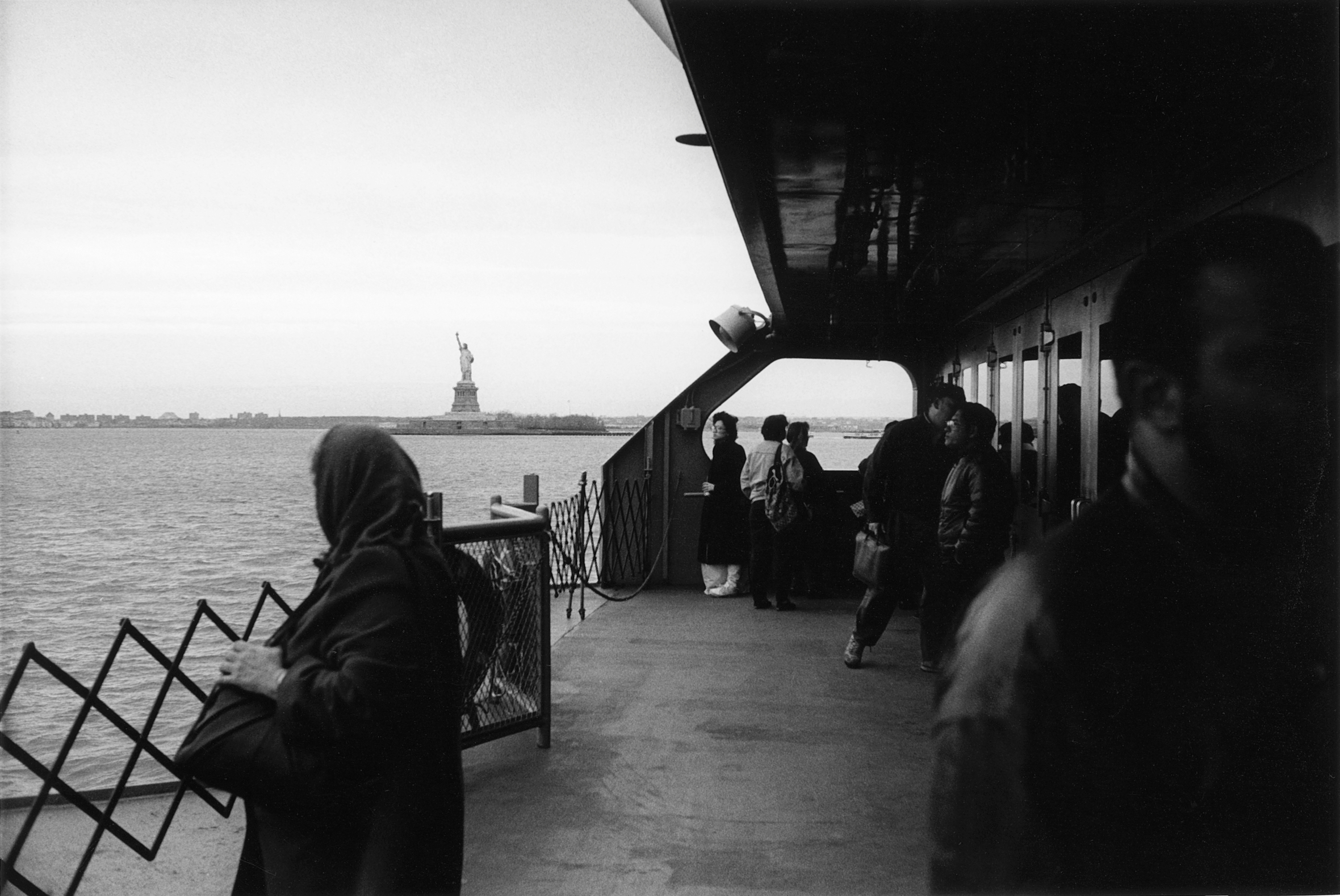
The SS Muir, an American troopship, lay at anchor in New York Harbor after a ten-day voyage from Bremerhaven, Germany. It had not been an easy crossing — stormy seas and icy weather — and almost all the passengers were seasick. Besides the crew, the Muir carried 1,100 refugees, almost all of them Jewish survivors of German concentration camps. I was among the few who weren’t Jewish. At twenty-one I had come to America because I could no longer live among my countrymen knowing what they had done to the Jewish people.
On this bitter-cold night in December 1951, it seemed as if every passenger, some still reeling from the voyage, found his or her way up on deck. We stood at the railing and stared in awe at the Statue of Liberty, lit up in the harbor. No one spoke much, and some cried softly. The statue was an emblem of a new beginning. I should have been scared to leave my old life and start over in an unknown country, but somehow I felt no fear. I was young, healthy, and full of hope for my future, with a grand total of ten dollars in my pocket.
In the morning we disembarked and formed long lines in the great hall at Ellis Island to have our paperwork processed by immigration officials. A volunteer named Mrs. Bannen helped me get a Social Security card and my first job. Three days after landing, I went to work for the Block Drug Company in Jersey City, New Jersey, packing toothbrushes into boxes for ninety-seven cents an hour. It was a good start.
Elizabeth Lega
Red Bank, New Jersey