In 1955, when I was nine years old and my sister was ten, my father bought his first 35 mm camera with money he didn’t have and dragged us and my mother on a cross-country trip for the opening of Disneyland. He went crazy taking pictures of us standing at the edge of cliffs, holding snakes, showing scrapes and bruises, and pretending to be happy. At the time I wanted to smash that old Kodak to smithereens. But now, of course, I am very grateful for that camera.
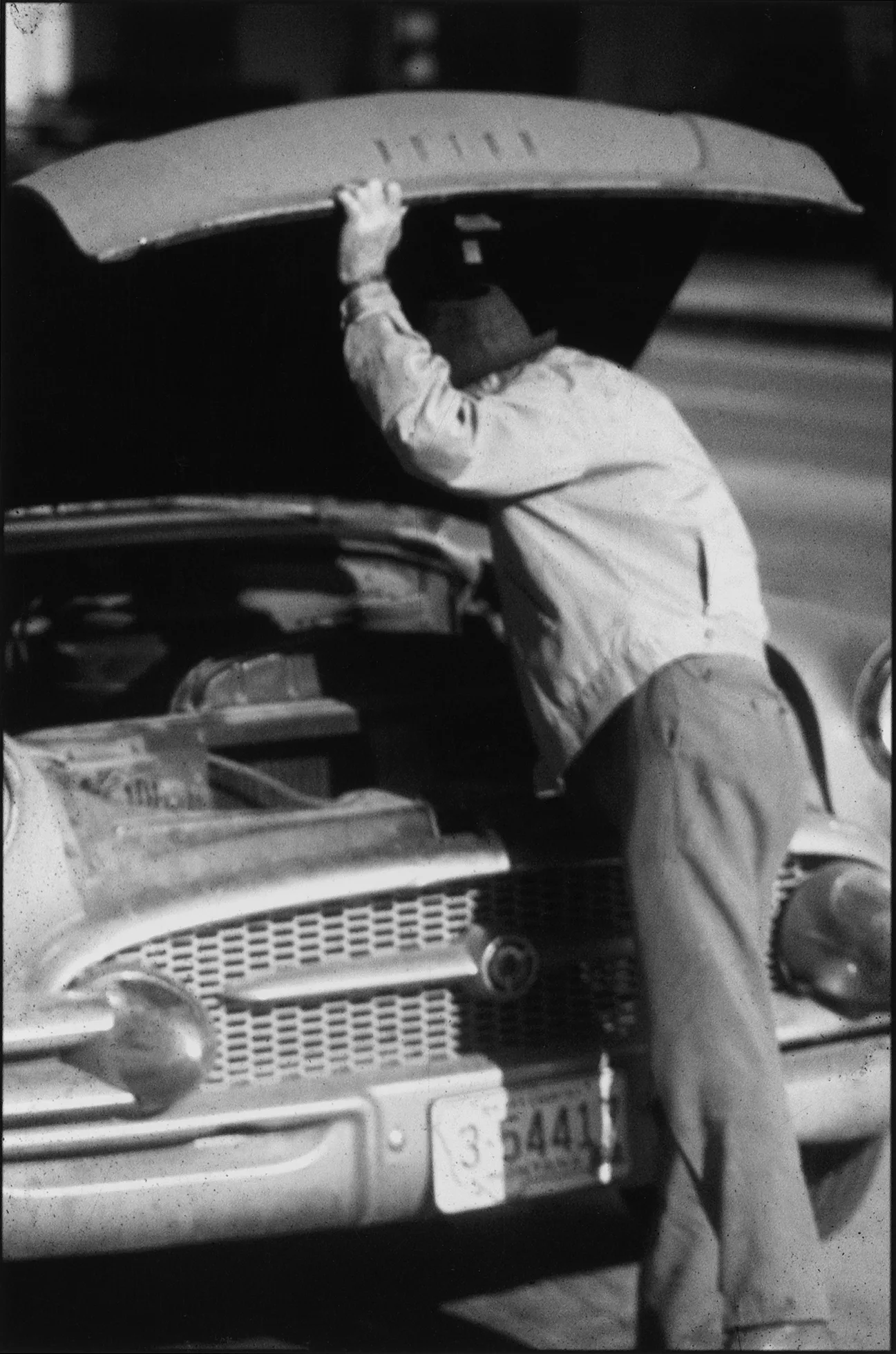
Clack-click. Here is a picture of our Chevy station wagon, navy blue body with a white roof, its rhombus shadow sprawled over a gas station in Iowa. We left our apartment in the middle of the night because the car and its roof rack were piled with belongings, like the Joads’ jalopy in The Grapes of Wrath, and my father did not want the landlord to know we had no intention of coming back.
In the slide, the car glints in the early-morning light, clean from the terrifying thunderstorm we drove through all night. Once, lightning even struck the car, and this slide’s crisp detail shows the burn mark in the door where the bolt struck.
In the background is a billboard for Chesterfield cigarettes, with a picture of a man and woman breezing along in a convertible, laughing and smoking, hair windswept, very happy. No children. But in our Chevy, my sister and I are slouched in the back, wedged between mounds of suitcases, bedding, and camera equipment, looking glum. Maybe we were just waking up. My mother is standing next to the car door, pointing to the place the lightning struck and smiling with staged relief. She sure as hell didn’t smile during the storm. She is wearing powder blue pedal pushers and a pink-and-white wing-collar blouse with a palm-tree print, the fronds of which you can make out in the slide’s stunning resolution. (No modern digital camera can come close.) On her feet are pink canvas shoes with straps that wrap around her ankles. A scarf covers her head and is knotted severely under her chin. You can see every hair curl trying to escape.
As my father aims the Kodak, his shadow claws across the asphalt, up a gas pump, jaggedly slicing a crimson pop machine. After he took this shot, my mother bought a grape Nehi, took a swig herself, then handed it to my sister and me. The bottle is not in this picture, but such is the power of slides to remind you. The colors are so vibrant that the images are almost three-dimensional — living, breathing things.
Even after all these years, that old pop machine makes me ache for a Nehi, which didn’t taste anything remotely like a grape but was so sweet it almost made me forget the terror of the storm. The machine was a horizontal tub with a heavy-hinged lid and ice on the bottom. You had to pull your preferred bottle by its cap along a metal hanger to a kind of holding pen that, when you put in your nickel, released a trap door and allowed you to lift the bottle. It reminds me of the old Union Stockyards, where they prodded cattle through a labyrinth of pens and gates to slaughter. There was no place to escape, only the illusion of free will.
My father’s prodding device was his new camera, a Kodak SLR, which he bought instead of paying our last month’s rent. We were going to be living out of suitcases for the next few weeks anyhow, he reasoned. We’d just find a new place to live when we got back. That’s why my sister and I got smushed in with so much crap in the back of the station wagon — crap that included slide film, lenses, a tripod, a light meter, a flash bracket and bulb, and still more film.
Clack-click. Here is a picture of a tree growing out of a boulder near Ames, Iowa. In front of the rock is a post with a plaque, and the slide is so clear you can read every word on it. After noticing a sapling sprouting from this rock, nineteenth-century firemen threw water on it from their fire engine. Eventually the sprout grew into a tree, and here it is — stout, full-leaved, tyrannical — lording over its legions of corn, columns of deep green foot soldiers, tall and impenetrable. I am on top of the boulder, looking miserable, refusing to smile, taunting my father with silent defiance. I remember trying to touch the tree and my father screaming bloody murder, as if I should have already known you weren’t supposed to touch a stupid tree. What was so terrible? All I wanted to do was touch it.
It seems to me now, after seeing this picture so many times over the years, that the tourism board of Ames, Iowa, was trying to create a kind of parable: with proper nurturing and encouragement, even a frail sapling can overcome the brute power of solid stone to reach heaven.
Off to the side, you can just make out my sister standing in the corn, deep in the stalks’ shadows, a pinpoint of red barrette her only hint of color. Having a year’s more experience with my father, she knew what would happen as soon as he told me to climb onto that rock, so she hid in the corn.
My mother is not in this picture. I don’t remember where she was when he took it, but it’s possible he was letting her turn the car around. She had a driver’s license, but I don’t recall her driving on that trip to California. He didn’t trust her, I guess. When they were in the car together, there was no question who would drive, even if he was dead tired and she was alert.
My father was a child of the Depression. He was only nineteen when my sister was born. He tried many jobs, but none seemed right. Meanwhile, we kept moving from one apartment to another, one relative’s house to another, one neighborhood to another. Maybe he believed that, like John Steinbeck’s Depression-era wanderers, he would find himself by hitting the road. Or maybe he just wanted to escape — his problem being that he couldn’t escape us.
Clack-click. Here is a picture of me shirtless, sleepy-eyed, with a dirty face. I never did like to wash. When I cried, my mother would wet a tissue with my tears and wipe the dirt off my cheeks. I was a skinny kid. In this slide, my tan pants — rolled-up, baggy hand-me-downs from my cousin Sherwin — are cinched around my waist, a frayed belt dangling to my knees. The slide is so sharp, you can see my broken belt loop and the grass stains on my knees. Even after all these years the clouds still seem to have texture, their shadows dark on the landscape. The shadows of my father’s arms and his Kodak pierce my chest.
I am standing on the edge of a drop-off with a valley of shrubby hillocks and dry, jaundiced earth below me. I think this is Wyoming. The sky is inky blue with fluffy clouds tinged in copper. If I had lost my balance, or the edge had given way and I had fallen backward, I probably would have survived. The drop was not straight down, and I see no jagged rocks. Maybe my father didn’t really want to kill me. I remember him saying, “Back, back. Go on, you little chicken. Don’t you trust your own daddy? Don’t keep looking back. I’ll tell you when to stop.” When he finally did tell me to stop, the ground had started to slope. My toes clawed dirt, but my heels grasped air. I remember searching for my mother and seeing her looking at me from the car, catching my glance, and looking away. He told me to smile. “Years from now I want you to remember what a good time you’re having. Go on, big grin.” I remember not being able to breathe until I heard the click of the Kodak.
My father never tired of regaling us with the life and times of Kodak’s founder, George Eastman, a man he admired immensely. Although Eastman was born seventy-five years before my father, Dad believed they had a lot in common. George’s father died when George was twelve, exactly like Dad’s, and the elder Eastman had also left his young family destitute. Like my father, George Eastman was a high-school dropout. At fourteen, they both had to find jobs. There the similarities seem to end. Eastman managed to overcome his economic adversity. His gift for organization and management, his tireless work ethic, and his lively and inventive mind made him a successful entrepreneur by his midtwenties, enabling him to lead his Eastman Kodak Company to the forefront of American industry. My father claimed he possessed the same temperament and mental skills. The only difference, he often told us, was that George was not saddled with a wife and two kids. If only he did not have to feed us, he would be free to “think big and act on it, too.”
When George Eastman was seventy-seven, he killed himself. Plagued by progressive disability resulting from a hardening of the cells in his lower spinal cord, he became frustrated at his inability to maintain an active life. My father used to threaten to shoot himself. “One bullet, one instant of pain,” he would tell us, holding his finger to his head and gazing at my sister and me so we could not mistake his meaning, “and — bam — this slow torture is over.”
Clack-click. Clack-click. The slide projector sounds like a semiautomatic weapon. You load a cartridge like a clip, insert it into its receiver with a sturdy, satisfying clack; you press a button, and — click — a “shell” drops into place and explodes onto the screen. When my sister and I were young, my father would set up his projector and make us watch slides for hours. He always picked Saturday nights at eight o’clock, because that’s when I Love Lucy was on. He knew we liked watching it but made us sit through his slide show instead. The projector’s rectangular metal cartridge held forty rounds. (These days the cartridge is circular and holds 160 slides. You don’t have to reload as often.) My father expected us to remain absolutely still during his presentations, because if our attention strayed, even for a moment, we would not derive the full enjoyment of the memories. In the bursts of color and the dust-swirling blasts from the projector’s muzzle, I would furtively watch my sister glaring at our father, her eyes so dark with hatred they reflected no light.
Clack-click. Here is a picture of me sitting on a Conestoga wagon at a pioneers museum in Colorado. You couldn’t imagine how huge these covered wagons were until you stood next to a wheel, which is taller than I am. I remember wanting to climb up onto the seat to pretend I was driving the wagon into the wilderness. Instead I avoided my father’s wrath by remaining earthbound. I am wearing a Davy Crockett T-shirt. Thanks to Walt Disney, Davy Crockett was all the rage, and every boy in America wanted a coonskin cap. My father’s philosophy was simple: since he’d never gotten anything when he was our age, why should we? Anyhow, for the cost of a stupid raccoon cap, he could buy several rolls of slide film.
In 1942, when my father was sixteen, he bought a camera for a dollar from a neighborhood woman whose son had been killed in the war and had no further use for capturing memories. To make his twenty-four exposures last, and to ensure that he took only the most judicious photographs, he imposed a strict limit of three pictures a day. He composed the images with utmost care, being mindful of lighting conditions, background, and movement of the subject. He could barely wait to get his film developed and see his pictures projected on a screen, in all their magnificent color — images he and no one else had captured, proving he could do something of value.
After eight long days, he brought his film to Levy’s Drug Store. For six more excruciating days he waited for the slides to come back, allowing him time to find a projector, which he tracked down at the West Side Boys’ Club. He checked with old lady Levy every day, and, finally, the slides were ready. Sixty cents: Two lunches at Woolworth’s. Two bicycle-inner-tube repair kits. One bicycle horn. Twelve streetcar fares. Six movies.
He tore open the yellow box right there in front of Mrs. Levy. He held the first slide up to the window. Black. The second slide, black. All the slides, black. Mrs. Levy was as baffled as he was. The camera was no good. The camera was shit. He rode home on his bicycle hating the woman who had sold it to him, hating her son who had died in the war. The next morning my father’s bicycle tire was flat, and he had no money to fix it.
Clack-click. Here is a rare picture of my father, standing next to a gigantic concrete Indian in front of Tomahawk Souvenirs. Along Route 66 every souvenir shop had some kind of attention-grabbing gimmick: a giant tepee, a snake petting zoo (oh, how my father liked that one), a twenty-five-foot-tall Tyrannosaurus rex. This one, in Arizona, has an almost-as-tall red-skinned “savage,” dressed only in a loincloth, baring pointed teeth, and wielding — what else? — an enormous tomahawk. Behind the giant Indian is a dirt parking lot full of tables with amateurishly hand-painted signs indicating the prices of semiprecious stones, Navajo dolls, and blankets. And behind all this kitsch is an adobe building, the store itself, squat and heavy, painted the same rust color as the Indian, suffering silently under the predatory sun. Shadows are short and sharp. Parked next to our station wagon is a dusty, liver-colored Ford pickup truck, vintage late forties. Sitting in the back, holding hands, a real live Indian woman and young girl are dressed in billowy skirts, too heavy for this climate. Maybe it’s Sunday and they are going to, or have just come from, church. You can see from their complexions and turquoise necklaces, their beaded headbands and stoic faces, that they are Indians.
My father is leaning against the concrete Indian, mimicking the statue’s tomahawk gesture, mugging for the camera. It was probably my mother taking the shot, although the picture-taker’s shadow is too small for me to know for sure. My father is wearing a captain’s hat, white with a navy blue bill and a gold-embroidered anchor with ropes on the front. He told us many times that he had wanted to join the navy and fight for his country. He was only fifteen when the U.S. entered World War II, and it was never clear why he missed the entire war. But he says he would have signed up for Korea if he hadn’t been stuck supporting my sister and me.
There is something about slides that makes them different from ordinary pictures. With their bigger-than-life, dazzling images, slides block out the familiar world and blur the distinction between imagination and reality, rendering the image more real than the original. Slides, then, can create a world where the illusion of an idealized past replaces the true experience they represent. A frozen smile, a fairy castle glinting in the sunlight, Indians holding hands — these become a drawbridge raised against time, a rampart of illusion.
Now when I view my father’s slides, I see things I never saw as a kid being forced to sit erect and quiet through the interminable Saturday-night viewings. I have come to appreciate them. Now I see, for example, how infrequently my mother is in the pictures, and how I appear more than twice as many times as my sister. (It might have been different had he taken any pictures on our way home, but that was not to be.) What would Freud have said about the ratio of family members in these photographs? What does it say about my father’s feelings toward me? Or, for that matter, mine toward him? Does it mean he singled me out for special torture, or did he really think he was doing me a favor, that someday I would inherit these slides and, viewing them with my own children, realize that — wow — he really did love me in his special way? Did he see something of himself in me?
Maybe if I project these images often enough, truth will beam through.

Clack-click. Here, at last, is Disneyland, 1955, opening year. It is like nothing we have ever seen before. And here we are, among the luckiest people on earth. What a wonderful father we had. A man with the spirit of Walt Disney, skilled at building and fulfilling dreams, a man with the daring of George Eastman. Here is nonfading, brilliantly colored, screen-size proof.
In the slide, my mother, my sister, and I are standing on the bridge crossing the moat to Sleeping Beauty’s castle. Fantasyland. All around us are other children gazing up at the lofty turrets, clasping hands with their parents, dreaming of being knights and princesses, riding steeds and wearing glass slippers. In the slide they seem happy. Yet here is my mother with her Lucy Ricardo lipstick job, her pained smile, my sister and I pressed against her as if we were all afraid of falling into the moat, not gazing at the castle at all, but staring into the lens of my father’s Kodak.
Clack-click. Here is the last slide of our trip to California: the Pacific Ocean, taken from a bluff above Muscle Beach. This picture isn’t labeled, but we well remember the name of this wide swath of sooty sand, littered with human detritus: red and white umbrellas, candy-striped chaise longues, crimson coolers, variegated blankets. There is an ice-cream stand with a torn awning and, painted on its clapboard side, an orange popsicle about to be eaten by human teeth, frozen between life and death.
Here is — as it must always be at the end of my slide show — the great, infinite sea: turquoise blue, eternal, beckoning. Even so many years and viewings later, in the picture you can sense the water’s amniotic warmth — a womb of insulation against life’s tribulations, wavelets lapping to the rhythm of respiration. Even in the fifty-year-old sunlight blazing on the screen, you understand the temptation to slip gently into its enveloping caress.
Clack-click. Clack-click. Show over. Screen blank, then dark. But I still have to leave the projector fan on to cool the bulb before packing it up. I don’t want a fire. I don’t want to burn the slides, not these. This is our Saturday-night entertainment. We can never see these slides too many times.
Here is my father, staring at the screen as if an image were still there. Maybe the image of my mother wading into the sea is projected onto his retinas. No one knows what he’s thinking anymore. They say with age comes regret, but in my father’s case, who knows? He could be saying to himself, I put up with those ungrateful bastards. They ruined my life, and I still took them to Disneyland.
There he sits, motionless, chin glistening, staring stupidly at the dark screen, until I — and only I — decide he can move. Until I feel like wheeling him back to his bedroom, where I will tuck him in. But I’m not ready for that yet. The fan is still running. The bulb is still hot.