Taking Care
Selections from the Archive
A few years ago a dear family friend in her seventies began experiencing symptoms of dementia. A group of her nearby friends, including my parents, stepped in to help. As her condition progressed, they eventually found themselves in charge of almost all her needs, from arranging doctors’ appointments and cooking meals to making sure her garbage can was put out on trash day. It was a huge commitment, but every one of them was happy to do this work until she was able to move close to her family for long-term assistance.
I thought of this friend often as we put together The Sun’s June 2024 issue, which opens with Mark Leviton’s interview of Emily Kenway about the prevalence of people providing at-home care for loved ones. Caregiving is “a fundamental fact of loving someone with a human body,” Kenway observes, and many other pieces in the issue reflect how universally that care is needed: a poem from Michael Mark about tending to his mother; a short story by Sybil Smith about an elderly woman’s interactions with a home aide; an essay by John Vurro about raising a son with autism.
Below you’ll find selections from our archive exploring the kaleidoscope of emotions that come with being responsible for another person’s well-being—devotion and grief, fear and comfort. Whether you’re giving or receiving care, we hope you’ll find a piece that speaks to you.
With appreciation,
Nancy Holochwost, Associate Editor
In an essay that anticipates many of the themes in Mark Leviton’s interview with Emily Kenway, Alane Salierno Mason asks, “Is others’ need really such a threat to the self, to our idea of what the self is? The American self is the doing, achieving, self-realizing, independent self. . . . Yet the world is continually telling us its truth of universal need, of mutual dependency.” This thought-provoking piece, about cooking for the Italian grandparents who taught the author how to eat, is filled with the warmth of family as well as questions about who’s responsible for holding the family together.
© Sara Ferguson
The Exegesis of Eating
My mother’s own illness keeps her from filling her traditional role of caretaker. As my mother’s only daughter, I often think I should be living with my grandparents, shopping and cooking for them—and for my mother, too. That’s how things went in the old country, and who’s to say there isn’t poetry and justice in it? To prepare for one’s elders the kind of food they prepared for you, in the way they taught you to prepare it, is an act that goes beyond a means of survival, something that can’t be replicated by home-care nurses or ready-to-heat meals.
That’s what I think, but I live more than an hour away and have one of those professional jobs that devours all my time and is never satisfied.
June 2002Owen Cason’s essay is an unrelentingly honest account of helping to raise his young niece, who has a rare, incurable genetic disease. The author does what so many Sun writers excel at: he tells the story of an impossibly painful experience with a deep love to match the heartbreak. It isn’t an easy read, but it’s an unforgettable one.
© Lisa Callamaro
For a Future You
I had open-heart surgery when I was young and have had a handful of operations since. That’s one of the reasons I’m your godfather. When you’re older and need someone who knows the strange, liminal feeling of anesthetic pulling you under; when you stand before a mirror and rub the edges of your scars—the hope is that you can come to me.
As I worked up the nerve to write this for you, I told myself my vantage point lies in a sweet spot: more objective than your parents, but more involved than your grandparents. I’m not just someone who comes over to play on weekends and causes you to miss naps. In my mind I’m as primary to you as you are to me.
August 2020“I never called her back, the woman / with the two babies born just like mine,” begins Danusha Laméris’s poem about two mothers of children with disabilities. Being able to talk to someone who knows exactly what you’re going through might sound like a gift, but the author peels away our expectations to show how that closeness can spark fear. The poem’s ending is a stunner.
DANUSHA LAMÉRIS
What I Didn’t Do
I never called her back, the woman / with the two babies born just like mine: / girls who couldn’t crawl or talk, / could barely smile, who lay there, / bundled in flowered dresses, staring / at the ceiling.
June 2013Poe Ballantine’s short story is narrated by a freewheeling, LSD-dropping teenager working as an orderly at a convalescent home in the 1970s. While caring for a despairing patient, he makes an impetuous, potentially boneheaded decision that ends up being just what the man needed. Parts of this story are as bleak as can be, but it’s also a vision of random, unexpected grace.
© Bill Lowenburg
Last Day at Lemon Acres
“Look, Jack,” I said now. “I can’t kill you and I can’t help you die, but I’m not unsympathetic. I know that fifty years down the road I’ll be lying in a room like this, pleading with some pimple-necked dufus who doesn’t understand. But I understand, Jack, so this is what I’m going to do.”
“What?” he said.
“Do you know what LSD is?”
Shadows passed across his face like the shadows of birds flying over, and he turned his head a notch, as if peeking out at me from behind a tree.
December 1996Caregiving for elderly people is usually thought of as the duty of family or professionals. Benjamin S. Grossberg’s bittersweet poem reminds us that near strangers can step in to meet a need others might not even notice, and that a small gesture can mean the world to the recipient.
BENJAMIN S. GROSSBERG
The Hairdresser
The hairdresser / sees the old woman—wheelchair bound, pushed by her daughter—glance / out the window, and goes in back / to fetch a shower cap. The woman tugs her daughter’s shirt and says, almost / inaudibly, It’s raining. // And it is raining. Barely. But clearly it wouldn’t take much rain to collapse / the woman’s hair back / to what it must have looked like when she came in here—that is, not so much / hair as the gray wisps // hair turns into if you live long enough.
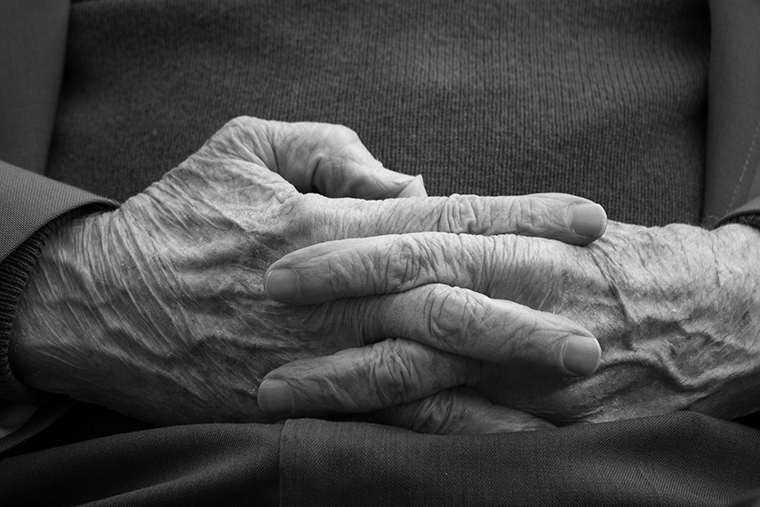
July 2020“Though my parents can no longer care for themselves, they care for each other,” writes Rebecca McClanahan, whose mother and father have been married for seventy-one years. In their bond the author sees the support she wants to have in her own marriage’s later years—so much so that she calls her husband to her parents’ house to witness them comforting each other after a frightening episode. “If this is what it comes to,” she says, “then this is what to do.”
© Nora Sweeny
What Love Looks Like from Here
Late last night a phone call from Mother jerked me from sleep. She was frantic, shrieking that there was a stranger in the house, a man who insisted he was her husband—“but he’s my father!”
“The stranger?” I asked.
“Yes. My father. He says he’s my husband. And I can’t find Paul anywhere.”
Paul is my dad. I told her I’d be right there. . . .
When I got into my own bed at home, I reached for Donald’s hand, and he shifted his body closer to mine. We’ve been married nearly forty years, but we are still learning from my parents what love looks like: How it moves. All the shapes it takes.
February 2017 PREVIOUS
We’ll mail you a free copy of this month’s issue. Plus you’ll get full online access—including more than 50 years of archives.
Request a Free Issue