Since the end of 2022, Israeli prime minister Benjamin Netanyahu has governed in a coalition with ultra-right settler parties who have moved swiftly to implement an ideology of Jewish supremacy. Israel’s current minister of national security, Itamar Ben-Gvir, from the Otzma Yehudit (“Jewish Power”) Party, has been arming settler militias and encouraging settler violence and intimidation against Palestinian communities in the West Bank. Finance minister Bezalel Smotrich, another far-right settler, has pushed through the approval of a record number of new settlements in the West Bank, boasting that this expansion will block any possibility of a two-state solution to the Israeli–Palestinian conflict. Meanwhile, the conflict in Gaza that followed the October 7, 2023, Hamas attacks on Israelis—in which roughly 1,200 were killed—has killed almost 75,000 Palestinians.
Human rights activist and writer Raja Shehadeh was born in 1951 in the Palestinian city of Ramallah on the West Bank, three years after his family fled Jaffa during the Nakba (“Catastrophe” in Arabic)—the removal of 750,000 Palestinians from Israeli territory at its founding. At the time of Shehadeh’s birth, Ramallah had come under Jordanian rule, while Jaffa was part of the newly established state of Israel. Shehadeh comes from a prominent Christian Palestinian family of writers and lawyers. His grandfather was a judge, and his father—one of the first Palestinians to advocate for a peaceful two-state solution—worked as a lawyer under the British Mandate in Palestine, and continued to work under Jordanian rule and Israeli occupation. Shehadeh followed in their footsteps, studying law in London, and in 1976 he returned to Ramallah to work in his father’s law office. While examining documents there, he realized that Israeli authorities, having gained control over Gaza and the West Bank during the Six-Day War in 1967, were creating a legal system that ensured Israeli domination over Palestinians and enabled Jewish settlers to take Palestinian lands. In 1979 he cofounded Al-Haq, an independent Palestinian human rights organization that monitored Israeli legislation in the occupied territories and offered legal aid to Palestinians.
In 1991 Shehadeh withdrew from a leadership position in Al-Haq to pursue a literary career. He has since published more than twenty books, mostly in English: legal analyses on human rights and Israeli occupation law as well as memoirs of his experience as a Palestinian living under Israeli occupation. His 1982 book, The Third Way, popularized the concept of sumud, often translated as “steadfastness,” a nonviolent approach to resisting Israeli pressure on Palestinians to leave their land. His 2007 essay collection, Palestinian Walks, won Britain’s Orwell Prize for political writing. His 2024 book, What Does Israel Fear from Palestine?, was a brief but pointed observation of conflicts past and present in the region, and last year’s Forgotten: Searching for Palestine’s Hidden Places and Lost Memorials, which he wrote with his wife, explores how the many layers of civilization are embedded and buried in this contested land.
I visited Shehadeh in December 2025 at his home on a quiet street in Ramallah. (We spoke again this spring via Zoom.) His 2019 memoir, Going Home, concludes with a description of his house and garden and how he does not feel safe from the Israeli army, even within the walls of his own home. This sense of threat was palpable as the taxi driver Shehadeh had recommended took me from Jerusalem to Ramallah. Our drive was tense. It was a Thursday, the day authorities of the Palestinian Authority in Ramallah return home for the weekend, and the checkpoints were particularly cumbersome. Hani, the driver, told me about the difficulties he and his wife faced with their residency permits as residents of East Jerusalem, all the while keeping an eye on his phone for updates on which checkpoints to avoid. A drive that could have been fifteen minutes took over an hour as we traveled a circuitous route on back roads to avoid army and settler patrols. During a long detour north of Ramallah, we passed the village of Deir Dibwan, where earlier that week settlers had burned down houses while the Israeli army stood by. The day before, a settler had shot a sixteen-year-old Palestinian boy in the head.
Shehadeh and I sat in his living room beneath a colorful abstract painting by his friend Kamal Boullata, and he talked about the changes to the landscape as new settlements are built, olive groves are torn down, and roads are cut through the mountains. His view of the current conflict was grim, but he still has hope that Israelis and Palestinians can live in peace. The roots of the conflict must be re-examined, he insisted.
Not all conversations are as linear and succinct as they appear. This interview has been condensed and edited for clarity.—Ed.
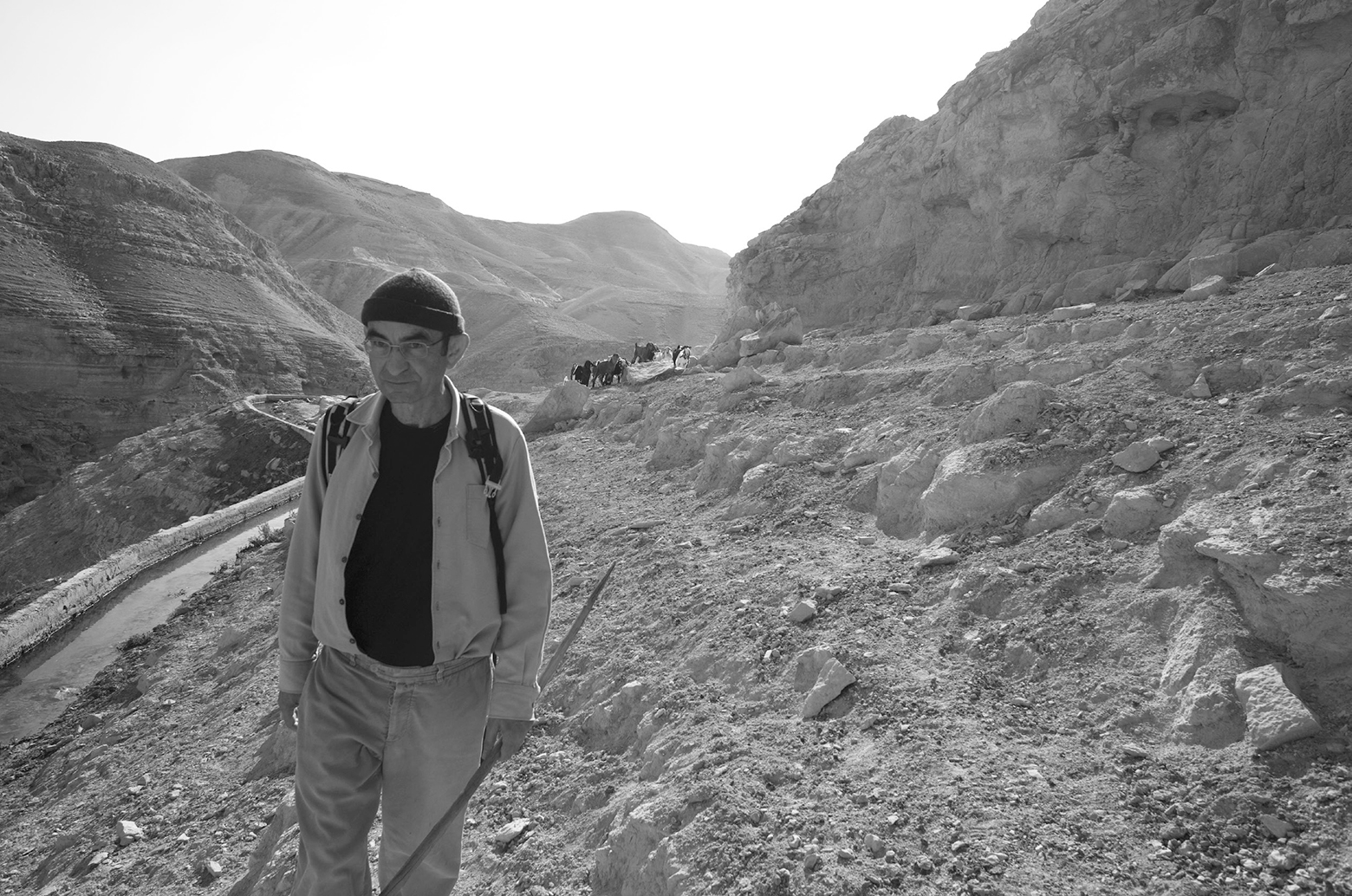
Raja Shehadeh in Wadi Qelt
© Bassam Almohor
Hertog: How did you see Israel when you were growing up in Ramallah, initially with the West Bank under Jordanian rule, and then under Israeli occupation after 1967?
Shehadeh: In my childhood, Israel was a mystery. I grew up listening to radio broadcasts from Palestinians who had stayed behind there. These were impassioned voices of people trying to reach their brothers, sisters, and other family members, updating them on their lives among the “enemy.” I had relatives who’d been forced to stay behind in Akka because my cousin had caught typhoid after Israeli Haganah forces had infected the wells there and they weren’t able to flee. On some Christmases, they would be given permits to travel from Israel to Ramallah to celebrate with us. It was all very strange and tense when my cousins were supposed to visit. For days everyone would be nervous because we were never sure if they could actually come or not. At that time the border was closed, but some Christian Palestinians from Israel were allowed to cross into the [Jordanian-occupied] West Bank.
My cousins described Israel to me as this place with a lot of greenery, lusher than the hills of Ramallah. But they also described the oppression they suffered there. So I had conflicting images of the place in my mind.
My father did not talk much about the Nakba or his past in Jaffa. He was a man of action, not interested in regrets. But my grandmother longed for Jaffa. She’d grown up in Haifa and moved to Jaffa when she’d married my grandfather, who was a judge. Her attitude was that Jaffa was the best place in the world. I remember standing at the edge of Ramallah with my grandmother to look at the lights of Jaffa in the distance—which I later realized were actually the lights of Tel Aviv. So, under my grandmother’s influence, I grew up with this feeling that life in Jaffa was real, and my life in Ramallah wasn’t. I didn’t respect the beauty of Ramallah. I looked across at the other side, thinking I needed to be there.
Hertog: How did your vision of Israel change after Ramallah came under Israeli occupation following the war of 1967?
Shehadeh: The war, as far as fighting in the West Bank was concerned, was a joke. There was some fighting in Jerusalem, but in Ramallah and other places there was none. The Jordanian army simply withdrew. It was all over very quickly. We stayed inside the house. On the third day, Israeli soldiers came and started shooting to see if there would be any response, but nobody had any weapons, so nothing happened. They took over the Grand Hotel, which was next to our house, and stayed there for several months, using it as their headquarters.
Not long after the war ended, my father took us to Jaffa to see what had happened to everything he’d left behind in 1948. That was painful. But it was also a time when he was very excited about the idea of the two sides making peace. I remember many of his Israeli friends coming to visit us in Ramallah. Before 1948 my father had worked as a lawyer under the British Mandate [a League of Nations mandate allowing the UK to administer the region following World War I—Ed.], and these Israeli friends were his fellow lawyers, with whom he had very good relationships. They hadn’t been in contact since 1948. After Israel occupied the West Bank, they sought him out to ask what we needed. So my first impression of Israelis was very positive. From the beginning my father said we must live with the Israelis because there was no way we could destroy them or they could destroy us. He became adamant about the need to make peace and worked for many years on it. But we now know that Israel was never interested in a peace agreement. They would tell the Jordanians that they couldn’t negotiate with them because they [the Israelis] were already talking to the Palestinians, and then they would tell the Palestinians that they were already talking to the Jordanians—just stringing everyone along. The Israeli researcher Avi Raz wrote about this in his book The Bride and the Dowry.
Hertog: In an interview with The New Yorker from August 2023, you said Palestinians were becoming more radicalized because of Israeli-settler violence, and you worried that a third Intifada would be a disaster for the Palestinians. Then October 7 happened. Was it as bad as you had expected, or worse?
Shehadeh: My first, optimistic, reaction was to think that now Israelis would realize that walls and barbed wire gates could not protect them, and they would perhaps seek another, more peaceful, way. That was, of course, totally naive and unrealistic, but I didn’t think for a minute that the Gaza war would turn into what it eventually became. It was much worse than I had expected. I’ve started to doubt that can we live together after the genocide in Gaza. So much has happened that is shocking, truly shocking! How can it be that Israelis think of Palestinians as nonhuman?
Back in 1982, several hundred thousand Israelis marched in Tel Aviv to protest the Sabra and Shatila massacre in Lebanon. [A Lebanese militia allied with the Israeli army massacred hundreds—possibly thousands—of Palestinian civilians living in refugee camps controlled by the Israel Defense Forces.—Ed.] But now, with more than seventy thousand Palestinians killed in Gaza, the response from the Israeli public has largely been silence. There were some small protests against the war, but far too few. Israelis no longer seem to care about Palestinian lives.
Israel’s leaders have not been preparing for peace. They built the wall to divide us, and they succeeded. A generation or two of Palestinians have grown up seeing Israelis only as soldiers, settlers, and oppressors. And Israelis, likewise, don’t see Palestinians as human beings with whom they can interact as equals. Even the Palestinians who are citizens of Israel aren’t accepted into Jewish society.
But, beyond that, Israel tends to use Jewish trauma and the Holocaust as a form of psychological warfare against Palestinians and a way to justify their actions. Soldiers are sent into Gaza believing that they are fighting for the survival of their people. For years the Israeli media and education systems have stressed the suffering of Jewish communities in the Arab world. Now among the Israelis who are the most aggressive toward the Palestinians are the Mizrahi Jews, who originate from Arab countries. They have been indoctrinated to believe that their ancestors were oppressed by their Arab neighbors, which ignores the fact that Jews lived peacefully for over a thousand years in Baghdad, where they developed a great culture and were an important part of society. But Mizrahi Jews have been taught to believe that it’s time for revenge. If Israel were interested in peace, it would have taught its children that Arabs and Jews used to live together peacefully, and that if it was possible in the past, it is possible now.
A generation or two of Palestinians have grown up seeing Israelis only as soldiers, settlers, and oppressors. And Israelis, likewise, don’t see Palestinians as human beings with whom they can interact as equals.
Hertog: You have said that many Israelis exhibit “double consciousness.” Can you explain what you mean?
Shehadeh: I mean they are aware of the genocide in Gaza and the Israeli treatment of Palestinians, but they refuse to acknowledge it. They want to think of Israel as a liberal and democratic nation, so they ignore the occupation and the oppression.
Hertog: Before the Gaza war in 2023, some Israelis organized one of the country’s largest protest movements ever in response to what they saw as Netanyahu’s attempt to demolish democracy. But some critics were disappointed that these protesters stayed mostly silent about the occupation. Is that what you mean by double consciousness?
Shehadeh: Yes, exactly. That movement was against the destruction of the High Court, which does mean something to us Palestinians, because some of the violations that Israel has committed in the West Bank have been challenged in the High Court. The Israeli Right wanted to make changes in the High Court to preclude that possibility. But I was distressed that all these “pro-democracy” demonstrations in Israel ignored the occupation. And almost none of those protesters seem to have considered that there can be no democracy as long as 5.5 million Palestinians are living under Israeli rule without equal rights.
Hertog: You have also said there can be no reconciliation unless Palestinians recognize the Holocaust and Israelis recognize the Nakba. Do you think, after what has happened in Gaza, that reconciliation is still possible?
Shehadeh: I start from the point that the Israeli nation and the Palestinian nation live on this small piece of land that we have to share one way or another. As my father said, there is no way that we can destroy the Israelis or that the Israelis can destroy us. So the question is how we can create a relationship that is workable and will lead to peace. It’s getting increasingly complicated, but the basis for peace has never changed: Palestinians must have self-determination, and there must be recognition of the Nakba by the Israelis, because otherwise it would be a false beginning. Of course, there must also be recognition of the Holocaust, although I think the Holocaust is already a widely established fact for most Palestinians.
Now the genocide in Gaza has become another big issue. It has proven that the Israeli government wants to destroy Palestinian society.
Hertog: How has the current war affected your relationships with your Israeli friends?
Shehadeh: My Israeli friends who are true friends are as shocked as I am about the situation. Our relationship is stronger, and we are in great communication. We are all trying to figure out what’s happening and to understand if the beautiful relationship we had in the 1980s—when we had so much hope for the future—was real or if we imagined it. But those who have not corresponded with me and don’t seem to be concerned about what’s happening—those people I don’t even think of as friends anymore.
Hertog: Do you still see some Israeli–Palestinian solidarity on the subject of peace?
Shehadeh: Of course. A small number of Israeli activists have stood up for Palestinians and have been involved in, for example, forming a protective presence against settler violence. These people suffer a lot of intimidation from the Israeli army, and I think they’re very brave. But it’s not just a matter of political solidarity. It’s friendship among people who are distressed by what is happening around them.
The basis for peace has never changed: Palestinians must have self-determination, and there must be recognition of the Nakba by the Israelis, because otherwise it would be a false beginning.
Hertog: Can you explain the current increase in settler violence in the West Bank?
Shehadeh: This moment is a chance for the far-right settlers to do everything they have wanted to do for decades. Their views are now fully supported by the government’s policies, and they have carte blanche to implement their ideology of ethnic cleansing. They see this as an opportunity to take over the West Bank and make life so difficult for Palestinians that we are forced to leave. There are constant settler attacks on Palestinian villages. Settlers come to burn and kill, and the army comes with them, not to protect villagers from the attacks, but to protect and help the settlers. Itamar Ben-Gvir has worked very deliberately on this since he became Israel’s minister of national security: first by giving the settlers weapons; then by making sure that the West Bank Civil Administration was in the hands of the settlers; and finally by ensuring that the army promoted a settler, Avi Bluth, as the top commander in the West Bank.
At this point we are already living in Greater Israel, from the river to the sea, with just a few pockets of Palestinian habitation left. And Israel continues to make life impossible for those Palestinians, not only through settler violence, but through the creation of checkpoints that make it difficult for Palestinians to move around, and by withholding tax money it collects on behalf of Palestinians from the Palestinian Authority so that salaries can’t be paid and people suffer economic hardship. Meanwhile, they have expelled almost all Palestinians from more than half of Gaza and are demolishing the remaining homes there.
Hertog: Do you think what is happening now can be seen as a second Nakba?
Shehadeh: What seems in store is even worse. The present right-wing government of Israel is supporting the ethnic cleansing of Palestinians through the use of pogroms against villages in the Jordan Valley and by making the life of Palestinians in the rest of the West Bank so difficult as to encourage them to leave. And now, with the war on Iran taking up so much global attention, the Israeli violence is only increasing.
But the memory of the Nakba is still so vivid that Palestinians are aware of what is going on. In 1948 and ’49 the Nakba caught the Palestinians by surprise. They didn’t realize what was really happening—that they would never be allowed to return to their homes, and that the Zionists would deny they’d ever existed as a nation with a long history on this land. Also, at that time the Holocaust was recent enough that much of the world sympathized with the Jewish people, and there was a lot of support to help Zionists establish a state of their own in Palestine. These factors do not exist today. Now the Palestinian right to self-determination has been recognized internationally and has gained a lot of support.
Hertog: How does your career as a human rights lawyer relate to your work as a writer?
Shehadeh: Both stem from my need to understand and chronicle what’s going on. When I finished my law studies in London in 1976 and returned to Ramallah to work in my father’s office, he asked me to sort through the military orders that were piling up, which nobody had been paying attention to. When I started trying to index them, I realized the Israelis were in the process of creating a secret, unpublished body of law and administration that separated Jewish settlers from Palestinians. They facilitated the expansion of the settlements through land-use planning policies that assigned most resources to the Jewish settlements and confined Palestinians to small, restricted areas. This made it difficult for Palestinians to stay on their own land. I soon realized documenting this was an immense job that needed an organization behind it. So I got in touch with some fellow lawyers, and together, in 1979, we founded Al-Haq, which was then called Law in the Service of Man. My first publication was a legal report titled “The West Bank and the Rule of Law,” published in 1980 by the International Commission of Jurists in Geneva and Law in the Service of Man, which chronicled Israel’s secret legislation. Meanwhile, I was writing letters to a Palestinian friend of mine, Kamal Boullata, who was from Jerusalem and was living in Washington, DC, at the time. He had no idea what was going on in the occupied territories, so I began describing my life under occupation and all the ways Israel was making life difficult for us. I eventually sent the letters to a magazine in London, which published them, and then an Israeli publisher, Yehuda Melzer, suggested that I publish them as a book. And that’s how, in 1982, my first book, The Third Way, came about. It was about the importance of sumud—steadfastness—and the various ways in which the Palestinians in the West Bank practice sumud.
Hertog: What does sumud mean to you?
Shehadeh: For me, it’s a matter of not giving up on our right to this land and making sure that, instead of packing up and leaving, we stay put, even when the circumstances are difficult. The quote on the cover of the book put it this way: “Between mute submission and blind hate—I choose the third way.” It’s a positive way of building a life here in Palestine and making it possible for others to build lives here by starting institutions and businesses that sustain Palestinian society. Individuals do count, and that’s particularly noticeable in a place like the West Bank. Our society is so small-scale that one person’s actions really can make a difference. Al-Haq is an example of sumud. And to think that the US sanctioned Al-Haq because it supported the case against Israel in the International Criminal Court.
Hertog: If we think of sumud as a commitment to maintaining Palestinian society, could it be seen as the Palestinian answer to Zionism?
Shehadeh: You might think of it that way, but the origins of sumud and Zionism are entirely different. Zionism started in the nineteenth century as an attempt to establish a place for Jews in Palestine. Sumud is the Palestinian response to being threatened on our own land. Sumud is the practice of a people who are on the land already, whereas Zionism is an attempt to bring people in from the outside. It’s a different starting point, a different trajectory.
Hertog: You write a lot about hiking and sense of place. Why does place matter, especially when it comes to the Israeli–Palestinian conflict?
Shehadeh: I grew up in a land of beautiful hills that change with the seasons, and these hills were preserved by farmers who for centuries carefully maintained the terraces on which they grew their crops. Now I see these hills being bulldozed to make room for settlements. I see old villages being destroyed. And that, for me, is a tragedy. The land is a part of my identity. It’s not that I can’t love any other place, but this place has a special meaning to me, and that meaning is being threatened in a violent way. I remember when Ariel Sharon said, “We are going to leave an entirely different map of the country that it will be impossible to ignore.” I saw this happening, and it alarmed me. That’s why I started writing Palestinian Walks about the vanishing landscape. I wanted to show the land as it was back then. It has significantly changed since. Intersections are now named after nearby settlements. And people in their twenties today don’t know what the land used to look like. Even I need to read what I wrote back then, to help me remember.
Hertog: You published a book called What Does Israel Fear from Palestine? a few years ago. Why do you think Israel is afraid of the very existence of Palestine?
Shehadeh: Because recognizing Palestine means reassessing the foundational myth that Israel is based on: that they arrived here to an empty land. It requires a reevaluation of everything they have told themselves and an admission that the state of Israel is born out of the dispossession of Palestinians.
Hertog: You’ve said that the occupation is destroying Israeli democracy. Can you explain?
Shehadeh: You cannot have a democracy without equal rights. In order to keep Palestinians disenfranchised, Israel must undermine the democratic institutions that protect the fairness of the legal system. The Israeli High Court, for example, used to be an institution through which Palestinians could file appeals against illegal actions by the Israeli military. But now the High Court is partially in the hands of extremists, and the legal system is in disarray. Religious fundamentalism is penetrating every aspect of Israeli life. Israel is losing friends internationally and depends increasingly on the United States, which is not a good long-term friend. There are many reasons to think that Israel is in peril.
In 1976 Yitzhak Rabin [the two-time Israeli prime minister who was assassinated in 1995 by an ultranationalist Israeli extremist—Ed.] described the settlements as a “cancer in the tissue of Israel’s democratic society” and warned that they would lead to apartheid. Back in the day, I wasn’t a great fan of Rabin because he was a hard-line military man who ordered Israeli soldiers to “break the bones” of Palestinian protesters during the First Intifada [the 1987–1993 Palestinian uprising against the Israeli occupation—Ed.]. But at least he had the courage and strength of character to change. Maybe, if he had lived, he would have changed even more, and people would have listened to him. There could have been a chance for peace.
Hertog: Jewish supremacy was once seen as a delusional fringe ideology. Meir Kahana, Ben-Gvir’s ideological inspiration, wasn’t even allowed to run for Parliament in 1988, and Ben-Gvir himself was once considered so extreme that he wasn’t allowed to serve in the army. Do you think it was inevitable that this ideology would eventually come to power in Israel?
Shehadeh: No, it’s a failure of the Israeli Left and the more rational groups in Israel. The extremists planned ahead. Their political opponents were complacent and didn’t see the danger. For example, in 1994 a settler named Baruch Goldstein killed twenty-nine Palestinian civilians in a terrorist attack in Hebron. In response Rabin had a chance to dismantle the settlement in Hebron, but he didn’t. And now Rabin has been assassinated, Ben-Gvir lives in that same settlement, and the man who committed the massacre is celebrated as a hero whose grave has become a pilgrimage site.
When the Labor Party [a social-democratic party that was largely in power from 1948 until the 1990s—Ed.] was in control, they were too comfortable in their role and did not see their own vulnerability. They did not realize that the force building against them was much more extreme and much more dedicated than they were. And when the settler violence began in 1982, they never took real action against it. I remember how concerned we were at Al-Haq. We published a report that was sent to the Israeli government, but they never acted on it. In the meantime the government was making changes in the land-use planning laws so that the settlements could grow. We were telling the Israelis and the world to pay attention, but nobody took action. Their neglect just let the extreme Right grow. I don’t think the Israeli Left realized what was about to happen. It used to be unthinkable that settlers could just go into Palestinian villages to commit pogroms without being stopped by the Israeli army. But now the army is helping the settlers.
Hertog: Religious fundamentalism seems to be on the rise among both Israelis and Palestinians.
Shehadeh: When there’s no hope, people turn to religion. Religion explains their despair to them in a way that no other framework can. I’ve so often heard people say, “There’s no future here. Our future is in heaven.” When people are afraid, religion gives them some sense of stability.
Hertog: What is happening with the Palestinian leadership? There haven’t been elections since 2005, and the approval ratings of the Palestinian Authority and its president, Mahmoud Abbas, who just turned ninety, are very low.
Shehadeh: For good reason. We see the police of the Palestinian Authority step aside when the settlers and the Israel Defense Forces arrive. They are not protecting us. Even in places where the Oslo agreements officially give the Palestinian Authority the power to act, it doesn’t do anything to stop the settlers. It is safe and convenient for Abbas to ignore the violence. He is treated like a head of state. Why would he bother to make an effort?
Unfortunately, political power is divided between Hamas, which rules in Gaza, and Fatah, which controls the Palestinian Authority. Any candidate who isn’t endorsed by either Hamas or Fatah doesn’t stand a chance, because neither group wants to give up power. Hamas is now popular because it has been fighting Israel. But this has, of course, brought disaster on the Palestinian people. Fatah remains in power because, as the party that controls the Palestinian Authority, it runs the civil service and pays everyone’s salaries. Every time there is any possibility for a Palestinian breakthrough, Israel manages to play the parties against each other in a classic colonialist strategy of divide and conquer.
Hertog: Why did the Oslo Accords fail the Palestinians in the 1990s? [The Accords between Israel and the Palestinian Liberation Organization (PLO) created the Palestinian Authority, allowing for limited self-rule in the occupied territories and generating hope for a two-state solution.—Ed.]
Shehadeh: By the time of the Oslo Accords, Israel had already put in place a legal and administrative system that privileged Jewish settlers over Palestinians. It was basically apartheid. In the early stages of the negotiations, I was a legal adviser to the Palestinian delegation that was negotiating with the Israelis in Washington, DC. I spent a whole year educating Palestinian delegates about the law, trying to make clear to them what was happening and that they had to make sure Israel wouldn’t make these laws permanent. The delegates were willing to listen to me, but the PLO leadership in Tunis wasn’t. Eventually I realized it was useless. I gave up and left.
The PLO just wanted to be in power, to return and beat Hamas. Yasser Arafat [who led the PLO from 1969 until his death in 2004—Ed.] thought that if the PLO had their foot in the door, they could push it open. But the door remained closed. When the PLO signed the Oslo agreement, they didn’t insist on annulling the military orders that were giving Israel the upper hand in every way; they didn’t insist on changing the land laws that Israel distorted to confiscate Palestinian land; they didn’t change the land-use planning laws that allowed Israel to give settlers most of the resources; and they didn’t stop the construction of more settlements. People were so excited about Oslo, thinking that it represented a new beginning. They didn’t realize that, in effect, the accords consolidated the system of inequality that Israel had already put into place.
Hertog: At the time of the Oslo Accords, there was still popular support in Israel for a peace deal with the Palestinians, but the subsequent failure of the accords and the violence of the Second Intifada convinced many Israelis that peace wasn’t going to work, which contributed to the rise of Netanyahu and the far right. If the two peoples must find a way to live together, how can they end the cycle of distrust, blame, and violence?
Shehadeh: Your characterization of the conflict as a “cycle of violence” doesn’t reflect the reality. Let’s assume the Palestinians stopped all acts of resistance to the occupation and submitted fully. Would this bring about peace and an end to violence? The Israeli government does not hide its ambition to force the Palestinians out and take over the entire geographic area of Palestine, which they call Eretz Israel. Clearly there is no parity.
After Oslo, the right wing in Israel did not want peace with the Palestinians. That’s why they killed Rabin, after which Israel started to build settlements at an even faster pace than before. The Second Intifada started because conditions in the occupied territories did not improve and there was no movement toward the eventual creation of a Palestinian state and the withdrawal of Israeli forces. Palestinians lost faith in the peace process.
Hertog: But regardless of the reasons for the violence, it did move Israeli public opinion to the right.
Shehadeh: Absolutely. But then, that’s what a bad agreement leads to. The way in which Palestinians went about the Second Intifada was very bad. The suicide bombings did not discriminate between civilians and soldiers, and this played into the hands of the extremists in Israel. It made things much worse.
Hertog: So let me rephrase my question: If violence only creates more extremism, how do we break that cycle?
Shehadeh: By having a negotiated settlement. But every time there has been a possibility for a negotiated settlement, Israel hasn’t allowed it. The Palestinians go along believing they can leave the past behind and move forward. But when they see that Israel is only interested in more land annexation, they turn to violence. I think the solution is to let the groups in Israel and Palestine who favor a negotiated settlement seriously go at it, which hasn’t happened yet.
Hertog: How do you respond to Israelis who are hesitant to support Palestinian statehood, not because of ideological reasons, but out of fear for Israeli security?
Shehadeh: It’s natural that they are afraid of Palestinian resentments. As long as they are the occupiers of the Palestinian people and are violating Palestinians’ rights, there’s going to be a reaction from Palestinians. If they don’t want to be afraid, they have to end the occupation.
Hertog: Meanwhile, the popular opinion in Israel is turning more toward the far right.
Shehadeh: Yes, unfortunately.
Hertog: Is there also a rise of extremism in Palestinian society?
Shehadeh: I’m not an expert on the whole of Palestinian society, but I think there’s a difference between the extreme right in Israel, which wants the annexation of the West Bank and Gaza, and the extreme right in Palestine, where we’re just trying to survive more than anything else. There is definitely more religiosity in Palestinian society than before. That’s true. I think people have lost faith in peace.
Hertog: Hamas’s attack on October 7 and calls for the destruction of Israel and the expulsion of Jewish Israelis from the land—aren’t those examples of extremism?
Shehadeh: Of course, but that’s not new. And Israel’s policies and conduct are not dissuading Palestinians away from this response. The settler violence is creating a sense that Palestinians can survive only if they counter violence with violence. That, of course, encourages extremism. I think Israel prefers it when Palestinians opt for violence and armed resistance, because Israel has the upper hand with its stronger military. What really threatens Israel is nonviolent resistance.
They are afraid of Palestinians who promote nonviolence, because Israel needs a justification for the use of violence. Even now, a simple traffic accident is used as an excuse for violence. This is to be expected when two communities live side by side in such enmity.
Hertog: You said Israel plays up anti-Semitism and Jewish trauma narratives to justify its treatment of Palestinians and deflect criticism of Israel. But anti-Semitism exists. How do we distinguish between Israeli propaganda and real threats to Jews and Israelis?
Shehadeh: Israel tries to argue that its existence is the only answer to anti-Semitism, because it’s supposed to be a safe refuge for Jews. But the reality is that it has only encouraged anti-Semitism by angering so many people who now associate Israel’s mistreatment of Palestinians with Judaism in general.
Hertog: What are your thoughts on the anti-Israel protests in the US and the students who have tried to push their universities to divest from financial support of Israel?
Shehadeh: The protests have made me hopeful. They are evidence that more people understand the origins of the problem. And Israel is no longer as sophisticated in its propaganda, while the Palestinians are becoming a little bit more so. But it’s more than a matter of narrative and propaganda. There needs to be real change that improves the lives of all people here.
Hertog: A number of European nations recently recognized Palestinian statehood.
Shehadeh: This means little as long as it’s not followed by any concrete actions, and they still support Israel militarily.
Hertog: And how about Donald Trump’s peace plan, which is supported by Arab nations like Qatar and Saudi Arabia?
Shehadeh: For us to depend on undemocratic Arab states like that is sad and disappointing. They are in it for their own interests. And we can’t rely on Trump to resolve this situation.
Hertog: It strikes me that it’s easy to love your country and society when everything is peaceful and prosperous, but once things get difficult, it’s tempting to either succumb to extremism or pack up and leave. This is happening not only in Israel but also in the US. Do you think the concept of sumud can be applied in a wider context?
Shehadeh: I think so. In a large country like the US, it may feel as if one person doesn’t make much of a difference, but the principle is the same: Instead of packing up and going, resist and try to be a positive influence!
I have been thinking that people all over the world these days are feeling a sense of despair because, like me, they are seeing the destruction of the world as they knew it. But it has occurred to me that the real destruction of my world happened in 1948, when the Palestinians lost Palestine. What people are experiencing now in the US—the dismantling of the rule of law and the threats to the existing world order—is something that I have already been through. In a way, I have more allies now. Many American Jews are realizing that they were wrong to support Israel unconditionally. I have been getting letters from American Jews telling me that they have read my books and have changed their minds about Israel.
If support for extremism ends, there could be change. Palestinians outside of Israel think of this place in abstract and idealized ways. They talk about Israel as a “settler colonialist state,” and then they stop there. OK, Israel is a settler colonialist state. So what? What’s the solution? Many Palestinian supporters abroad—not all of course—sum up the situation in abstract and ideological or academic terms. But the reality is that we have to find ways of living together. People who live here think in terms of direct relationships and memories and realities. If you don’t have to face the realities of living here, then it’s easy to talk in broad, absolutist terms, because you don’t have to suffer the consequences of your positions. It’s the same for the Jews. Many Jews abroad are more extreme about Israel than Israelis. Abstract ideologies are always false, as far as I’m concerned. Or, rather, they are wanting.
Hertog: Do you think Palestinians in the diaspora differ from those who are on the land in the way they see Palestinian identity and think about how to move forward?
Shehadeh: I think so, because Palestinians abroad have become much more sophisticated about how to communicate about the struggle, and some have found important positions in the media and other influential professions. But they also have to be very careful because speaking out against Israel can lead to accusations of being anti-Semitic. The United States government, as we’ve seen, has tried to suppress Palestinian advocacy. This may make people in the diaspora feel more Palestinian than ever before, but it also puts them at greater risk. Palestinians on the outside can tend to see the situation in a much more static way than people here see it.
Hertog: What do you mean by a “static way”?
Shehadeh: I think some Palestinians abroad support a one-state solution, which is an easy position to take when you can avoid considering the reality on the ground. People who live here realize that we have to come to terms with all the complications of Israeli society, which will not accept a combined Palestinian-Israeli state.
You can see the same type of abstract thinking among Jewish people abroad. The Jewish pro-Israel lobby in the United States is much more extreme than the average Israeli. It’s done a lot of damage by supporting the most anti-Palestinian elements in Israel. The settlers have been supported financially and diplomatically by the Jewish lobby abroad.
People who live here think in terms of direct relationships and memories and realities. If you don’t have to face the realities of living here, then it’s easy to talk in broad, absolutist terms, because you don’t have to suffer the consequences of your positions.
Hertog: When you mention a “one-state” solution, are you talking about a Palestinian state that excludes Jewish Israelis?
Shehadeh: A one-state solution would have to include Jewish Israelis. Those who believe in it talk about one democratic state where everybody has the right to vote and everybody is equal.
Hertog: That doesn’t seem extreme.
Shehadeh: It’s extreme in that it’s not realistic. I don’t think we can be under one umbrella with Israel at this time. Israelis have had much more experience running a state than Palestinians. We would be completely overwhelmed. And Israel has its own problems with the ultra-Orthodox Jews and with settlers and extremists. We wouldn’t be able to deal with all that. I think it would be better to have two states, or at least start with self-determination for Palestinians and an end to the occupation. Then we could slowly build a new relationship between the Palestinian and Israeli peoples.
Hertog: Some Palestinians do call for a purely Palestinian state that would exclude Jewish Israelis.
Shehadeh: Yes, some advocate for that, but it, too, is not realistic. We need self-determination for Palestinians as well as for Israeli Jews, and we need a new, peaceful relationship between the two national groups. Eventually relations would be built between Israel/Palestine and Jordan, Syria, Lebanon, and the whole Middle East, because that’s the most natural thing for the region. It seems far-fetched now, but it will come to that, I think.
Hertog: Do you think if there was a chance for peace right now, people would embrace it?
Shehadeh: Yes, I think people would go along with it. They’re fed up. That’s the thing: When people have hope, they become willing to do what they had been unwilling to do before. I’ve seen that hope after Oslo.
Hertog: Is there anything that you wish people abroad understood about Palestinians’ lived experiences?
Shehadeh: When you see a situation from the outside, you always simplify it. People on the outside fail to understand that life goes on even amid war and occupation. Even with all the settler violence, daily life in the West Bank is still being lived. Of course the situation here is terrible, but there is also a tendency to exaggerate the suffering and the heroism of Palestinians, to portray us as much more heroic or tragic than we are. People are people everywhere.
Hertog: What effect does this exaggeration have on the way Palestinians see themselves, especially the younger generation?
Shehadeh: From the outside, people see only the difficulties and the bombs and the settler attacks, and they imagine all of life here in the West Bank is just a combination of these extremes. But they miss the day-to-day routines in between. Even during a war, there are routines. Yes, people suffer when there is an attack, but afterward they go on with their lives. It’s not all suffering. We are also living. The weather is good, the cafes in Ramallah are open, and we try to go on with life. It’s difficult for outsiders to see the totality and the normality of life here, because they want to see it as a heroic struggle. Yes, there are some heroes, but many of us are just trying to live normal lives. It’s true, though, that living here, in itself, has a meaning, a purpose, an objective. Perhaps that is heroic in its own way.
Hertog: Are there things happening in Palestinian society that give you hope?
Shehadeh: There is resistance, there is strength, and people are enduring. Despite the incredible difficulty of just moving around with all the checkpoints and roadblocks, people travel from Nablus to work in Ramallah every day. The trip takes them hours, yet they still work, still go to school and university. It’s bad, but people have not given up. I don’t think of it very often because I take it for granted, but it’s an example of sumud. And that makes me hopeful.