After World
An Excerpt from Debbie Urbanski’s First Novel
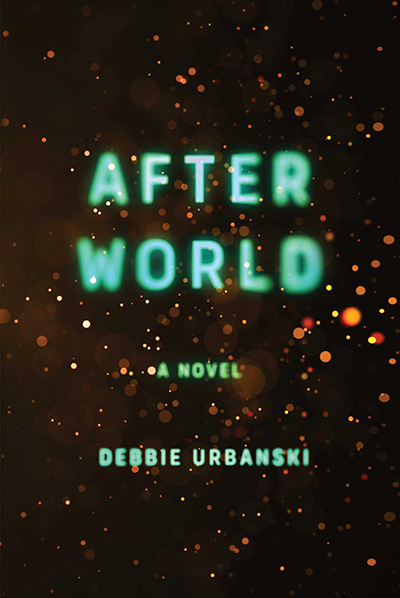
We are pleased to share this excerpt from Debbie Urbanski’s first novel, After World, published by Simon & Schuster.
The last live stream Sen can access goes down in June of her final year. The feed had shown a caged ape who played a keyboard in exchange for vouchers, which were supposed to be a short-term transitional currency, though it never worked out that way. There used to be rinds of fruit in the corners of the ape’s cage. For years fresh fruit had been difficult—impossible?—to find. The cam must have been located near a wild orchard. Someone must have brought the fruit from the orchard to feed the ape. There must have been someone. This is what Sen tells herself. Above the keyboard, mounted to the wall, there used to be a monitor in the cage. A viewer could, after transferring the appropriate number of vouchers, upload an image, which would appear on the monitor. The ape would study the image then play a song of remembrance. He could have been pounding random notes on the keys; whoever came up with this system framed it otherwise. They framed it as an animal choosing to remember humanity, similar to a prayer candle in a minor basilica’s back corner. These kinds of cams became popular during the Great Transition because, while humans were remembering other humans all the time, nonhuman species were, in general, or even specifically, remembering humans hardly at all (M. Khamphet, “What Does It Take to Make You Notice We’re Leaving?,” New York Times, S.+24 days). So it felt special to have such an animal remember a beloved.
The second-to-last time Sen checked this feed, the cage was empty, the cage door open, the keyboard smashed, the wind blowing with increased intensity through the doorway. The last time she checked, the feed had gone to gray like all the other feeds on the increasingly unreliable Humannet. But before the empty cage and the static, Sen transferred the remainder of her transitional vouchers, useless now, so why not, to the ape-cam’s account. She sent over all her vouchers then uploaded the photograph Dana had brought with her to the cabin. Sen wasn’t in the photo but Mama Lindsy and Mama Dana both were. The ape, still caged at the time, studied the picture on the screen in front of him—Sen’s distant mothers sitting on a faraway blanket in a far-off field—before carefully choosing his first note. He played the note again. He played it with repetition, allowing vast protracted pauses to build between notes, pauses no human musician would have attempted for fear of wearying the listener (V. Markopoulos, “How to Ruin a Song,” Guider, S.–4291 days). The pauses made Sen often think, mistakenly, that the song was over. The ape’s hands looked like human hands encased in a realistic costume. Eventually the animal played other notes, though the repetitions, whenever they happened, continued for a long time. Each note felt like it was a choice. He never played the black keys. The right hand played more rapidly than the left and often fell out of time. Above the ape’s keyboard, Sen could see the contours of her mothers. The song kept going. There must have been no one else in the queue, or in the world, waiting for their turn.
That is the last live stream Sen, or anyone, will ever see.
There are thousands of other lasts to go. The last human step, the last human nightmare, the last human word, the last human bruise, the last human scream, the last human blink, the last human tear, the last human swallow, the last human thought, the last human emotion, the last human breath, the last human heartbeat, the last human reflex, and so on. All of them Sen’s.
When Maia launches, there will be just as many firsts.
Sen doesn’t plan on going to Maia. From the margins of notebook #43: I don’t want another world. She assumes that whether to proceed to Afterworld is, for her, a choice. She is wrong about that (L. Anjali, “Are You Eligible for Deletion? It Depends . . . on Your Job,” Informed Living, S.+43 days).
Excerpted from After World. Reprinted by permission of Simon & Schuster. Copyright © 2023 by Debbie Urbanski.
DEBBIE URBANSKI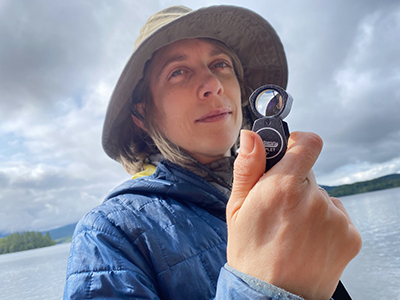
© Harold Kyle
Debbie Urbanski is a writer, nature lover, and human whose stories and essays have been published widely in such places as Best American Science Fiction and Fantasy, Best American Experimental Writing, Granta, and Orion. A recipient of a Rona Jaffe Foundation Writers’ Award, she can often be found hiking with her family in the hills south of Syracuse, New York. After World is her first novel.
more PREVIOUS
We’ll mail you a free copy of this month’s issue. Plus you’ll get full online access—including more than 50 years of archives.
Request a Free Issue