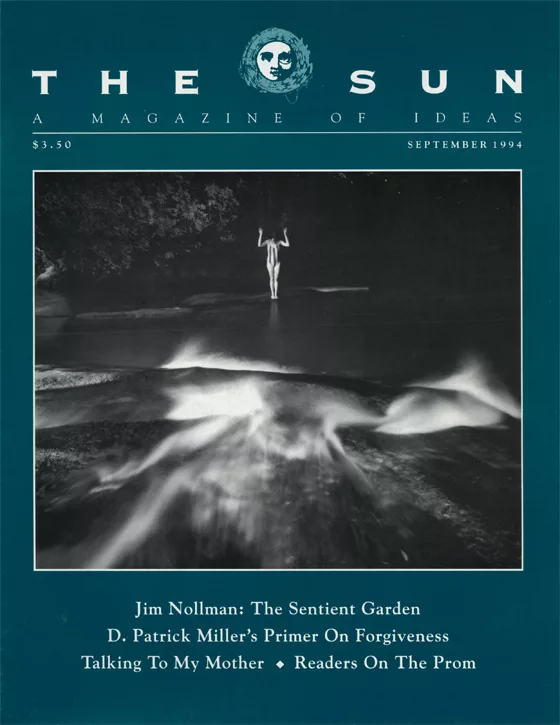
Jim Nollman talks to whales. He also talks to dolphins, deer, daffodils, and almost any other living thing. Nollman is the founder of Interspecies Communication, an organization devoted to promoting dialogue between humans and the other inhabitants of our planet.
— Andrew Snee
The more I learn about my garden, the less objective I feel about it. Now that I can rattle off the Latin names and vital statistics of so many of my landscape plants, you might think I would regard them as botanical specimens, each possessed of a unique genetic recipe and species-specific traits. Call me sentimental: I think of them as friends.
I’m no expert, not a professional gardener, and certainly not a botanist. I learned in the ninth grade that science mandates an emotional separation be maintained between observer and observed. If so, then what I do is not science. I can be a keen observer, but not always an objective one. I treat gardening as a cooperative affair. I rather feel like part of a neighborhood in which plants, animals, dirt, rocks, and a human family all participate collectively in a love affair with place.
Neither the language nor the forthright pragmatism of horticulture is able to plumb the depths of what I consider to be a mostly unspoken, intuitive relationship with the garden. My mind treats its growing stockpile of horticultural information, not as the basis of gardening, but rather as a background hum to the experiential impulses of digging, smelling, enjoying. This confession also explains a hunch of mine: that the sentient garden is best explained in the first person. The instincts that apprehend it turn tentative when clothed in the garb of dispassionate observation. Why obscure the sentient garden’s many insubstantial traits with scientific jargon that transmutes pure delight into an objective posture? We are all heirs to this jargon, the innocent children of the reductionist idiom it represents.
I pity the gardener who peers into the sentient garden and perceives nothing but solid resources exhibited to the senses through the media of biological processes bound up in laws of causation and ticking away with the precision of a machine possessed of molecular tolerances. Look again. See that ornamental plum tree over there? That one’s a warrior. A survivor. An interspecies communicator. Or look at these cabbages. They are the gift givers. Sentient beings possessed of a shy and humble integrity.
Most of us read such descriptive prose and our education immediately puts up a stop sign to keep our senses from proceeding any further down this garden path. We conclude that such descriptions smack of too vivid an imagination. No, I protest. Look again. Look differently. Refocus your eyes on the spaces between the imagination and the resource. There! See the cabbages? The plum tree? The sentient garden is beckoning to us.
This is hardly a game. I sometimes believe that acknowledging a consciousness and a conscience within nature holds the last best hope for humanity, bent as it is on destroying this fair earth. But that is a very large idea. We would do better to start this walk down the path of the sentient garden by avoiding grand conclusions. Let us commence by conversing about humble experiences. But let’s not be too timid to indulge in personal hunches. As we wander the sentient garden chatting about the personality of plum trees and the shy integrity of cabbages, realize that scientific terms like species-specific characteristics and genetic makeup tell us nothing about how we might connect with the plants. As a layman, I consider all such terms to be official jargon — words best reserved for people primarily bent on distancing themselves from their subjects as well as from their own emotional point of view. In my case, plant personalities is what I say. Personalities is what makes sense.
Several years ago, I planted two ornamental hawthorns, two pears, a peach, a blireana ornamental plum, and a prune-plum — all strung out in a skewed line along a deer path leading from the edge of a fir forest. Despite the well-known ability of deer to leap over tall barriers to get at fruit saplings — which ordinarily leads all the gardeners hereabouts to string a six- or eight-foot-tall fence around the young trees — I remained a stubborn aesthete. Not a chicken-wire fence in sight.
Over the years, the deer have arrived on my property during the latter half of the winter, when the wild browse is at a minimum. I’ve noticed that they avoid the hawthorns and the blireana plum, which are right on their path. They usually grab no more than a nibble at the leaves of the pear trees before moving on. They show no interest whatsoever in the peaches. Yet they would have destroyed the prune-plum years ago if I hadn’t pruned off all the lower branches and circled the trunk with a fence: a thirty-inch-tall barrier of chicken wire just inches from the tree trunk, held up by a single bamboo stick.
I call it my ideogram fence, because it reminds me of one of those characters in the Chinese alphabet that represents an object or an idea rather than a phonetic sound. More than a fence itself, this chicken-wire-and-bamboo-stick sculpture represents a fence. Any deer could break through it in a second if so motivated. I’m not sure why my ideogram fence works, but it seems to work far better than no fence at all, which is good enough for me.
The ideogram fence means that I have never had to consider getting violent with the local deer population. I have never considered buying a gun. Nor have I acquired a dog to keep the deer away. I have never needed to construct a high fence around any of the fruit trees, as I would later do around the vegetable garden. Explaining why the ideogram works on the fruit trees and not on the vegetables seems mostly a matter of thinking like a deer. If I were a deer I could forgo a few plum leaves each spring if that idea were communicated to me. Of course, no communication would sway me if I chanced upon a winter garden filled to the brim with roots and greens.
In the process of recognizing this ideogram as a solution, I have discovered something important about doling out garden advice. Although the local deer display distinct preferences in their choice of browse, no general rule of thumb can be ascertained from this very local lesson. The ideogram fence may work for someone else. And then again it may not. Deer are not blank-eyed no-brainers possessed of nonpersonalities and generic taste buds. Nor do they exhibit any predictable inclination to linger near or far from the houses of human beings. The best “how-to” advice I am willing to offer anyone is to try an ideogram fence around the base of any tree favored by deer. It appears to work for me. However, no one can convince me that if I ripped out that well-scarred but productive prune-plum and replanted the exact same hole with another prune-plum, the same fence strung around the new tree would repel the local deer as it did before. In other words, the map is not the territory.
Every tree and every deer has a distinct personality. People who build fences have distinct personalities. Even the fences — real, symbolic, or wholly imagined — have distinct personalities. The relationship between all these beings and structures, each one of them bursting with personality, seems to exist beyond the reckoning of any logic. Scientists will never fathom this relationship through any wile of statistical analysis. Does it exist? Let’s withhold judgment a moment.
This relationship motivates me to recommend successful strategies to other gardeners, but not tactics. In this case, the strategy is simple: do not treat natural predators as a manifestation of evil. Treat the deer as discerning neighbors. Talk to your neighbors! Communicate. Build a sign, an ideogram fence. But don’t build a Great Wall of China unless you like running a prison camp for fruit trees. Plant all the trees you like and rest assured that the deer will be just as finicky in choosing the ones they like. And another strategy: follow the tortoise’s example. Plant two of every fruit tree you like and then sit back and watch the deer, watch the trees. In five years you’ll know which ones the deer prefer. In eight years the trees will have grown too large for any deer to harm.
Five years to run a fruit-growing experiment? Feel blessed when a hundred golden peaches start ripening on a tree that is a mere four-year-old stripling and takes up about the same amount of garden space as a picnic table. Feel blessed that it’s not sequoia cones we’re waiting for. That might take decades. If we’re in a hurry, we should consider a hobby like sprinting instead.
There is another plum tree growing in my sentient garden. This is the ornamental blireana plum possessed of a penny-candy fragrance and striking coral-colored leaves. It grows off by itself at the very edge of the forest. I have observed over several years that, of all the trees in the extended landscape, my cat sharpens her claws only on this ten-foot-tall sapling. She actually goes quite a bit out of her way to use that tree. I was recently surprised while visiting a friend; I was admiring the distinct coppery coloring of her own blireana plum when I noticed scratches along the length of the trunk. Was it possible? She informed me that her cat also prefers to scratch his claws on a blireana plum tree. Paradoxically, I have since talked to another neighbor whose own blireana plum was recently destroyed by a deer. Mine is completely deerproof.
What have I learned from my blireana plum during its tenancy along the deer path? Although my particular plum has nothing to fear from the local deer, I would certainly think twice before recommending that someone else plant an unprotected blireana plum on a deer path.
I feel certain that my blireana plum tree has formed an alliance with the three or four deer who frequent this neighborhood. Is this conclusion mystical? Is it sentimental? Is it merely anecdotal? Or does it square with recent botanical evidence demonstrating that several tree species possess rudimentary communication skills? For instance, one species of rain-forest tree is capable of signaling the presence of predators to other nearby members of the same species. The other trees alter their chemistry accordingly. But what is the effect of this alteration? Do beetles and sloths suddenly find the leaves inedible? Or is this rather an announcement, a kind of arboreal stop sign, an ideogram of unpalatability? No one seems to know for sure. The predators aren’t telling.
What we have to admit, however, is that this example lends a bit of credence to my own cockeyed hunch. I notice the plum tree while out on my garden tour and wonder if it is even more sentient than those chemistry-altering trees, which, after all, can only discuss their sense of well-being among themselves. Does the blireana plum with the scratched trunk communicate to the black-tailed doe with the crooked hind leg? Does it talk differently to the big buck? And what does it say to the cat? I’ve noticed that most of the scratch marks have healed during the past year, signifying that my cat has quit her blireana claw-sharpening predation. Did the tree have anything to do with it? Or is the cat responding to my own annoyance over the scratch marks? Is the plum communicating a tree’s version of a fence ideogram directly to predators? Maybe it communicates many other things as well to anyone able to hear it. Maybe I could hear it. Maybe you could too. I want to learn how to do that, but I don’t know where to begin. Do you?
So many maybes also reveal why the sentient garden is so seldom found in books about gardening. We live in a culture that devalues the intuitive. For garden literature — a subject composed of unequal parts science, craft, aesthetics, and mysticism — the result is a steady stream of books written about the science, the craft, and the aesthetics of gardening, and only a few books that set out to elucidate its mystical side.
The most famous of these is The Secret Life of Plants, which is probably the most controversial best-selling book about the vegetable kingdom published in the last fifty years. The Secret Life of Plants is best understood as a history of various experiments in plant sentience viewed through the rationalist lens of scientific analysis. The book is overwhelmingly the product of two savvy science writers who spent much more time in libraries than in gardens. The result is a text that masterfully expands the envelope of scientific plausibility, a kind of new-age botany text. Yet the book carefully sidesteps any personal message of transcendence except through inferences from specific experiments; there are almost no references to the experiential aspects so crucial to any gardener’s relationship to the garden. Then again, The Secret Life of Plants was never intended to be a gardening book.
Why do garden writers avoid the subject of sentience? Because writers are as affected by our culture’s devaluation of the intuitive as anyone else is. Most of them work hard to present themselves as experts of one stripe or another. As every potential expert soon discovers, dabbling in the intuitive for its own sake definitely diminishes one’s projected sense of authority. And authority is essential for anyone bent on offering practical advice. This may explain why magazines such as Sunset, Fine Landscaping, Horticulture, and Country Living are all remarkably silent about the sentient garden.
Were plants conscious, it would imply that they smell their own fragrance, see their own colors, hear the thunder of a neighboring tree as it falls to the whine of a chain saw.
Not to say that garden writers haven’t explored the intuitive side of their relationship to the garden. One of the best of them, Gertrude Jeckyll, was an artist who treated the garden as a living, loving canvas of color and texture, and in the process forever changed the garden from a pretty view to a work of high participatory art involving plants and space. Vita Sackville-West, another English author, composed chatty prose that added a touch of the mystical to the greater discussion of gardens and gardeners. She was a sensualist, obviously enamored of fragrance, who gushed about her roses as if they were special friends possessed of sensual genius. Luther Burbank, the great turn-of-the-century plant breeder, often wrote about his plants as if they were peers collaborating with him to attain new forms and useful traits. The Japanese writer Masanobu Fukuoka wrote The One-Straw Revolution, promoting a sacred view of plants and soil as allies.
Were more gardeners to look into the myriad ways that plants respond to human beings, they might fall on these words in Leo Lionni’s Parallel Botany:
In our everyday garden grow the rosemary, juniper, ferns, and plane trees, perfectly tangible and visible. For these plants that have an illusory relationship with us, which in no way alters their existentiality, we are merely an event, an accident, and our presence, which seems so solid, laden with gravity, is to them no more than a momentary void in motion through the air. Reality is a quality that belongs to them, and we can exercise no rights over it.
Were plants conscious, it would imply that they smell their own fragrance, see their own colors, hear the thunder of a neighboring tree as it falls to the whine of a chain saw. Were plants conscious, it might imply that they even choose their own fragrance, admire their own long silhouette reflected by the low winter sun. Consciousness also implies that plants possess a sense of place. Luther Burbank, who drew as close to the plant world as any human ever has, insisted that his own plants existed primarily to accommodate place. They altered their traits to fit certain places and climates more quickly than genetics warranted.
In time-lapse photography, the metabolism of flowers seems more like our own. I could watch flowers bloom this way for hours on end, quite willing to withhold my own unkinetic, unevolved perception of plants, if only for a brief time. But it is a trick of the human mind that causes these now fast-moving plants to seem more alive and, yes, more conscious than they appear in my own garden. Faster equals more consciousness because plants start to resemble animals, acting out behaviors and reacting quickly to their environment. They seem nimble, talented, bold, even vain, whereas previously they only seemed beautiful in their stasis. These films hint that plants do possess a temperament a bit like our own, merely acted out at a different tempo.
Watching these racing, hugging, attacking, unfolding plants causes me to wonder why our modern scientific worldview no longer lets us accept the idea of consciousness in other beings unless those beings are already like us. Some of us obviously won’t accept the idea of seeing our intellectual reflection in creatures like deer, octopuses, or millipedes, not to mention plum trees. It does not serve the present regime. As environmental philosopher Michael Cohen has written, “how convenient for us to conceive mud, water, and stones to be dead; to decide that other life has no consciousness, pain, or equality. What an incredible alibi we have created to soothe our guilt of killing for profit.” The sentient garden speaks to us, not only about the limits of the rationalist worldview, but about its arrogance as well.
There is an inherent ecological value to acknowledging the sentient garden. People who believe that plants are sentient invariably treat them with greater respect than those who don’t. If we all believed that plants are sentient — that the very garden itself is sentient — we might, for example, be less willing to continue killing the soil with chemicals.
I’m out on a limb here. Many sober people refuse to grant consciousness to monkeys and dolphins, who are like us in so many ways, and here I am ascribing a similar characteristic to plum trees. I even wonder if the vegetarians may have gotten their salient argument about consciousness all wrong because, in fact, plants are every bit as conscious as the animals are, albeit quieter and far less mobile. Isn’t that the reason a sizable minority of us gardeners talk to our plants? We do talk to them, you know. Even though many of us won’t admit it.
To acknowledge the sentient garden, we must first learn to see it. For the benefit of those who see no point in even looking for this garden, it may serve us well to take a peek at history. As we sift through the intellectual baggage of the past, two perceptual ideas soon emerge from the heap; the first one is our culture’s devaluation of the intuitive. The second one is anthropocentrism.
The devaluation of the intuitive is an unfortunate result of science influencing our perceptions about reality. Science is based on measurement. Careful measurement establishes objectivity. It also mandates that a separation be strictly enforced between observer and observed. In field biology, when an observer interjects his or her own personal intuitions about the behavior of an observed animal or plant, the results are called anecdotal. Anecdotes make for weak science. Too many of them make for no science at all.
Our perceptions about the way the world works are deeply affected by this scientific principle of measured data leading to objectivity. Our schools teach us to believe that nonmeasurable and intuitive experience does not offer as credible a model of reality as experience gleaned from objective observation. As a result, scientists turn a blind eye to phenomena that cannot be reduced to measurement, and the rest of us subordinate the subjective — for example, my hunch about the sentience of trees — because it doesn’t “measure up.”
The case has been made many times that the scientific worldview itself is one cause of our steamrollering the world. We do so because we have forgotten how to honor nature as an animate being. The devaluation of the intuitive causes us to suppress any nonrationalist masculine feelings and utterly disempowers the feminine. It also may cause some members of the rationalist establishment to throw up their hands in exasperation to read this proclaimed nonexpert promoting a specific plum tree as a sentient being.
To understand anthropocentrism, we must dig deeper into our pile of intellectual baggage. Doing so, we discover that the contemporary relationship between gardener and garden (and most of the rest of nature as well) originated during the latter half of the seventeenth century, a period of breathtaking perceptual transition. Europeans were starting to perceive of nature, not as the penitential leftovers from a divinely inspired Eden, but as something new: a perfect, maintenance-free machine designed by God as the home for the human race. Whereas the old God-centered view taught that everything on earth was a temptation, either a weapon or a trap in the epic struggle between heaven and hell, the new view said that everything in nature was made for human use. We call this human-centered notion of how the world works anthropocentrism.
It fell upon the ministry of the time to justify the ways of the new God to the masses raised to believe in a different God whose every act was adjudged to be beyond human comprehension. To keep the new conceptual bubble intact, the learned men of the day churned out anthropocentric arguments to explain what must have seemed like ungodly flaws in the divine handiwork. Justifying the ways of God to man became such a common activity that it soon got a name attached to it: theodicy. It was all the rage in the sermons of the European Enlightenment.
For instance, if this new rationalist God had constructed the world to accommodate humanity, then what possible reason could He have had to design the likes of smallpox, aphids, poison ivy, and sharks? Answering this fundamental question, the seventeenth-century physician George Cheyne wrote that the Creator made the horse’s excrement smell sweet because he knew men would often be in its vicinity. Horseflies, vouched the Virginian William Byrd, had been created “that men should exercise their wits in order to guard against them.” Even the lowly louse was indispensable, explained the Reverend William Kirby, because it provided “a powerful incentive to habits of cleanliness.”
Over the centuries we have grown much more sophisticated in our ability to identify a human center in the machinery of nature. From the Amazon rain forest to the Arctic National Wildlife Refuge, our actions demonstrate that our civilization still endorses the basic belief that nature exists for human accommodation.
But what our actions tell, our thoughts often dispel. Like the men and women of the late seventeenth century, more and more of us today are starting to realize we are caught between two vastly different views of reality: the first one, human centered or anthropocentric; the second, life centered or biocentric. We are starting to sense that human beings are not at the center of the earth’s purpose. Our species is, rather, one integral aspect of the greater interdependent network of nature.
Our culture sits squarely between the two views. Most of us are unsure of its implications and misread the message of conflicting realities as an issue of jobs or resources. Some of us strike out in a different direction. We look to the trunks of plum trees or the taste buds of deer to find some visible sign of a biocentric network. Still others repudiate the very idea that anthropocentrism is just another worn-out opinion about reality, and not reality itself. All of us want to know: whose nature is this anyhow?
Most garden writers define gardening as the control of nature for aesthetic reasons. This theory of control treats the plants and the beds as elements, like paint applied to a canvas. Control sets up a hierarchy, with gardeners poised at the top as lord and master, and gardens as petit kingdoms created to be aesthetic triumphs of human accommodation. Control creates a horticultural version of the prevailing scientific model separating human beings from nature — what writer Loren Eisley once referred to as “man’s long loneliness.” Control treats unruly nature as a dragon intent on thwarting our every attempt to build a pocket paradise here on Earth. The dragon heaves a never-ending artillery of weeds, insects, deer, and unaccommodating weather our way. With the dragon so ready to pounce, we must never let down our guard.
Granted, dredging up such a fire-and-brimstone tone to describe the likes of dandelions and tent caterpillars exaggerates the way most gardeners actually deal their own controlling hand. But if the allusion seems overblown — and admittedly it is — then it is not without reason. It is far less overblown than the herbicides and pesticides we now wield in our daily combat with the dragon.
The control of nature for aesthetic reasons is troubling. Art critics are often clever at disguising their personal biases as if they represent a universal truth about art. Control for aesthetic reasons suggests that a rose picked from a bush sprayed with pesticide is equally beautiful to its twin picked from an unsprayed bush. A definition based on control says that we get more roses, and thus more beauty, by spraying, and less roses, and consequently less beauty, when we forgo spraying.
Misbegotten assumptions about beauty end up killing nature. The insects we seek to annihilate eventually become resistant to chemicals, and our gardens lose a measure of their artificially sustained beauty. More powerful chemicals are applied. The insects adapt again. A vicious cycle is set in motion. All across America gardeners set out to achieve the greenest lawn, the earliest tomato harvest, the largest roses — none of which could ever prosper without a control born of anthropocentrism. Too many dandelions growing in too many green lawns cause too many controlling gardeners to lay on too much herbicide, which ends up poisoning too many aquifers. By attempting to keep nature out, even on a small scale, each gardener adds his or her own small contribution to the poisoning of rivers, coastal waters, and soil. Given that conclusion, which should we eradicate: dandelions or green lawns? In fact, it is our point of view that needs to change, and not the composition of our lawns.
The biocentric view asks us to take a fresh look at our choices. It shows us that a beauty dependent upon excessive control is an arrogant beauty, even a vicious beauty. This perception of beauty keeps us from developing a more compliant, participatory relationship with place. Some biocentrists would argue that a human-centered aesthetic offers no beauty at all. At best, they regard it as an outmoded beauty; a sense of beauty that is woefully naive about the challenges we face.
I have been spotted, on one or two occasions, sitting in the sawdust of my sentient garden, whispering sweet nothings to the cabbages.
Without meaning to sound contradictory, every garden exhibits the controlling hand of the gardener, whether that gardener is anthropocentric or biocentric in outlook. A tidy garden demands that weeds get pulled, edges get defined, slugs get evicted. I state the obvious to make the crucial point that gardening is always going to be somewhat about taking control of nature in the pursuit of aesthetic perfection. If this were politics we might call the gardener an enlightened despot.
The biocentric view suggests, however, that the garden prospers when control is balanced by equal measures of humility and benevolence. A balance is struck. Control, servitude, imagination, pragmatism, respect, ecological conscience, compliance, and a certain measure of mysticism and altruism all meld together to provide nurturance. Try to separate the various aspects into their constituent parts — grant any one of them the status of a fundamental definition of gardening — and one soon skews the entire process. Put them back together again in the service of the two-way street called nurturance, and we express the state of grace called gardening.
So we seem to have backed into a different definition of gardening. If the anthropocentric definition hinged on control, the biocentric one hinges on nurturance. With our revised definition now in hand, we are finally ready to wander down the garden path leading into the sentient garden. We stand at the gate, take a peek through the slats of the ideogram fence, and give a sigh. Even as we sense the garden with fresh eyes, so we now notice that this garden also senses us.
I have been spotted, on one or two occasions, sitting in the sawdust of my sentient garden, whispering sweet nothings to the cabbages. I’m not sure why I do this, although I recognize it as a manifestation of the cocreative point of view. It seems the natural thing to do.
This activity commenced after I discovered for myself what has been a truism for plant breeders for millenniums: that cabbage plants sprouted from the same seed packet are not identical. They may all display a common rosette pattern of nine leaves spiraling up from the center, but each one is also as unique as each human baby, as unpredictable in its growth pattern as the weather that nurtures it. Two cabbage seeds I planted just eighteen inches apart grow in two different ways. One sprints to a broad four inches and then remains that way for two weeks or more. Meanwhile, the other grows spindly. It falls prey to earwigs and slugs while its cousin has nary a mark on it.
I pay a visit to the garden one June morning and am very surprised to notice that the two cabbage heads are about the same size. I suddenly start humming into the nonexistent ears of the two cabbages as my way of expressing an aesthetic encouragement to their growth. I sing a Tibetan mantra over and over again in the same opportunistic manner that the walrus recited sweet poetry to the oysters in Alice in Wonderland. The act is spontaneous. There isn’t meant to be much logic to it.
I stop singing and notice that the cabbage that was chewed up as a sprout has grown strong just to protect itself from further predation. This one grows quickly over the next several weeks. We harvest it at six pounds on the last day of July. Most of the tough outer leaves are noticeably beaten up, but the heart is as perfect as one might expect from a vigorous, healthy, organically grown cabbage.
Meanwhile, the other one is taking its sweet time to mature. The second cabbage is harvested ten days later than the first, also at six pounds. My wife shreds it into coleslaw. We sit down to dinner; my two daughters recite “blessings on the meal,” and the four of us set to the task of devouring it. It tastes superb. Life is perfect. A few weeks later, at a well-attended neighborhood barbecue, I tell the story of the two cabbages to the general throng. Someone mentions the auspicious timing of the two cabbages.
“The auspicious timing? What’s that supposed to mean?” I ask.
“Well, my family doesn’t like to eat cabbage more than once every ten days. Does yours?”
“Well, no.”
“And ten days is what you got, isn’t it? Sounds like there may be something to it.”
It is at this juncture that I hurl myself boldly off the twentieth-century rationalist cliff. I land, not in cool water where I am brought to my senses, but on the warm August soil of a 1930s-cartoon world where anthropomorphic plum trees dance the cakewalk while a bouncing purple cabbage points out the words of a Tibetan chant. Om mani padme huuuuummmmmm! Some people spend their entire lives unsuccessfully trying to communicate to their spouse or their kids. This crazy gardener wants you to believe that you can talk to cabbages.
Let us turn skeptical instead. What other stretches of elasticized logic might just as easily explain the case of the synchronized cabbages? It could just as easily have been a coincidence. For that matter, if I orchestrated the ripening moment of the two cabbages, I must have also modified the eating habits of several insect predators. Do I believe my little mantras have altered the culinary habits of local slugs and cabbage-moth larvae? And how about the fact that a nearby willow casts a slight shadow over the more northerly cabbage? Did I test the chemical variations in the soil? And why am I so unwilling to acknowledge that genetics played some part in this drama?
Evidence also suggests that I may be suffering from a common malady known as after-the-fact wishful thinking. I stand guilty of applying cause-and-effect sentience to my own desires. All may be true. Yet I still insist upon talking and listening to the plants.
Aboriginal peoples around the world have always asserted that the process of food gathering is an act of gift giving from prey to person. It is said that the spirit of the gift increases even as the body of the gift is consumed. The predator who expresses gratitude for the gift receives more gifts. The predator who forgets to acknowledge the gift suffers dire consequences.
Why is this important? Many aboriginal critics of contemporary culture believe that the environmental crisis is exacerbated by our culture’s neglect to honor the profound gift given from prey to predator. But how can we honor something we do not recognize? In fact, there can be no honoring until we first learn to acknowledge the sentience of other creatures. Inuit people in the High Arctic express real fear over the consequences of a dominant civilization bent on denying the value of ancient beliefs about animal and plant sentience. They believe that unless modern peoples are able to revitalize and redefine these same aboriginal perceptions about ecosystems existing as neighborhoods — and on a global scale — none of us has much hope of surviving. To the indigenous person, animal and plant consciousness promotes an atmosphere of mutual esteem across species. It instills humility wherever the relationship is honored. No matter if this relationship is sung, danced, touched, carved, planted, worn, hugged, dug, or eaten, it is always honored.
Honoring the gift between predator and prey — recognizing the sentience of all life — is not the same thing as glorifying the primitive. To regard them as a paraphrase of one another only trivializes the genuine modern longing to reconnect with the natural world. Reconnecting is what biocentrism is all about. And we need to get with it. Biocentrism is fast becoming the reality of our children’s generation.
In that sense, my plum and cabbage anecdotes offer a kind of ecological myth (like the well-known case of the hundredth monkey) whose value — as with most myths — sometimes offers more to a person than its debunking ever could. I wish to believe in a conscious relationship between humans and nature because it enhances my life. Thus I continually find myself promoting its expression, even as my logical education constantly reminds me I may have my head screwed on backwards. No matter; this belief makes more sense to me than the depiction of nature as a vat of names, categories, and resources.
This is no hocus-pocus; I offer no burnt offerings to the god of this garden, don no feathers, bend no elbows to the four directions.
Nor am I unaware of the fact that by exalting plum trees I may be guilty of grabbing at the same proverbial straws as William Kirby, who exalted the lowly louse in a similar attempt to explain his own new worldview to denizens of the old. Yet the more I face up to these very personal biases, the more I discover that the relationship between myself and plum trees and deer is just as much about truth as it is about ethics, or simple faith, or even the postmodern philosophy of reality as personal preference.
There is an old saying: If you look too hard, paradise disappears. If so, then there is a risk of scrutinizing the sentient garden too intensively. Yet there are still important questions waiting to be answered. For instance, how do I explain the plum tree’s keeping the deer at bay?
Unfortunately, I have no clear answer, although that is not quite the same thing as admitting I do not know. What I do is visualize an unspoken (and mostly subconscious) wish to have the trees prosper. Sounds simple enough. Regard it as a gardener’s prayer mumbled directly to the sentient garden. But this is no hocus-pocus; I offer no burnt offerings to the god of this garden, don no feathers, bend no elbows to the four directions. Nor do I possess any hidden agenda to promote myself as the next generation of consciousness athlete. Perhaps I make too much of events that cannot be properly verified. The scientific method would beg me to take notes for another year; and then again the year after that. Not a bad idea.
Cooperating plum trees is one thing. But claiming a unified sentience for the entire garden seems quite another. At what point in the process of constructing a garden does this bold leap to sentience occur? Is it sudden? Gradual? And to what extent is the mind of the gardener tangled up in the process? Is it just gardens that are loved intensely, sweated over profusely, or admired roundly that gain consciousness?
Such questions remind me of Baron von Frankenstein sewing body parts together, giving them a jolt of electricity, and then forever agonizing over how to control a creation that had started making real demands on his peace of mind. This entire line of thought leads nowhere because it presupposes that we believers in sentient gardens promote some kind of naive pop mysticism for the horticultural set.
This is not a case of listening to birds sing and hearing trees talk. Permit me to swap the word garden for art, below, and thus paraphrase the author, Ken Wilbur, as he paraphrases Schopenhauer to express the same idea this way:
Bad gardens copy, good gardens create, great gardens transcend. What all great gardens have in common is their ability to pull the sensitive viewer out of him- or herself and into the garden, so completely that the separate self-sense disappears entirely, and at least for a brief moment one is ushered into a nondual and timeless awareness. A great garden, in other words, is mystical no matter what its actual content.
Or regard another image taken from Keith Thomas’s Man and the Natural World, which earlier gave us sweet-smelling horse manure and instructive lice:
One of the most treasured memories of an old lady friend of mine, recently deceased, was of her visits, some sixty years or more ago, to a great country house . . . and of her host, who was then old, the head of an ancient and distinguished family, and of his reverential feeling for his old trees. His greatest pleasure was to sit out of doors of an evening in sight of the grand old trees in his park, and before going in he walked round to visit them, one by one, and resting his hand on the bark he would whisper good night. He was convinced, he confided to his young guest, who often accompanied him in these evening walks, that they had intelligent souls and knew and encouraged his devotion.
An old man wanders his garden a hundred years ago, chats up the trees, and charms a young friend who, herself, has recently died of old age. The story shows that the sentient garden transcends any inclination to do good deeds, such as garden organically. Rather, the sentient garden is a charmed garden. All the parts — including the human part — work together to create a sense of place. The gardener who acquires such a sense catches a fleeting glimpse of the divine mystery of life.
The Sun published Nollman’s account of an expedition to the High Arctic in September 1993 and the story of his participation in an Alaskan whale-rescue mission in January 1992. “The Sentient Garden” is an excerpt from his latest book, Why We Garden: Cultivating a Sense of Place, reprinted here by permission of Henry Holt and Company. Copyright © Jim Nollman, 1994.
For more information about Interspecies Communication, write to Nollman at 273 Hidden Meadow Lane, Friday Harbor, WA 98250.