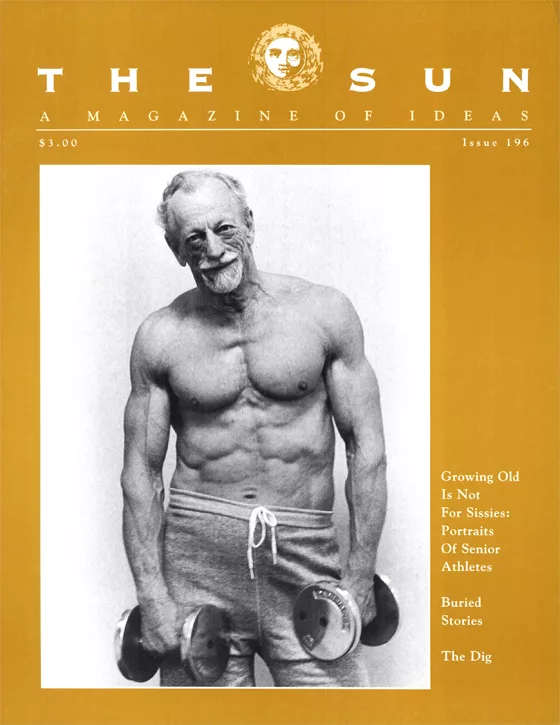
We struggle to find dignity in aging. True, we tell ourselves, the bones grow more brittle, the eyes fail — but there is still the wealth of memory, there is still the heart. The elderly have their rightful place, we assure ourselves — a place ensconced within our stereotypes.
Etta Clark’s Growing Old Is Not for Sissies: Portraits of Senior Athletes takes aim at these stereotypes. Clark gives us portrait after portrait of men and women in their seventies, their eighties, their nineties, who are distinguished by their physical prowess. Their bodies don’t require apology, they demand celebration. They bear scars, their skin is withered, their faces are creased. But there is a physical integrity here, a gravity made possible only by seven or eight decades of life. Our shrines to youth would collapse under such weight. The scars, the creases hint at a beauty we have forgotten: the veneration of ancestral homes, the dignity of sailing ships. In an age of face lifts and tummy tucks, we are offered here a different — and more authentic — aesthetic. Life has an edge finer than any scalpel.
“For most of us,” Clark writes in her introduction, “time is a cruel master. Body parts wither, waists thicken, fatty deposits seem to rush to the worst and most unsightly places. Egos slump. Self-image slackens. Confidence wanes.
“But not always.”
Consider her photographs: there is John Turner, the sixty-seven-year-old psychiatrist pictured on the cover of this issue. Turner leads a sedentary professional life (“I sit and listen to people all day”), so he compensates by weight lifting, jogging, and taking long walks. There is seventy-two-year-old Ada Thomas, who ran her first marathon at age sixty-eight; Sister Marion Irvine, at age fifty-four the oldest woman ever to qualify for the Olympic Trials; Ludwig Magener, a ninety-three-year-old swimmer, his chest draped with medals; Clark’s own mother, Mary Shutkin, an accomplished fox-hunter and skier, who agreed to pose nude at age sixty-four. “Age, who cares,” Shutkin told her daughter. “The years belong to someone else. I’m interested in living.”
Clearly, not everyone can take up pole vaulting at seventy. But Clark isn’t suggesting that we all need, or should, emulate such feats. Yet the fact that some can proves instructive. To insist that growing old is but a postscript is akin to talk of dancing blacks, drinking Indians, and loud Puerto Ricans. For Clark’s subjects, growing old is surely a preamble.
— T.L. Toma
The photographs from this selection are available as a PDF only. Click here to download.
Sister Marion Irvine, 54
In 1978, Sister Marion Irvine, at age 48, went jogging for the first time. Five months later she entered her first competitive race, an eight-mile run, and placed fourth among all women entrants. In her first marathon, she set a national record for women in her age group. In 1983, she completed the California International Marathon in 2:51:01, breaking her own world record by more than eight minutes and qualifying for the 1984 US. Olympic Trials, where she competed against America’s best long-distance women runners — many of them half her age. She was the oldest woman ever to qualify for the Olympic Trials in track and field.
The other Sisters in her order were put off initially by her skimpy running clothes — shorts and a T-shirt. But she couldn’t very well run in her knee-length habit, and soon they were very supportive.
Sister Marion is a principal of a Catholic school. The fastest 56-year-old woman in the world, she is appropriately referred to as “The Flying Nun.”
Tom Rice, 71
George Farnsworth, 68
Since 1966, Tom Rice and George Farnsworth have been swimming together almost daily. They started within the confines of the San Francisco Aquatic Park, but soon ventured out into the bay beyond the piers because “they wanted to go somewhere.” They swim out against the tide, then ride the tide back in, with Tom swimming on his back to look out for boats behind them and George swimming the crawl, watching for boats in front of them.
George has been swimming all his life. Tom began swimming in the 1950s. He was a professional wrestler — “The Masked Marvel” featured on television wrestling matches — when he injured his shoulder and knees. He started swimming with fins to build up his legs and then started towing boats attached to a belt around his torso.
When I photographed them, George was just returning to regular swimming after a triple-bypass operation. After a race he had come out of the water feeling ill, was taken to a hospital, and had the operation.
A year later, Tom was recuperating from quadruple-bypass surgery. When he flunked a treadmill test, his doctor told him he could control his heart condition with medicine, but would have to give up his strenuous swimming. Tom opted for the operation.
Today the Bypass Boys are still swimming together, complete with matching scars.
Ada Thomas, 72
Ada started jogging at age 65, shortly after she retired. Now she runs five miles every weekday and plays tennis on the weekends. She ran her first marathon at age 68, and the following year she finished first in her age group in the women’s division. She told me, “When I look in the mirror I like what I see. I say, ‘You’re 72 years old, you old devil, and you’re looking good.’ ”
Joe Bruno, 71
Joe is a member of the Dolphin Club. He has swum under the Golden Gate Bridge (more than 1 mile) 53 times, the first time in 1933 when the bridge was still under construction. He swims in the bay every day of the year. I photographed him the day of his 49th Golden Gate race. It was a cold, foggy autumn day. I had on several sweaters and a parka, and could not imagine diving into that ice-cold water. He dove!
Mary Shutkin, 64
Mary Shutkin is my mother. She is a skier, jogger, and fox-hunter. She posed nude for me without hesitation — over the objections of my stepfather and my husband. Her advice on how to cope with getting older: “Don’t wear your glasses because then you won’t get a shock when you look in the mirror.”
Saul Kaye, 82
Saul ballroom dances two to three times a week. He has a regular dancing partner, but when she is out of town he is certain to ask any available woman to accompany him in his fancy footwork. Before retiring, he was a dentist.
Ludwig Magener, 93
I wanted to photograph Ludwig at a pool, but the one he swims in does not allow women. So I went to his home on a cold, wet, winter day. His younger wife opened the door for me. Ludwig was playing a beautiful piece on his violin, and his dining room was filled with small paintings he had done. He told his wife to leave the room, explaining that he did not often have the chance to be photographed alone by a young woman, and that he did not want to share the experience.
When I asked him to put on his swimsuit, there was not a moment’s hesitation. He disappeared and returned in a bathing suit, shoes, and socks. When I asked him to put on his medals, he murmured, “I’ll be dressed up like a horse in a 4th of July parade,” but he went along with my suggestion.
At age 90, Ludwig was the 1982 National Masters Swimming Champion in all six of the freestyle and backstroke events he entered.
Our thanks to Etta Clark and Pomegranate Calendars & Books for permission to reprint these photographs and the accompanying text. Growing Old Is Not for Sissies is available for $20.20, postpaid, from Pomegranate Calendars & Books, P.O. Box 808022, Petaluma, CA 94975.
— T.L. Toma