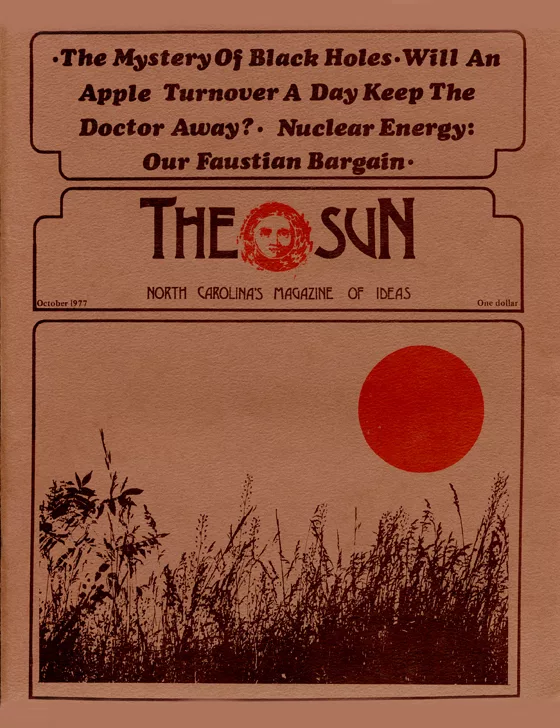
The occupation by 2,000 demonstrators last spring of a half-built nuclear reactor in Seabrook, New Hampshire was the first large-scale protest against nuclear power in the United States (there have been many in Europe, where the issue has brought tens of thousands into the streets).
Karl Grossman writes from New York: “I see nuclear energy as the Faustian bargain of modern man, and surely the story of our age . . . As you can see, the stakes are cosmic. A tablespoon of plutonium can kill 200 million, a pound 9 billion, and an accident at a plant can spew tons of plutonium into the environment . . . There is no place from which to hide. They have a plant, constantly having accidents, up in Vermont — Vermont Yankee it’s called. Even here on eastern Long Island they’re coming, and there’s big plans for the Carolinas. Many of the people at Seabrook were those who escaped the Megalopolis for Massachusetts and Vermont, and now the Death Machine was coming for them, for everybody. I think once your readers see that even the bucolic North Carolina countryside is far from immune, and these are the risks, it could be quite an issue. And there’s no need for all this risk and capital expense. Solar, wind, tidal, geothermal power can provide all the energy we need. Safe, free, renewable.”
Karl’s story is in three parts: an account of the Seabrook protest; an interview with the man who’ll soon be deciding whether a nuclear plant gets built in your backyard; and a review of a controversial court decision that could end the U.S. nuclear program.
I.
The monster that Seabrook was to fuel lined both sides of Route 128 rounding Boston — shopping centers and Holiday Inns and Howard Johnsons and big, grey anonymous industry. And cars, cars all over. Interstate Culture. On the road in America, 1977.
But no nuclear power plants in this midst. No, you don’t put nuclear plants near cities — keep them at least 50 miles away, the government says, so not that many people will be killed when the first accidents happen.
“If nuclear plants, because they’re not safe, can’t be placed near Boston or New York City, why is my life any less important?” asks Cathy Foote Silver, a biologist from Seabrook, whose family of fishermen has lived for eight generations in the seacoast town.
This country’s adventure with nuclear energy is seen as a calculated risk by its purveyors — like introducing the automobile knowing beforehand it will kill so many people in accidents but figuring that’s the cost.
The nuclear advocates in government, in the Nuclear Regulatory Commission (formerly the Atomic Energy Commission), in industry and the universities know people will die.
But in a government study called the Rasmussen Report, a very limited assessment of nuclear risks put out by nuclear boosters at MIT, the chances of a catastrophe are likened to the odds of being beamed by a meteor.
Big Science likes nuclear power because it provides scientists with all kinds of grants, like those which led to the Rasmussen Report, and plenty of business. The unemployed aerospace scientists would have liked a similar hustle, but who needs private rocket ships?
The bankers, utilities, and Big Business like it because Big Science tells them they can pay 10 per cent of the price of oil for uranium. And, after 30 years, when uranium runs out, they’ll have all that recyclable man-made radioactive substance, plutonium, named aptly for Pluto, the God of Hell. A pound evenly distributed could give everybody on the planet a fatal dose of cancer.
And a meltdown at a plutonium breeder reactor could spew tons of plutonium into the environment. There’s already been two near-meltdowns at two experimental breeders. President Carter is saying no for now to the plutonium breeder, but the rest of the world dashes ahead, and the big nuclear money here figures it’ll just be a matter of waiting it out. Meanwhile, there’s plenty of uranium around (but up 600 per cent in price in four years and still going up fast, eliminating cost advantage now over coal) and anyway, they reason, plenty of money has been invested, so switch fuels later but meanwhile get the U.S. on a nuclear course.
Not that between now and the day of plentiful but poisonous plutonium it will be that much safer with your average uranium plant. A meltdown in one of these can cause wide-scale deaths, cancer, and genetic malformation in an area as big as the state of Pennsylvania. The 50-mile boundary is just make-believe.
“Nuclear power is the ultimate in insanity,” Dr. Helen Caldicott, a pediatrician at Harvard’s Children’s Hospital, tells a rally at Seabrook. “We’re in the hands of lunatics,” she says, “and at the crossroads of time. If we proceed with nuclear power we’re doomed. It’s time we rise up and say this is our world, we want to live.”
Once scientists thought there was a “safe” level of radiation. For awhile it was 500, then 200, then 100, then 50, then 20, 15, now 5 rads — for a worker in a plant — but even just one rad of radiation, recent studies have shown, is enough to increase rates of cancer, leukemia, genetic malformation.
The bitter truth is that there is “no safe” level. The background radiation in the environment presently, stresses Dr. Caldicott, is a main cause of cancers and genetic malformation. Any increase will show up in the incidence of these maladies.
But the slow increase in background radiation that will be produced by the thousand plants planned for America by the end of this century, the thousands envisioned all over the world, won’t show up in health breakdowns immediately. A big accident will. If the body’s defenses against disease are destroyed, you’re dead, or will die soon.
The low level radiation emissions, from the little accidents, from waste leaking into the environment, from “normal” operations, will take two decades to show up in increased cancers and leukemia and genetic malformation. Indeed, much of the genetic disorder will appear in following generations; we can look forward to forever increased genetic malformation in the human gene pool.
Only 2,000 people were permitted by the Clamshell Alliance on the Seabrook site, all put through several hours of training in nonviolent resistance.
Everyone was organized in groups of 15, each with a “spoke” reporting to DMB, “Decision Making Body.” Civil disobedience, after the 60’s, had become a High Art. No theatrics. Everybody knew why they were there. Maybe it was even more serious than the peace marches. This was something that could kill everybody. It wasn’t as if Monday you could go home from Washington, and if you could beat the draft you could survive. That half-built reactor site at Seabrook told the story: it was rising, like a deadly mushroom.
“In my life moral laws are pre-eminent over legal laws,” says Gary Clark, a college student. “Nuclear power plants are a threat to existence of life on this planet. All it takes is one mistake . . . If the democratic process doesn’t work, civil disobedience will have to.”
Governor Meldrin Thomson flew in in his helicopter. He’d originally teamed up with the Public Service Company of New Hampshire to push the twin 1150 megawatt set of nuclear power plants, among the biggest ever built, on New Hampshire’s coast, all 18 miles of it. Seabrook got selected without knowing it. When the village of 6,000 found out, they voted in referendum against it. The rumble of the National Guard trucks getting set to deal with the occupiers told how further opposition would be met. Gov. Thomson was calling his state police chief “general” already. And he was itching to clear out the “terrorists.”
They planted corn at Seabrook an hour before the cops moved in. It was done in a religious way. Life might someday happen on the site, a beautiful Eden-like array of cool woods, with a stream running gently through, and fields overlooking marshland rich with sea life. And there were the bulldozer cuts. And there were the cops with dogs. And there was the half-built reactor silo. And there were the signs saying: “Danger.” And there was the danger rising, in a paradise.
“We shall overcome. We shall overcome. We shall overcome, some day . . .” It was that song. But this was a fight not just to stop hurting and killing others. This was the movement to stop some people from hurting and killing all of us. Under a spring sun — enough to provide all the energy of all the nuclear plants times a thousand — the politics of survival reached confrontation stage.
II.
A decision last March 31 by North Carolina District Court Judge James B. McMillan may — if affirmed by the U.S. Supreme Court — end the U.S. nuclear program.
Judge McMillan ruled as unconstitutional a federal law called the Price-Anderson Act, which has provided a $560 million liability for utilities in the event of an accident at a nuclear power plant. Such an accident, government studies have shown, could cause massive death and damage in the billions of dollars.
The decision stemmed from an effort by Carolina environmentalists to stop Duke Power Company’s McGuire plant, 18 miles northwest of Charlotte.
The Carolina Environmental Study Group of Charlotte, the Catawba Central Labor Union of Rock Hill, S.C., and 36 Charlotte and Rock Hill individuals filed suit in 1973 to stop McGuire construction, after the Atomic Energy Commission (now the Nuclear Regulatory Commission) approved licensing of the plant.
Also participating was the North Carolina Civil Liberties Union and, as the case developed as a major national test of the Price-Anderson Act, Ralph Nader’s Public Citizen Litigation Group.
In his decision, Judge McMillan described the plaintiffs as “a group of people with a common interest in protecting themselves and other present day citizens and their children against what they see as the deterioration and destruction of their property and the world they live in . . . They include people who have moved away from homes near the nuclear plants and some who plan to leave the area because the plants are being constructed, people whose use and enjoyment of the lakes and their shores . . . will be affected by operation of the plants, people who have legitimate fears that nuclear power plants are dangerous.”
The Price-Anderson Act not only sets the liability for a nuclear accident at $560 million, but authorizes the federal government to pay the first $500 million.
The McGuire station is a $1 billion twin-reactor facility, nearing completion. At 1,180 megawatts each, the nuclear reactors are among the biggest ever built. There are 1.5 million people within a 50-mile radius of the plant, and there will be two million by the year 2,000.
A nuclear power plant works like any power plant. Heat is produced — in this case, by splitting atoms — which causes water to turn to steam, moving a turbine. But, in a nuclear plant, enough heat is generated to melt through the thick steel walls of the reactor core in a few hours, unless it is effectively cooled.
A stoppage, even for minutes, can cause a “core melt” or meltdown. “A core melt,” the judge said, “can melt through the floor and into the earth beneath it. It can also break through into the containment building and produce an explosion by generating steam . . . rupture the containment building which houses the reactor and discharge radioactive contaminants into the atmosphere. This would be the worst of the numerous possible consequences of a nuclear power plant accident.”
Although nuclear reactors don’t contain a high enough proportion of uranium to cause a blast, like an atom bomb, they can disperse far more radioactivity, because they contain more radioactive material than a bomb. Each McGuire reactor, wrote the judge, would contain “about 1,000 times the amount of radioactive material as the bomb which devastated Hiroshima.”
To avoid a meltdown, reactors require massive amounts of cooling water, two million gallons of water a minute — thus their placement on lakes, rivers and along the sea.
The McGuire plant is on Lake Norman. Discharge of spent cooling water from the plant will raise temperatures “in large areas of the lake” to 95 degrees or more in hot weather “with immediate effects on the environment.”
“Emergency cooling systems are provided to keep the reactor cool in the event the regular cooling systems fail,” but there has been “no actual operating test of the functional ability of the emergency core cooling system” on any reactor.
Even without an accident, normal operation of the McGuire plant, according to the judge, would have these “immediate effects”:
- “It will . . . produce immediate additional, non-natural radiation which will in small quantities invade the air and the water where several of the plaintiffs and many thousands of other people live.” The government permits nuclear plants to emit radiation, claiming the doses are “small” compared to background radiation levels.
- The “sharp increase” in lake temperature will make the water “too warm for pleasurable swimming” and interfere with “normal use of the waters of the Catawba River,” to which the lake connects.
- “The likelihood of an accident resulting in uncontrolled release of large or even small quantities of radioactive material into air, water or land, will constitute a continual threat to the plaintiffs . . . based upon the distinct possibility that the plaintiffs may suffer a taking or destruction of their land or health or their property or their lives, all without adequate assurance that compensation will ever be provided.”
What is the likelihood of a major accident, and its effects?
“The court finds as a fact that the probability of a major nuclear accident producing damages exceeding the $560 million limit of the Price-Anderson Act is not fanciful but real . . . it is not the kind of risk which responsible government or business places upon bystanders.
“Plaintiffs have no source from which they can get insurance against loss or damage from atomic radiation. Insurance companies, regardless of the odds, won’t write policies to cover such losses.”
“The court,” declared Judge McMillan, “is not a bookie . . . The question is not whether a nuclear catastrophe (at two hundred to one or twenty thousand to one) is more or less likely than a tornado, an earthquake or a collision with a comet. The significant conclusion is that under the odds quoted by either side, a nuclear catastrophe is a real, not fanciful, possibility.”
“Radioactive pollution of a few hundred square miles of heavily populated Piedmont North Carolina or South Carolina could well produce property damage vastly exceeding the Price-Anderson ceiling,” said the judge.
And thus, the judge ruled, the Price-Anderson Act — without which, he noted, supporters of nuclear power in the government and industry conceded nuclear power couldn’t continue — was unconstitutional.
It “violates the due process clause because it allows the destruction of the property or the lives of those affected by nuclear catastrophe without reasonable certainty that the victims will be justly compensated.”
Some industry and government witnesses, “like Pollyanna,” insisted that “everything will turn out all right” with nuclear power despite the “strong evidence that the dangers are real.” He quoted Robert Burns: “The best laid schemes o’ mice an’ men, Gang aft agley, An’ leave us nought but grief an’ pain, For promised joy.”
III.
Joseph M. Hendrie is likely to have a pivotal voice in America’s nuclear future. He has been nominated by President Carter to be chairman of the U.S. Nuclear Regulatory Commission, which governs nuclear power.
He was initially selected as a member of the five-person commission, but after a 40-minute interview with the President in the Oval Office, Dr. Hendrie was offered the position of chairman. Thus, it is assumed he reflects Carter’s thinking on nuclear policy.
His nomination is opposed by a number of environmental organizations, including Friends of the Earth. Lorna Salzman, mid-Atlantic representative of the group, charged that in the appointment of Hendrie and Kent F. Hansen of the Massachusetts Institute of Technology, Carter was trying to “pack the NRC with nuclear establishment people . . . make it a kangaroo court . . . These people owe their positions and livelihoods to the nuclear establishment. They’re not going to make an objective assessment of the problems of nuclear power. They accept science as an article of faith, a religion. They think science and technology will solve all our problems. And if they’re wrong a lot of people are going to die.”
Hendrie was interviewed at Brookhaven National Laboratory in New York, where he began his work as a nuclear engineer in 1955 and is now an administrator. He acknowledged that his relationship with James Schlesinger, who heads the new Department of Energy, “must have been contributory” in getting the White House offer. He worked with Schlesinger on the Atomic Energy Commission, of which Schlesinger was chairman, in 1970 and again in 1972.
If confirmed by the Senate, Hendrie’s activities would have impact not only on nuclear plants proposed for the U.S. but particularly on construction of nuclear power plants using plutonium as a fuel.
President Carter has been against a plutonium “breeder” reactor project, citing fear of “proliferation” of plutonium for nuclear weapons.
A commercial plutonium-fueled reactor would contain four tons of plutonium. Twenty pounds is all that’s necessary for an atomic bomb. Plutonium, too, is among the most toxic substances known.
Plutonium reactors are seen by the nuclear industry as replacing uranium reactors, particularly with uranium running out as a fuel source in about 30 years. Plutonium is derived by man from uranium.
“I think that there’s quite a high likelihood for plutonium reactors,” said Hendrie. “We are going to find we need that extra energy you can get from uranium if you can breed fissionable material.”
As for diversion of plutonium for nuclear bombs, Hendrie called it “a terribly important matter” and said Carter, by opposing the Clinch River plutonium “breeder” reactor project in Tennessee, has managed to “concentrate people’s attention on the need of being serious about doing things about proliferation.”
But, he said, he and Carter believe “that we ought to continue the research work on breeder reactors . . . to keep that option open.”
As for the consequences of an accident at a plutonium plant, Hendrie said, “Plutonium certainly is a highly toxic substance and we need to handle it with great respect and great care.”
But, he said, he didn’t believe a serious accident at a reactor fueled by plutonium would be that much worse than a major accident at the uranium-based light water reactors being built today. An accident at a plutonium reactor would probably be “more energetic,” he said, but he noted that large amounts of plutonium build up in the “water reactor cycle.”
As for calculations by some scientists that the worst possible accident at a uranium plant could contaminate with radioactivity an area the size of the state of Pennsylvania, and one at a plutonium reactor could contaminate an area the size of the states of Indiana, Illinois and Ohio combined, Hendrie said, “It certainly would be serious but I think it doesn’t go to that sort of magnitude.”
On projections by Dr. Jan Beyea of Princeton University that there is a one-to-15 chance of a catastrophe accident during the 30-year life of a twin reactor facility like the Duke Power Company’s proposed McGuire facility, killing half the people within 25 miles, Hendrie said vigorously, “I don’t agree.”
Hitting his hand on the table for emphasis, he declared, “We’ve had something going on 1,000 reactor years of commercial nuclear reactor service in the world and a couple of thousand more in the nuclear navy and we haven’t gotten anywhere close.”
Why, if nuclear power plants are so safe, does the government prohibit them from being placed in or near cities? Dr. Hendrie said, “There’s never been anybody I know of that stood up and said there is no absolute guarantee that there cannot be fission product releases but what we’ve been able to say is we think honestly that the probability is low . . . Nobody says it can’t happen, and if something should happen why it’s probably a good thing if you’ve got fewer people around. Among other reasons these things don’t happen instantaneously. If there’s an accident why there’s probably going to be some time and so forth so you have the opportunity for some evacuation or you’d probably have time for evacuation in most accident circumstances. The fewer people you’ve got to move around close in, the more likely you are to be able to do it in an effective and orderly way.”
Concerning testimony from scientists that what the government allows as “routine” emissions of radiation from nuclear plants will cause increases in cancer, leukemia and genetic defects — Dr. Helen Caldicott of Boston warns of “epidemics” as a result of nuclear plants — Hendrie said, “Only in a sort of statistical sense and only if indeed the conservative theories of radiation health effects are so.”
“The routine emissions from nuclear facilities contribute a very small fractional increase to the background radiation in which all of us live,” he said. “Now, if it is in fact so, that there is some damage at any increment of radiation, in other words that there is no threshold, then no matter how small an amount you add, you create synthetically, you can say in the statistical sense you have added to the radiation health effects that the population suffers . . . The pertinent question is: is it a meaningful addition? And if it’s of a very small fraction my view is it’s an acceptable situation since some of the alternatives also have their difficulties. There’s no free lunch.”
He said, “all the energy technologies including conservation have greater or lesser negative aspects to them. Nuclear certainly does. Coal certainly does. Oil certainly does.”
What about safe, renewable energy sources such as solar, wind and tidal? “It’s a shame we have come so lately to paying attention to them,” said Hendrie. “But until the Energy Reorganization Act of 1974 no government entity was authorized to do serious research and development on other than nuclear energy . . . nothing comparable to nuclear energy development as a conscious effort to move ahead and develop a piece of technology.”
“We’ve really come very late in the game,” he said, “to a recognition that these other sources have the capacity eventually to be important, that they may be preferable to some of the ones we have now, and that they’re well worth working on.”
But, he maintained, there wasn’t sufficient time now to depend on these sources of energy. “I think we tend often to underestimate the time and the difficulty that there is in constructing an industrial base for a major technology, whether it’s power production or making automobiles. And it’s certainly a very difficult and complex structure to erect for a power supply because it’s a capital intensive industry and you need these big complicated machines. I think even if you and I between us this afternoon invented a scheme for solar and electric power or solved the confinement problem for fusion or something like that . . . it might take tens of years, 30, 40, 50 years, to see the industrial base in place to support a power supply for that technology.”
Of the highly toxic waste generated from nuclear plants — some of which remains radioactive and must be safeguarded for more than a million years — Hendrie acknowledged, “We don’t have a demonstrated long-range waste disposal method.”
But, he said, “We certainly have several variations of a technical approach” and was confident that ways would be found to “encapsulate” wastes and “imbed” them “deep underground in stable geological” formations.
He said he thought the Price-Anderson Act, a federal law limiting the liability of a utility for a nuclear plant accident to $560 million, was “fair.”
As to the NRC never having turned down an application by a utility for a nuclear power plant at a hearing, Dr. Hendrie said this doesn’t reflect what he claimed was a rigorous process the agency puts utilities through prior to hearings.
THE COMPLICATED ENGINES manufactured by man demand, if one really wants to use them, much calm. Ever since our love for machines replaced the love we used to have for our fellow man, catastrophes proceed to increase.
— Man Ray
IN THE WEST, our desire to conquer nature often means simply that we diminish the probability of small inconveniences at the cost of increasing the probability of very large disasters.
— Kenneth E. Boulding
THE GERMINAL PHASE is the crux. As long as things are in their beginnings they can be controlled, but once they have grown to their full consequences they acquire power so overwhelming that man stands impotent before them.
— Richard Wilhelm, Introduction to the I Ching
HE WHO SHITS on the road will meet flies on his return.
— South African saying