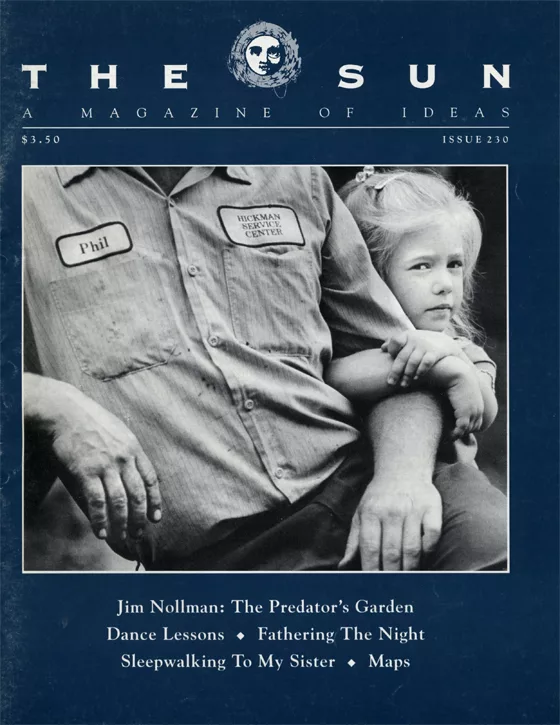
Jim Nollman plays reggae music with pilot whales off the Canary Islands, but he’s not just an eccentric musician. Nollman is founder of Interspecies Communication, an organization promoting dialogue between human beings and other living creatures.
At home, Nollman converses with nature through his garden, sometimes getting into arguments with neighboring creatures who prey upon his plants.
— Andrew Snee
Until I started a garden, I never considered deer predators simply because I did not consider plants prey. As a transplanted city dweller, I imagined that sighting a deer from my living-room window was the blessing of a rural lifestyle. Were I a nongardener, no doubt it would still be so. However, this ardent planter now gazes upon his front yard with an entirely different set of eyes.
For the local blacktailed deer, February is the cruelest month. The deer’s known stores of young tree shoots and other browse material are nearly exhausted. Everything that grows wild is betwixt and between, therefore there is not much to eat. It took the deer exactly two winters to discover this garden full of nonnative fruit-tree saplings and foolhardy nonnative bulbs poking their succulent greenery four inches or more above ground by mid-February. I watched one of the creature’s early forays, transfixed, from behind the blinds of my window. The small female, who would have made an effective role model for Eve, proceeded tentatively as if unwilling to believe that this vegetative Eden held no hidden devils waiting to lunge at her should she make the wrong move. She stared in careful apprehension at a young plum sapling for nearly a minute, then finally grabbed hold of a branch with her teeth, ripped off the bark, and jerked her head up high to survey the scene as she chewed. She gobbled it down and immediately took a single step back, cocking her ears forward.
The three deer destroyed four beds of chard, kale, lettuce, cauliflower, and cabbage in a single night. When I inspected the damage the next morning, for the first time in my life I was moved to consider owning and using a shotgun. Luckily, the urge passed.
Something had spooked her. It might have been the fact that the exposed-bedrock yard offers no cover. Or that the smell of wood smoke sometimes lingers on the knoll at this time of year. A brightly lit house also implied the potentially deadly threat of a nearby dog (although we don’t have one). Perhaps she had finally spied me spying her from behind that otherworld of glass. Or was it some fundamental, intuitive distrust of this uncommon winter feast laid out before her? Here was a magical kingdom beyond her imagining, a situation simply too foreign, all full of prune-plum cambium, thick hyacinth leaves, and gargantuan raspberry canes. The deer seems a creature whose every sense seeks after mistrust. She dashed into the woods and was gone.
From that point on, I inspected my kingdom every single morning right into June. As far as I could tell, she never returned. Would this predation prove to be a one-time occurrence?
I should have known better.
The next year I began trying to grow food through all twelve months of the year. Winter gardening in a climate that hovers around freezing for three months demands careful planning of the beds, a genuine compulsion, and a thorough knowledge of what to plant and when. For example, broccoli thrives in the lengthening days of early spring, whereas Chinese cabbage and certain cauliflowers seem to prefer the shortening days of fall. I discovered the special plants that thrive in cold conditions: corn salad grown in France, red kale from eastern Europe, and the cold-hardy greens bred over centuries in China. I started keeping three beds of Jerusalem-artichoke tubers, potatoes, and parsnips. (All three offer up their bounty during the coldest days in January and, in fact, seem to grow sweeter as the days grow colder.) My hard work was paying off.
My interest in winter gardening has eventually led me to believe that the salvation of the world lies in organic gardening. Here is one of the most meaningful steps any of us can take to end the hegemony of centralized technology that has become so debilitating to our ecosystem. Even a city dweller can grow something in a window box. And if not, let every one of us support organically grown produce as the ultimate environmental cause.
I learned to sing the praises of the lowly earthworm, which neutralizes the soil, builds enriched topsoil from its castings, provides oxygen to the roots of growing plants, and recycles as much as thirty tons of topsoil per acre back to the surface each year. I learned that 2.7 million pounds of earthworm-eradicating pesticide are spread on American soil every single day. Consequently, a world full of bountiful organic gardens may be the most realistic way to put pesticide companies out of business permanently. And a home garden needs no transport, no elaborate distribution system. It thus offers a viable means to contain petroleum overconsumption.
So, also, I learned that twenty vegetarians could be fed on the same acreage needed to feed one meat eater. Even milk came under my scrutiny. Although the American Dairy Council assures us that cow’s milk is nature’s most perfect food, in fact it is the most perfect food for no one besides a baby cow, which has four stomachs, doubles its weight in forty-seven days, and is destined to weigh three hundred pounds within a year.
For reasons such as these, I rejected store-bought produce almost too boisterously, while transmuting my organic message into a harbinger of doom. I warned my nongardening friends that those Mexican-raised tomatoes were a repository for carcinogenic pesticides. And while some of them either joined their local co-op or immediately took up gardening for themselves, others found my rantings tiresome. It took a while before I learned to temper my comments.
Meanwhile, my family grew healthy, not only because freshly grown produce contains more vitamins and minerals and less fats and chemicals, but also because of what Wendell Berry described so well:
It may take a bit of effort to realize that among modern achievements, perhaps the most characteristic is the obsolescence of the human body — but it is true. Jogging and other forms of artificial exercise do not restore the usefulness of the body, but are simply ways of assenting to its uselessness; the body is a diverting pet, like one’s chihuahua, and must be taken out for air and exercise. A garden gives the body the dignity of working in its own support. It is a way of rejoining the human race.
One day it dawned on me that I was like a sober ant diligently working in preparation for an utter breakdown of society. Should the petroleum industry collapse, should the trucks, ships, and planes that deliver food to market be put out of commission, should any or all of us be called upon to fend for ourselves, my family would still be able to set a healthy and sustaining table in perpetuity.
I found myself not only accepting this disturbing prospect but in fact arrogantly thumbing my nose at it, daring it to come. I expanded the bed of Jerusalem artichokes because this crop shows almost nothing above ground from late fall until midspring. In other words, the tubers grow deep enough to escape the initial onslaught of — you guessed it: nuclear fallout. Should the apocalypse come, I would be prepared for the worst.
There I stood, ready for the end of civilization — but not, however, for the February onslaught of that delicate female blacktailed deer. By now I was starting to think of her as just another garden pest, a four-legged Japanese beetle. Unlike any beetle, however, she possessed the strategic mind of a smart mammal. She carefully scoped out the scene to determine that no dog lived on the premises. Furthermore, no human had yet challenged her with guns, arrows, slingshots, rocks, or any of the other projectiles favored by gardeners resisting incursions by such as she. During the course of that year she devised an ingenious browsing strategy keyed to the on-off status of the lights in my house. Like a wily military adversary, she attacked as we slept.
The second year’s raids commenced in late February. The three deer (she had given birth to two fawns) destroyed four beds of chard, kale, lettuce, cauliflower, and cabbage in a single night. When I inspected the damage the next morning, for the first time in my life I was moved to consider owning and using a shotgun. Luckily, the urge passed.
Over the next several weeks I spent well over a hundred dollars building a seven-foot-tall fence around my vegetable patch. I went so far as to string chicken wire underground to keep out the local rabbits and rats, just in case they got any ideas. I then went ahead and replanted two entire beds of radishes, kale, and broccoli. But a hailstorm, a week-long twenty-degree freeze, and winds in excess of fifty miles per hour soon leveled all my young starts. There was no winter garden that year.
Although the fence proved successful in keeping the deer from devouring the vegetables, I still had a long way to go to safeguard the many smaller beds that proliferated on my eccentrically landscaped property. My property? Is that what it was? Had I lost sight of the irony implicit in that contrived term property? Here was a legal human term used to designate a skin-deep layer of earth measured and plotted on a map by a pencil-wielding human surveyor; all of these territorial graphics generated for the primary purpose of adding my so-called claim to the local tax register. Yet we all do it: transmute a sense of place into an object, turning our deep-seated aspiration to reinhabit the land into a financial arrangement that obscures a potentially sacred relationship.
On a deeper level, I realized that the possessive pronoun my — as it relates to the noun property — only applies to human beings recognizing the land claims of other human beings. In fact, the two words offer a telling statement about our human sense of place in a wildlife-depleted world. The deer and her kin never read the tax register. They did not honor the plat lines. They trespassed. They broke the law. The three of them continued to ravish just about everything not set behind that seven-foot-high fence. They ate my tulips, my sweet william, my Brussels sprouts. I was outraged. I wished I could make all deer extinct within the boundary of my property. Never mind that the deer did not and could not recognize such terms of possession. Never mind that humans protecting their property have made many species extinct. For all my good intentions, I came close to reenacting this long-term human folly of destroying an environment in hopes of saving it.
But there was hope for both me and the deer. I noticed a pattern to her predation. One night she bounded up the rocky knoll I call home and banqueted her way through an unfenced bed of yellow-and-red Juan tulips rimmed with sweet william and primroses. She obviously enjoyed the repast because she returned with her entourage the very next night to continue browsing through another bed of tulips and sweet william. What was it about these specific plants? I had to find out.
The next morning I picked one of the erect tulip leaves and turned it over in my hand. It was a substantial thing, pea green in color and, surprisingly, far more succulent than kale, which I considered the prize green of my February garden. Feeling a bit like Alice trying to decide whether the mushroom would make her larger or smaller, I went ahead and bit into the leaf. It was sweet and savory at the same time, perhaps a bit stringy, but essentially as tasty as anything I grew for winter salad greens. Next came the primrose leaf, which physically resembled a miniature romaine. It was tasteless. I was less sure about the sweet william. The cherry red, lance-shaped leaves looked like nothing endemic to the human diet. But curiosity prevailed. One bite proved that it was as bitter as it looked.
Except for a few staggered raids, the deer party stayed away from my garden for another year.
I expected her return sometime that next winter, and I wasn’t disappointed. At ten one clear evening, I opened the door to let out the cat only to come face to face with my garden’s February persecutor. She stood in the moonlight quite alone, not more than twenty feet away, staring at me with her huge eyes from the perimeter of the primrose bed. We watched each other for what seemed a full minute. What was it about this beautiful animal that made me so unwilling to share a few meager greens during the coldest time of the year? As I pondered this essential question of control, the deer grew accustomed to my presence. Did she sense my hesitation? Possibly so, because she began to test it by munching through the last of my sweet william. Something snapped. I bolted from the porch, determined to jump that deer if only I could catch her. Before I had even reached the steps of my front porch, she was a hundred yards down the hill and gracefully loping over the four-foot-high brush into the forest.
I stood there in the cold night air and, for the first time in our relationship, felt a glimmer of genuine admiration for the beast. The night was warmer than usual, a hopeful sign that spring was indeed near. I had a hunch that as soon as the normal forest growth rejuvenated itself, I would not see my adversary, except infrequently, until next February.
I sat down on the top step to review my options. I could selectively plant only those flower species undesirable to the taste buds of a deer. Daffodils, delphiniums, irises, and annual poppies are just a few of the plants that no deer in my yard has ever chomped on. Or I could disregard the deer’s predation, plant whatever struck my fancy, and permit her to decide which plants would survive to blossom and which would become deer fodder. Or I could scare the deer away from my gardens permanently — a resolute dog would accomplish that in no time. I could become the resolute party myself, standing by my front door with matches in one hand and a cherry bomb in the other, waiting diligently for the deer to appear, at which point I would light a firecracker and lob it like a grenade at the feet of my herbivorous challenger. Or I could take a hint from any of several traditional cultures (as well as the more starry-eyed of my friends), and attempt to “talk” to the deer: reason with her, ask her politely to please refrain from eating my cultivated beds, explaining in plain language how much pleasure those blossoms bring to my family and friends. Why not strike a bargain, offer to plant a special bed of tulips in exchange for leaving the rest to me?
I chose the dog.
And so commenced a campaign to sell the idea of a new canine family member to my wife and daughters. I started looking at my neighbors’ dogs in an entirely new way, weighing which pedigree might best serve a household with two young children. One day I got so far as putting on my jacket in anticipation of a trip down to the local pound. But at that point, car keys in hand, I finally relented. Reward a dog for barking at man and beast? A dog whose job it would be to assist me in my human folly of destroying an environment in order to save it? A dog whose sole purpose in life would amount to protecting tulips from a little deer during the few months of the year when the woods offered her almost nothing to eat? What about the other months?
Good questions, and ones that many of my neighbors never seem to ask themselves. Stories circulate around town about individual dogs who have been trained to keep deer out of gardens. It is said they skulk off at midnight to form packs, reverting to their feral ancestry, crippling half-starved deer before finally tearing them to pieces. It seems a classic case of pets reflecting the wild monster within ourselves, doing our dirty work, giving rise to a savage metaphor for our devouring of nature: the big bad human masquerading as the big bad wolf.
I soon learned there is an ongoing local controversy about the right of farmers to shoot and kill these roving dogs never trained to distinguish between a wild fawn and a ranch lamb. “Hey mister, that dead dog was someone else’s property.” Which raises the legal quandary of what is worth more under the law — a lamb killed by a dog or a dog killed by a farmer? The dead deer, of course, has no standing whatsoever. A few neighbors also expressed the bizarre idea that any deer is worth more dead than alive. Some went so far as to declare — by deed if not by self-incriminating word — that certain animals, such as deer and ducks (those they euphemistically refer to as game), are best met with a loaded shotgun, be it “in season” or not.
Another pertinent issue surfaced. The deer are overpopulating this neighborhood as a result of their natural predators in this part of the world — especially the cougars — being killed off. One neighbor made the point that dogs who kill deer are actually serving to right the balance between long-gone wild predators and overpopulated prey. Although I found myself agreeing with him that we did not want to reintroduce mountain lions to the neighborhood, the idea of letting dogs kill the deer seemed an abomination. I had no easy answer to the problem of overpopulated deer in a world that is likewise overpopulated by human beings. A strictly enforced hunting season seems to do the job as well as we might hope for under the circumstances.
I concluded that a dog was no longer an option. Instead, to appease what was fast becoming the death throes of my anxiety, I went out and bought a single firecracker. For the next four nights in a row, I systematically rose from my chair at half-hour intervals and whipped open the front door with matches in one hand and an appropriately named Jade Garden Salute in the other. When my wife asked what on earth I was doing, I replied with a laugh, “I just wanted to give the deer a good scare.”
But clutching this miniature rocket in my hand, I also felt discomfort. I had excluded the deer from my own definition of neighborhood. Whether we employ dogs or Jade Garden Salutes or nuclear bombs, violent solutions are less a reflection of our power than of our anxiety. In this case, a compulsive desire on my part to maintain a peaceful, alternative lifestyle results in an interspecies war. Kill for peace.
The deer reacted accordingly: she vanished altogether. Nor was there any sign that she had surreptitiously snuck into the yard during the wee hours. At first, with my credulity stretched to the breaking point, I wondered if I had inadvertently tapped into my original plan number four: discussing the issue mind to mind. Might my own stubborn fury be an example of what psychics call focused attention? My rationalist education made this supposition as hard for me to swallow as a bowlful of sweet-william leaves. On a practical level, it made no sense because everything so far seemed like a classic case of miscommunication. With the situation beyond my comprehension, I relented and spent the next evening immersed in the movie Platoon. That’s when the deer returned. She ambled through a distasteful daffodil bed before commencing her task of granting my sweet william a crew cut fit for a training-camp recruit.
Is it possible she somehow knew I was too busy watching a movie to reach for the Jade Garden Salute? I couldn’t decide whether the deer actually possessed the tactical stealth of a cat burglar or only appeared to have it. Either way, I’d had enough. I gave in. Firecrackers now seemed as invalid a response to a hungry deer as growing Jerusalem artichokes is to nuclear fallout.
The point is not so much that the deer was stealthy, intelligent, or even possibly telepathic. Rather, the relationship itself had evolved to include interspecies neighborliness — an essential component of any sense of place. For three years, my selfish point of view had kept me from giving the deer its due as a key member of the ecosystem within which I had built my home. Now something had changed. Hurting the deer began to seem like a baseball fan shouting, “Kill the umpire!” When we kill the umpire, we kill the game. When we kill the deer, we destroy the neighborhood. When we work too hard to build our world outside the loop of nature, we lose our ability to see the loop for what it is: the central glorious fact of our existence. Now the flourishing relationship between gardener and deer seemed to offer a key, a deeper entry into that same natural system to which I had long sought admission as a planter of flowers, trees, and vegetables. Is it possible? The little doe had metamorphosed before my eyes from a devious thief into an arbiter of ecology.
But the truth is foxy stuff. It takes several contradictory forms at the same moment. In this case, the deer returned and returned and returned. Like the toniest New York cafe, my yard had been “discovered.” It was one thing to revel in the deer’s attention as a precious gift, but quite another to develop some working method for nurturing an unfenced garden of flowers within the same ecosystem inhabited by a hungry herbivore and her spanking-new fawn. She had given birth again.
As I mentioned earlier, the deer never touched certain plants. For instance, she avoided any flowers in the Ranunculus genus, including such ornamentals as anemones, delphiniums, peonies, and columbines. Neither would she eat rhododendrons, marigolds, poppies, lilies, tomatoes, potatoes, garlic, artichokes, asparagus, onions — in fact, a veritable country garden full of flowers and vegetables. This observation suggested a more farsighted strategy for replanting the few ravaged beds. For example, because the potato plant was a forbidden fruit for my deer, I planted the potatoes outside the garden fence. I surrounded my young and still-vulnerable plum trees with the nearly pharmaceutical aroma of a bed of self-seeding poppies and wormwood.
What I had stumbled upon were the first tentative stages of what is properly known as a permaculture garden. This method of horticulture favors a permanent approach to a flourishing garden, with a minimum of intervention by a human overseer. We eliminate the use of all poisons, artificial fertilizers, and violence as a means of inducing plants to do our bidding. We eschew the horrific commercial practice of first destroying every living thing that grows over, on, or under the soil and then laying down a coating of some petroleum-based chemical before planting just one variety of one crop — a crop which can only be kept alive by spraying increasing amounts of pesticides and herbicides that taint the land for years to come.
Permaculture insists we plant fewer hybrids, not as a hedge against nuclear winter, but because these infertile athletes of the flower world are not self-perpetuating. Instead, we favor annuals that reseed themselves and perennials that do not need special pampering. We mold the garden to fit the contours of the land, rather than expending huge amounts of time and money excavating a garden plot prone to erosion. We educate ourselves as to the microclimates of the garden, planting the squashes where the sun shines and the gooseberries where they’ll get some shade. Because the garden grows itself, permaculture emerges as a gardening method fit to feed future generations. I imagine my great-great-great-great-great-grandchildren gardening alongside the progeny of that deer in the shadow of a giant sequoia tree.
Last January, with apples overflowing the winter larder, I went so far as to lay an entire bushel of half-turned banana apples beside one of the deer’s favorite paths. (I snickered to think she might also get a bit inebriated from eating too many.) She found them within forty-eight hours and ate every last one, which led me to acknowledge that this surreptitious deer had been browsing the knoll more often than I had suspected.
One naturalist neighbor criticized the gift as an inadvertent attempt to tame the deer, to turn her into a dependent. But I disagreed. To lay a gift at the feet of a wild animal once a year seemed to me more an act of coevolution than of coercing subservience. I preferred to treat my gift as a counterpart to the rituals of the Huichols of Mexico, who revere the deer as the harbinger of abundance; or of the ancient Chinese, who honored the deer as a teacher of communication within the supernatural realms. I reinvented myself as an heir to the many shamanic peoples who recognized the deer as a possessor of grace and compassion, a creature who merited a yearly gift. In fact, these were all attributes that had coevolved in our own relationship.
Perhaps coincidentally, it is mid-February as I tell this tale of the deer in my life. It has been a brutal month in an otherwise mild winter. The area was hit with a storm two weeks ago that brought zero-degree temperatures and ninety-mile-per-hour winds. As usual, the tulips, the daffodils, and the irises all had a few inches of greenery thrust above ground when the storm struck. Now, two weeks later, the edges of their leaves are obviously frostbitten. But they have started to grow again. And my winter garden? Until the storm hit, it had seemed a miracle that provided parsnips, Jerusalem artichokes, kale, cabbage, beets, and even some romaine lettuce as late as the end of January.
But winter gardening must remain the ultimate challenge for at least another year. Almost every vegetable within my seven-foot fence succumbed to the cold. Only the leeks and parsnips seem to have made it. And, as always, the Jerusalem artichokes growing outside the fence have produced more tubers than all of us could possibly eat. But my fantasies of doom are diminishing; this spring I plan to cut that bed in half.
“The Predator’s Garden” is excerpted from Nollman’s Why We Garden: Cultivating a Sense of Place, reprinted here by permission of Henry Holt and Company. © 1994 Jim Nollman. The Sun has previously published three essays by Nollman: “The Sentient Garden” [September 1994], “Wild Heart” [September 1993], and “When Nature Is Larger than Life” [January 1992].
For more information about Interspecies Communication, write to Nollman at 273 Hidden Meadow Lane, Friday Harbor, WA 98250.