Eleven O’Clock At Night
I lie alone in my bed; cooking and stories are over at last, and some peace comes. And what did I do today? I wrote down some thoughts on sacrifice that other people had, but couldn’t relate them to my own life. I brought my daughter to the bus — on the way to Minneapolis for a haircut — and I waited twenty minutes with her in the somnolent hotel lobby. I wanted the mail to bring some praise for my ego to eat, and was disappointed. I added up my bank balance, and found only $65, when I need over a thousand to pay the bills for this month alone. So this is how my life is passing before the grave?
The walnut of my brain glows. I feel it irradiate the skull. I am aware of the consciousness I have, and I mourn the consciousness I do not have.
Stubborn things lie and stand around me — the walls, a bookcase with its few books, the footboard of the bed, my shoes that lay against the blanket tentatively, as if they were animals sitting at table, my stomach with its curved demand. I see the bedside lamp, and the thumb of my right hand, the pen my fingers hold so trustingly. There is no way to escape from these. Many times in poems I have escaped — from myself. I sit for hours and at last see a pinhole in the top of the pumpkin, and I slip out that pinhole, gone! The genie expands and is gone; no one can get him back in the bottle again; he is hovering over a car cemetery somewhere.
Now more and more I long for what I cannot escape from. The sun shines on the side of the house across the street. Eternity is near, but it is not here. My shoes, my thumbs, my stomach, remain inside the room, and for that there is no solution. Consciousness comes so slowly, half our life passes, we eat and talk asleep — and for that there is no solution. Since Pythagoras died the world has gone down a certain path, and I cannot change that. Someone not in my family invented the microscope, and Western eyes grew the intense will to pierce down through its darkening tunnel. Air itself is willing without pay to lift the 707’s wing, and for that there is no solution. Pistons and rings have appeared in the world; valves usher gas vapor in and out of the theater box ten times a second; and for that there is no solution. Something besides my will loves the woman I love. I love my children, though I did not know them before they came. I change every day. For the winter dark of late December there is no solution.
Mourning Pablo Neruda
Water is practical,
especially in
August.
Faucet water
that drops
into the buckets
I carry
to the young
willow trees
whose leaves have been eaten
off by grasshoppers.
Or this jar of water
that lies next to me
on the carseat
as I drive to my shack.
When I look down,
the seat all
around the jar
is dark,
for water doesn’t intend
to give, it gives
anyway,
and the jar of water
lies
there quivering
as I drive
through a countryside
of granite quarries,
stones
soon to be shaped
into blocks for the dead,
the only
thing they have
left that is theirs.
For the dead remain inside
us, as water
remains
inside granite —
hardly at all —
for their job is to
go
away,
and not come back,
even when we ask them,
but water
comes to us —
it doesn’t care
about us, it goes
around us, on the way
to the Minnesota River,
to the Mississippi River,
to the Gulf,
always closer
to where
it has to be.
No one lays flowers
on the grave
of water,
for it is not
here,
it is
gone.
My Father’s Wedding 1924
Today, lonely for my father, I saw
a log, or branch,
long, bent, ragged, bark gone.
I felt lonely for my father when I saw it.
It was the log
that lay near my uncle’s old milk wagon.

Some men live with an invisible limp,
stagger, or drag
a leg. Their sons are often angry.
Only recently I thought:
Doing what you want . . .
Is that like limping? Tracks of it show in sand.

Have you seen those giant bird-
men of Bhutan?
Men in bird masks, with pig noses, dancing,
teeth like a dog’s, sometimes
dancing on one bad leg!
They do what they want, the dog’s teeth say that!

But I grew up without dogs’ teeth,
showed a whole body,
left only clear tracks in sand.
I learned to walk swiftly, easily,
no trace of a limp.
I even leaped a little. Guess where my defect is!

Then what? If a man, cautious,
hides his limp,
Somebody has to limp it! Things
do it; the surroundings limp.
House walls get scars,
the car breaks down; matter, in drudgery, takes it up.

On my father’s wedding day,
no one was there
to hold him. Noble loneliness
held him. Since he never asked for pity
his friends thought he
was whole. Walking alone, he could carry it.

He came in limping. It was a simple
wedding, three
or four people. The man in black,
lifting the book, called for order.
And the invisible bride
stepped forward, before his own bride.

He married the invisible bride, not his own.
In her left
breast she carried the three drops
that wound and kill. He already had
his barklike skin then,
made rough especially to repel the sympathy

he longed for, didn’t need, and wouldn’t accept.
They stopped. So
the words are read. The man in black
speaks the sentence. When the service
is over, I hold him
in my arms for the first time and the last.

After that he was alone
and I was alone.
No friends came; he invited none.
His two-story house he turned
into a forest,
where both he and I are the hunters.
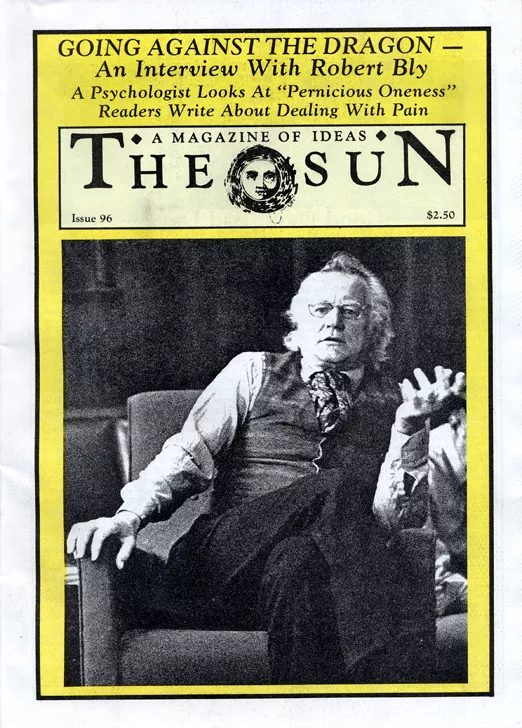
These poems are from Robert Bly’s newest book of poetry, The Man in the Black Coat Turns (Penguin, 1983, $6.95), and are reprinted with kind permission.
Copyright © Robert Bly 1981