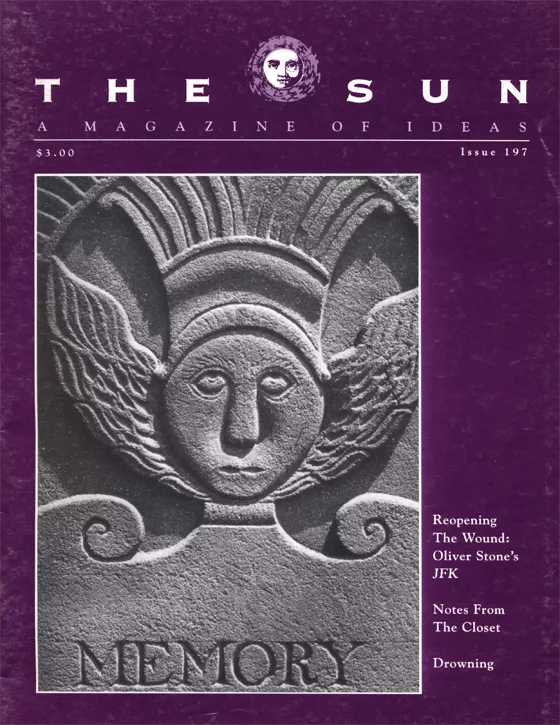
Brenda Peterson is to Puget Sound as Henry David Thoreau is to Walden Pond. “I’ve apprenticed myself to Puget Sound,” writes Peterson, “because I believe it will teach me more about living than what I have learned so far.” In Living By Water: Essays on Life, Land & Spirit, Peterson employs a gentle lyricism to show how the abiding rhythms of water have shaped both her life and her thinking.
— T.L. Toma
At the age of two, I saw the ocean for the first time. I threw wide my short arms and ran shouting, straight into the Pacific, where an undertow reached out to embrace me. I still remember the upside-down whirlpool of warmth, like the womb out of which I’d so recently swum.
Spun around in the waves of that undertow, I remembered my first mother. My air gone, I instinctively opened my mouth like a guppy, breathing in the dark, nutrient-rich liquid. There was no panic, no struggle. I tucked myself in tiny somersaults and suckled sea water. Who knew which way the sun shone? The ocean had its own light: I saw bright blowfish and bioluminescent bacteria shine through the water like a constellation. There were pink coral and purple sea anemones; sea cucumbers slithered by as my fingers sought their velvety, speckled backs. Orange starfish inched past snaggletoothed, slinking eels — and just when I closed my eyes to rest from such splendor, I heard the far-off lowing lullaby of a gray whale singing me to sleep.
My father woke me, rather rudely. Cranking my arms like an old-fashioned Model-T, thumping my chest, then sucking the seaweed from my mouth, he kept yelling at me — the way he did when it was time to come in from my play. There were lots of people around. I was afraid to open my eyes, which stung with sand and tears. But I heard the crowd, skittering around like sandpipers and calling my name as if I didn’t know who I was. What I remember most is my anger at being brought back home before I wanted to return. And the dawning conviction that my real home might be this ocean.
“You could have drowned!” My mother was beside herself.
“You did drown,” my father said grimly. Then he crushed me to him — an experience more painful than the undertow.
But I allowed it because my parents had forgotten to punish me for running away from them. “Pretty,” I assured them. Then I tried to explain about the fishes that made their own light.
“No, honey,” my father gently dismissed my vision as if I were in a delirium. “You didn’t see anything, just a lot of silt. You weren’t deep enough for those bright little fish.” Then he promised me, “And you’ll never go that far down . . . at least not until you can swim!”
But I did go down, I still do go down to the very bottom of the ocean — though not physically. Many nights I find myself sleeping on the ocean bottom, my body drifting in the fluid pulse of the sea. In dreams I recognize almost casually that I’m not human, but aquatic with all manner of gills, fins, antennae, exoskeletons. In one of my favorite dreams I am an octopus with red suction cups, jetting through the water and squirting ink in my elegantly elusive wake. A dream I usually tell only to children is of living inside the belly of a blue whale: I’m just so much silly krill slipped through the blue’s mouth. Children, knowing the power of being small, don’t mind imagining themselves as tiny, shrimplike crustaceans. And the innards of a whale seem no odder a residence than the recent round womb of one’s own mother.
Early on, I learned to keep mum about my drowning dreams. When I was five and my great-grandmother died, I tried to ease my mother’s sorrow by suggesting that Great-Grandmother was back home in the sea. Such sacrilege in a Southern Baptist home was not taken lightly. Had Satan put it into my head that the Earth’s own ocean was heaven, not — as everyone who was saved knew — the sky? It earned me solitary confinement without supper.
At eight, when I should have known better, I asked a Sunday-school teacher why heaven was up and not down. “Maybe heaven is at the bottom of the ocean,” I blurted. “In my Bible’s concordance there are thirty verses under sea and only two under sky.”
“Yes,” said Mrs. Lucas, with a look of evangelical triumph. “But now let’s look under heaven.” Dutifully we all did. It filled half a column. “And heaven is far above us. It’s someplace to which we ascend.”
I was not convinced. When I read Genesis, all I saw was that God said, “Let there be a firmament in the midst of the waters.” When I looked up firmament in my school dictionary, it explained that this was the “vault of heaven,” and though the first definition listed for vault was an arched ceiling or roof, the second was “an arched space, chamber, or passage, especially one located underground.” A final definition was “burial chamber.” I was thrilled to think God’s firmament in the waters was a secret passage or burial chamber at the bottom of the ocean. Maybe when I died, I’d take up my heavenly residence inside one of the many pearly mansions of a chambered nautilus.
My secret life was nurtured by the fact that my father almost always located us near water. Walking or playing by water was daily worship for me — after all, what went on by the water was holy compared with the pounding, fidgeting, droning atmosphere of church. In third grade, when we lived across the street from the Atlantic Ocean in Revere Beach, Massachusetts, I discovered a socially acceptable way to speak of my underwater world: earth science. It was my salvation to give my siblings long discourses on amphibians, those near-kin who begin as water beings and then grow into land-dwellers.
“We were all amphibians once upon a time.” I told my younger sisters and brother my scientific discoveries like bedtime stories.
Gleefully I’d show them my earth science book with its colorful illustrations of green frogs and coral pink salamanders. I’d remind them of the boy in our church born with webbed feet. “This is what you looked like inside Mom,” I’d tell them. They’d gape like little fish. “You had tails and gills and breathed water just like a tadpole.”
Anchoring my science book in my lap, I’d pretend to delve into deeper chapters of scientific fact. But what I’d really tell them were my dreams and stories. I’d read of the mer-people, a tribe of undersea people who lived in vast caverns — “heavenly vaults,” I called them. I showed them National Geographic photos of Anasazi cliff dwellings as dry-land evidence of how ancestors of the mer-people lived their sea life in caves before the water receded.
Each dusk when my sisters and brother and I combed the cool Atlantic’s summer beach, looking for couples entwined like tangled seaweed or drowned people cast back on shore, I told them my favorite stories of sea changelings: the selchies, sirens, and water nymphs who wander between the worlds. I secretly suspected I was one of these changelings.
Aside from the mermaids and mermen who swam through my dreams, my favorite changeling was the selchie. In the sea, she is a sleek, playful seal; on land, she’s just like you or me, except maybe more fun. We’d seen sea lions and seals on our trips out West and the vision of those flapping flippers, the sheer speed of their torpedo bodies slicing through waves, reminded me of the weightless acrobatics I performed nightly in my dreams.
Often my siblings clamored to hear the South American tale of the ancient pink dolphins who, the Amazon Indians believe, navigate their nightly way up shallow tributaries. Leaping ashore, the dolphins change into lovers, reunite with their human mates, lie with them wrapped in the rocking waves of dreams. From their sacred bond are born children the tribe considers half-human, half-dolphin. These children are special go-betweens or shape-changers who can heal the broken treaties between tribes of land and those of water.
Hans Christian Andersen’s wrenching tale of “The Little Mermaid” made me so mad I boycotted it. My youngest sister also read Andersen’s moralistic little tragedy of the little mermaid who falls in love with a human prince, saves him from drowning, only to witness him mistake the first young woman who finds him on the shore for his savior. The mermaid sacrifices her beautiful voice, her undersea kingdom, her sisters and father — all to dance on human legs that cut her like knives. She devotes herself to the prince who dotes on her but marries the woman he believes saved his life.
What enraged me most about the story was Andersen’s insistence that mer-people had no immortal soul. In his version, undersea folk lived for three hundred happy years, then changed into so much sea foam. Human beings, however, ascended — there was that word again — to heaven to live forever with God. The little mermaid, unable to marry the prince, loses her chance to gain a soul. But she’s given an opportunity to redeem her three hundred years of undersea life by killing the prince on his wedding night. She flings the murderous knife into the sea, then she herself changes into foam. But wait! She is not just nothing. She’s granted a place among the “daughters of the air,” who through good deeds (mostly making bad children behave) earn immortality and “share in mankind’s eternal happiness.”
“So who wants to be a mermaid?” my mutinous sister said, after reading Andersen’s story. “You’ll only get to heaven if a mortal loves you or if you go into the air and do three hundred years of good deeds. You’d never last that long trying to just do good.”
“ ‘The Little Mermaid’ is a made-up story,” I countered.
“You make up all your stories, too!” my sister shouted and flounced away as if I were so much dead sea foam at her feet. “Liars don’t go to heaven.”
“Well, then, I’ll stay here!” I called after her. “I won’t be lonely.”
“Sure,” my sister said matter-of-factly. “You won’t be lonely here on earth, you’ll just be lost.”
I was beginning to believe my sister and Hans Christian Andersen were right. This fear, and the fact that we’d moved to Virginia, right next to our church’s fundamentalist preacher, and spent almost every night in the church, made me wonder about my eternal soul surviving an undersea heaven on earth. Then, just when I was about to lapse and entertain ideas of ascension or joining the adolescent daughters of the air, I drowned again.
Because I’d been breathing air for twelve years longer than the first time the water took me, the transition was not so easy. Our family was moving again, something we did every other year or so, and we were midcountry in a Nebraska motel. After a day of steaming inside a station wagon, our family of six splashed into the motel pool, even though it was night, with no lifeguard and no pool lights. For all my nights of undersea explorations, I am not a strong swimmer. My basic stroke is a simultaneous frog kick and lunge to scissor my way through the chlorinated waves.
Since in my dreams I breathe water, holding my breath requires an effort of will. So I’m always disappointed when I swim in pools. That Nebraska night was no exception. Of course, what no one mentioned during our water play was the grief we felt at leaving yet another homeland.
My father played a dunking game with us: just as we surfaced from our dives, he’d let us gasp once, then push us back down below. With no pool lights, my father didn’t see that I’d surfaced and forgot to breathe. With a shout, he put both hands on top of my head and in a mighty shove pushed me down to the bottom of the pool. He held me there, counting aloud while everyone laughed.
I remember sitting cross-legged on the bottom of the cool cement pool, my father’s hands cupping my head. It was unfamiliar, this panic, this tearing pain in my chest. I screamed and then inhaled a great gasp of water. There was a split second of complete lucidity. Oh, I thought, and was suddenly grateful, this again, followed by calm as my body returned to its watery rhythms. But this time there was no splendid sea bottom. There was just darkness and a distinct loss of feeling in my legs.
I woke with a howl as someone popped open my sternum bone like breaking a lobster shell. My father’s face swam before me. I had two bodies — my fragile, bony chest and arms, while below the waist my legs felt fused, somehow a familiar feeling. In one powerful leap I thwacked my tail and saw it shining with translucent silver-gray scales as brilliant as mica. Then I passed out again.
When I came to, I was stretched out on a pool chair, towels wrapped tightly around my body. Everyone around me was dressed in white towels, too, like bathers in an ancient Greek underground gymnasium. The pool gleamed in the moonlight. I was in another world until someone handed me a soda and I heard my father’s voice.
“Not again . . .” he said wearily, his face very white. “I almost couldn’t get you back.”
“Did you see heaven?” my little sister demanded. “Well, did you?”
“No,” I said slowly, my ears still plugged. “It was too dark to see. Except I did feel my legs change into . . .” I stopped.
My little sister gave me a meaningful I-know-what-that-means look. She was merciful enough not to mention hell or how the devil had a tail, too. However, she did remind me that when God first destroyed the world he sent water.
These were the dark years of disbelief and forgetting who I really was, that time when one’s first world is destroyed and who knows what comes next. “After the Deluge,” I call these teenage years, because it was then I began reading the myths of lost continents sunk fathoms deep because of the so-called sins of their advanced civilizations. I didn’t like the sin stuff, a reprise of all I’d heard in church. But I was fascinated by this deluge myth common in so many far-flung cultures. My favorite was the Toltec myth, adapted by the Mayans and Aztecs, of the five worlds the People journey through to come to this last world. In each world, the gods of air, fire, water, and earth look down and see the People have forgotten how to give thanks for their world.
Loath to completely destroy the People they created and love, the elemental gods search for one good man and one good woman. Those who still believe or remember to sing praises are rare, but at last the one good man and woman are found. They are given a cypress tree for a raft and to this, as well as to their faith, they cling while the thunderclouds cover the world, the volcanoes spit long tongues of lava, the earth trembles from its fiery core. All the world is drowned, all the wide world is water, except for one volcanic peak.
As they are drowning, sinking to the bottom of the great sea, the People remember their gods and call out their names with their last breaths. Mercifully, the gods change the lost People into all manner of brightly colored sea life — fish and great whales and all the sea folk that swim and breathe life in the deep. All that is left of the once vast tribes of the People are one good man and woman afloat on their cypress bark. When the waters recede, this one man and woman begin again. And as the story goes, they have plenty of fish to eat.
After my own adolescent deluge days, I also recreated my world: I left home for college. I left behind the first world of my parents’ beliefs and their suspicion that I was absent among the saints: those saved and destined for the sky. At school I studied comparative literature and dived into world mythology with my old passion. I rediscovered that even in early Christian symbolism, those first followers of Christ used the sign of the fish, the fish being a ritual religious meal; they celebrated their new belief by baptism — immersion in waters holy enough to cleanse every sin.
When at last I arrived here in the Northwest, I sank myself into a study of native Indian tribes. My favorite Northwest deluge story comes from the Okanogan tribe.
Again there is the theme of a sadly disappointed divinity, a tall white woman called Scomalt, who could create whatever she wished. Scomalt ruled over an island race of white giants forever at war among themselves. At last, Scomalt drove the wicked warriors to one end of White Man’s Island, broke off that part of the land, and sent it far out to sea. What happened? All perished except that one good man and one good woman. The man caught a whale, stowed its blubber in a hand-built canoe, and paddled almost forever until they came to the Okanogan country (upstate Washington). The legend ends with a warning:
In time to come, the Okanogan Indians say, the lakes will melt the foundations of the world, and the rivers will cut the world loose. Then it will float as the island did many suns and snows ago. That will be the end of the world.
To what do all the many deluge myths refer? Could it be that myths are really memories? If, as the legends say, the world was once destroyed by water, wouldn’t it be so catastrophic an event that its memory must survive? Whether or not the flood actually happened, what does it mean that our stories tell us that once we all drowned?
My father, the scientist, might say we’re simply remembering our amphibious evolution as a species. My little sister, still a staunch Southern Baptist, might say it’s God’s punishment and get ready for the fire next time. I like to believe that we all have some memory of drowning because we are creatures who can live in two elements: the very earth and water that make up our bodies, as well as our world. And when I die, if given a choice, I’d just as soon stay here on earth and undergo another sea change.
Once an astrologer startled me by speaking about “my last death.”
“Neptune . . .” she said softly. “You were lost at sea.”
Whether I believed it or not, it felt true — or perhaps she was simply picking up on a two-year-old’s undertow.
“Maybe,” I suggested hesitantly. “I was a whale?”
The large woman looked at me for a moment and I felt like a child again telling my sea stories when I should have kept silent. Then she laughed heartily and shrugged, “Well, maybe you were!”
And maybe I will be a whale again. I wonder what the world would be like if we told our children that their grandparents and other beloved, lost relatives are still living alongside us, that as the Northwest Coast Indians taught, the sea is the saltwater blood of our ancestors? If our myths and our bodies never abandoned the Earth for the sky, would we hold our natural world more sacred?
The sea story that most restores my childhood faith is Renewal, told by the Canadian author Gua Gua La (Barbara Smith). In retelling the myth of those ancient mer-people, the Anishoni, and the prophesied reunion with their long-lost kin, the land-dwelling Ticanishoni, Gua Gua La speaks of a time we might all remember, a time before the waters and the People were divided.
This was long before Tyowa, the sun and singer of great songs, shone down so passionately upon the sea that the waters receded to expose earth as well as some of the People of the sea. As Gua Gua La writes, they “now found themselves earthbound, took their bone knives, and split open their tails, making for themselves legs and feet on which to walk the new land. . . .
But all was not well with the People of the earth, who forgot their mutual beginning in the womb of the sea and claimed a separate creation for themselves. No longer were the birds in the air or the fish of the sea their brothers. They saw these creatures as beneath them, made for their using. They forgot the universal speech which travels from mind to mind, linking all life. They stood alone on a high hill in the darkness, hearing and seeing nothing of the world around them, and for the first time in the world there was loneliness.
Loneliness, the myths tell us, always comes from forgetting who we are. Does the sea make us so lonely because we’ve lost our connection and come keening to her shore like motherless children?
Sometimes at night when I lie in my bed listening to the siren voice of a south wind singing off Puget Sound, when my bed rocks with its waves of air and outside the high tide crashes over its breakwall in a steady, sonorous shush like the sea herself is breathing, I close my eyes.
I’m lying on the very bottom of the ocean, my luminous, languorous tail as ballast and anchor. Graceful tentacles of kelp and the sponges’ spiky tendrils wave in reunion. This underwater world holds one rhythm, holds all in its sway. I gaze up through an undulating ballet of tulip-shaped yellow stalks to see the shy shadow of an octopus, the white belly of a beluga whale, the darting cloud of a million minnows.
Far above is the sun, its warmth shining down like memory; below, pulled by the moon, the water glows a calm blue-green. Everywhere in these sea caverns are the tribes of my people. They’re meditating, too, dreaming of a world far above them where they sometimes send their souls. They believe that we, their brothers and sisters of the air, have our own heaven up here — just as we long for their watery underworld. Maybe fathoms deep in the sea is where all the old and the new souls are dreaming and changing and being born again.
“Drowning” is excerpted from Living By Water © 1990 Brenda Peterson, and is reprinted by permission of Alaska Northwest Books, a division of GTE Publications, Inc.