The Occasion Of The Monster
The heroine gasped and said to the hero, “Hurry! Hurry! We only have fifteen minutes to save the universe!” The monster-beast stepped on another building, and the desperate couple fled.
The Monster Who Came To Stay
A mass of wet, blue fur, mister monster-beast burst out of the sea, pulling seaweed from the scales on his stomach and yawning fire. He looked well-rested, very horrible. Most beach-goers scattered toward the dunes, screaming, but one muscle-man stood firm, flexed, and got gobbled up with a dog and a blow-up sea horse. Then the monster cruised the shoreline, pounding his chest and roaring for effect.
“Oh no! It’s the monster! Hurry!” cried Marc, as he grabbed Abbey’s hand and ran with her along the surf. When they reached a safe distance, behind a lifeguard stand, she readjusted her top and Marc hugged her.
Abbey — the young woman, the girl who actually wanted to sit in the second row all those nights, so that the movie gore would be bigger than just big, who hid her face in his shoulder during the scary parts, who had short tan hair, the same color as her large tan eyes; Abbey, our heroine, who looked innocent but wasn’t, who brought monsters home like orphaned puppies, who worried over Lon Chaney, Boris Karloff, the sewers of Paris, the pilots of the biplanes flying around the Empire State Building.
“What happened to them?” she asked. “The soldiers who died fighting Kong?”
“Abbey,” Marc said, “there exists no more noble cause to die for than the defense of humanity!”
She assented, the girl who was all Marc ever wanted. The serious young man, Marc, who found her finding him, the boy who indulged monsters with her, entertained and hosted them, fixed them tea, made them dinner; pragmatic Marc, our hero, her hero, who was not forgetful, who refused to believe there was nothing to believe in, who finally thought he’d found someone he could actually love.
Marc and Abbey, founding love upon the nothingness of the gray of cinema strobes and dinner candles and twilight walks. They — the hero, the heroine, the couple, the lovers, the husband, the wife — they who, weaponless, struggled with the indomitable. And their loving struggle began one night when — five rows behind them, sprawled in the silver darkness of the cinema, combing through his furry lap for Raisinets — our monster-beast saw them. Our monster-beast, who came to watch himself spit fireballs like clots of phlegm at the city. It began when he followed them home.
The Monster Stalk
Doom. Doom. Doom. That was the sound of his footsteps. Doom. Doom. Doom. As he walked to Tokyo. Doom. Which he would eat. Doom. And destroy. Doom. You could feel his breath, hear his deliberate footfalls, see trees splinter, mountains disintegrate, trains derail, doom, peasants come to be screaming snacks, wiggly hors d’oeuvres. Doom. Doom. Doom.
“I’m scared, Marc.” Doom. “We’re in trouble,” Abbey gasped, with a tremolo. “Oh Marc, we’re not safe.”
“There is a dagger hanging over our heads, Abbey.”
The Monster Who Whispered Too Much
One warm summer evening, when the wind was up, they sat on the porch, and the monster-beast asked Abbey and Marc the following: “Metaphysically, where do you stand? What is the furniture in your emotional household? What color is the interior? Are the windows large and sunny? Have you grown a garden in the yard? Do birds nest in your chimney? Are there drafts in the winter? Are you well-insulated? Stormproof? Insured? Do tiny monsters breed in your walls? Are you afraid of an electrical fire in the night while you sleep?
“We are defined by what we love. What do you love? What would you save, if you could save it, say, from a fire? What we dream and hope for is more who we are than who we are. Who are you? What do you need?
“Did you know that, tucked in the eastern ring of the Carpathians, in the heart of Transylvania, the Black Church in Brasov has a truly massive organ that may be heard all the way to the castle at Bran, where Vlad Tepes lived? Vlad Tepes was Dracula. Ever see Bela Lugosi draw his cape to ward off the daylight? Ever see him try to hide his insubstantiality? Did you know that, when he died in the fifties, he was buried, as requested, wearing that cape?”
The monster paused while the blender blended some more daiquiris, and they ate, from his claws, the marshmallows which he breath-toasted for them, golden brown and perfect.
Happiness Is An Absent Monster
The red wine went well with their mustard-soggy sandwiches and with the green apples and the sun. The red wine went well with the far view to the bay from the grassy hill, the bending bay, the swerving shore, the dandelion-dotted green grass. The red wine went well with ships in the sound and the occasional belling buoys. The red wine went well with the rich smell of the sea, with dessert, rhubarb-strawberry pie, and with the black ants crawling through the Swiss cheese. The red wine went well with Marc’s sweater, which Abbey wore, and with his dash after the escaping paper bag. It went well with the tangle of hair that she held in the corner of her mouth between her tongue and lips. In short, the red wine went very well with The Day; and though nothing interrupted them, no ogres intruded on the sanctum of their picnic, no furious leviathan lurched from the waters hungry for desolation, no chimera sneered fire, no low-passing harpy beat ravening wings above; and though no monstrous apparition or activity ravaged anything anywhere, tears came to their eyes, from the wind.
The Monster Drooled
Under the bed, amid the dark and the dust, our monster-beast lurked. “Don’t put your foot over the edge! We’re not safe anywhere but here,” Abbey said. So they stayed in bed, hardly noticing the thud of the monster’s heartbeat, or the puddle he drooled as he snoozed, or his incessant scratching at his dandruff. Just as Lugosi drew his cape to ward off his insubstantiality, Abbey pulled the covers over them. She clung to Marc, hard, like he could save them, and Marc clung to Abbey, hard, like she could save them.
The Monster-Beast: Up Close And Personal
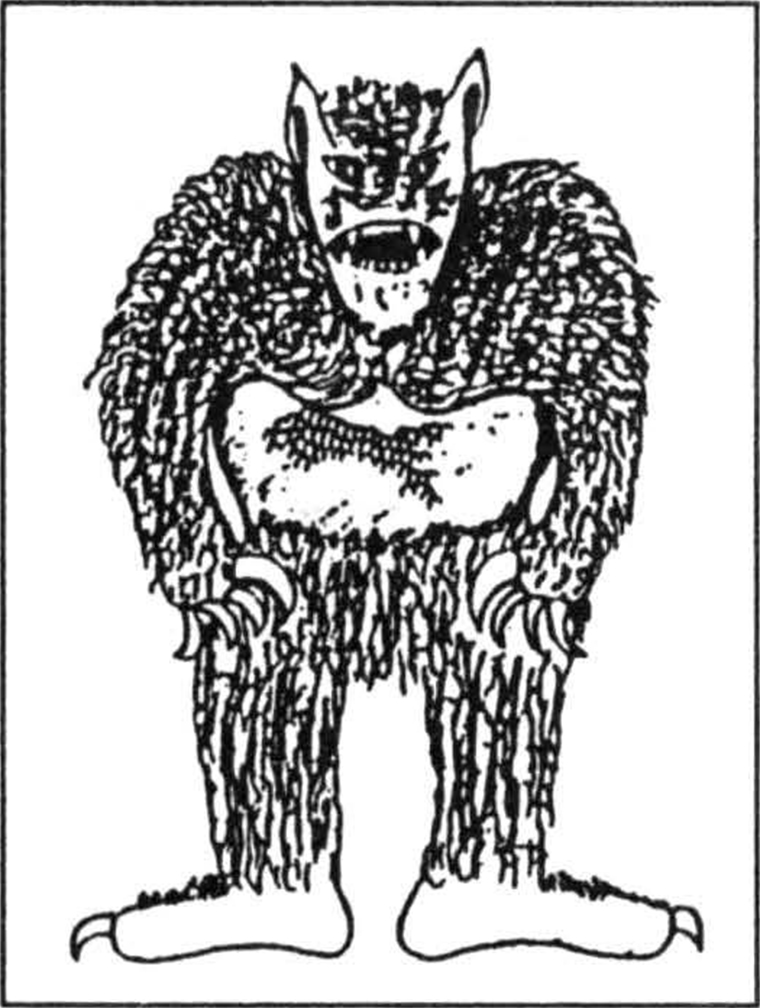
This is the monster-beast, smiling:
VITAL DATA
Height: 7’6”.
Weight: 325 lbs.
Hair: blue.
Eyes: luminously purple.
Most Memorable Moment: plague, Europe, mid-fourteenth century.
Life With The Monster-Beast
He drank too much beer at the restaurant one night. Had a good time, he said, dancing on the table, until he got carried away and ate the horn section of the band. Abbey and Marc were ushered from the establishment graciously.
He showed up at Abbey’s office and found her reading self-help books, a stack of them. She said she was concerned he might have an eating disorder. “Do you eat when you’re not hungry?” she read from a list. “Do you make yourself vomit if you eat a lot? Do you think you’re fat?” The monster said he was lonely in the house, that he just wanted to say hello, that he would leave in a little bit. A little bit turned into all day, three boxes of pencils, and too many legal pads to mention. “I don’t have any disorders,” the monster-beast said.
He got bubble gum in his hair, and it took a whole painful Saturday to get it out.
He had many annoying habits, and life with the monster-beast entailed acceptance of them. For instance, he would always eat a sock or a pillowcase from the laundry. As a matter of course, he’d hide Abbey’s wallet in a place they’d never look. He’d gnaw at the fenders of the car, scratch the records, break the household appliances. He would make them misunderstand each other. He’d make them scrimmage over what movie to go see together, make them deconstruct the past so that nothing was real, throw everything into doubt. He would make the risk of happiness exhausting. He’d eat their neighbors, relatives, goldfish, mailmen; eventually, everything they cared about, everything they needed, he devoured.
The Domestic Monster
If Abbey and Marc were home, the monster just reclined in a lawn chair on their patio, blowing saliva bubbles all day, watching the garden grow, tomatoes proliferate, sunflowers bend under their own success. If Abbey and Marc were home, he would shoo the woodchuck and the crows. If Abbey and Marc were home, he would fall asleep to the sounds of their words together in the nights of talk, and enjoy wonderful nightmares in which he starred. He’d wake alone and creep into their bedroom, loom over them, remind them why he was there, showing them what doom meant. He thought to himself, hiding beneath their bed as they made love, that he, the monster-beast, had made their love, that he had created the urgency of their passion.
The Monster-Beast Paraphrases Heraclitus
Over breakfast the monster said, “The essence of time is flux, dissolution of the momentarily existent. The essence of life is time, the constant alternation of creation and destruction. Nothing stands still. All things flow. However permanent a thing may seem, it is changing and will be swept away. ‘You cannot step into the same river twice,’ Heraclitus said to his devotee, Cratylus, who answered, ‘Yes, but you cannot even step into the same river once.’ ‘True,’ let’s imagine Heraclitus saying. ‘I suppose we must plunge!’ ”
The Melancholy Monster
“It was a mangy lawn, anyway!” the monster-beast told Marc.
“That’s still no excuse for this.” Marc pointed to the area around the monster which smoked in a singed circle of brown. Marc brought out the hose. “Sorry,” said the monster-beast. “I didn’t even know I was snoring!”
This argument was in the morning, and it made the monster melancholy. He felt empty, sorry for himself, so he ate the UPS man first, then all the packages and the van, too. That started the relapse of the old strife because then the monster-beast tragically chain-ate an entire schoolbus of children, the Yahtzee Club at the old-age home, and the entire second shift at the Frito Lay factory. Then he felt guilty, so he stuck a sapling down his throat and threw up. Then he felt ashamed, so he stormed into the VFW and efficiently swallowed everyone but the bartender — whom he ordered drafts from — and tried to keep his stomach settled and calm. He tried to feel good about himself. He tried to tell himself that he was OK. “I am a good monster. I’m a good monster. I know it. I’m a good monster.”
Nevertheless, the monster was nervous. He popped pool balls into his mouth like malt chocolates. His ulcer erupted. He drank the fish tank in the corner and spit the pink plastic scuba man onto the floor.
A vet stumbled in drunk, and recognized the monster. “Hey! Weren’t you in Manila? The Pacific Theater?”
“I made a few appearances, I believe,” said the monster-beast politely, trying to maintain his composure.
“Look,” the soon-to-be-vaporized man said. There was a big scar along his belly. “That was you! You clawed me! Remember? You yanked the arms and legs right off my buddy like he was a fly or something.”
The monster stood up suddenly, tipping the table in his wake. He took a deep breath, “Wrong day! Wrong monster!” He exhaled fire and — poof — the man was smoke.
The monster felt horrid.
Home, the monster-beast went directly into the bedroom and snatched Marc from the bed. Abbey screamed. The monster dragged Marc out into the street. He dangled him by the ankles, looking into Marc’s terror. Then, despite Abbey, despite his love for them, the monster put the orb of Marc’s head into his mouth until Marc drowned against his rough and rancid tongue. He pulled the head from his mouth with a loud pop. Marc’s head glistened, matted and wet under the streetlight.
“One,” the monster counted, “two,” the licks it would take, “three,” to get to, “four,” the center, “CRUNCH! Four. Four licks, hmmm.” The monster nibbled down Marc’s legs, arms, and then the rest disappeared in a giant, uncomfortable gulp.
The Aphoristic Meta-Monster
The wind is a patient monster. It is the key eroding factor to the things we love, to our emotional architecture; and, no matter how strongly things are built, no matter how much we love them, nothing lasts, nothing endures; efforts at maintenance are as weak as air in the wind. This is why the wind brings tears from the horror of non-being.
The Monster Made “All Gone”
Abbey cried all night long. “I am sorry, belle,” the monster said over and over. “I’m sorry. Say it’s OK. Please. I’m sorry. I’m sorry. I’m sorry.”
“Take me,” Abbey said, putting her arm into the monster’s open jaws, over his big yellow teeth, down, down deep to the shoulder. The monster sat still, gazing at the ceiling. A long, terrible crack ran along the plaster. Abbey slid in her other arm, deep down, then her head, then she crawled in and in and in until she was all gone.
Oily tears crept down the monster-beast’s snout, not because she was — not because they were — gone, not because they had been, not because of anything, but just because.
The Lonesome Monster Cried
Finally, the monster collapsed onto the bed. The comforter comforted him, the drapes draped, the walls met. He burped and grimaced at the Marc-and-Abbey aftertaste. Before the mirror, he remarked that he looked too decent, not misshapen enough, not quite horrible. He practiced a growl, a snarl, a gross gutteral gurgle. Upon the edge of the mirror was stuck all that was really left of Marc and Abbey, besides silence. The monster took it down. He regarded it for a moment and then breathed it into flame, into oblivion. It had been a snapshot of them smiling.
This story previously appeared in the Clockwatch Review.
— Ed.