Claude Anshin Thomas, a Zen monk and teacher, has made many pilgrimages to war-ravaged parts of the globe to promote nonviolence. But his mission hasn’t always been peaceful. At eighteen, Thomas was a U.S. soldier in Vietnam.
Thomas served his full tour of duty and received a Purple Heart and numerous combat decorations, but he later suffered from memories of the fighting and guilt over the people he had killed. He became addicted to alcohol and drugs, and for a time lived on the street. When he began recovering from his addictions, Thomas found that the pain and guilt he’d been numbing with substances were still there. It wasn’t until he encountered Vietnamese monk Thich Nhat Hanh that he found a way to confront and accept his own suffering.
In his book At Hell’s Gate Thomas tells his entire story, from his violent childhood, to his wartime experiences, to his ordination as a Zen monk and current life of nonviolent activism. The following is an excerpt from At Hell’s Gate, ©2004 by Claude Anshin Thomas. It is reprinted here by arrangement with Shambhala Publications, Inc., Boston, MA (www.shambhala.com). Our excerpt begins with the author’s induction into the army.
— Ed.
“GO INTO THE MILITARY,” my father said. “It will help make a man out of you.” I thought becoming a man would mean being respected and being loved.
I remember the day I left for my military service. My father drove me to the bus station in Erie, Pennsylvania. I had a Boy Scout suitcase with my name written on it in black Magic Marker. My father bought me a ticket and left me there to wait for the bus. No goodbye hug, no handshake, no parting words.
The bus took me to Buffalo, New York, where I was to be inducted. When I got to Buffalo, the first thing I did was go out and buy some alcohol. I was terrified.
The next morning I was hung over, but I made it through the physical. Then I stood in a room with the other recruits and took an oath. I was a soldier.
When the other inductees and I got off the bus in Fort Dix, New Jersey, a staff sergeant immediately began screaming obscenities at us — humiliating obscenities. I thought, My father lied to me.
The first few weeks of basic training were terrible. I excelled at the physical aspects but had a difficult time with what was called “discipline.” For a barracks inspection, an officer would come in with white gloves on, and if there was the slightest bit of dust anywhere, he would be propelled into a tirade. He would knock over wall lockers and randomly dump footlockers on the floor and scatter their contents around the barracks. When he was finished, he would give us twenty minutes to be ready for reinspection. For no clear reason, we would have to scrub the shower-room floor with a toothbrush, or shave our faces without water or lubrication. We would be called out by a drunken drill sergeant at two in the morning and ordered to stand in formation in the freezing rain in our underwear with our collar brass in one hand and our belt buckle in the other hand, all highly shined.
At one point I was feeling so despondent and desperate that I came into the barracks and punched out every window in the place with my bare fists. My hands cut and bleeding, I went into an upstairs room, pushed a wall locker in front of the door, climbed out the window, and sat on the roof.
A first lieutenant managed to get out on the roof with me. I was crying and told him I didn’t know what to do. His response was to slap my face and punch me repeatedly. It didn’t occur to me that he shouldn’t have done that, that it was against regulations. Abuse seemed normal to me by then.
Later, a staff sergeant talked to me with what seemed to be some measure of compassion. He said: “Listen to me. You’re not going to go home. You’re here for three years, so you might as well make the best of it.”
Something about the way he spoke to me made me shut down. I said to myself, I’ll just do this thing, be the best soldier that I can be.
CLAUDE ANSHIN THOMAS, age 18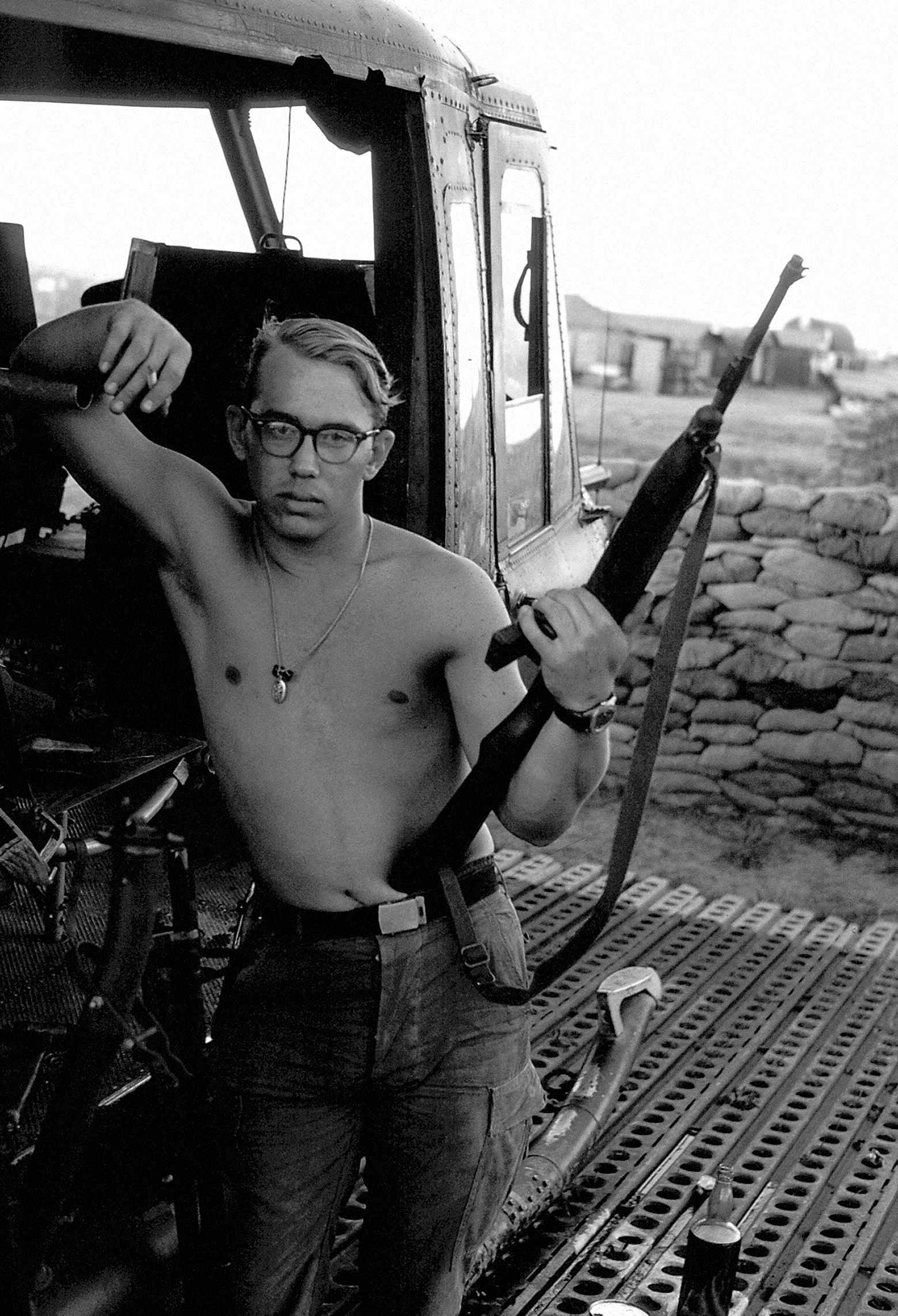
IN PHU LOI, near Saigon, I was assigned to the 116th Assault Helicopter Company. Richie, the crew chief, showed me the gun shack, where the tools of my new trade were kept: the 7.62mm M60 machine guns. He showed me how to clean the guns and how to mount and load them.
We flew to several different locations that day to pick up and deliver mail, and we took soldiers to Saigon on pass. The more we flew, the more familiar my new surroundings became. The weather was cool and dry, and I remember naively feeling a sense of wonder about this thing called war.
That night, Richie came running into my barracks and told me that the unit had gotten into a mess; some helicopters were down, and we needed to fly.
As we approached the landing zone (LZ), the sky was lit with parachute flares, which gave the darkness a bright yellowish tint and cast everything in silhouette. I sensed tension in the air, an unspoken fear. The pilot gave the order to open fire, and the next thing I knew we were on the ground and all our troops were off the helicopter. Other ships were taking off all around us, but ours wasn’t. I realized we had been shot down.
Richie yelled at me to get the pilot out and grab the guns. I ran to the pilot’s door and opened it. There was a piece of body armor designed to protect the side of the pilot’s head. We had been instructed to be cautious when sliding the armor back, because we could easily push it right off its track and damage the floor of the helicopter. Of course I did exactly that. I was so wrapped up in guilt over my screw-up that it took me a second to notice the pilot was seriously wounded. I ran for Richie. He told me to unbuckle the pilot and get him out of the ship. I had to carry the pilot over my shoulder because he was unconscious. I laid him down, and then I went back and grabbed my machine gun and then Richie’s. Richie told me that the company would send in a helicopter to get us out. I didn’t find out until the next morning that the pilot was dead.
We ended up spending the entire night in the LZ. My infantry training hadn’t prepared me for what happened in heavy combat. I didn’t know whether to shoot or to be quiet. I decided to be quiet, because once you expose your position, you’re vulnerable. All around me I saw and heard the wounded.
While we waited to be evacuated, a lot of men cried for their mothers or prayed. But I didn’t cry, and I didn’t pray. I was proud of myself. Besides, whom would I have prayed to? It didn’t make sense to believe in God. If there was a God, how could he let this happen?
I went on to become a very good soldier. I received many awards and decorations. And I enjoyed my job: not the way one might enjoy a hike in the mountains, but the way one enjoys being useful. Imagine that: in the chaos and insanity of war — that was where I felt comfortable.
I was promoted to crew chief. I crewed slick ships (the helicopters that carried soldiers into battle and did medical evacuations) and gunships (helicopters that provided close fire-support for soldiers on the ground). From the moment I became a crew chief, I was in combat nearly every day. One of the many decorations I received was the Air Medal. To get an Air Medal, you must fly twenty-five combat missions. By the end of my tour, I had been awarded more than twenty-five Air Medals, which means I flew at least 625 combat missions. On all of those missions I killed people, but I never saw them as people.
I experienced the Vietnamese only as the enemy, every one of them: shopkeepers, farmers, women, children, babies. Once, a group of six soldiers and I went into a village that was supposed to be pacified — i.e., friendly. We passed three or four men with shaved heads and saffron robes. When the men were about forty meters behind us, they turned and opened fire with AK-47s. Three of us were killed, and two were wounded. Killed and wounded by monks. Were the men really monks? I don’t know. They looked like monks to us. So monks were our enemy too.
On another occasion, the infantry unit that our company supported began to receive heavy automatic-weapons fire from a village, and they radioed us for help. We flew in with a heavy-fire team: three B-model Huey gunships with rockets and 7.62mm machine guns, one with a 40mm cannon. Without a thought, we opened fire and destroyed the entire village. We killed everything that moved: men, women, children, water buffaloes, dogs, chickens. We did it without any feeling. All that remained when we were finished were dead bodies, fire, and smoke.
My job in Vietnam was to kill people. By the time I was first injured in combat — three months into my tour — I had been directly responsible for the deaths of several hundred people. I can still see many of their faces.
I WAS INVOLVED in a special-operations mission somewhere near the Duc Hua rubber plantation, which was on the Saigon River, on the border with Cambodia. I hated flying in that area. We had been shot down twice there, and shot up numerous other times.
We’d been sent to pick up a group of chu hoi, Viet Cong soldiers who had surrendered. On the way, the call came in over the radio that some of these men had changed their minds and run. We were directed to the area where the escaped chu hoi were thought to be. Flying just above the treetops, we spotted them, flew down, and herded the men toward a rice-paddy dike. They waved their arms above their heads in surrender. We hovered next to them, preparing to capture them and return to base.
Just as I was about to jump off the ship, one of the chu hoi threw something into the helicopter. Someone yelled, “Grenade!” and we opened fire. I began frantically looking for the thing to throw it out. At the same time, the pilot flailed the helicopter about in an effort to get rid of it. By the time I managed to find the grenade, it should already have exploded. It hadn’t. It was obviously a dud. Instead of throwing it out of the ship, however, I just held it for a time. I ended up holding it for hours, unscrewing and removing the firing pin, then screwing it back in. Finally someone suggested that it might be best to get rid of it.
RIGHT BEFORE MY tour ended, we were sent to pick up a group of “Kit Carson scouts,” Viet Cong soldiers who had surrendered and agreed to work for us as double agents. The whole concept seemed bizarre to me. How could these men be trusted?
As we approached our pickup point, we hovered at the tree line. Suddenly there was a loud sound. In my peripheral vision I saw the helicopter next to ours turn upside down in flames. The air around us was filled with the orange-red glow of tracer rounds crackling like downed electric wires. I could feel the rounds hit the ship: thump . . . thump, thump, thump. Our pilot lifted the tail of the helicopter, pointed the nose down, and rotated back and forth in a 180-degree arc as we opened up with all of the firepower we had, like a giant mechanical badger protecting its den.
The Special Forces sergeant riding with us began to panic and yelled, “Get us out of here! Get out!”
“Shut up and shoot!” I told him. I fired my M60 until the barrel glowed red. I stopped firing long enough to change the barrel, then began firing again. The pilot maneuvered our helicopter around and behind the downed ship, and I jumped out to assist the crew. Amazingly, they had all survived.
Back at our main base, we went through the usual procedures of shutting down. Then I headed up to the barracks to pack my stuff. I was supposed to be leaving the country the next morning. I had survived my tour of duty. It was time to rotate back to the States.
I had some beers, went to sleep, woke up, ate breakfast, and headed out to the airstrip for my last helicopter ride in Vietnam: to Bien Hoa Air Base, where I boarded a jumbo jet to the States.
During the flight home I didn’t talk to anyone. I had nothing to say. Conversation, unless functional, was simply not important. Besides, I didn’t really want to get to know anyone, because then, when they were wounded or killed, there was no one to lose.
We crossed the international date line and arrived at Travis Air Force Base in California the same day that we had left. Other returning soldiers and I deplaned and boarded buses with blackened windows so that we would not see the protesters waiting outside the gate with their antiwar signs, their slogans, their hatred directed toward us.
AFTER THE WAR I participated in the peace movement, but I made it very clear that I was not a pacifist. I participated because I believed the war wasn’t being fought properly. If we weren’t going to fight to win, I reasoned, then we shouldn’t be in Vietnam.
In my experience, the peace movement was just another form of war, often violent and ugly. We Vietnam veterans were prized possessions, yet also expendable. If we could serve the movement, then we were wanted, but seldom was there any interest in helping us heal.
I went to Washington, D.C., with other soldiers who had fought in Vietnam. We handcuffed ourselves to the fence around the White House and took our war medals and threw them over the fence. The police came and beat us. These were the very same people I had fought for, the people for whom I had offered up my life.
In 1969 I was in college in Pennsylvania. I think I was the only combat veteran in my school at the time. When the newspapers began to report that U.S. soldiers had massacred innocent civilians in a village called My Lai, I was taking a political-science class. A discussion started about the atrocity. The other students insisted that Lieutenant William Calley, who was responsible for the group of soldiers, should die for his actions. These were self-proclaimed proponents of “peace” — not soldiers — who talked like this.
I stood up and said that if that lieutenant was a war criminal, then so was President Harry Truman, who had killed hundreds of thousands of Japanese civilians by giving the orders for dropping the atomic bomb.
The other students questioned my knowledge on the subject. “You don’t understand the nature of war,” they said.
I let them know I was a Vietnam combat veteran, injured on several occasions and severely wounded on one, all before my nineteenth birthday. It was they who didn’t understand the nature of war, I told them: “You don’t understand what soldiers have to confront on a daily basis, just to protect your right to do what you are doing now. You don’t understand!”
I became overwhelmed with rage. The next thing I knew, the police were escorting me out of the classroom at gunpoint.
FROM THE TIME I came home from Vietnam until about a month before I went into a drug-and-alcohol rehabilitation program in 1983, I carried a gun everywhere. I didn’t feel safe without one. I slept with a gun, I ate with one, I went to school with one, I kept one in my car. I didn’t yet understand that security and safety don’t come from controlling the world around us — or within us.
By 1990 I had abstained from drugs and alcohol for seven years. Now I had fewer places to hide from the reality of Vietnam. All my tightly repressed feelings about the war were coming to the surface. I became so tormented that I was unable to leave my house. My counselor at the time was a wonderful, generous woman who continued to phone me and helped me understand that I had not gone mad but was getting in touch with my feelings about the war, perhaps for the first time. She told me about a Buddhist monk who’d had some success helping Vietnam veterans be more at peace with themselves. She suggested I read some of his books. I wasn’t able to, however, because they were written by a Vietnamese man — the enemy. Every time I would try to read one of them, I would think about the monks who had opened fire on us.
Six months later a woman in a therapy group I had joined gave me a catalog from a holistic-education center in the Northeast. She’d bookmarked a page for me. When I opened it, I saw a photo of that same Vietnamese Buddhist monk, Thich Nhat Hanh, and an announcement that he was leading a meditation retreat for Vietnam veterans. There was a note in the catalog, highlighted for me in yellow, saying that scholarships were available for those in need. I couldn’t use the excuse of not having any money. I called to make arrangements to attend the retreat.
I explained to the person who answered the phone that I often became anxious and uncomfortable in ordinary social situations and needed to be by myself much of the time. I also informed her that I had a hard time sleeping at night — a polite way of describing my intensely disturbed sleep pattern.
Nervous about having an “unstable” Vietnam vet on their hands, the people at the center called the retreat leaders and asked if it was all right for me to participate. These Vietnamese monks said, “We don’t turn anyone away.” This was the response of my enemy. My countrymen, the people I’d fought for, wanted to reject me, but the Vietnamese said: “We don’t turn anybody away.”
At that time, I rode a black Harley-Davidson and dressed all in black: black leather jacket, black boots, black helmet, mirrored sunglasses. Not exactly a warm and welcoming look. My style of dress was intended to keep people away, because I was scared to let anyone get close.
I arrived at the retreat early so I could walk the perimeter of the place: Where were the boundaries? Where would I be vulnerable to attack? Coming here had thrust me into the unknown, and, for me, the unknown meant war.
After my recon, I went down to the registration desk and asked where the camping area was; I didn’t want to sleep near anyone else. It was sunset, a time of day that filled me with fear: of ambush, of attack, of things exploding at any moment.
I pitched my tent in the woods, away from everyone, and sat there asking myself, What am I doing here? Why am I at a Buddhist retreat with a Vietnamese monk?
The first night of the retreat, Thich Nhat Hanh gave a talk. The moment I looked into his face, I began to cry. Although I knew the Vietnamese only as my enemy, I realized this man wasn’t my enemy. Thich Nhat Hanh said to us, “You veterans are the light at the tip of the candle. You burn hot and bright. You understand deeply the nature of suffering.” He told us that the only way to heal, to transform suffering, is to stand face to face with it, to realize the intimate details of suffering and how our life in the present is affected by it. He encouraged us to talk about our experiences and told us that we deserved to be listened to and understood. He said we represented a powerful force for healing in the world.
Still, being in the presence of Thich Nhat Hanh and his assistant, Sister Chan Khong, a Vietnamese nun, caused memories of the war to rush through me. At one point, participants at the retreat stood in a circle to do an exercise. I wouldn’t join the circle because it didn’t feel safe. Later, when Sister Chan Khong began to walk away from the circle, I was confronted by the memory of that “pacified” village and the monks walking away from us and then opening fire with automatic weapons. Now here I was observing a Vietnamese nun leaving a group of American veterans who were unarmed and vulnerable. I started to panic because I didn’t have a gun. Who could be trusted? Who?
Thich Nhat Hanh told us that nonveterans were more responsible for the war than veterans; that because of the interconnectedness of all things, there is no escape from responsibility. Those who think they aren’t responsible are the most responsible. The nonveterans’ very lifestyle supports the institution of war. The nonveterans, he said, needed to sit down with the veterans and listen, really listen to our experience. They needed to embrace whatever feelings arose in them when they spoke with us — not hide from their experience, not try to control it, but just be present with us.
I wanted to apologize through Thich Nhat Hanh to the Vietnamese people, to make amends in some way for all the killing, but I didn’t know how. Finally I worked up the courage to ask Sister Chan Khong, “How do I atone for the destruction that I was responsible for in Vietnam?”
She said to me: “If you blow up a house, then you build a house. If you blow up a bridge, then you build a bridge.”
“But if I killed a person,” I said, “how do I make that right?”
She repeated what Thich Nhat Hanh had said about nonveterans being more responsible than veterans, but I knew that I had asked her a question that she couldn’t really answer. I had to find my own way.
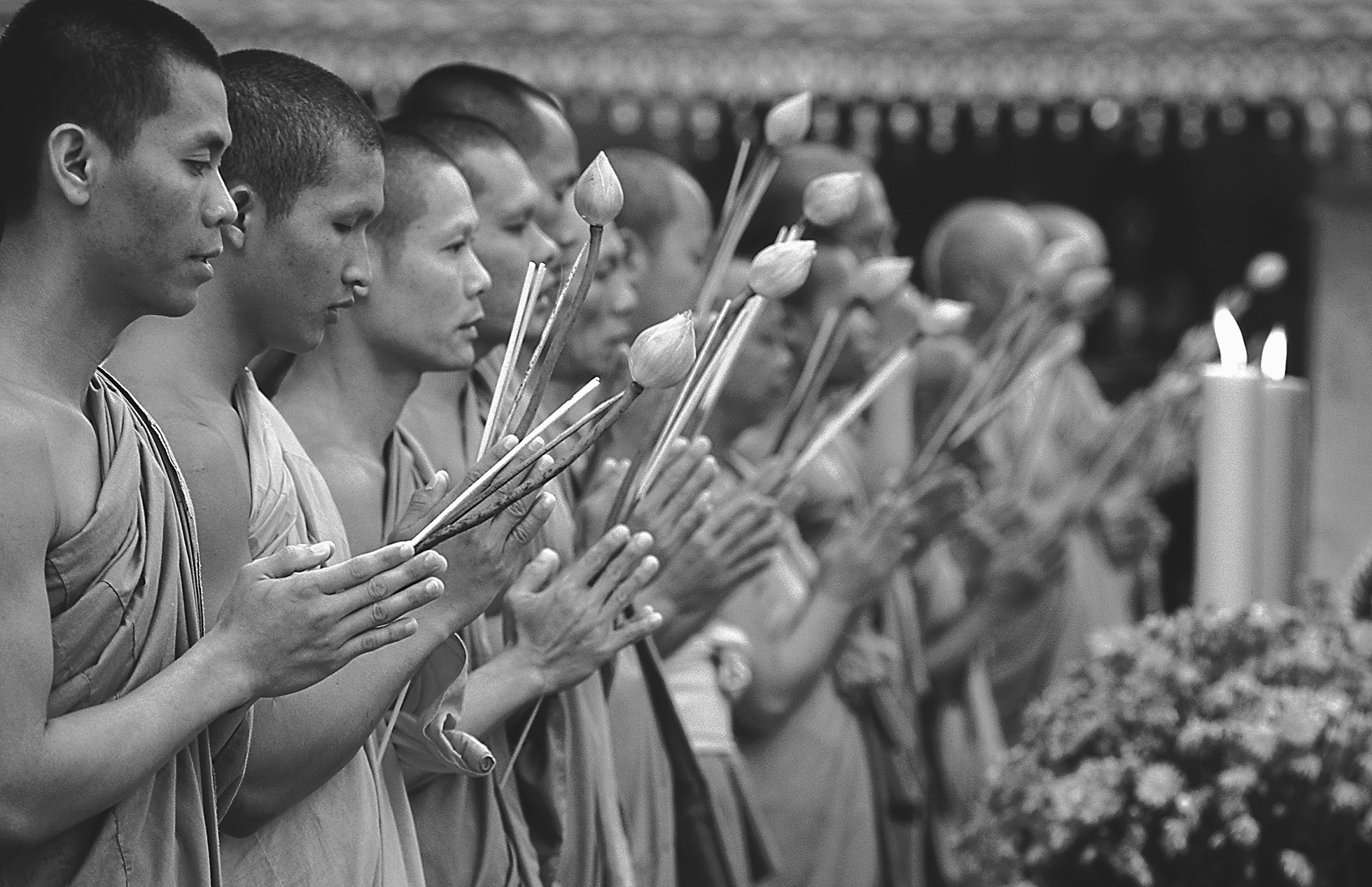
THE FIRST BUDDHIST precept is: “Aware of the suffering caused by the destruction of life, I vow not to kill, not to let others kill, and not to condone any act of killing in my life.” Keeping this precept helps me wake up to all the ways in which I might precipitate acts of killing. When I drink a glass of water, I realize that I am killing microorganisms in the water. The moment I see myself as separate from those microorganisms, as better than they are, I start creating a hierarchy, and then what I did in Vietnam, where I saw the Vietnamese as less than human, is only a few steps away.
But I have to drink water to stay alive. So what do I do? My practice then is to drink the water with the conscious awareness of the ramifications of my action. I take each sip of water with the reverence it deserves. I turn the drinking of water into an act of spiritual practice, an act of conscious awareness, because if I don’t drink the water, then I am also killing, because I would die without water.
A while ago I read the book On Killing: The Psychological Cost of Learning to Kill in War and Society, by Dave Grossman, a lieutenant colonel who taught at one of the military colleges. He writes that if the military took away the guns and the planes and the bombs, there would be less killing, because you would have to come in close to kill, be involved directly in the act, and most people don’t want to do that. It’s easier to believe you are not responsible if you don’t have to see or touch the other person. The fact is, however, that even at a distance, we are still responsible. I am still responsible.
I can’t directly stop the many wars that are being fought around the world, but if I can wake up to the war inside me, then I can bring an end to my own war. This happens as I become more aware of the nature of my suffering and the causes and conditions of my life.
If I recognize the interconnectedness of all beings, then I can come to a place of understanding, a place beyond the intellect, a place where I am not separate from anything. And here I will discover that my actions have an impact on the whole world.
For a time I lived and studied in Plum Village, a Buddhist monastery in France. While I was there, I kept asking myself what I could do about the lives that I had taken. I couldn’t reconstruct them. What I am discovering through Buddhist practice is that by waking up and living consciously, I can begin to repair what I have done. I’ve come to believe that the universe does not work by simple arithmetic: an eye for an eye, a tooth for a tooth, a bridge for a bridge. But by decreasing the reservoir of pain and suffering, we can save lives and even create new life.
I cannot think myself into a new way of living, however. I have to live myself into a new way of thinking. For me, the answer lies in trying to live a life of service and do what is positive and useful. This service takes the form of helping others, because I wouldn’t be here if people hadn’t helped me. So atonement, for me, means offering to others what I have learned from Buddhism about healing the wars inside us.
I BELIEVE THAT violence is never a solution. I have been led to this view by my own experience, by our collective history, and by the truth of cause and effect. Every action brings an equal and opposite reaction, says Newton’s third law of physics. This holds true for our actions in life, as well. Though we cannot predict with certainty when the reaction will take place or how it will manifest, we can know that violence leads to more violence. A look at history confirms this: we see an endless succession of wars, all justified with the rationale that war is necessary to bring an end to conflict. But it never has.
At speaking and teaching engagements, when I make the pronouncement that violence is never a solution, I am often asked what I refer to as the “Hitler questions.” These include: If by killing one person you could save one hundred lives, wouldn’t you kill that person? If someone broke into your home and was intent on killing everyone in your family, wouldn’t you use force to stop him? If we hadn’t taken aggressive action against Hitler, what would have been the consequences?
These questions are legitimate. And they are also inherently rhetorical. I don’t know what I would do if I were confronted with the sort of situations that they pose. The Second World War appears to have been successful, but is the world a safer place for it? Have those who aspire to gain power through the use of violence and aggression been deterred? Without a doubt, the answer is no. While it is true that Germany’s defeat stopped the Holocaust, for me there still exists the nagging question: Did this bring an end to genocide?
Many people believe that, in certain circumstances, we should kill to prevent further killing. My hope is to help people discover what a terribly dangerous argument this is. This argument has been used to justify preemptive strikes, to maintain a nuclear arsenal that could destroy the planet a hundred times over, and to uphold the death penalty. It is being used as a rationale for the current occupations of Iraq and Afghanistan — and it was used by the Fascists and the Nazis to justify their agenda in Europe. As we can clearly see, this argument can be used to justify almost anything.
I know, unwaveringly, that violence is never the solution to humanity’s problems, and that the real solution resides in the ethic and value of nonviolence. Nonviolence is not to be confused, however, with being passive or complacent. Passivity — like its opposite, aggression — is a behavior of those controlled and dominated by fear. I also know that a commitment to nonviolence requires an almost complete overhaul of our conditioned nature. It requires us to live differently.
Ultimately, all responsibility and all action begin with the individual, and so it is here that we must start. In its simplest form, nonviolence is rooted in knowing that we have the capacity to act violently and consciously choosing not to do so. Nonviolence is not succumbing to the sense of helplessness that has us decide, again and again, either actively or passively, to support the use of violence as an effective form of conflict resolution. Nonviolence means standing up for truth and compassion in the midst of confrontation — and doing so without aggression.
As a soldier trained and seasoned in the savagery of war, I make a concerted effort, when talking and writing about war and violence, to be direct and succinct. Contrary to pessimistic or fatalistic opinion, war is not inevitable. Conflict is inevitable, but the degeneration of conflict into slaughter, mayhem, and the abject abandonment of truth is not.
We do not need war to stave off our boredom or give us meaning and definition as a people. It is not our human nature but rather our unhealed, unaddressed suffering that propels us to industrialized killing. Killing at this level is the consequence of a fear-based philosophy that drives us to seek safety by attempting the impossible: to control everything and everyone around us.
In his book War Is a Force That Gives Us Meaning, Chris Hedges accurately describes war as both myth and narcotic, the one created to sell the other. The myth of war as noble and heroic leads citizens and soldiers alike to support it. The nationalistic fervor that results is so intoxicating we become addicted. And the nature of addiction is that it leads us to lie and attempt to manipulate everyone and everything around us. We repeat these lies so often that we begin to believe them. But escape from this deadly and ever-tightening spiral is possible. If we don’t believe this, then we seal away any possibility to live differently.