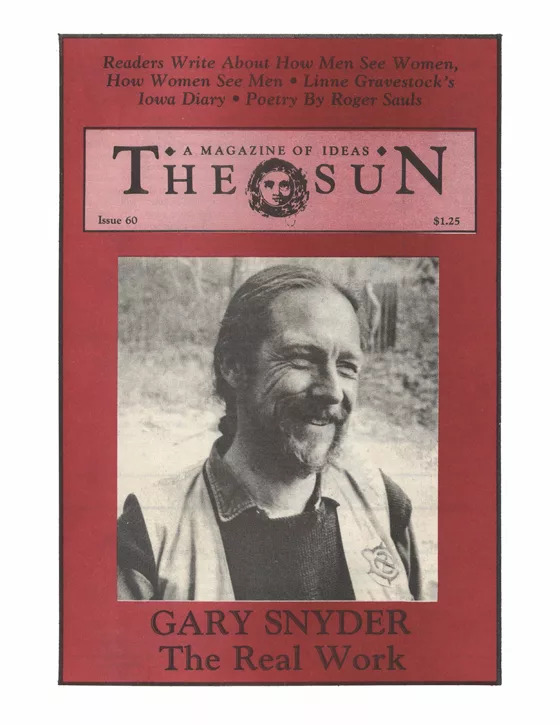
The Real Work is a classic of enlightened common sense and one of the best books I’ve read in years.
Editor Scott McLean describes this collection of interviews and talks given by Gary Snyder from 1964 to 1979 as “good, plain talk with a man who has a lively and very subtle mind and a wide range of experience and knowledge.”
Snyder is one of America’s clearest thinkers and most respected poets. His influence on the literary and cultural landscape has been profound — from the early beat days up to the present.
As the fabled Japhy Ryder in Jack Kerouac’s Dharma Bums, he was described as “strangely Oriental-looking with his somewhat slanted green eyes . . . wiry, suntanned, vigorous, open, all howdies and glad talk and even yelling hello to bums on the street and when asked a question answered right off the bat from the top or bottom of his mind I don’t know which and always in a sprightly sparkling way.”
This was in the heyday of the San Francisco renaissance in the fifties, the beginning of the beat poetry movement, in which Snyder participated with Allen Ginsberg, Philip Whalen, Kenneth Rexroth, and Michael McClure. His poetry then, as now, in McLean’s words, drew “its substance and forms from the broadest range of a people’s day-to-day lives, enmeshed in the facts of work, the real trembling in joy and grief, thankfulness for good crops, the health of a child, the warmth of a lover’s touch. Further, Snyder seeks to recover a poetry that could sing and thus relate us to: magpie, beaver, a mountain range, binding us to all these other lives, seeing our spiritual lives as bound up in the rounds of nature.”
Snyder was born in San Francisco in 1930 and grew up in the rural Pacific northwest. In college, he studied anthropology, literature, and languages. He worked as a seaman, a logger, a lookout in Mt. Baker National Forest, and in other outdoor jobs. In 1956, he went to Japan, and lived for a year and a half in a Zen temple. In 1959 he returned to Japan and lived there until 1968.
With his wife, Masa, and their two children, Gen and Kai, Snyder lives in the foothills of the Sierra Nevada — without electricity or telephone, among neighbors with a similar ecological outlook. He divides his time between farm and forestry work, planetary environmental politics, poetry, and work on a prose study of China and nature.
These are some of his concerns in The Real Work. He is as attentive to the outer world as he is to the inner structures of mind. The sub-headings suggest the range of his interests: power-vision in solitude; Japanese counter-culture; tribal social organization; meditation and the authenticity of experience; nature and animal symbolism; demons of the unconscious; bioregionalism. The Real Work is a celebration of Snyder’s deep reverence for all forms of life.
Snyder’s books include Riprap and Cold Mountain Poems, Myths and Texts, The Back Country, Earth House Hold, Six Sections from Mountains and Rivers without End, Regarding Wave, and the Pulitzer prize winning Turtle Island.
We’re thankful to New Directions for permission to print the following excerpts from The Real Work.
— Ed.
From The Real Work, Interviews & Talks 1964-1979 by Gary Snyder
FOWLER: You have written that as a poet you “hold the most archaic values on earth . . . the fertility of the soil, the magic of animals, the power-vision in solitude, the terrifying initiation and rebirth, the love and ecstasy of the dance, the common work of the tribe.” Do these values enter, pretty much at a conscious level, into your selection of subjects to treat and poetic tools to use or reject?
SNYDER: Not really at a conscious or deliberate level, I think. These values are very basic to me, and to my friends. They’re, in the Buddhist sense, rooted in the belly; and this is where the breath starts, so where the poem starts. I think these concerns are basic to everyone, but most don’t think about them, aren’t aware of them. They buy vegetables in the supermarket, but don’t think about the soil these grow in; they keep pets, but don’t look into an animal’s eyes and see an intelligence there, a sensibility; they are driven into solitude, into their own personality, by the stresses of our culture, but don’t look for new strength there. . . .
As for the common work of the tribe: most think they’re working for themselves; but that just isn’t how it is. My poems, on one level, call the society’s attention to its ecological relationships in nature, and to its relationships in the individual consciousness. Some of the poems show how society doesn’t see its position in nature. What are we going to do with this planet? It’s a problem of love; not the humanistic love of the West — but a love that extends to animals, rocks, dirt, all of it. Without this love, we can end, even without war, with an uninhabitable place.
I’d emphasize again the importance of a sense of community, a need for the poet to identify with real people, not a faceless audience. There should be less concern with publishing, more with reading. A reading is a kind of communion. I think the poet articulates the semi-known for the tribe. This is close to the ancient function of the shaman. It’s not a dead function. The poet needs a long view. He can’t just plan in terms of a few poems to be done immediately. He may be eighty years old before he’s ready to do his masterwork. The creative imagination doesn’t stop growing like the body. It keeps growing and getting ready to strike deeper into the basic relationships between the personal perception, the social ritual movements, and nature. Poetry is a life’s work.
One of my poems [“February,” in The Back Country] is about doing a lot of little chores around the house. It is very close to what I am thinking of, in a very obvious way, of the act and the thought being together. And, in that sense, there is a body-mind dualism if I am sweeping the floor and thinking about Hegel. But if I am sweeping the floor and thinking about sweeping the floor, I am all one. And that is not trivial, nor is the sensation of it trivial. Sweeping the floor becomes, then, the most important thing in the world. Which it is.
. . . I was working for a trail crew up in Yosemite Park. I found myself doing three months of long, hard physical labor, out on the trails every day, living more or less in isolation, twenty-five miles from the nearest road. We never went out. We just stayed in there working on those trails week after week. At the beginning, I found myself straining against it, trying to exercise my mind as I usually exercise it. I was reading Milton, and I had some other reading, and I was trying to go out on the trails during the day and think about things in a serious intellectual way, while doing my work. And it was frustrating, although I had done the same thing before, on many jobs. Finally, I gave up trying to carry on an intellectual interior life separate from the work, and I said the hell with it, I’ll just work. And instead of losing something, I got something much greater. By just working, I found myself being completely there, having the whole mountain inside of me, and finally having a whole language inside of me that became one with the rocks and with the trees. And that was where I first learned the possibility of being one with what you were doing, and not losing anything of the mind thereby.
FLAHERTY: In Zen, they speak of satori. How does this influence your poetry?
SNYDER: I don’t lay claim to any great enlightenment experiences or anything like that, but I have had a very moving, profound perception a few times that everything was alive (the basic perception of animism) and that on one level there is no hierarchy of qualities in life — that the life of a stone or a weed is as completely beautiful and authentic, wise and valuable as the life of, say, an Einstein. And that Einstein and the weed know this; hence the preciousness of mice and weeds.
FLAHERTY: How does the state or condition of meditation fit into your notion of the authenticity of experience?
SNYDER: There’s nothing exotic about meditation. It’s a birthright of everybody. Animals know all about it. Animals have the capacity of sitting still and tuning in on their own inside consciousness, as well as the outside consciousness, for great periods of time. And they can restore themselves by doing that; you can see them doing it. The calmness of deer at rest at midday is the order of meditation. . . .
It’s a great oversight not to take the time to look at what your mind is doing and what your body is really like and what speech is when something rises from within, that makes you want to utter a sound. So meditation is sitting still and cutting off the inputs and the distractions and the things that are always leading you from one thing to the next thing to the next — just stopping that stream of often very trivial and inattentive acts and creating a condition of attention in which you look within and try to see what the mind is doing on its own within you — a completely natural thing to do.
Meditation is a very broad term which includes a number of different interior exercises that can be done once put in a position of no inputs. The condition of no inputs is best achieved by sitting in the half-lotus or the full-lotus with your back straight in a quiet place and breathing in a certain way from the diaphragm. So posture is important. Then, if you’re working as a Buddhist, according to the tradition that you are studying, your meditative exercises may proceed in several possible directions although ultimately they will all complete the different areas that they are exploring. One may start out exploring a certain way but they will all come back to the complete view of the whole eventually. . . .
All of us will come back again to hoe in the ground, or gather wild potato bulbs with digging sticks, or hand-adze a beam. . . . We’ve been living a dream that we’re going to get away from it. . . . That work is always going to be there. It might be stapling papers, it might be typing in the office. . . . The real work is what we really do. And what our lives are.
Poetry comes into this at many levels. Poetry is before it begins in a sense. Like stopping a person momentarily in their tracks with a poem they have happened to look at accidentally and they forget that they were to catch a bus somewhere and they look around and think: My God, I’m living in the world! Or like the great enlightened poet saints like Milarepa or Zen Buddhist masters who wrote poetry. They wrote poetry at the height of their delight, the sheer play of being. Or they would trade poems with each other that other people had written. So the poem always stands there as almost the essence of it. And the beauty of it is that at the beginning and at the end it is equal. That the poem is as valid for the Zen master who is seeing through it, as it is for the man on the street who suddenly remembers that it is spring because the poem has turned his head from his preoccupation. That’s one way of looking at it. Another way is to simply see it as classes of poems that work in different ways. That’s historically true. There are work poems, love poems, war poems, or actually songs. In a sense poetry is really the dance at the top of the whole process because it’s going out into emptiness and into the formless which is the nature of pure joy. And what do you do then? You sing. . . .
The true poem is walking that edge between what can be said and that which cannot be said. That’s the real razor’s edge. The poem that falls all the way over into what can be said can still be very exciting, but the farther it is from the razor’s edge the less it has of the real magic. It can be very well done but the ones that make your hair stand on edge are the ones that are right on the line. And then some of them fall too much in the realm of what can’t be said.
Then they are no longer poems; they are meditation themes like the koan, or they are magical incantations, or they are mantras. Mantras or koans or spells are actually superelliptical poems that the reader cannot understand except that he has to put hundreds of more hours of meditation in toward getting it than he has to put in to get the message out of a normal poem. And the experience is correspondingly more profound than a reader usually experiences with a poem. But then it is the property of a very special practice.
GROSSINGER: What would you say to people who say that they’re isolated?
SNYDER: In relation to what? Nobody is really ever isolated. The question seems to be whether or not they’re able in whatever, say, lonely region they think they’re in, to have a cooperative or semi-cooperative community function . . . or to what degree sharing takes place with neighbors, and in that process, to what degree the circle of neighbors is able to establish a sense of its own center, its own knowledge, its own magic . . . or it remains dependent on news from outside, and thus feels continually in a cultural backwater. This is one of the strangest problems of this century . . . that business of whether or not you can feel you’re at the center or whether or not you feel you’re in a backwater. It’s paradoxical that Portland, Maine, feels like it’s a backwater, but maybe some hippie commune deeper in the hills doesn’t feel like it’s a backwater.
To serve mankind’s interests well and to make the greatest possible development of the creative potential available does not require either numbers of human beings or a complex society. The exploration of consciousness itself and the unfolding recognition of the same principles which are at work in our minds as being the exact principles that are operating around us is the most beautiful of possible human experiences, at least for some time to come yet. . . .
As the American Indians, as the Pueblo assert, we are in a transition phase right now: between having lost our capacity to communicate directly, intuitively, and to understand the life force, and the return to that condition. We are doing hard practice, hard yoga on Earth for these thousands of years because of some errors we made. But our practice will win us back that skill, that capacity, that direct knowledge of the forces and energies of the universe. Those cannot be won by scientific inquiry or fancier tools; those can only be won by the most complex and sophisticated tool there is, the mind.
NYQ: You said at one point that you felt you needed a great deal of solitude to write —
SNYDER: Not just to write, to live.
NYQ: Are you a seasonal poet? Do you write more in the fall than in the spring?
SNYDER: Well, the way I live right now, I guess I probably write more in the winter. Because in the spring I go out in the desert for a while, and I give a few readings, and then when I get back it’s time to turn the ground over and start planting, and then right after that’s done it’s time to do the building that has to be done, and then when that’s done, it’s time to start cutting firewood, and then when the firewood’s done, it’s just about time to start picking apples and drying them, and that takes a couple of weeks to get as many apples as possible and dry them, and then at the end of the apple season I begin to harvest the garden, and a lot of canning and drying is done maybe, and then when that season passes, to chestnuts and picking up the wild grapes, and then I’ve got to put the firewood in, and as soon as I get the firewood in, hunting season starts — and that winds up about the end of October with Halloween festivities, and then I go East for a month to read. So December, January and February is my time of total isolation, writing; and I don’t see anybody in those months.
NYQ: When you say solitude, do you mean literally alone?
SNYDER: Well, no, my family is with me, and there are neighbors to walk to. It’s also during those months that we’re most cut off, no electricity anywhere, no phone; the roads get snowed in and you can’t get to my place. So the actual reading and writing is part of a seasonal process for me now. Although, of course, if you can get a poem going any time of the year, you’ll do it — but to concentrate on that deeply, to get a lot of reading done, is a winter three-month chance.
There’s something about craft that we haven’t touched on — I can’t throw any light on it, really; I’d just like to suggest it as something to keep in mind, and that is: How do you go about — what kind of criteria do you employ — in feeling that a poem is well crafted? How do I feel when I feel a poem is well crafted? It’s an extremely subtle thing, but part of it can be described in no other way than taste. There is an intuitive aesthetic judgment that you make that in part spots phoniness, spots excess, spots the overblown, or the undersaid, the unripe, or the overripe, and feels its way out to what seems just right, and that balance is what I work for, just the right tone, just the right balance for the poem to do just what I wanted it to do. Or I shouldn’t phrase it that way — for the poem to be just what it wanted to be. Then it takes on a life of its own, and it loses no energy in the process.
JACOBY: That leads me to another question I wanted to ask about rhythm. I remember when Riprap came out I’d seen a prose statement that said that the rhythms of the poems came from the rhythms of the physical labor, or riprapping, and the other work described. Now that you’re not doing physical labor, do you have similar places to catch rhythms from?
SNYDER: Well, it’s a mistake to assume that I’m not doing physical labor.
JACOBY: If you built your own house, I guess it is. . . .
SNYDER: I not only built my own house, I do everything else around it continually. I’m farming all the time: cutting six cords of firewood for the winter, planting fruit trees, putting in fencing, taking care of the chickens, maintenance on the car, and maintenance on the truck, doing maintenance on the road. There’s an enormous amount of physical work to be done.
That’s a kind of work rhythm to be sure . . . which is just good old rural life work rhythms. Though I think probably the rhythm I’m drawing on most now is the whole of the landscape of the Sierra Nevada, to feel it all moving underneath. There is the periodicity of ridge, gorge, ridge, gorge, ridge, gorge at the spur ridge and tributary gorges that makes an interlacing network of, oh, 115-million-year-old geological formation rhythms. I’m trying to feel through that more than anything else right now. All the way down to some Tertiary gravels which contain a lot of gold from the Pliocene. Geological rhythms.
Everything is going to be new politics now. It’s all going to be energy politics. Everything is going to be redrawn. The realignments of the nations of the world according to their own access to energy is now taking place. Everybody thought it was money that counted before. Now it turns out that the only real wealth is oil. That is real wealth. You can’t burn money — I mean you can’t get much heat out of it when you burn it. You can light a cigar with it, and that’s about all. So oil is now the real wealth, fossil fuels. The actual “real wealth” is knowing how to get along “without.” Now which of those is the real wealth? “Do more with less,” as the slogan goes. In other words, human mind-energy capacities, human intelligence capacities as against mechanical and fossil-fuel-fired capacities. This is a marvelous time in which the nations of the world may get a new balance and a perspective on themselves — if it doesn’t degenerate into hysteria and short range crisis thinking. . . . We should try to allay anxiety and spread confidence in the natural beauty of the human mind and the natural dignity of life at its normal, natural, ancient, slower pace. I think that creative people, poets, religious people, if they wish to speak, have a message which is of great value now . . . although whether or not anyone will heed it is another question.
GENESON: For you personally, what is the attraction of the rural life?
SNYDER: Well, apart from arguments about poetry, and city or country, it’s obvious that city life has become difficult. It’s quite obvious. And it’s only natural that people should look for other ways to live. There is an implicit satisfaction in rural life, and in backcountry life — at least for some people. The pleasures are numerous and the work is hard, and one is literally less alienated from one’s water, one’s fuel, one’s vegetables, and so forth. Those are fundamentals, those are ancient human fundamentals.
And it wouldn’t be going too far to say that human creativity and all of the arts will begin to wither if they are pulled too far away from fundamentals of how people really should and have had to live, over millennia. We are, after all, an animal that was brought into being on this biosphere by these processes of sun and water and leaf. And if we depart too far from them, we’re departing too far from the mother, from our own heritage.
The problem is, where do you put your feet down, where do you raise your children, what do you do with your hands. Now, working in a tanker with my body and with my hands in the engine room of a ship is in some ways less alienated than it would be to sit and look at this beautiful view, talking constantly on a telephone and typing on a typewriter and never touching it. It’s the use of the body and the involvement of all the senses that is important at that point.
I think that young people who want to have a teacher should not look at a university as a university, but look for the teacher. If the teacher happens to be a professor in the university, that’s all right. But if not, not. In either case you go to that person directly, not to the administration building, and you say, “I want to be your student. What do I have to do?” And in doing that you expand the relationship into something more personal, more menial, more direct.
The model for that, for me, is the Japanese potters who take apprentices. And the thing that the apprentice first learns how to do is mix clay. Or Japanese carpentry apprentices who will spend months learning how to sharpen chisels and planes before they ever touch the tools to do work. You could learn as much from a good mechanic and how parts go together, and how you move and what goes in what order. . . . A master is a master. If you saw a man who was a master mechanic you’d do better — say you wanted to be a poet, and you saw a man that you recognized as a master mechanic or a great cook. You would do better, for yourself as a poet, to study under that man than to study under another poet who was not a master, that you didn’t recognize as a master. . . .
There are true poets who can’t teach because they’re hooked onto inspiration, spontaneity, voice, language — they do it but they’re not grounded in details. They don’t really know the materials. A carpenter, a builder knows what Ponderosa pine can do, what Douglas fir can do, what incense cedar can do and builds accordingly. You can build some very elegant houses without knowing that, but some of them aren’t going to work, ultimately.
And so, I’m saying that behind the scenes there is the structural and the fundamental knowledge of materials in poetry, and learning from a master mechanic would give you some of those fundamentals as well as studying from an academician, say.
Finally, I gave up trying to carry on an intellectual interior life separate from the work, and I said the hell with it, I’ll just work. And instead of losing something, I got something much greater.
I learn about my craft as a poet. I learn about what it really takes to be a craftsman, what it really means to be committed, what it really means to work. What it means to be serious about your craft and no bullshit. Not backing off any of the challenges that are offered to you. You know, like not being willing to read books, for Christ’s sake. You run into people who want to write poetry who don’t want to read anything in the tradition. That’s like wanting to be a builder but not finding out what different kinds of wood you use.
GENESON: W. H. Auden said about poetry that it won’t change anything. Is that how you see poetry?
SNYDER: Ezra Pound, said, to quote an oft-quoted line, that artists are the antennae of the race. How that probably functions in the practice is that some people’s sensibilities, as well as maybe their lifestyles, are out at the very edge of the unraveling cause-and-effect network of a society in time. And also are, by virtue of the nature of their sensibilities, tuned into other voices than simply the social or human voice. So they are like an early warning system that hears the trees and the air and the clouds and the watersheds beginning to groan and complain a little bit. And so they try to send a little bit of a warning back, although they themselves may not know what it is they’re hearing. They also can hear the stresses and the fault block slippage creaking in the social batholith and also begin to give out warnings.
What proceeds on that is, for the poet in particular, a sense of the need to look at the key archetype image and symbol blocks and see if the blocks are working. Poetry effects change by fiddling with the archetypes and getting at people’s dreams about a century before it actually effects historical change. A poet would be, in terms of the ecology of symbols, noting the main structural connections and seeing which parts of the symbol are no longer useful or applicable, though everyone is giving them credence. And out of his own vision and hearing of voices he seeks for new paths for the mind-energy to flow, which would be literally more creative directions, but directions which change politics. Poets are more like mushrooms, or fungus — they can digest the symbol-detritus.
GENESON: Some of the things you were writing in the fifties and sixties are just beginning to be talked about today: the preservation of the forests, and the whole general ecology, which seems to have reached near crisis —
SNYDER: Yes. But that’s only one side of it. The work of poetry is really not the work of prophecy. Nor is it, ultimately, the work of social change. That’s just part of it. The other part of it is in the eternity of the present, and doesn’t have to do with evolutionary processes at all, but has to do with bringing us back to our original, true natures from whatever habit-molds that our perceptions, that our thinking and feeling get formed into. And bringing us back to original true mind, seeing the universe freshly in eternity, yet any moment.
GENESON: You would like to see poetry “grounded” essentially, rather than off in some metaphysical flight?
SNYDER: I would like to see people “grounded.”
GENESON: In touch with their environment?
SNYDER: In touch with their own lives.
GENESON: With their bodies?
SNYDER: Yes. And let the poetry do what it wants from that. Get the people grounded and the poetry’ll take care of itself.
Let me expand on that. To be a poet you have to be tuned into some of the darkest and scariest sides of your own nature. And for a male, the darkest and scariest is the destructive side of the female. . . .
As an infant in your dependence you trust, and in a sense crave, the female to be beneficent, because of the helplessness. The mother is, in general, the nourisher. But the female, as well as the male, also has a negative side. To a male child the negative side of the mother is the darkest, scariest thing he can perceive. What could be scarier than that? A bunch of scary warriors coming through would be rationally acceptable — they’re not your mother, at least.
So a woman who, of her own nature, has a dark side — she will also be creative. Something is triggered by being a witness to that most paradoxical of human situations, witnessing the dark and light side of the mother simultaneously. Most people only witness the light side of the mother. Literally. They only see the bright side of the mother, in one way or another. But some people see the dark side of the mother. If you only see the dark side you probably go crazy. The poet holds the dark and the light in mind, together. Which, by extension, means birth and death in its totality. We worship not only the positive forces, the life-giving forces — not just that. We can all say, “Ah, planet earth biosphere, mother earth, mother wonderful — all these green plants.” But there’s also death, there’s also the unknown, there’s also the demonic. And that’s the womb and the tomb, that’s samsara, that’s birth and death, that’s where the Buddhists go in. And that’s where poetry goes in: That’s where poetry gets its hands on something real. And it is triggered, I think — in many people I know it is triggered by seeing that in their infancy as a condition of the universe in the psychology of their own life.
There are two kinds of human sets that we all relate to. One is our network and the other is our community. Some peoples don’t have communities to relate to and only relate to the network. The network is like: all the dentists in the United States have a magazine and they have conferences and they all talk the same lingo and don’t talk to anybody else. That’s a network. There’s a poet’s network. And I correspond with poets all over the U.S. and other parts of the world. We have a lot in common — a lot of shoptalk with each other. There’s a network of intellectuals, university professors, students, graduate students, ecological radicals, and so forth that I’m connected with. That gives me a certain sustenance and part of my work lies with that. . . .
But there’s also the community, who are the people in the place that you live. The thing about a network is that everybody speaks the same language and more or less agrees with each other. The thing about a community is that you don’t all agree with each other and there are problems that you have to live with and work out over a long scale of time. I find for my work and my own spiritual growth that the kind of life that happens in a community is, if anything, more valuable than that of the network. Because the network really does encourage you to think that you’re important, but the community doesn’t. I have followers, if you want to use the word, across the U.S. in the poetry and Zen Buddhist networks. I don’t have followers on the San Juan Ridge because we all know each other too well. . . .
Poetry is not about lifestyle. And my Zen Dharma is not about lifestyle really. On a low level, lifestyle on a low level.
KOWAL: Oh, but it’s still there.
SNYDER: But it’s not much. Living your life is living your life.
KOWAL: Yes, but you’ll say something like “walked out this morning and saw deer shit on the trail” and that’ll turn somebody in the city onto a whole different lifestyle.
SNYDER: Or it completely leaves them cold. They don’t give a shit about deer shit in the road.
KOWAL: Oh, I bet they do.
SNYDER: I know people who’d say, “Go out there in the woods? Are you kidding?” You need a broader reach than that. And poetry has to have a broader reach than that. The city is just as natural as the country, let’s not forget it. There’s nothing in the universe that’s not natural by definition. . . .
KOWAL: Do you approach writing as a job?
SNYDER: Well, some kinds of writing like translations and essay writing I approach like I’m building a chicken coop. You get your materials laid out; you make your plans. And you go right ahead and do it. Writing poetry’s not like that. Writing poetry is delicate and unpredictable and requires a continual openness to inner surprises and a willingness to pay attention to very subtle signs. If you don’t notice them, you slide over them and miss the point.
KOWAL: Do you consider yourself to be a very open person? Sometimes I think of you as a very open person and sometimes very closed.
SNYDER: Open and closed is always a two-way thing. I’m open to people who approach with good manners and I’m closed to people who don’t. People who don’t realize that everybody has their own space and everybody is busy doing something. You have to go through certain steps and certain rituals in approaching somebody else’s territory, just like two squirrels or two hawks. Americans are terrible that way.
I try to approach others carefully and to assess whether or not I’m welcome and whether or not they have the time to talk to me. And I would only ask the same of others.
There is a very fine spiritual line that has to be walked between being unquestioning/passive on the one hand and obnoxiously individualistic/ultimately-trusting-no-one’s-ideas-but-your-own on the other. I don’t think it’s uniquely American; I think that all people have these problems on one level or another. Maybe that’s one meaning of the Middle Way: to walk right down the center of that. In one of the Theravada scriptures the Buddha says, “Be a light unto yourself. In this six-foot-long body is birth and death and the key to the liberation from birth and death.” There is one side of Buddhism that clearly throws it back on the individual — each person’s own work, practice, and life. Nobody else can do it for you; the Buddha is only the teacher.
The overwhelming problem of Americans following the spiritual path is that they are doing it with their heads and not with their bodies.
If there is any one thing that’s unhealthy in America, it’s that it is a whole civilization trying to get out of work — the young, especially, get caught in that. There is a triple alienation when you try to avoid work: first, you’re trying to get outside energy sources/resources to do it for you; second, you no longer know what your own body can do, where your food or water come from; third, you lose the capacity to discover the unity of mind and body via your work.
The overwhelming problem of Americans following the spiritual path is that they’re doing it with their heads and not with their bodies. Even if they’re doing it with their heads and bodies, their heads and bodies are in a nice supportive situation where the food is brought in on a tray. The next step, doing their own janitorial work and growing their own food, is missing except in a few places.
We are six-foot-long vertebrates, standing on our hind legs, who have to breathe so many breaths per minute, eat so many BTUs of plant-transformed solar energy per hour, et cetera. I wouldn’t like to separate our mindfulness into two categories, one of which is your forty-minute daily ritual, which is “practice,” and the other not practice. Practice simply is one intensification of what is natural and around us all of the time. Practice is to life as poetry is to spoken language. So as poetry is the practice of language, “practice” is the practice of life. But from the enlightened standpoint, all of language is poetry, all of life is practice. At any time when the attention is there fully, then all of the Bodhisattva’s acts are being done.
I’ve had many teachers who have taught me good practices, good habits. One of the first practices I learned is that when you’re working with another person on a two-person crosscut saw, you never push, you only pull; my father taught me that when I was eight. Another practice I learned early was safety: where to put your feet when you split wood so that the ax won’t glance off and hurt your feet. We all have to learn to change oil on time or we burn out our engines. We all have to learn how to cook. By trial and error, but also by attention, it gets better. . . .
From many people I learned the practice of how to handle your tools, clean them, put them back; how to work together with other men and women; how to work as hard as you can when it’s time for you to work, and how to play together afterwards. I learned this from the people to whom I dedicated my first book, Riprap. I came also to a specific spiritual practice, Buddhism, which has some extraordinary teachings within it. The whole world is practicing together; it is not rare or uncommon for people who are living their lives in the world, doing the things they must do, if they have not been degraded or oppressed, to be fully conscious of the dignity and pride of their life and their work. It’s largely the fellaheen oppression and alienation that is laid down on people by certain civilized societies throughout history that breaks up people’s original mind, original wisdom, the sense and sanity of their work and life.
GENESON: In your poem, “The Real Work,” you mention that the “real work ” is
washing and sighing,
sliding by.
What exactly is “the real work”?
SNYDER: I’ve used that phrase, “the real work,” a few times before. I used that term, “the real work,” and then I asked myself a lot: what is the real work? I think it’s important, first of all, because it’s good to work — I love work, work and play are one. And that all of us will come back again to hoe in the ground, or gather wild potato bulbs with digging sticks, or hand-adze a beam, or skin a pole, or scrape a hive — we’re never going to get away from that. We’ve been living a dream that we’re going to get away from it, that we won’t have to do it again. Put that out of our minds. We’ll always do that work. That work is always going to be there. It might be stapling papers, it might be typing in the office. But we’re never going to get away from that work, on one level or another. So that’s real. The real work is what we really do. And what our lives are. And if we can live the work we have to do, knowing that we are real, and it’s real, and that the world is real, then it becomes right. And that’s the real work: to make the world as real as it is, and to find ourselves as real as we are within it.
From Gary Snyder, THE REAL WORK,
Interviews & Talks 1964-1979.
Copyright © 1980 by Gary Snyder.
Reprinted by permission of New Directions.