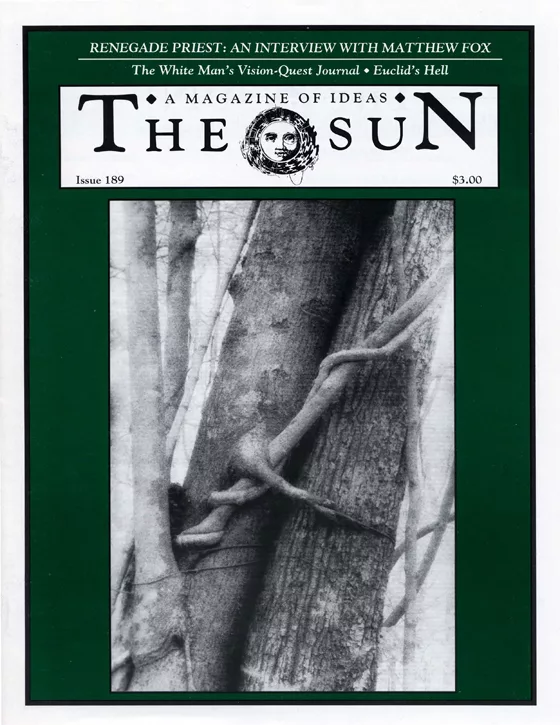
For many, God is a forbidding patriarch unwilling to forgive us the episode in the Garden — an aloof being who got the ball rolling and now sits back with finger wagging. Matthew Fox has struggled to promote a radically different view, one that celebrates a God very much in the world, no farther away than the earth beneath our feet or the presence of a loved one.
Fox rejects the notion of original sin central to much of contemporary Church doctrine. Instead, he urges a cosmology of creation in which God’s design is an ongoing — and unfinished — piece of work. True reverence, Fox argues, flows not from our terror before a vengeful God, but from the sense of mystery that the universe evokes.
Fox’s criticisms are made all the more pointed by the fact that they emerge from within the citadel of the Church itself. Born in Madison, Wisconsin, in 1940, Fox entered the Dominican order in his late teens. Since his ordination in 1967, Fox has set forth his views in Original Blessing, The Coming of the Cosmic Christ, and A Spirituality Named Compassion. He founded the Institute of Culture and Creation Spirituality in 1978, and currently serves as editor-in-chief of Creation magazine. Two years ago, in response to his writings, the Vatican sentenced him to twelve months of public silence. In hopes of maintaining his standing with the Church, Fox yielded, and spent the year writing and traveling. In that time, he met with theologians and pastoral leaders in Europe and Latin America, and went on a Native American vision quest in the Pacific Northwest. While Fox agreed to acquiesce to the Church’s decree, he has intimated that he might not do so a second time.
Michael Toms, the executive producer of “New Dimensions,” a nationally syndicated series of radio interviews, talked with Matthew Fox before the Vatican’s announcement of censure took effect.
— T.L. Toma
TOMS: When did your view, which is very different from the one normally associated with the traditional Church, first become fully alive in you? There had to be a turning point, a transition point.
FOX: I got a basically sane approach to spirituality from my family — especially from my mother — but this was beaten down as I went deeper into American education. For example, I used to write poetry as a child. But as soon as I hit college, it just went underground for years. When I went to study in Paris, at the advice of Thomas Merton, it all came washing back.
It was there that Father Chenu, who is now an eighty-six-year-old radical French Dominican, first explained the creation tradition for me. It made so much sense! He described the burden of dualism, the fear of the body, the put-down of artists, the put-down of women, and so on, that had characterized so much of my formal training in the seminary but did not correspond to my deepest spiritual needs.
Chenu named the two traditions for me: the dualistic tradition in the West, that has certainly dominated, and the holistic tradition that we need to know more about. The tradition of original blessing is far older than that of original sin. It’s the oldest tradition in the Bible. It goes back to the ninth century B.C. The idea of original sin arrived in the fourth century A.D. with Saint Augustine — very late! Jesus never heard of original sin. And no Jew has.
Elie Wiesel says that “the idea of original sin is alien to Jewish thinking.” This idea introduces a suspicion of our right to be here in the universe, and of the beauty that we bring to the universe. We’re talking about our origins — and the way people feel about their origins, and the twenty-billion-year history that has brought us to this point, is very significant.
Meister Eckhart says, “When I flowed out of the Creator” (meaning when he was born), “all creatures stood up and shouted, and said, ‘Behold, here is God!’ and they were correct.” Now that’s creation theology, which says that we’re not only not worms — and guilty worms! — but that we are divine. We bring an image of divinity into the universe that is unique and surprising, and that’s why the whole universe celebrates our existence. When parents start teaching children this, and our institutions encourage it, we will have a totally different society.
TOMS: Are there other individuals who are functioning this way within the institutional structure? Is this something that’s happening in the Church?
FOX: It’s definitely happening in the Church. The despair of our times is causing a lot of people to take another look at their religious roots. And I think that the harder you look at the Christian roots, the more you have to go back to the Jewish roots, the farther back you go, the more you realize you are talking about a creation theology, a holistic theology.
This whole tradition links to the native traditions — the Native American, native European, and native African, among others. I’ve had African students, Latin American students, Asian students, who catch on to this immediately. Just a week ago, for example, during a program in Philadelphia, a young Filipino man came up to me and said, “I can hardly wait to go back and teach this! I’m going to have our people dancing our traditional dances, singing our traditional hymns. Now I see a link between Christianity and our native roots.” Part of the colonization of native peoples everywhere has involved a denial of the wisdom of their spiritualities. But the creation tradition welcomes this wisdom; it’s a real bridge from Christianity, which is a latecomer, to these traditions that are tens of thousands of years old.
TOMS: You mentioned original sin. What about the concept of sin in the creation-centered tradition?
FOX: To begin a theology with sin is to leave out 19,996,000,000 years of the universe’s work. It ends up trivializing sin. Our religious vocabulary doesn’t have the words for the real sins of our times because it has no conception of cosmos. We have to address the sins against the cosmos: the sin, for example, of destroying the marvelous network and balance between trees, animals, fish, and two-legged ones.
Science is just beginning to talk about the good news — the amazing gift that the universe is. For example, the only water we know of in the whole universe is here, on this earth. We’re talking about water, the sacred, holy gift of water, that it took the universe twenty billion years to invent and make flow on this earth. You don’t have to rebaptize the water.
We have to get back to the holiness of our existence, the fact that this earth, four billion years ago, had to maintain a precise and narrow set of conditions before life could come about. None of us would exist without this gift of the original blessing of the universe.
This is where we should begin all our theologies, with the wonder and the gratitude which is really what prayer is about — thankfulness for existence. Then you move into the responsibilities, and from there you move into areas of sin. But everyone is always talking about sin. Christians should begin with the notion of original blessing. Then, by developing the wondrous powers of the human race — especially for imagination and creativity, which is our divine power — we can work ways out of sin. The creation tradition does indeed deal with sin, but we refuse to begin with it.
TOMS: When one pursues spiritual growth, personal growth, some critics suggest that one becomes less socially conscious. There’s the image of the monk on the mountain who is totally uninvolved in what’s going on in the world. But your work is very much involved in the social fabric of the society and the culture.
FOX: In the tradition that embraces original sin, in the dualistic tradition, you must withdraw from the world to be spiritual. This isn’t so in the creation-centered tradition. It is a tradition of the prophets, who were very much involved in the struggle, the suffering, and the responsibility for their culture. Meister Eckhart, who was the greatest single articulator of this tradition in the West, was fully involved in the women’s movement, and in the peasant awakening of his day. And this had everything to do with his condemnation. It was a political condemnation, as so many have been. Hildegard of Bingen, the great twelfth-century Benedictine nun, was a painter, poet, prophet, criticizer of popes, bishops, archbishops, abbots — she was thoroughly involved in the politics of her day. Father Chenu, my mentor, was silenced by Pius XII for twelve years because he had joined the worker-priest movement in the late 1940s in France. He paid the price of a prophet. But he was reinstated by the Second Vatican Council, which urged Catholics to find their spirituality in the world.
The social struggle is a struggle for visions, for what we believe in. It’s about whether our institutions are worthy of us, whether they’re as beautiful as we have a right for them to be, and as we want to pass on to our children. When you look at the prophets, the mysticism there has an energy that allows you to enter the struggles of everyday life, earthly institutions, giving birth to new ones, letting the old ones go, or surviving in those that are half-good and half-bad. We need energy to do that without selling our souls. We need to be in and not of these things. And that is where mysticism plays its authentic role — to bring the cosmos, to bring creativity, to bring beauty, to bring what I call erotic justice, personalized justice, into our institutions. To do this, you need a grounding in mysticism.
One of the real tragedies of Western culture is that we’ve put mystics in a closet — which means we’ve put ourselves in a closet, because every human being is a mystic, at least potentially. But academia has cut the mystic off from knowledge; as a result, we don’t have wisdom in our universities anymore, we have only knowledge and information. And churches have cut the mystic out of worship, so you’re left with a lot of words. But where’s the dance? Where’s the letting-go? Where’s the childlike-ness? Where’s the spontaneity — what Eckhart calls “unselfconsciousness”? This is what the churches should be teaching people. It can be done, especially through art. That’s what we’re doing in our institute, recovering art as meditation through play, dance, massage, painting, music — not to produce something, not capitalist art, but to enter into it, as process. This is what heals us and brings the cosmos in and makes us young again. Jesus said that until you adults turn and become like children, you’ll not receive the Kingdom and Queendom of God. Churches and synagogues should be inviting people to turn, to let go of some of our adult ways and become childlike again. Thus we recover our wonder, our appreciation, and our responsibility to the universe. Effective justice-making results from this. The prophet is the mystic in action.
TOMS: You mentioned the Second Vatican Council, and I think of Pope John XXIII and the impact that he had, not only on the Catholic Church but on the world.
FOX: He was so special. I met a priest in New Jersey a few years ago who told me this story. Back in the late 1950s, he was visiting Spain, and he stayed overnight in a seminary there. At one in the morning there was a knock on his door. A short, fat cardinal woke him and said, “Come with me, come with me.” The priest said, “I’m sleeping.” The Cardinal said, “Come with me.” So they went down to the dining room and there was an entire banquet laid out. The Cardinal said, “It’s the middle of the night; I couldn’t sleep. I had to cook myself something. I never eat alone, so mange, mange!” So at one in the morning they were eating this incredible banquet. A year later this cardinal, Cardinal Roncalli, was elected pope.
I remember the first picture I saw of John XXIII. He had a cigarette in one hand and a martini in the other, and he was kicking because his short, chubby feet never touched the ground. He was an Italian peasant. He was always kicking, telling stories. He was thoroughly creation-centered, you see. This is why he could tell the stories and people could relate to them, whether Jew or Moslem or Buddhist. He had a radical humanity about him.
There’s no question that there was a very special spirit, an avatar, who came our way in the person of John XXIII. I certainly am indebted to him. I grew up, theologically, under the Vatican Council. He brought back into the core of Catholicism theologians like Chenu and Teilhard de Chardin, who had been on the fringes.
TOMS: How has Teilhard de Chardin influenced your work?
FOX: Here’s a man who was scientist and poet and priest. He had a vision of what could happen when Western civilization brought science and theology together again. You can’t create a cosmology, which is the vision that moves people, without both scientific and religious myths.
Western culture, in the last three centuries, is the only tribe of human beings that imagined it could assign the soul to religion, and leave the cosmos to science. And what has happened? Today we’re seven minutes away from blowing up the world because some scientists, going the way of the cosmos without conscience, discovered the ultimate power of the cosmos. And religion today has so trivialized the soul that it puts people to sleep, in church and out of church.
Now we can stand on the shoulders of Teilhard, with a more mature science on one hand, and a fuller grounding of theology on the other. Mystery has returned to the universe, thanks to Einstein. Newton thought that the universe was essentially inert; it was settled, it was just getting along. But now we find matter is anything but inert. It’s so exciting that the physicists bubble when they talk about it. Matter is dancing. “A scenario of dance,” Fritjof calls it. That, combined with the creation spirituality, allows for amazing cross-fertilization. Scientists are human beings, too, and they are waking up to the issues of conscience that they’ve often turned off in the name of “objective science.” But Einstein has shown that no science is objective; it’s all relative to the observer. We’re learning what human arrogance is doing to our planet — much of it in the name of technology and science — and this is waking up a lot of scientists.
One of the ironic and perverse spectator sports of our time is to observe the religious fundamentalists on one hand and the fundamentalist scientists on the other, fighting each other head on. It’s really a pity. I think we can let go of fundamentalist science, which is science that does not take into account mysticism and mystery, and we can let go of fundamentalist religion, which is still arguing about whether the world was created six thousand years ago or twenty billion years ago. The Bible teaches that creation is going on all the time. Every time a flower blooms or a child is born or a friendship is struck up or a song is composed or a movement is organized, there is God creating, co-creating with us and with the rest of creation. We should let go of those fundamentalist, dualistic, either-or approaches to science or to religion, and begin to move with the cosmology that’s now emerging.
Western culture, in the last three centuries, is the only tribe of human beings that imagined it could assign the soul to religion, and leave the cosmos to science. And what has happened? Today we’re seven minutes away from blowing up the world because some scientists, going the way of the cosmos without conscience, discovered the ultimate power of the cosmos.
TOMS: Could you talk more about the connection between the creation-centered tradition and Native American peoples?
FOX: For the last couple of summers, I’ve gone to the Tekakwitha Conference, attended by about fifteen hundred Native American peoples. One summer I led a workshop on creation-centered ways and Native American ways with a Native American priest. When we ended, a Navajo woman turned to her parish priest sitting next to her and said, “Why did I have to come all the way to Montana to hear about this? All of my life has been split down the middle, between my native ways and my Christianity, and now I realize the split has been between my native ways and Saint Augustine,” who is the namer of original sin, the dualistic tradition in the West, the very patriarchal tradition that has dominated.
The wisdom of the native peoples — not just Native American, but also native European, native African, native Asian — is one of the great gifts of our time. Our efforts at genocide have not been successful precisely because one of the ways the earth has of saving itself from human chauvinism and arrogance is to bring back the wisdom of the native peoples. They have developed over the centuries ways of teaching people to befriend the earth, to befriend darkness, to deal with pain — ways that are gentle and celebrative and truly form community.
At one of these conventions, I was eating dinner with twelve Inuit people, and I happened to ask the woman sitting across from me, “Did you make that dress?”
“Oh, of course,” she said. And they told me, “She makes parkas, too.”
And then I asked the man next to me, “Did you make your bracelets?”
“Oh, yes, from the tusks of walruses.” I went around the table that way and learned that twelve out of twelve were artists. It’s taken for granted in native traditions everywhere that everyone is an artist. That’s what the Bible teaches: we’re all images of God. But industrial society and a dualistic theology have made us think that only geniuses are artists, only professionals are artists. As Eckhart teaches, the only work that is human and satisfying is art — that is, what we give birth to that goes from inside out.
And this is why the recovery of art as meditation is so essential, not only for putting everybody to work — which is one of the key issues of our time, for everybody to work — but to good work, where the returns are good for the community, for exercising imagination so we can begin to imagine different economic, political, educational relationships and ways of worship that will do us justice instead of bringing more pain.
Frederick Turner wrote a book called Beyond Geography, which is a history of America from the moment Columbus landed, from the point of view of the Native American — a little different reading. Turner calls it, in his introduction, “an essay in the history of spirituality,” which amazes me. His thesis — subtitled “Western Spirit Against the Wilderness” — is that white, European Christianity repressed the wilderness, that is, the sensual, the mystery, and the sexual, and then came over here and projected this repression onto the native peoples, calling them “savages” who needed “redemption.” And in that process genocide was legitimized.
TOMS: Would you regard Mother Teresa, and her work with poor people in India, as an example of creation-centered spirituality?
FOX: Not really. I would celebrate Dorothy Day before I would celebrate Mother Teresa, especially in the North American context. I would not venture to judge what’s possible in India, and I’m sure that Mother Teresa is doing superb and generous work in India with the destitute. I admire her. But I do think there’s a lack of social consciousness that is typical of the old dualistic spirituality. It’s a band-aid approach. I’m interested in a more justice-oriented and social and intellectual approach — a creative approach — to the overall malaise of the human race. There are reasons why there are so many destitute on the streets of India.
We need something much more than that kind of charity. In 1977, Buckminster Fuller said we could close down every university, every library, every computer in the world, and with the knowledge we then had, we could, within two and a half years, clothe and house and provide basic education, health care, food, and work for everyone in the world.
Now that’s the kind of approach I’m interested in. We’ve had the poor for centuries and centuries, and now we have more poor because we have more people. There’s really no reason for it except, as Fuller said, “We have the knowledge; we don’t have the will.” We don’t have the willingness to change our patterns of living and our frozenness in the institutions, in the closed structures we now have, to get on with the task of celebrating one another. So I really see Mother Teresa, as much as I respect her on an individual basis, as representing basically a familiar — and really a too-familiar — spirituality.
TOMS: When you wrote Original Blessing and some of your other books, did you have any idea that they would cause such an uproar in the Church?
FOX: No. I thought I was doing my job, recovering the spiritual tradition of the Church. But as Jung points out, the mystics — how does he put it? — are always a cross to the Church. Look at Church history: Eckhart was condemned, and he was our greatest mystic. Thomas Aquinas was condemned three times. John of the Cross had to run from the Inquisition his whole life, as did Teresa of Avila, whose autobiography was condemned.
Today, though, we cannot afford the luxury of being patient and obedient in this regard. The issue isn’t how am I getting on with Rome, it’s how is the planet getting on with our species. And I think that question takes us far beyond the sensationalism of a North American priest’s being honored in the fashion of these others of the past.
TOMS: It seems the censure creates the very thing Rome hopes to avoid. It brings great attention to this issue — perhaps to people who wouldn’t have otherwise noticed.
FOX: Why do they do this? Why do they pour gasoline on a fire? It’s akin to the machinations of a dysfunctional family. If you live in an isolated situation, which is how dysfunctional families survive, you don’t think about the consequences. You’re so busy dealing with your own struggle, your own neurosis, that you don’t see the world around you as it is. In the long run, what they’re doing is foolhardy. If they want creation spirituality to go away, they should be as quiet as they can. But it’s not going to go away because, in my opinion, this is the best of our tradition.
TOMS: In the opening part of The Coming of the Cosmic Christ, you deal with the number of deaths that are occurring on a planetary scale, and one of the deaths you refer to is the dying Church. What do you mean by the dying Church?
FOX: The Church in its present form, in its institutional form and its patriarchal expression, is clearly dying. In fact, it’s on a kind of suicide binge. I have an image of this great patriarchal dinosaur that is dying and its tail is flashing around and bringing others down with it — and the real problem is that it’s dying on top of its own treasure. Our job is, one, to stay away from that tail, and two, to try to get the dinosaur to roll over enough so that we can retrieve the treasure. Because I think that there are treasures there, especially around the mystical tradition, the prophets, the gospels.
It’s dying, just like other patriarchal institutions are dying, because the paradigm — the way of seeing the world — that the institutional Church has relied on for centuries is no longer adequate. The irony is that deep within the bosom of this same tradition there are useful paradigms. Just this morning I was lecturing on the Goddess tradition of the twelfth century that gave us Chartres Cathedral and 580 other churches the size of Chartres in France, all built in a hundred-year period and all dedicated to the Mother Goddess — that is, Mary. This was an amazing period, a period of renaissance and cosmology — which is what we need today. Patriarchy doesn’t have a cosmology. It reduces everything to mechanism and control. What we need is this influx of the Goddess tradition. It’s the cosmological tradition of the West.
TOMS: How would you view Mary in the context of Catholicism?
FOX: To the extent that we’ve emphasized Mary as Virgin and Mother in a human-centered context, we’ve missed the point. Mary is a cosmic center, an archetype of the wisdom that lies at the heart of the universe — and that is available in the heart of every human being. That, of course, is the essence of mysticism — which is heart knowledge.
The great line from Rilke, “the work of our eyes is done, now go and do heart work,” really moves me. That is the essence of the paradigm shift: we have to move more into mysticism and incorporate it with the accomplishments of our left brain. There has to be a spiritual awakening — I call it a global renaissance. And it has to be grass roots. Father Chenu says that the only renaissance that was effective in the West was the twelfth-century renaissance. Not the sixteenth, which is what we think of when we hear the term “renaissance,” but the twelfth. It was grass roots: women, peasants, the young. That’s what’s needed today. It could happen if all the world religions would let go of their excessive institutionalization and get more deeply into their mystical traditions. That’s why the archetype of the Cosmic Christ is so meaningful — because this tradition is in all the world religions. It’s called the “Buddha nature” that’s in all of us, if you’re a Buddhist. It’s the divine light that’s in all of us.
Religions of the world have never related at this level of mysticism. When Western European Christianity first encountered the wisdom of Native American, African, and Asian cultures in the sixteenth and seventeenth centuries, we had already deposed the Cosmic Christ. We had lost our own mystical tradition. We didn’t know the wisdom we had encountered. We were busy slaying the other religions. Today’s a different day, and I think mysticism could lead the way to a really authentic renaissance.
The wisdom of the native peoples — not just Native American, but also native European, native African, native Asian — is one of the great gifts of our time. Our efforts at genocide have not been successful precisely because one of the ways the earth has of saving itself from human chauvinism and arrogance is to bring back the wisdom of the native peoples.
TOMS: What do you think will become of the Church? We speak of the paradigm shift and a new consciousness emerging.
FOX: The Church is going to have to strip down its institutional structure considerably. Within our tradition we do have the idea of the mystical body of Christ, or the cosmic body, and I think this is where we have to move with understanding of “Church.” It has to do with awe and wonder, as well as with justice and the struggle for justice. And this means justice toward all creatures, not just the two-legged ones. It means that every creature, as Hildegard said, is a glittering, glistening mirror of God. That’s a wonderful image. It applies to every galaxy and every atom and every whale and every leaf and every horse and every human. We have to get back to that sense of raw reverence. And by reverence I don’t mean this bourgeois thing of nodding your head and being pious. Reverence comes from the word to revere, which means to stand in awe. The Bible has been mistranslated; where we read that wisdom begins with fear of the Lord, it should read awe. Awe is the beginning of wisdom.
TOMS: The title of your book, The Coming of the Cosmic Christ, suggests that in some sense the Cosmic Christ is already here — it’s our coming to that understanding.
FOX: Exactly. The “coming” would be our awakening to it. It’s really a matter of consciousness, isn’t it?
TOMS: Why do you think there is this difference, this constant dichotomy and dualism, between the literal and the metaphorical, the linear and the intuitive? Why do we — particularly institutions like the Church — want to interpret the literature, the liturgy, the scriptures in a literal sense?
FOX: It’s control. And it’s also distrust, which is interesting. Really we’re talking about a lack of faith among churchmen, who don’t trust the process of the spirit to make order out of chaos. But every artist knows — and there’s an artist in each one of us — that part of the artistic process is undergoing the via negativa, the chaos that precedes creativity, and that you have to trust the process.
In the first century — when the Gospels and the epistles were written and Jesus and Paul lived — the number one scientific question of the day was about angels: “Are the angels our friends or our foes?” Angels represented the cosmology. It was believed that four elements — earth, air, fire, water — were pushed around by angels. So this was a cosmic question: “How much anxiety should we be living with here in this universe?” When Einstein was asked, “What’s the most important question you can ask in life?” his answer was, “Is the universe a friendly place, or not?” It’s the same question! There is something in our tradition that speaks to the cosmology of the twentieth century.
For three hundred years in the West we’ve been worried about whether we’re saved or not, but the issue is much bigger. The issue is how glorious is the universe, how much are we empowered by it — and let’s get on with healing.
TOMS: What would the Church find wrong with what you just said?
FOX: You mean the hierarchy in the Vatican. Let’s not give them the credit to be called the Church. The folks who understand this in the heart are Church. And I think other creatures are Church — my dog is my spiritual director. I’m notorious for saying that creatures have a lot to tell us about the wisdom of the Cosmic Christ.
But what would the Vatican have trouble with? I don’t know. They complained that I called God “Mother” in Original Blessing, and I proved that all the mystics of the Middle Ages did that. All the creation mystics and even Pope John Paul I called God “Mother.” And the scriptures call God “Mother.” Essentially, of course, the Vatican is stuck in patriarchy and probably a lot of it is unconscious. They’re stuck in a totally male worldview and want to keep their images of God male. Keep it clean. And needless to say, the implication is that if you open up our images of God to gender justice, then you might be opening everything else up — including the Vatican Library.
If the resistance weren’t there, then you probably wouldn’t be really naming something at its core — where it matters. Resistance is the sign of doing something right. Jesus certainly met a lot of resistance, and Gandhi met it, and Sojourner Truth met it. The more we commit ourselves to a paradigm shift, the more resistance there will be.
You’re dealing with the shadow side of a society, of individuals. And where there are shadows that are unnamed and uncared for, you are also dealing with the wounded child. A lot of people who have found a safe haven in religion — as comfort or as security — have a deeply wounded child inside. And that child has to be cared for or it’s going to emerge as a killer adult.
Today the fundamentalist movement is alive and well, not just in Christianity but also in Islam and in Judaism. That is very frightening. There’s no violence like that of a religious fanatic.
TOMS: You refer to the dying of the planet.
FOX: Every day there’s more evidence. There are more scientific congresses meeting around the world now, finally, making it clear. The rain forests are disappearing. The desert is moving faster. And, of course, there’s the hole in the ozone layer over Antarctica, the waters that are being so polluted, and the disappearance of species. Ordinarily, one species disappears every two thousand years in the course of evolution. Currently we have a species disappearing every twenty-five minutes — and a species is a once-in-a-universe event.
The reason we allow our soil to be raped by multinational agribusiness interests is that we don’t believe the soil is divine, we don’t have reverence for it. If we had reverence for it, we would realize that small farming is essential for preserving the divinity of the soil — the sacredness, the holiness of the soil. And this applies to all the species, to the forests, to the water and the air and so forth. We have no reverence because we don’t live in a cosmology. We think food comes from supermarkets, and water comes from spigots! The paradigm shift requires that we go from anthropocentrism to cosmology, and with that shift will come a new sense of awe at our being here — seeing the gift that water is, appreciating all the other creatures that have served us so generously on this planet, and realizing that we could change our ways.
It has to happen in our generation or it will be too late. Time is not on our side. But that makes our times very exciting to live in. It’s like water boiling — it doesn’t look like a lot’s happening until it moves that crucial degree or two. I think that underneath there’s a lot of water boiling in the human psyche today, including the fear of the fundamentalist movements. That alone is a sign that something deep wants to change, and that’s why fundamentalists — whether it’s in the Vatican or in the Bible Belt of this country or in Islam or in Judaism — want to put tighter and tighter clamps on things. They are getting the same message that I’m getting — that there’s an earthquake, a psyche quake, a second coming of Christ. If you’re a fearful person, your first response is control. But that really won’t do. None of us got here by control. We got here because our parents loved each other enough to lose control; that is part of the universe’s ecstasy.
Our civilization has not done a good job with the energy called delight and joy. People get their ecstasies from a wheel of fortune and the next lottery ticket. There’s a real repression of the capacity for cosmic joy in our civilization, and that’s a tragedy. Out of this repression comes a lot of our shadow side, our violence. We’re cosmically lonely, so we’re cosmically violent — they go together. The Cosmic Christ is such a rich archetype to lead us out of this painful existence. Whether it’s drugs or alcohol or entertainment or television or shopping — where do these addictions come from? I define alcoholism as liquid cosmology. I think a civilization that can’t offer up a cosmology is in trouble. People have to get cosmology someplace. In a civilization that doesn’t offer one, they’re going to get it from drugs or alcohol or racism or fascism or nationalism. These are pseudo-mysticisms.
The churches and the synagogues in the West have failed in this primary task of eliciting from all of us the mystic inside and teaching us ways to honor and nurture that mystic. Native peoples, in contrast, have wonderful ways to do that: the sweat lodge, the drumming. What does a drum do? It brings back your nine months in the womb, when you were next to your mother’s heart. Drumming was very important when we began our journey in the universe. It stands for the heartbeat of Mother Earth as well, and the heartbeat of cosmic wisdom.
Worship is more important for changing Western civilization than the media. If we could redeem worship, if worship could become an instrument in bringing about the paradigm shift through the love of the earth and the experience of the Cosmic Christ, our civilization, which needs to be global civilization, would truly be healthy again.
And by reverence I don’t mean this bourgeois thing of nodding your head and being pious. Reverence comes from the word to revere, which means to stand in awe. The Bible has been mistranslated; where we read that wisdom begins with fear of the Lord, it should read awe.
TOMS: How would you see a renaissance in worship?
FOX: We put on cosmic Masses in gymnasiums, because you can’t pray in churches that have benches that prevent your body from moving. We have to get rid of the benches where we sit our tired bodies. We have to start playing again. We adults have repressed the child inside, as our religions encourage us to. Part of worship must be to allow the old to play again and this means circle dances and spiral dances — playing in the universe. No books!
We’ve got to get rid of the books. Praying is not about being read at or reading from — that’s reading class. Prayer is about heart, opening the heart up. If we can’t pray out of our hearts, then we’re doomed.
Jews and Christians have a Book of Lamentations in their Bible, but it’s a book — it’s on a page. No one of our dominant culture knows how to lament or wail anymore. I was in New Zealand recently. We were taken to a Maori school — Maoris are the native people in New Zealand. About sixty sixth-grade boys and girls put on a welcoming ceremony for us that lasted about forty minutes. It was beautiful! It ended with the boys doing a canoe chant that was very powerful, very masculine, and I realized that the sixth grade marks the age that children on a Native American reservation often go into drugs and alcohol and depression.
Could you imagine moving from a rich cosmological tradition into a world offering McDonald’s hamburgers? It’s no wonder that those people are especially struck with the disease of alcoholism. Depression replaces energy.
TOMS: Sixth grade is where boys discover girls and vice versa.
FOX: There’s not going to be a renaissance without an unleashing of erotic energy. There’s no creativity without eros, as Jung says. I call for churches to cease being houses of sublimation, and to be instead oases of recovering sexuality, mysticism, and cosmology. The Song of Songs is a wonderful example of this. It is a cosmological poem about the Cosmic Christ, about meeting the Cosmic Christ in human love, in the universe. It ends with the woman saying to her lover, “Come play on the mountains of myrrh.” In Hebrew, the word for mountain also means breast — breast of Mother Earth. So this woman sees herself as Earth, Mother Earth. All that dimension of play and cosmology has to return to our understanding of sexuality. We have to take eros back from the pornographers. It belongs in religion.
TOMS: You’ve said that you’re going to abide by the decision of the Congregation for the Doctrine of the Faith and go into public silence. What do you see yourself doing in the future?
FOX: I don’t know how long I’ll be in that silence. I have to wrestle with my conscience every day. Given the issues that creation spirituality speaks about, we cannot afford the luxury of unending patience. I’m willing to do this for a few months to express my continued goodwill and to give the Vatican an honorable way out. But I can’t be silent for too long.
During the period that I am silent, I want to go to Latin America. I want to visit with Father Boff and other liberation theologians. I thought he and I could have a party where no one talks. And I want to go to Africa. I met a fellow this summer who has been in Zimbabwe twenty-three years. He said the most exciting thing happening in the African church is creation spirituality. He said the last Mass he was at in Africa went on for two and a half hours — and an hour and a half of it was dancing, everybody dancing. I want to experience that. And I’m sure I’ll be doing some writing and reflecting and relaxing.
TOMS: At the end of The Coming of the Cosmic Christ, you have a piece about Vatican III. It’s kind of a vision.
FOX: I had a dream when I thought I’d finished the book. I dreamed that there was a new pope, John XXIV, who was a black man from Africa. This fellow first put out an apology to all the native peoples of the world — also to women, homosexuals, artists, scientists, and other victims of the Christian church over the centuries — asking forgiveness. Each of these groups went into its prayer houses and consciences, thought about it for a while, and then accepted the apology. The result was that there was a tremendous unleashing of energy — a creative energy — in the world.
In my dream, a Jubilee Year was declared for the year 2000, when all debts would be erased between First and Third World countries. There was a restructuring of our economic systems to make them more global, more interdependent. We realized that the basis of wealth is not money, gold, securities, or stock, but the health of our earth — the health of the air and the waters, and the animals, and our own bodies. As a countdown for the year 2000, every nation agreed to cut back 10 percent each year on its military budget. We’re now spending $1.8 million a minute on weapons. What if we had that money back again? How could we put it into something more interesting, from education to extended families to art and creativity? That’s how we’re going to put the 700 million unemployed adults to work — through creativity. The only hope Mother Earth has for survival is our recovering creativity — which is, of course, our divine power. Creativity is so satisfying, so important, not because it produces something but because the process is cosmological. There’s joy and delight in giving birth.
It was an interesting dream. I don’t think even the Vatican can condemn me for publishing a dream.
A number of Toms’ interviews, including those with Robert Fuller, Henryk Skolimowski, Patricia Sun, as well as the one here, are reprinted in At the Leading Edge, published by Larson Publications. It’s an eclectic and insightful survey that challenges many of our reigning orthodoxies. The book can be ordered for $14.95 plus $3.00 shipping from Larson Publications, 4936S Route 414, Burdett, NY 14818.
This interview is reprinted with the permission of Larson Publications.