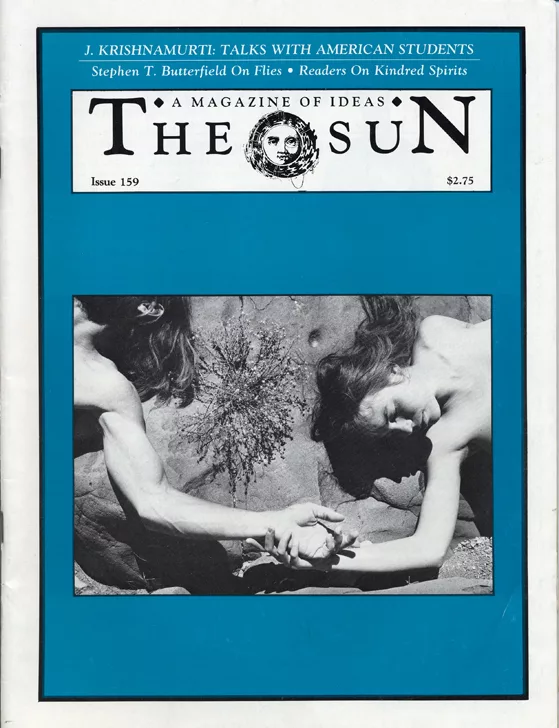
It’s rare for me to devote nearly half an issue to the work of one teacher. What makes it more unusual is his disdain of all teachings, all religions, all paths — a disdain that bordered on arrogance. An enigmatic sage who despised gurus, he insisted on complete attention from his listeners, yet could be surprisingly impatient himself. Astonishingly forceful, oddly innocent, J. Krishnamurti was a profound thinker who has influenced me as much as anyone I’ve ever read.
Krishnamurti devoted his life to alleviating suffering, to setting humanity “absolutely, unconditionally free.” His work is faithful to the Buddha’s famous metaphor of the arrow: the human condition, the Buddha said, is like a man with a poisoned arrow in his back. Our fundamental task is to pull out the arrow and to help others do the same.
What a compelling image, yet how rarely do we acknowledge so simply, so poignantly, the nature of our dilemma. In this “new age,” with so many teachers to soothe us, sometimes to fool us, who addresses as uncompromisingly as Krishnamurti the immense burden of our conditioning? Who insists so vigorously on the necessity of radical change from within?
When Krishnamurti died three years ago, at the age of ninety, we printed excerpts from his works. Now, with the publication of Talks with American Students, comes another opportunity to pay homage to this brilliant man.
In 1968 Krishnamurti gave a series of talks to college students in the United States. In an age of rebellion, he reminded them that changing the world is impossible without first facing the chaos inside us. In a free society, he questioned whether freedom has any meaning as long as we remain tyrannized by fear.
Published last fall by Shambhala Publications, Talks with American Students is one of more than thirty books in which Krishnamurti reiterated his basic message: that the truth is in each of us, and must be discovered by each of us, through constant awareness of who we are and how we live.
— Ed.
It would be rather interesting to know why most of you are here. Probably out of curiosity, or you have a genuine desire to find out what a man who comes from the East has to say. I think, first of all, it must be made quite clear that the speaker in no way represents India, Indian thought, Indian philosophy, or any of that mysterious Oriental business.
I think it is important to establish a certain kind of communication between us. The difficulty lies in that each one of us unfortunately translates, compares, or judges what is being said — in fact, we don’t listen! On the other hand, if we listen attentively and seriously, then communication becomes quite simple. If you are at all serious, wanting to find out, you listen with care and attention, with a certain quality of affection. You must not only be intellectually critical but also be minutely examining and exploring everything that is being said. And to explore and listen attentively you must be free — free from the image, the tradition, the reputation which the speaker unfortunately has, so that you are capable of listening directly and immediately in order to understand.
If you listen with a tendency to draw certain conclusions from what is being said, comparing it with what you already know, then what the speaker has to say merely becomes a matter of agreement or disagreement, a subject for mental examination or intellectual amusement. So during these talks, if we could establish a right kind of communication between yourselves and the speaker, then perhaps there might be a chance of going very deeply and seriously into this whole complex problem of living, to find out whether it is at all possible for human beings, who are so heavily conditioned, to change, to bring about within themselves an inward psychological revolution.
I hope you will not mind my suggesting that it is very important to learn the art of listening: to listen so intimately, so completely, so intensely, that not only do we communicate, but go beyond and commune with one another like two friends who are very serious, very earnest about something. Communion is entirely different from communication: to commune we must not only understand the meaning of words, knowing full well that the word is never the thing nor is the description ever the described, but we must also be in that state of mind whose quality is attention and care, and a sense of intimate concern; and that can take place only when both of us are very serious. Life demands great seriousness — not casual, occasional attention, but constant alertness and watchfulness — because our problems are immense, so extraordinarily complex. It is only a very serious mind, a mind that is really earnest, capable of inquiry, and therefore free, that can find a solution to all our problems; and that is what we are going to do.
One observes throughout the world that all human beings, whatever their color, creed, or nationality, have their problems — problems of relationship, problems of living in a corrupt society, which man has built over the centuries. Man himself is responsible for this structure, this society which is the product of his own hopes and demands, the result of his own violence, the outcome of his fears and ambitions; and in this structure we human beings are caught. And the structure is not different from the human being.
The society, whether in Europe, Asia, or here in America, is not different or separate from each one of us: we are the society; we are the community; not only the individual, the human entity, but also the total, the collective. So there is no division, no separation between the society and ourselves; we are the world and the world is us, and to bring about a radical revolution in society — which is absolutely essential — there must first of all be a radical transformation in ourselves; therefore we must inquire whether such a revolution in ourselves is at all possible. I am not using that word “revolution” in its Communist, Socialist, or bloody sense, but I am speaking of a revolution which brings about a complete and radical transformation in the psyche itself, in the whole structure of the heart and mind.
The real issue then is whether human beings, as we are now, living in this complex and corrupt society with its wars, its struggles, its ambitions and competition, can bring about within ourselves a radical transformation, not gradually, through many days or many years, but immediately, without accepting time at all. Apparently man has committed himself to war, to violence, and this violence exists throughout the world, although in Asia and especially in India — where ideologies flourish as a fungus on damp ground — they talk a great deal about nonviolence. We human beings are committed to violence, to a way of life that leads to war, a way of life that is divided by religions and nationalities into beliefs, dogmas, rituals, and extraordinary prejudices. Man is committed to this strange pattern of existence, righteously condemning one war, yet willing to take part in another; he is himself violent, brutal, and aggressive, which the anthropologists say he has inherited from the animal. Whatever the anthropologists or specialists say, however, has very little meaning, because we can examine and find out for ourselves the nature of our own violence — how brutal we are toward one another, not only verbally but also in our thoughts and gestures. For thousands of years we have accepted a way of life that must inevitably lead to war, to wholesale slaughter, and we have not been able to change it; the politicians have tried but have never succeeded.
We are ordinary human beings — not specialists or experts — living in this society and conditioned by our own background; we accept a way of life that is so corrupt, in which there is no love, nor a single word of compassion. Observing all this, the problem then is whether it is at all possible for human beings, such as we are, to bring about a radical transformation within ourselves, and go further, to come upon that state which man has everlastingly sought and has called God, or whatever name you wish to give it (names are not important).
Now, can human beings ever find this thing, or is it reserved only for the very few? We must first ask ourselves what place the religious mind has in the world today and whether it is possible to come upon this quality of love. You know, the word “love” is so heavily laden with ugliness. It is like the word “God.” Everybody uses it — the theologian, the grocer, and the politician; the husband uses it for his wife, the boy for his girlfriend, and so on. But if you look at that word, you will see that it is the cause of so much suffering, so much misery, so much conflict, and so many tortures; it also begets envy, jealousy, and fear. One asks therefore whether the mind can be free of all this, whether there is a quality of love which is not corrupt, which is not made ugly by thought.
There is no division, no separation between the society and ourselves; we are the world and the world is us, and to bring about a radical revolution in society — which is absolutely essential — there must first of all be a radical transformation in ourselves.
These are some of our problems: whether a man can ever live at peace with himself and with his neighbor; whether there is a reality that is not put together by thought; whether there is such a quality of love, compassion, and affection that has never been touched by jealousy, never tainted by fear, anxiety, and guilt. Can the mind, which is so heavily conditioned, ever completely and totally free itself and discover, in that freedom, whether there is an ultimate reality? If we don’t explore and find out for ourselves the truth of all this, then we must inevitably make life into a mechanical affair, in which there is constant struggle and which becomes utterly meaningless.
Is it possible to uncondition the mind, so that it looks at life in a totally different way, so that it is no longer a Christian or a Buddhist mind, a Muslim or a Hindu mind? Is it possible for such a conditioned mind ever to be free, to be innocent, and therefore vulnerable?
The main difficulty is that man lives in fragments, not only within himself, but outwardly; he is a scientist, a doctor, a soldier, a priest, a theologian, an expert or specialist of one kind or another. Inwardly his life is broken up, fragmentary; his mind, his intellect, is at times cunning and clever, brutal and aggressive, while at other times it can be kind, gentle, and affectionate. He tries to be moral — although the morality of society is utterly immoral — and his many desires tearing one against the other cause this fragmentation within and without. Man is forever trying to bridge the gap, to bring about an integration, which of course is absurd; there cannot be integration. If you examine that word and go behind it, you are forced to ask yourself who is the entity who is going to bring about this integration. Surely this entity who is going to integrate these many fragments is himself part of those fragments and therefore cannot possibly effect an integration.
Obviously there must be a different approach, which is to see the contradiction, the fragments, the opposing demands and conflicting desires; to observe them, and to find out whether it is possible to go beyond them. It is this going beyond which is the radical revolution. Then the mind is no longer torn, no longer tortured; it is no longer in conflict with itself, and therefore with its neighbor, whether that neighbor be next door, in Russia, or in Vietnam.
We are dealing only with facts, not with suppositions or ideals. Ideals have no meaning whatsoever: they are idiotic, the invention of a cunning, clever mind. When it cannot solve a problem like violence, the mind invents nonviolence as an ideal — that is, to be gentle at some time in the future. The very invention of an ideal produces another conflict, another struggle, another state of contradiction.
It is important to be aware of what is, not what should be, because the “what should be” is a fiction, a myth, a romantic notion, which all religions and idealists throughout the ages have nurtured and exploited. What good is the ideal of nonviolence if I am full of violence?
One can see quite clearly how ideals — the Christian ideal, the Hindu ideal, the Communist ideal — have divided man. Man is held by ideals; he is a slave to them and consequently is incapable of observing what is; he is always thinking about what should be.
The first demand then, the first challenge, is to observe what is, to know yourself as you really are, not as you should be. Look at violence and observe it. How does one look? First, we must observe without identification, without the word, without the space between the observer and the thing observed; we must look without any image, without the thought, so that we are seeing things as they actually are. This is very important, because if we do not know how to look, how to observe what we are, then we will inevitably create conflict between what we see and the entity who sees. I observe that I am violent in my speech, in my gestures and thoughts, and in my daily activities, both at home and in the office. I can observe that I am violent only if I do not attempt to escape from it or avoid it, and I will inevitably escape from it if I seek refuge in some ideal which says I must not be violent. When I say to myself I must not be violent, then there is the fact of my own violence and the ideal of what should be (that I must not be violent); hence there is a conflict between what is and what should be. For most of us, that is our life.
So it is important to observe the nature and the structure of violence within ourselves, and to find out why we are violent. The mere discovery of the cause of violence does not end it; neither does analysis, however clever, however subtle, bring violence to an end; nor is it to be overcome by thinking about nonviolence. Violence is merely a word, and the description of that violence is obviously not the fact. If you would be free of violence, which is buried so deep, you must first learn about yourself. You can learn only if you observe yourself. If you follow Jung or Freud or some other specialist, you are merely learning what they have already told you, so that is not learning at all. If you really want to learn about yourself, then you must put away all the comforting authority of others, and observe.
That observation is very complex, full of difficulties. First of all, is the observer different from the thing observed? I observe that I am violent, not only superficially, consciously, but deep down; throughout my whole being, I am violent. So I observe it in my speech, my walk, my gestures, and in my ambitious drive to succeed. In this country particularly, success is praised to the heavens; we must succeed at all costs, but in the success there is a great deal of violence, aggression, and brutality. So I see that I am violent. Is this entity who observes different, separate, from the violence, the thing he observes? If I may suggest, don’t just listen to the words, because words have no importance; what is important is to see whether or not the mind can ever be free from this terrible disease called violence. And is the observer who says, “I am violent” different from the violence itself? Obviously he is not. What takes place when the observer realizes that he himself is the violence which he has observed? What is he to do to be free of that violence?
The real issue then is whether human beings, as we are now, living in this complex and corrupt society with its wars, its struggles, its ambitions and competition, can bring about within ourselves a radical transformation, not gradually, through many days or many years, but immediately, without accepting time at all.
When the observer finds out for himself that he is the observed, he is the violence, and that it is not something separate from him which he can change or control, then the division between the observer and the observed no longer exists; so the observer has instantly removed the cause of conflict and contradiction within himself. However, the fact of violence remains; I am still violent by nature; my whole being is violent; it is sheer nonsense to say that part of me is gentle and loving, while the other part is violent. Violence means division, contradiction, conflict, separateness, and a lack of love; but I have now realized the central fact — that the observer is the observed, and is, therefore, no longer in conflict with the observed. I am the world and the world is me; I am the community and the community is me. So to bring about a radical transformation in society and in oneself, the observer must undergo a tremendous change — that is, to realize that the observer and the observed are one.
Can my mind observe the image of what I consider to be violence, as well as my vested interests in that violence? The whole image I have about myself and the violence must disappear, so that the mind is free to observe. And after observing, the fact still remains that I am violent, even though I may say that the violence and I are one. So what am I to do? When I observe that I am violent and I see very clearly that the observer is that violence, then I realize I cannot possibly do anything at all, because any action, whether it be positive or negative, is still part of that violence.
There is this whole problem of egocentricity; we are enormously selfish, extraordinarily self-centered. We may go out of our way to help others, but deep down, the root, the core, is this self-centered activity. It is like a tree whose main root has a thousand roots, and whatever the mind does or does not nourishes this root. Please bear in mind that the description is never the described. Mindful of this, therefore, one sees the necessity of being in direct contact with the fact of this egocentric operation going on all the time within each one of us, which is the action of separation, isolation, division, fragmentation. When one asks oneself whether there is a different kind of action, the very asking of that question is still part of this fragmentation. One then realizes one must look at violence in complete silence.
So, you have to be your own teacher and your own disciple, for there is no teacher outside, no savior, no master; you yourself have to change. Therefore, you have to learn to observe, to know yourself. To learn, the mind must be free; it cannot learn about violence if you have already accumulated knowledge about violence. Knowledge and learning are two different things. The doctor, the scientist, the engineer have accumulated knowledge, and they add to it as new discoveries are made, and therefore their knowledge becomes a storehouse, a tradition. But that is not learning. Learning is possible only in a state of constant movement; it takes place only in the active present. Learning is a movement, whether you are learning in a college or learning about yourself; you are learning as you go along, not having learned and then applying what you have learned, what you have accumulated. That is not learning at all; that is merely the accumulation of knowledge.
In that learning there is great joy; there is no despair at what you see, because you are not comparing it with your ideal, with what you should be; there is only what is, and when you observe what is, your learning is infinite. Everything is in you. Man is a living thing, and a living thing is not to be conditioned; but we have conditioned it, and that is why our life has become such a torture, such a meaningless struggle.
You know, the word “love” is so heavily laden with ugliness . . . it is the cause of so much suffering, so much misery, so much conflict, and so many tortures; it also begets envy, jealousy, and fear. One asks therefore whether the mind can be free of all this, whether there is a quality of love which is not corrupt, which is not made ugly by thought.
Questioner: You have talked about silence, and occasionally my mind is silent, but what is this silence you speak about?
Krishnamurti: The speaker can tell you what that silence is, but unless it is yours, it will have very little meaning. Silence is absolutely necessary to look, to listen, and to observe. If your mind is chattering — and our minds are everlastingly chattering — how can you possibly listen? How can you possibly look at a tree, a cloud, or a bird without that silence? You must be silent to look at your husband or your wife without the image; you are no longer silent, however, if you carry with you the image of your husband or your wife. It is only in silence that you learn, and love is completely silent.
This love is unknown to us because thought, which breeds pleasure and fear, is always casting a shadow over everything. This silence is part of meditation, and without understanding meditation — the beauty of it, the ecstasy of it, and its very benediction — life has no meaning. Meditation is not something separate from everyday life, nor is it learning some trick in a monastery; meditation is a way of life, and part of this immense silence about which we were speaking.
Questioner: Could we discuss observation without the observer?
Krishnamurti: What is the observer? The observer is the experience — whether it be the experience of yesterday or of a thousand yesterdays. The observer is the accumulated knowledge, the memory; the observer is essentially the tradition, the past, the dead ashes of many thousand yesterdays. The observer is the one who says, “I am hurt,” “I am angry,” “I have been insulted,” “This is my view,” “That is my opinion.” The observer is the one who thinks and is caught up in formula. So the observer is essentially the past.
Can you look without the past? Can you observe a tree, a cloud, a bird without the past, which means without the word, without your knowledge, without all the images you have about the tree, about the cloud, about the bird? Can you look without the past? It is comparatively easy to look at some object without the past. But can you look at your wife or at your husband without the image of the past, the hurts and the nagging, the quarrels and the brutality, the pleasures and the delights, and the various forms of hidden and unexpressed demands, hopes, and fears? Can you look without all this, so that you are looking with fresh eyes? It is quite an arduous task because it demands attention; it demands the joy of learning.
We human beings have no relationship with one another, no matter how intimate we may be, no matter how many times we have slept together. We have images, and the relationship is between two images, not between human beings. Human beings are living things, and it is very dangerous and uncertain to have a relationship with a living thing; above all we want to be certain in our relationship. That’s why we say I know my wife or my husband, my neighbor or my friend. And to look without the observer, which means looking without the past, without the memory, without all the accumulated hopes and fears, the pleasure and enjoyment, the sorrow and despair — to look in such a manner is the beginning of love.
Surely the intention of these meetings is to go deeply into ourselves and discover ourselves, not to be told what to do and what to think (which is too immature, too childish), not to create another authority, another guru, and all that absurd business. Self-discovery is not asking “Who am I?” but actually observing yourself as you would look at your face in a mirror, observing your actions, your gestures, and the words you use, observing the way you look at a tree, at a bird or a passing cloud, at your wife, your husband, or a neighbor. So through observation one begins to discover what one is, because one is never static; there is nothing permanent within, although the theologians and the other “godly” people assert that there is a constant entity; this, again, is a theory, an idea. We could then inquire, joyfully and freely, whether the mind — this human mind which has lived for millions of years and has been so heavily conditioned by a thousand experiences, which has embraced and accepted so many ideas and ideologies — whether such a mind can go into itself and find out whether or not it can be completely and totally free from violence.
Now let us approach this problem differently. As long as there is fear, there must be violence, aggression, hatred, and anger. Most human beings are afraid, not only outwardly but inwardly, although the outer and the inner are not separate; they are really one movement. So if we understand the inner — its design, its nature, and the whole structure of fear — then perhaps we shall be able to bring about a different society, a different culture, because the present society is corrupt and its morality is immoral.
So we have to find out, not ideologically, not intellectually as a kind of game, but actually discover for ourselves whether it is possible to be free from this fear. There are various forms of fear: the fear of darkness, the fear of losing one’s job or one’s livelihood, the fear of being found out when you have done something of which you are ashamed, the wife’s fear of the husband, the husband’s fear of the wife, the parents’ fear of the children, the fear of not being loved, the fears of old age, of loneliness, and of death. So unless we understand fear, the central issue of fear, we shall live in darkness and, therefore, we shall never be free from this brutality, aggression, envy, and competition.
What is fear? What is the actual state of fear itself, not the various forms of fear? What causes fear? We are not concerned with analysis at all. Analysis postulates an analyzer and a thing to be analyzed, whereas the analyzer himself is the analyzed; he cannot possibly separate himself from the thing he wishes to analyze. If you really want to go beyond the nature and structure of fear, eradicate it altogether, you must come to it not through any analytical process or intellectual design but directly. If you would understand something, especially a living thing, you must observe it with a living mind — not with dead knowledge, not with something that you have already learned or that you already know.
To lay the right foundation, so that we become a light to ourselves, we must understand fear. We are not trying to overcome fear, nor are we trying to suppress it or give it a different quality; instead we are trying to understand it, trying to find out what fear actually is, and how it comes into being. So what is this fear — the fear of what has been, the fear of yesterday, the fear of tomorrow, the fear of not being and not becoming? If you are faced with a challenge, an enormous crisis in your life — and there is no yesterday and no tomorrow — you act instantly, don’t you? It is the thinking about what happened yesterday or what will happen tomorrow that breeds fear. But when your action is immediate, you cannot think about what is happening now, at this instant; thought cannot enter into the active present. It is only when the action is over and done with that you can think of what might have been, of the past or of the future. So the cause of fear is thought, thinking about the past and the future, thinking about yesterday and tomorrow: “I had pain yesterday and tomorrow perhaps it will return,” or, “Tomorrow I may lose my job, so I am afraid.” Please, observe your own mind and heart! Go into it yourself and you will see how extraordinarily simple it becomes! If you don’t do it, then it is very complex; then it has no meaning whatsoever.
Therefore thought breeds the fear: the thought that perhaps I am no good and I may not succeed; the thought of being unloved and utterly lonely; the thought of being found out in some shameful act I have committed; the thought of losing something which is very precious and dear to me. So in its wake thought brings regret and despair.
As well as being the source of fear, thought is also the source of pleasure. The thought of something which has given you enjoyment nourishes that pleasure, gives substance to it. When you see a sunset or the early morning light on the hills, and you take in all its beauty and loveliness, or in the surrounding stillness you hear the sound of a quail — when this happens, at the actual moment of perception, there is no thought, only a total awareness of everything around you. But when you start to think about it, go back to it in thought, and say to yourself, I must have more of this pleasure, recapture the beauty of it, then the thinking about it gives further enjoyment. So thought breeds pleasure as well as fear. Pleasure contains within it the seed of fear. So pleasure is fear.
Please watch this very carefully! We are not saying you must deny yourself pleasure. All the religions throughout the world have condemned pleasure, sexual or otherwise. We are not saying that! A religious man does not deny or suppress, but rather he is learning, observing.
So thinking about what has happened or what might happen brings fear, as with the fear of death, for instance; it is postponed or put away into the distant future, but it is there. One might think about some shortcoming in one’s past that others might use to their advantage; one might think about the pleasure of sex and keep the image alive. This thinking about something does breed either fear or pleasure.
The question then arises: is it possible to live our everyday life without the interference of thought? This is a very important question, because man throughout the ages has worshipped thought and the intellect in all the books with their theories, and in all the theological works with their concepts about God, showing us the right way to live. These experts and specialists are like people who are tethered to a post: they are restricted from going any further because of their conditioning; so whatever they think, they are limited. And because they are the result of ten thousand years of propaganda, their gods, their dogmas, and their rituals have no meaning whatsoever. Man has worshipped thought, put it on a pedestal.
Now what is thought and what significance has it? There are people who have said, “Kill the mind.” You can’t kill it! You can’t just drop thought as though it were some garment. You have to understand this extraordinary process of thinking, your own thinking, not by studying books or being lectured to about thought. When you think at all, what is the origin of thinking? When is thought necessary and when is it not? When is it an impediment and when is it a help? So, you must find out all these things for yourself, not be guided by the speaker or some other authority.
How can a mind that is clouded by perpetual thinking and incessant chattering ever be free to look, to inquire, to live, and to know that ecstasy which is not of pleasure? Can thought come to an end at a certain level and yet function at other levels rationally, sanely, objectively, non-emotionally, and impersonally? What is thought? Surely this is very simple: thought is the response of memory. Someone asks you a familiar question and you reply immediately; and, if the question is a little more complex, you take time before answering. During the interval between the question and the answer, memory is in operation, and from that memory you reply. So thinking is the response of memory, and memory is the storehouse of thousands of experiences, both conscious and unconscious. The unconscious is the vast storehouse of the memory of the race, of the tradition, whether it be Christian, Hindu, or Buddhist, and therein is hidden the accumulation of many centuries; the conscious mind is the storehouse of knowledge you yourself have acquired. Through this whole structure of memory you are conditioned, and from that conditioning you respond; if you are conditioned as a Republican, a Democrat, or a Communist, then from that background, from that memory, you respond. If you are brought up as a Christian and have been indoctrinated by the propaganda of the church with its dogmas and rituals, then you respond according to that memory, that conditioning; or if you are a Hindu, then you respond from the background of your gods and your puja, the rites of the temple, and so on.
Thought is the response of the brain cells which have accumulated knowledge as experience; and since thought breeds fear, it has divided itself and separated the thinker from the thought. The thinker says, “I am afraid.” The thinker, the “I,” is separate from the thing of which he is afraid, the fear itself, so there is duality, a division — the thinker and the thought, the observer and the observed, the experiencer and the experienced. This duality or division, this separation, is the cause of effort, the source from which all effort springs. Apart from obvious dualities as man and woman, black and white, there is an inward psychological duality — the observer and the observed, the one who experiences and the thing experienced. In this division, in which time and space are involved, is the whole process of conflict; you can observe it in yourself. You are violent — that is a fact — and you also have the ideological concept of nonviolence; so there is duality. Now the observer says, “I must become nonviolent,” and the attempt to become nonviolent is conflict, which is a waste of energy; whereas if the observer is totally aware of that violence — without the ideological concept of nonviolence — then he is able to deal with it immediately.
It is important to be aware of what is, not what should be, because the “what should be” is a fiction, a myth, a romantic notion, which all religions and idealists throughout the ages have nurtured and exploited. What good is the ideal of nonviolence if I am full of violence?
One must observe, therefore, this dualistic process at work within oneself. It is thought which says, “I am dissatisfied with what is, and I shall be satisfied only with what should be.” It is thought which has enjoyed some experience as pleasure and says, “I must have more of it.” So in each one of us there is this dualistic, contradictory process, and this process is a waste of energy. Why is there this constant effort between what is and what should be? Is it possible to eradicate totally the what should be, the ideal, which is the future, as well as the what has been, the past, from which the future is built? Is there an observer at all except as thought dividing itself into the observer and the observed? The observer is always the past, never the present; the thing observed may be new, but the observer always translates it in terms of the old, the past. So thought can never be new and, therefore, never free. Thought is always the old, so when you worship thought, you are worshipping something which is dead; thought is like the children of barren women. We who are supposed to be great thinkers actually live in the past, and therefore we are dead human beings.
Thought, then, has created pleasure and also fear, which breeds violence. If thought suppresses itself, says, “I won’t think about it,” the fear is still there. If I attempt to escape from it, accept or deny it, I am still afraid, it is still there.
What takes place when the observer is the observed? The observer is the result of the past, of thought; and the thing observed, which is fear, is also the result of thought. So the observer and the observed are both the product of thought. Now whatever thought does with regard to this state of fear — whether it accepts or suppresses it, whether it interferes and tries to sublimate it, whatever it does — fear continues in a different form. Observing this whole process, learning intimately about itself (not being told by another), seeing for itself the nature and structure of fear, which is itself, thought then realizes that whatever it does with regard to fear still gives nourishment to fear. What comes out of this understanding?
I have observed fear — which is thought — as I have observed pleasure. Now the observer is the observed, although thought has separated the observer and the thing observed. I see that very clearly; there is an understanding of it, not as an intellectual concept but as an actual reality. This understanding is not intellectual; it is the highest form of intelligence. To be intelligent in this way means to be highly sensitive, aware of the nature and the whole structure of fear. If I suppress fear or run away from it, then there is no sensitive perception of fear and all its implications; therefore I must learn about fear and not run away. I can learn about something only when I am in direct contact with it, and I can be in contact with it so intimately only when I can look freely.
This freedom is the highest form of sensitivity, not only physically but in the mind also; the brain itself becomes highly sensitive. This understanding is intelligence, and as long as there is this intelligence, there is no fear; fear comes only when this intelligence is absent. This must be understood at a very deep level; you can describe food to a hungry man but the words and the description do not appease his hunger. This intelligence is the highest form of sensitivity, and it is this intelligence which is the foundation of virtue.
Nowadays, I am afraid, most people spit on that word “virtue.” It has lost all its meaning. But without virtue there is no order. We are not talking of political order or economic order; the order of which we are speaking is virtue, not the so-called virtue or morality of the church and society, because they are based on authority. This order can come into being only when we understand the whole negative process of disorder which is in ourselves, this division which has been brought about by the process of thought. Unless we understand this state of order and virtue very clearly and lay its foundation deeply within ourselves, there is no possibility of going into the question of meditation, and of finding out what love is and what truth is.
Questioner: Could you discuss what takes place within oneself when one wishes to look at something very clearly?
Krishnamurti: I wonder if we have ever observed within ourselves what slaves we are? Why do we look at everything through an image? Why do I look at my wife or my husband, or at my friend, with an image? My wife has done a great many things — she has possessed me, nagged me, bullied me, annoyed me, insulted me, and discarded me. Through time, through many days, I have put all this together; it has become a memory, and through that memory of all these hurts I look at her.
Can you look at someone without the image? Can you look, without the image, at the man who has insulted you or flattered you? It is possible to look without the image only when you have understood the nature of experience. What is experience? The word “experience” means to go right through something, but we never do! Let us take it at the simplest level. You insult me and the experience remains, leaves an imprint on my mind, becomes part of my memory, so you are my enemy; I don’t like you. The same thing happens if you flatter me: the memory of the flattery remains; then you are my friend. Can I, at the moment of the flattery or the insult, go through it completely, so that the experience leaves no mark on the mind at all? This means that when you insult me, I listen to it and look at it, totally, completely, objectively, and without emotion, as I look at this microphone. This means giving total attention to it with my whole mind and heart, to find out if what you say is true; and if it isn’t, then there is no point in holding on to it. This is not a theory; the mind is never free if there is any form of conceptual thinking or image-building. And I do the same if you flatter me, say what a marvelous speaker I am. I listen with my whole mind and heart while you are speaking, not afterward, to find out why you are saying it and what value it has, whether or not I am a marvelous speaker. Then I have finished with both insult and flattery. However, it is not as simple as that, because we enjoy living in a world of images, images of likes and dislikes. We live with those images, and our minds are forever chattering, forever verbalizing, so we never look at our wife, our husband, or the mountain with a free mind; it is only the innocent mind that can look.
Can you look at your wife or at your husband without the image of the past, the hurts and the nagging, the quarrels and the brutality, the pleasures and the delights, and the various forms of hidden and unexpressed demands, hopes, and fears? Can you look without all this, so that you are looking with fresh eyes?
Questioner: How can we get rid of the division in ourselves?
Krishnamurti: First of all, if I may suggest, don’t get rid of anything! Getting rid of something is to escape from it. You have to look at it, go into it! This division of like and dislike, love and hate, mine and not mine exists within oneself. Why? There is this problem of division, of contradiction within ourselves, and I want to understand it, go into it to find out if it is possible for the mind to be completely non-fragmentary.
You can have direct perception only when there is no condemnation of this division, when there is no evaluation. You can’t achieve harmony as long as this division between you and harmony exists as an idea, because that division, which is brought about by thought, breeds further division.
Since ancient times they have said there is God and there is man — this everlasting division. Later, they said God is not over there, he’s here, in you; and again there was this division between you and the God within you. The God who previously was in a stone, in a tree, in a statue, who was venerated as the Savior, as the Master, was now in you; you are the God. Then the God within you says do this, don’t do that, be harmonious, be kind, love your neighbor; but you can’t, because there is a division between you and the God within you.
So thought is the entity that divides, and through thought — that is, through analysis — you hope to come upon that state in which there is no division at all. You can’t do it — it can come about only when the mind itself sees and understands this whole process, and is then completely quiet. Have you ever noticed when your mind is quietly listening — not arguing, judging, criticizing, evaluating, comparing, but just listening — that only then does understanding come? There is this division within ourselves, this everlasting contradiction, and we must simply be aware of it, and not try to do anything about it, because whatever we do causes this division.
This is the last talk so, if I may, I would like to go into something which might be slightly foreign to you, although perhaps you have heard the word and given it a special significance. I am speaking of meditation and it is one of the most important things to understand. If we can, then perhaps we shall also be able to understand the whole complex problem of existence, and live it. In existence is included all relationship, not only the relationship between ourselves and our property, but our relationship with each other and also our relationship, if there is any, to reality.
In this troublesome and complex existence, understanding is absolutely essential. I am not using the word “understanding” in its literal sense, because to me understanding means the very doing itself. You do not understand first and then do, but the understanding is the doing, is the action; the two are not separate. In the understanding of this whole problem perhaps we shall also come upon that word “love” and, maybe, the thing which most human beings dread, death.
Meditation is the approach to the understanding of this problem of living, not merely as a phenomenon, but as something tremendously significant, to be greatly cherished and deeply lived; in fact meditation is the living. Many people, however, treat meditation as an escape from life; they retire into a monastery, put on special garb, and withdraw completely from living. There are certain schools in India and in Asia where they offer a method, a system, a way which perhaps will give a greater sensitivity and — if you are foolish enough to have visions — will enable you to escape into some mysterious metaphysical existence which in reality is still the same old sordid life. But meditation has no way, no system, no method. It is not an abstraction of life with all its delights, sorrows, and despair; nor is it an avoidance, an escape into some mystical, non-realistic, romantic world of one’s own imagination.
So the speaker is not using that word as a means of escape, but rather as an approach to the understanding of the whole of existence. Then meditation has great significance; then it becomes a benediction, an extraordinary thing which must be understood at the deepest level. So let us go into it together! You know, recently meditation has become very fashionable. It is almost on every lip; one even sees it in The New Yorker, and the long-haired gentlemen talk about it a great deal. They offer you a method, a system, give you a few words to repeat as a mantra, and assure you that through this practice you will transcend all your sorrows and achieve some extraordinary reality — which is, of course, nonsense, because a dull, stupid mind that is so heavily conditioned, sodden by its own superstitions, prejudices, and conclusions, can follow a certain method and meditate indefinitely, but it will remain a dull, stupid mind. Through examination we can see the utter futility of the method, the “how,” the pattern, whether it is laid down by the ancients, or by the modern guru with all his pretensions, offering a state which is generally called enlightenment in exchange for a sum of money. So we won’t concern ourselves any further with this kind of meditation, which is a form of escape; we can objectively and intelligently put it aside.
Meditation is not a form of entertainment; it is not something you purchase from another, whatever the price. Neither is it the acceptance of authority of any kind, including that of the speaker — especially that of the speaker — because in understanding this extraordinary problem of living, there is no authority, no teacher, no master, and no guru; they have all failed. Each one of us is in sorrow, in travail; we are confused, miserable, striving after something. It is essential to understand this rather than some mysterious vision. Visions are very easily explained. Through the use of drugs, through the repetition of words and phrases, through the practice of various forms of self-hypnosis, the mind can produce any fantasy, believe in anything, and play innumerable tricks upon itself.
We are concerned with life, and with the living of that life every day: with its painful struggles and fleeting pleasures; with its fears, hopes, despair, and sorrow; with the aching loneliness and the complete absence of love; with the crude and subtle forms of selfishness; with the ultimate fear of death. So it is that which directly concerns us and in order to understand it deeply, with all the passion at our disposal, meditation is the key.
The word itself means to ponder over, to think over, to enter deeply into an issue. Meditation is not how to think or what to do to control the mind so that it becomes quiet and silent, but rather the understanding of all life’s problems, so that the beauty of silence comes into being. Without this quality of beauty, life has no significance at all. By beauty I do not mean the beauty of those mountains, those trees, the beauty of the light over the water or the bird on the wing, but the beauty in living, the beauty in your daily life, whether you are in the office or at home or walking by yourself communing with nature; without that beauty, life is utterly meaningless.
If you do not know how to meditate, how to live, then your life becomes a very dull, empty, shallow affair. I am afraid most of us lead a very superficial life: going to the office, having a good job, having a family and a home, being entertained either at a cocktail party or at the cinema; and this we call living. You may have all the luxuries in the world: good food, good houses, good bathrooms, and good health. But without the inward life — not the secondhand inward life of another, but an inward life of your own, which you have discovered for yourself, which you have cherished, which you are living, and which is meditation — then life becomes a very shoddy business; then we shall have more wars, more destruction, and more misery. So meditation, whether you like it or not, is absolutely essential for every human being, whether he is highly sophisticated or a simple person by the wayside.
Meditation is usually understood to involve concentration, which can be a way of exclusion; that is, concentration implies forcing thought in one particular direction and excluding everything else. You focus and direct the mind upon something, and that concentration builds a wall, erects a barrier which prevents any other thought from entering. When that happens, there is a dualistic process at work, a division, a contradiction. So meditation is something other than concentration and control of thought.
Meditation involves attention, which is not concentration, although concentration is included in attention. To attend means to give your whole mind, your heart, and your body passionately to something; in that attention, there is neither the thinker nor the thought, neither the observer nor the observed, but only a state of attention. To attend so completely, so freely, there must be freedom.
Here then is the whole problem: freedom comes only from a mind that is totally free, which can give complete attention, attending both intellectually and emotionally, aware of all its responses. This is not so difficult, if you don’t give it an extraordinary meaning; it is really very simple. When you listen to anything — whether to music or to the weird cry of the coyotes as they call to each other in the evening, whether to the song of a bird or to the voice of your husband or wife — then give complete attention to it, and you do when the challenge is very great, immediate. Then you listen with extraordinary attention. When it is painful or profitable, when you are going to get something out of it, you listen very attentively. But when there is a reward in that listening, there is always the fear of losing.
Only a free mind is capable of that quality of attention in which there is no achieving, no gaining or losing, and no fear. A quiet, attentive mind is absolutely essential to understand this immense problem of living and come upon that state of love. The attentive mind is the meditative mind. We are going to learn together about this problem of living, which is relationship, which is love, and which is death.
How can a mind that is clouded by perpetual thinking and incessant chattering ever be free to look, to inquire, to live, and to know that ecstasy which is not of pleasure?
What is living? Not what should living be; not what is the purpose, the goal of living; not what is the significance of living; not what is the principle upon which life should be based; but what actually is living, as it is now, at this moment, in the privacy and secrecy of our daily life. That is the only fact, and nothing else. Everything else is theoretical, unreal, and illusory. So what is this life, the life of a private human being? What is the life of a private human being in relationship to the society which he has built and which holds him prisoner? Surely he is the society, he is the world, and the world is not different from him.
We are actually dealing with what is, with our own life and not with abstractions, not with ideals. From the moment we are born until we die, our life is a constant battle, a never ending struggle, full of fear, loneliness, and despair, a wearisome routine of boredom and repetition and a total lack of love, relieved occasionally by a fleeting pleasure. This is our life, our daily tortured existence, spending forty years in an office or factory, or being a housewife with its drudgery and dull care, with its envy and jealousy. The utter boredom of it all — fearing failure and worshipping success, and everlastingly thinking about sexual pleasure. So that is the pattern of our life if you are at all serious and observe what actually is.
We want to find a way of living differently; at least we say we do, and some of us make an attempt to change it. Before making any attempt to change, we must understand actually what is, not what should be; we must actually take what is in our hands and look at it. You cannot do that — come closely and intimately in contact with it — if you have an ideal, or if you say this must be changed into that, or if you are intent on changing. If, however, you are capable of looking at it as it is, then you will find quite a different quality of change.
Here is our difficulty. To be in direct relationship with something, there must be no image between you and the thing you observe: no word, no symbol, no memory of what it was yesterday or a thousand yesterdays ago. The relationship that you have with your wife or with your husband is the relationship based on an image, the image being the accumulation of many years of pleasure, sex, conflict, strife, boredom, repetition, and domination. You have that image of each other and the contact between these two images is called relationship; we have accepted that, whereas in point of fact it is not a relationship at all. So there is no direct contact between one human being and another; in the same way there is no direct contact with the actual, with what is.
Because we have not lived rightly either in youth or middle life, old age becomes an enormous problem. The fact is we have never really lived at all, because we are frightened of living and frightened of dying.
Do please follow this! It may appear to be complex but it isn’t, if you listen quietly. For example, there is envy. One is conditioned to accept it. Someone is bright, intelligent, successful, and the other is not. Ever since childhood one has been brought up to measure, to compare, so envy is born. But one observes that envy objectively as something outside of oneself, whereas the observer himself is that envy; there is no actual division between the observer and the observed. So the observer realizes that he cannot possibly do anything about that envy; he sees very clearly that whatever he does with regard to envy is still envy, because he is the cause and the effect. Therefore, the what is, which is our daily life with all its problems of envy, jealousy, fear, loneliness, and despair, is not different from the observer who says, “I am those things.” The observer is envious, is jealous, is fearful, is lonely and full of despair, so the observer cannot do anything about what is — which does not mean he accepts it, lives with it, or is content with it. This conflict comes about through the division between the observer and the observed, but when there is no longer any resistance to what is, then a complete transformation takes place. That transformation is meditation. Finding out for yourself the whole structure and nature of the observer, which is yourself, and also of the observed, which is again yourself, and realizing the totality, the unity of it is meditation. In meditation, there is no conflict whatsoever, and therefore there is a complete dissolution and going beyond of what is.
We have dealt with fear. We are now going to consider this question of love. You know that word is loaded; it has been abused, distorted, trodden upon, and spoiled by the priest, by the psychologist, by the politician, by every newspaper and magazine; they write and talk about it endlessly. So what is love? Not what should it be, not what is the ideal or the ultimate, but what is the love that we have, that we know? The thing that we call love contains jealousy and hate, and is beset with anguish. We are not being cynical; we are merely observing actually what is, what the thing that we call love is. Is love jealousy? Is love hate? Is love possessiveness, domination of the wife by the husband or of the husband by the wife? You say that you love your family, your children, but do you? If you really loved your children with all your heart, do you think there would be a war tomorrow? If you really loved your children, would you educate them in the way you do, train them, force them to conform to the established order of a rotten society? If you really loved your children, would you allow them to be killed or horribly mutilated in a war, whether it be your war or somebody else’s? If you observe all this, it indicates, does it not, that there is no love at all? So love is not sentiment or some emotional nonsense, and, above all, love is not pleasure.
To most of us, love, sex, and pleasure are synonymous. When we talk about love, there is the love of God — whatever that may mean — and there is also the so-called love that is implied in sexual pleasure. Also involved in love are anguish, pain, and despair. So if love is not pleasure, then what is pleasure? Please bear in mind that we are not denying pleasure! It is a great pleasure to see those lovely mountains lit by the setting sun, to see those marvelous trees that have withstood the forest fires and the dust of many months, sparkling and washed clean by the rain; it is a great pleasure to see the stars of an evening. But to us this is not pleasure; we are concerned only with the sensuous pleasures, with the intellectual and emotional pleasures. So we have to ask ourselves: what is pleasure? We are not condemning it; we are trying to understand it, trying to go behind the word.
Pleasure, like fear, is engendered by thought. Yesterday you stood in the silent valley looking up at the marvel of the distant hills, and at that particular moment there was great delight. Now thought comes in and says how nice it would be to repeat that experience of yesterday. So thinking about that experience of yesterday, whether it was gazing at the lovely tree, the sky, and the hills, or your sexual enjoyment, is pleasure. The image, living in thought with something which gave you enjoyment yesterday — thinking about it — is the beginning of pleasure. In the same way, thinking about what might happen tomorrow, the possibility that pleasure may be denied, that you may lose your job, be taken ill, or have an accident, with all the worry and pain, is the beginning of fear. So thought creates both pleasure and fear, but to us love is thought.
Please, follow this very closely! Love is thought because to us love is pleasure, which is the outcome of thought, which is nourished by thought. The pleasure is not at the actual moment of seeing the sunset or the sexual act, but the pleasure is the thinking about it. So love is engendered by thought and also love is nourished, sustained, and prolonged as pleasure by thought.
Then one asks oneself: is love thought? We know that thought can cultivate pleasure, but it cannot under any circumstance cultivate love, any more than it can cultivate humility. So love is not pleasure; neither is it desire. However you cannot deny either pleasure or desire. When you look at the world, at the beauty of a tree or a lovely face, there is great delight, at that particular moment; then thought interferes and gives it time and space to flourish as pleasure.
When you understand the nature and structure of pleasure in relation to love and when you realize it — which is part of meditation — then you will find that love is something entirely different. Then you will really love your children; then you will create a new world. When you come to that state, when you know love, then do what you will, there is no wrong. It is only when you are seeking pleasure — as you are now — that everything goes wrong.
There is also the problem of death. We have considered what our actual everyday living is, and we have, I hope, taken a journey together deeply within ourselves to find out what love is, so now we are going to try to discover what death is. You will understand this tremendous problem of death (not what lies beyond death) only when you know how to die, and when you know how to die, what happens after death is completely irrelevant; so we are going to find out what it means to die.
Death is inevitable. The body, the organism, like any machine that is constantly in use, must eventually wear out, come to an end. Most of us, unfortunately, die through old age or disease, without knowing what it is to die. To us old age is a horror. I do not know if you have ever noticed how, in the autumn, when a leaf falls from a tree, what a lovely color it is, how full of beauty and gentleness it is, and yet it is so easily, so effortlessly destroyed. Whereas with us, as we grow old — well, just look at us! The ugliness, the disfigurement, the pretensions! And because we have not lived rightly either in youth or middle life, old age becomes an enormous problem. The fact is we have never really lived at all, because we are frightened of living and frightened of dying, and as we grow old, everything happens to us. We are, therefore, going to find out what it means to die, knowing full well that the organism must come to an end, and knowing also that the mind, in its despair at ending, will inevitably seek comfort and hope in some theory, some belief, which is usually resurrection or reincarnation.
So we are not escaping from death through some theory, but facing it without fear. What does it mean to die psychologically, inwardly? In the death of the organism, there is no argument; you can’t say, “Please, wait a few more days until I become boss of the business!” or “Can’t you hold on a minute while they make me an archbishop?” It is final! So you have to find out how to die inwardly, psychologically. To die inwardly means that the past must completely come to an end — you must die to all your pleasures, to all the memories you have cherished, to all the things you hold dear; every day you must die, not in theory but actually. To die to that pleasure you had yesterday means dying instantly to it without giving continuity to pleasure as thought. To live this way, so that the mind is always young, fresh, and innocent, always vulnerable, is meditation.
Once you have laid the foundation of virtue, which is order in relationship, then there comes into being this quality of love and of dying, which is all of life; then the mind becomes extraordinarily quiet, naturally silent — not made silent through suppression, discipline, and control — and that silence is immensely rich.
Beyond that, no word, no description, is of any avail. Then the mind does not inquire into the absolute because it has no need, for in that silence there is that which is. The whole of this is the benediction of meditation.
Our thanks to Shambhala Publications and to the Krishnamurti Foundation for permission to print these excerpts. More information on Krishnamurti is available from the Krishnamurti Foundation of America, P.O. Box 216, Ojai, CA 93023.
— Ed.
From Talks with American Students by J. Krishnamurti. © Copyright 1970 by the Krishnamurti Foundation, Brockwood Park, Bramdean, Hampshire, England. Reprinted by arrangement with Shambhala Publications, Inc., 300 Massachusetts Avenue, Boston, MA 02115.