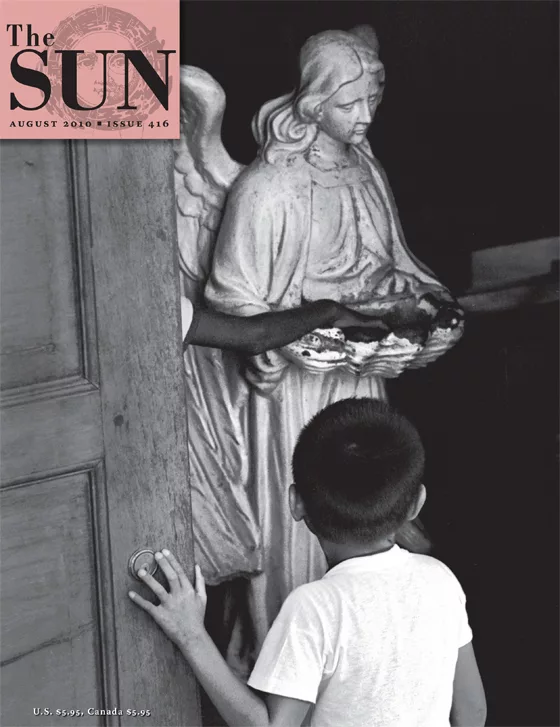
Yes, the Sherwood Anderson.
Robert Cooney, a subscriber from Point Reyes, California, sent me this story, one of his favorites. I was deeply moved by it.
Anderson, author of Winesburg, Ohio, was one of the first American authors to respond to Freud’s teachings and was a precursor of the stream-of-consciousness technique.
My desire to print “When We Care” evoked some controversy in the office. Carol Logie, THE SUN’s assistant editor, explains why in her note following the story.
“When We Care” was written in 1943. It was in included in Civil Liberties and the Arts: Selections from “Twice a Year” 1938-1948, published by Syracuse University Press, and is reprinted with kind permission.
— Ed.
I got into a group of people one evening in Paris. It was at a house belonging to some wealthy Frenchman but leased to an American woman. I was taken there to dine by an American writer, a very popular and successful writer.
We were shown into a large, expensively furnished room. There were several men and women. Where they came from, I do not know. Ours is a money civilization and there are these men and women sometimes suddenly shot up into prominent positions and aristocratic conditions of life.
The men were all popular and successful writers or painters. The women were all beautiful. At least they had what most men mean when they speak of beauty in women.
They were handsomely clad. How much money is spent trying to enhance the beauty of women! There are all these wonderful gowns. Men devote their lives to making them, little fat men with keen eyes. They think of women impersonally. I have been to establishments where they assemble their creations. Outdoors and in these workmen study the lines of women, and in the rooms where they work there are adjustable figures. There is this long suave line here, down across the hip. You accentuate it a bit here, flatten it there. Something to please the eye.
If you are a woman who has money or can get a man who is a moneymaker you may have their services and the services of innumerable people all at work to enhance your beauty. They will accentuate this or that good point. The line of your mouth may be changed, the color of your hair. There is no need of your making any effort.
But what does make beauty in a woman anyhow? Is it her clothes, her carriage, her figure, her hair, her eyes, her features? I should say that beauty is a thing you cannot localize, tie down to any one feature. It is something mysteriously present, showing itself almost involuntarily in unexpected spots, through unexpected motions, turns of the head, gestures of hand or arm, radiance of an inner light. And the women in this room in the Parisian house were not beautiful. I do not know why. I only know that all that evening all the people present hurt and kept hurting each other and me.
I kept thinking of an old mountain woman, seen over in Grayson County, Virginia, one day. She was the wife of a small farmer over there and had lived with him for forty years. He had died. When I saw that old woman she was coming home along a mountain road afoot from the funeral.
There were several people in the road. I happened to be standing in a stream. I was trout fishing. The people came silently along the road. I had stepped behind an overhanging bush. I could see along the road. There was the old mountain woman, two grown daughters and a troop of grandchildren. They were all dressed in cheap Sunday clothes poor people wear on such occasions. The old wife walked alone behind them all. She had gotten herself a cheap black dress for the occasion.
The sun was shining. It was late afternoon. The old mountain woman was small and slender. Why had all of her own people left her to walk alone like that?
The reasons were pretty obvious. There are times when every human being who has experienced life at all keenly must be alone.
Someone very, very near to you has died.
Or, if you get life that way, it may be someone not near to you, someone you may never have seen. For example I myself remember what happened to me when I was told one day that the writer D.H. Lawrence had died. I had never met Lawrence, had never seen him, did not know he was ill.
“He’s dead,” someone said.
“What?”
“Yes, D.H. Lawrence. He died. Hadn’t you heard? He died. He’s dead.”
So, a sudden blackout of the skies. A queer feeling of emptiness, all life being empty. Why should I try to describe the feeling? Innumerable people have felt it. Have you ever gone into a house or a room in a house where someone you once loved formerly lived? It may have been a man or a woman. It doesn’t matter. She or he is there no longer.
Why did I think of the poor thin little old mountain woman once seen walking in a road? The point is, she was beautiful, and if I speak of her now it is only to show that beauty can exist in the aged, in the tired, in the defeated.
I knew the old woman’s story, knew it vaguely. It was simple enough. As a young girl, the daughter of a poor mountain family, she had married a poor and perhaps, as we in the modern world think of education, an uneducated mountain man. He couldn’t read or write. He had a little bit of mountain land.
They lived there, they raised their children there — in some way they managed.
Their children grew up and married. They lived in other little farms scattered about over the Virginia mountains. For years they lived alone together. Every year they raised and fattened a pig; they kept a cow; they worked a few poor fields. On Sunday afternoons sometimes their children and their grandchildren came to see them. Now he was dead. On the day I saw her walking in the road she and the others had just come from the burial.
The old woman was alone, walking behind the others in the mountain road that day. The others of her people walked ahead of her in silence in the road. Even the children were silent. There was one of the daughters had a tiny babe in her arms. As she walked she suckled it.
The beauty of the old woman flamed. She had braced her shoulders and thrown her head back. Her watery little old eyes were fixed and staring.
As everyone knows there is a beauty of grief as well as of laughter, and it was in her. It was in her and came out of her. It seemed to me that day, standing in the water of that creek, near a bridge, near a turn of a mountain road, it seemed to me suddenly that coming out of her it ran through the trees. It ran through the cold waters of the mountain stream that washed my legs. It climbed in my legs. It sang in distant hills. It sang in every particle of dust in the lithe fields on the side of the hills. . . .
This beauty of which I am speaking in this rather disconnected way can exist in men as well as in women. You go into a certain room or office. A man you have known and loved for years works there. You have gone there often to sit and talk with him. He has left his marks everywhere in the room. Let’s say he is a cigarette smoker. There is a mark at his desk, at the edge of his desk. He had put his cigarette down there. He was talking. He was absorbed. In fact there is a little row of black marks. He was thinking perhaps of his work. It doesn’t make much difference what his work is.
So there is your friend, standing in his room. Once again he has put his burning cigarette down at the edge of his desk. He is trying to tell you something. He stands there struggling let us say for words. Now the cigarette has begun burning the wood. The desk is varnished, the hot end of the cigarette melts the varnish a little, there is a faint stench in the room. You do not mind. He is beautiful at that moment, because of work, because of absorption in some kind of work. He is doing something he cares about doing. He cares rather tremendously. I think most men I have thought beautiful as I looked at them have been so because they cared.
And all about them there is this “singing.” Silently and still musically it is in the furniture, the desks and bookshelves, and in the window frames and walls. It is as if in straight lines of these objects there were a flow and a rejoicing. They stream with it. I am talking about inanimate things. It is something it seems we do to them.
We do it to each other. All of us go about all the time doing something to others. When for example you go to a friend’s house you take something with you. You take health, the gift of beauty in yourself, give that to your friend. Or you take ill health, you take poison. Friends you have, people you love, die and are born again. You know what I mean. There are little deaths as well as the final thing we habitually think of as death. It is always happening to everyone you love. Some quality that made you love your friend dies in him or is born again perhaps through us.
So likewise in the objects. I am in a certain room. I work there. It doesn’t matter much whether what I am trying to do in the room ever comes off or not. I do something to everyone who comes into that room, but that isn’t all. There are the things. The room has walls. There are chairs, a couch over here, a table yonder. On the walls hang paintings. The paintings, if they are living work of living men — I mean if they are the work of men alive when they did the painting — they do something to me all the time, but I do something to them, too. They sing like the objects in my friend’s office at the moment he was speaking, give forth the melody of their lines and their colors, or are silent.
It all comes down to a terrific responsibility in life. Something our scientists have made plain to us poets and other men.
They have been breaking all of life up into something every minute — atoms, electrons, molecules. As I understand the whole thing it is something like this:
In the palm of my hand here there are certain tiny specks of what is called dirt. There probably are a good many of them. I have been out walking in the streets.
The scientists tell us that each particle of this so-called dirt — to my not young eyes invisible particle — is a little world. There are suns and moons, there are planets, moving at incredible speed, there are vast empty spaces all within that speck of so-called inanimate matter.
You see there isn’t any such thing as inanimate matter. Here is a bit of wood. Over there a piece of steel or iron. Here is the cloth of my coat. This piece of wood, that piece of steel, this coat I wear are masses of tiny, terrifically active worlds. Life is going on down inside there, swimming, revolving, speeding, an intense life. They are all alive as I am when I live. It is but another step to say there is music down in the wood of this desk, in the wool of this coat — music I may never hear anymore than I may ever see the world the scientists have described. Still it is there.
I may be bungling this. But recently a scientist told me — he was a bit embarrassed and shy in telling me; scientists are not like us brash men who dare go about talking, lecturing, writing; they hate to commit themselves — at any rate this man told me about certain experiments he and others working with him had been making.
It was his idea that there is a real music of the molecules present in every form of matter living or dead. While incapable of being heard directly by the ear, this music can be recorded on the spectrographic plate and “translated” into musical chords which can be played on the piano. If a beam of light is passed through a glass of water, it is possible to discover each molecule of water vibrating much like a violin string and emitting three tones. The frequency of these tones being about one hundred trillion vibrations per second, they are much too high for us to hear, but by dividing the frequency by the velocity of light it is possible to transpose these tones to lower frequencies. The spectrograph it seems had revealed even more. It showed the atoms in constant motion, moving in three different ways, and each motion corresponded to a note in a chord formed by the ensemble. The experiment this man and his colleagues were trying to make was that of turning the wave lengths — varied as they are: long and short, long and swinging, abrupt and sudden — trying to turn these activities in gasoline, in metal and woven stuff by simplification, into actual audible music notes and harmonies.
The actual song of this table then, the song of this coat, the song of these walls!
I had best stop all this. The actual music of which the scientist spoke may never be heard. It may be too faint, too far away. But I am poet enough to know that it exists. What the scientists say clicks with something I have always felt. I know my clothes incessantly sing, the timbers in the floor on which I am walking sing, every speck of dust in every field sings — as the distant hills sang while the poor little old woman passed.
I spoke of the new responsibility. Is it not the tremendousness of caring, in people, in myself, that makes us hear the music? We are beautiful when we care tremendously, and when we are beautiful the “harmony of the spheres” is audible.
Perhaps this sounds like preaching. It doesn’t matter. I am like the man I have tried to describe to you, struggling to find words to say some subtle and difficult thing while his cigarette burned the varnish on his desk.
A memory of a “dead” house in Paris, where I met certain rich, successful men and “beautiful” women, started me speaking.
What’s Missing
There are no doubts about Sherwood Anderson’s kindness, the quality of his writing, the gentleness of his message, the goodness of it. I simply find it difficult to listen, pulled aside by the images he chooses for men and women, the ones I am assigned and excluded from. The images are disturbing, distracting.
Jeez, being a little petty aren’t you? After all, the guy wrote it in 1943, pretty advanced stuff for his time most likely. Why pick at the edges? Surely you are big enough to see around and beyond the stereotypes!
No. I am not big enough. Raised on the images of being small, living with them, they are mine. I dislike them, I recognize them with distaste, but they are mine. I worry about not recognizing them, a complacence which keeps me small. I am taught to be small and then assumed to be big enough to regard it as no obstacle. And still, I hesitate to mention the smallnesses to which I am sensitive, afraid to be told again they don’t matter.
“. . . the old woman’s story . . . was simple enough . . . she had married a poor . . . uneducated mountain man. He couldn’t read or write.” I don’t hear her story. And a woman’s caring is expressed in grief over her husband, a man’s for his work. The painters, poets, and scientists are men. They are there, simple stereotypes. I run the risk of being charged with exaggerating their effect by dwelling on them. But to overlook them is to overlook my most urgent dilemmas; I am assumed to be in the story but I see only passivity. I wish to be bigger, not the strongest, just stronger, as strong. I point out the images of smallness not to argue about them but to insist that they influence me. I sit on unqualified praise of this story as blacks sat at the lunch-counter, not because I wish to make trouble, but because the images are so ingrained that to question them inwardly, silently doesn’t work.
I consider women whose circumstances are ripe for action and yet they do not act. They wait to feel more certain, bigger. Their talents wither with the accumulated moments lacking in confidence to practice them. They struggle to know themselves, always feeling on the verge of change, yet they hold back. They wait. They hesitate. With the desire to work for themselves, they continue to work for others. Girls can’t be scientists! They have said it aloud only enough times to believe in the possibility of its falseness. The doubt is still there. They wait for it to go away, chiseling away at it. They watch the men at work, with a willingness to learn from them. But they are assumed to need no further training, to feel a bigness which they don’t feel. Without a recognition that something is missing, they blame only themselves, feeling small, acting small. They wait, passively, following behind, itching for a release from something they cannot yet clearly enough name.
It is for these women, for myself, that I insist on attention to Mr. Anderson’s images, out of a need not simply to contradict them, to argue with them, but to understand just how they contribute to inaction, to understand the discomfort of their familiarity, to understand how they mold, and especially what they deny. Because I don’t know. I don’t know what precisely is missing. Only that these images hit me hard. When I am asked to overlook them, I feel so passed by as to be invisible.
— Carol Logie
Assistant Editor of THE SUN