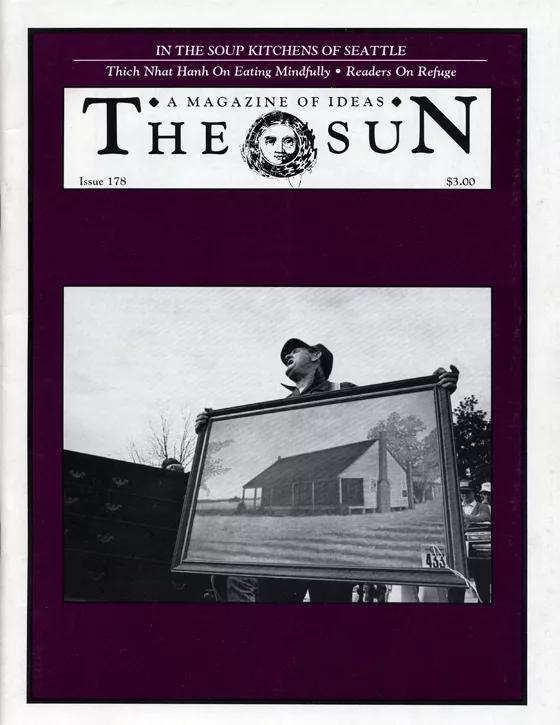
Dr. Martin Luther King, Jr., once nominated Thich Nhat Hanh for the Nobel Peace Prize. A Buddhist monk and Vietnamese poet, Hanh was in the peace movement at the height of the Vietnam War.
Hanh’s book, Present Moment, Wonderful Moment consists of a series of gathas, or short verses, aimed at helping us to remember. For Hanh believes that we tend to live our lives in a state of forgetfulness. Our preoccupation with the many activities that take us through the day robs us of a true sense of the moment.
Hanh, in a powerful twist, employs these very activities to return us to ourselves. He introduces gathas for the most mundane activities, from waking, to using the telephone, to driving a car. In each gatha, Hanh encourages us to pause, to attend fully to what we are doing at every instant. Hanh hopes to recall us to ourselves, and the singular — and ultimately sacred — character of each moment.
— T.L. Toma
A few years ago, I asked some children, “What is the purpose of eating breakfast?” One boy replied, “To get energy for the day.” Another said, “The purpose of eating breakfast is to eat breakfast.” I think the second child is correct. The purpose of eating is to eat.
Eating a meal in mindfulness is an important practice. We turn off the TV, put down our newspaper, and work together for five or ten minutes, setting the table and finishing whatever needs to be done. When the food is on the table and everyone is seated, we practice breathing. “Breathing in, I calm my body. Breathing out, I smile.” We can recover ourselves completely after three breaths.
We look at each person as we breathe. We don’t need two hours in order to see another person. If we are really settled within ourselves, we only need to look for one or two seconds; that is enough to see our friend. If a family has five members, five or ten seconds is enough to practice this “looking and seeing.”
After breathing, we smile. We have a chance to offer an authentic smile of friendship and understanding. It is very easy, but not many people do it. To me, this is the most important practice. If the people in a family cannot smile at each other, the situation is a very dangerous one.
After breathing and smiling, we look at the food in a way that allows the food to become real. The food reveals our connection with the earth. Each bite contains the life of the sun and the earth. The extent to which our food reveals itself depends on us. We can see and taste the universe in a piece of bread.
The opportunity to sit with our family and friends and enjoy wonderful food is something precious — something not everyone has. Many are hungry. When I hold a bowl of rice or a piece of bread, I experience compassion for all those who have no food to eat and are without friends or family. We do not need to go to a temple or a church to practice this. We can practice it right at our dinner table. Mindful eating cultivates seeds of compassion that will strengthen us to do something to help nourish the hungry.
In order to aid mindfulness during meals, you may like to eat silently from time to time. Your first silent meal may cause you to be uncomfortable; once you become used to it, you will find that meals in silence bring much peace. As with the TV, we “turn off” the talking in order to enjoy the food and the presence of one another.
I do not recommend silent meals every day. Talking to each other is a wonderful way to be in touch. But we have to distinguish among different kinds of talk. Some subjects, such as talk of others’ shortcomings, can separate us. The food that has been prepared carefully will have no value if this kind of talk dominates our meal. When compared with the experience of talking about others’ shortcomings, awareness of a piece of bread in your mouth is a much more nourishing experience.
While eating, refrain from discussing subjects that can destroy the awareness of the family and the food. Say things that nourish. If someone is thinking about something other than the good food on the table, such as his difficulties at the office or with friends, he is losing the moment, and the food. Say, “This dish is wonderful, don’t you agree?” and draw him out of his thinking and worries. Bring him back to the here and now, enjoying you, enjoying the wonderful dish. You become a bodhisattva, helping a living being toward enlightenment.
The verses which follow can help us practice mindfulness while eating:
Looking At Your Empty Plate
My plate, empty now,
will soon be filled
with precious food.
When many on this earth look at an empty plate, their plate will continue to be empty for a long time. I am grateful to have food, and I vow to find ways to help those who are hungry.
Serving Food
In this food,
I see clearly the presence
of the entire universe
supporting my existence.
We see that our life and the lives of all species are interrelated.
Contemplating Your Food
This plate of food
so fragrant and appetizing,
also contains much suffering.
This gatha [short verse] has its roots in a Vietnamese folk song. When we look at our plate, we should be aware of the bitter pain of people who suffer from hunger. Every day, 40,000 children die from malnutrition. Looking at our plate, we can “see” Mother Earth, the farm workers, and the tragedy of hunger and malnutrition.
We who live in North America and Europe are accustomed to eating grains and other foods imported from the Third World: coffee from Colombia, chocolate from Ghana, fragrant rice from Thailand. Most children in these countries never see such fine products. They eat inferior foods, while the finer products are put aside for export. Because they do not have the means to feed their children, some parents sell their children as servants to families who have enough to eat.
Before a meal, we can join our palms in mindfulness. Slowly we breathe three times and recite this gatha. Perhaps one day we will find ways to live more simply in order to have more time and energy to do something to change the system of injustice that exists in the world.
Beginning To Eat
With the first taste, I promise to offer joy.
With the second, I promise to help relieve the suffering of others.
With the third, I promise to see others’ joy as my own.
With the fourth, I promise to learn the way of non-attachment and equanimity.
During the first mouthful, we may express our gratitude by promising to bring joy to at least one person. With the second mouthful, we can promise to help relieve the pain of at least one person. After the fourth mouthful, we get in touch with the food and its deep nature.
Finishing Your Meal
The plate is empty.
My hunger is satisfied.
I vow to live
for the benefit of all beings.
This verse reminds us of our gratitude — to parents, teachers, friends, and all organic and inorganic species that support and enrich our lives.
Washing The Dishes
Washing the dishes
is like bathing a baby Buddha.
The profane is sacred.
Everyday mind is Buddha’s mind.
The idea that doing dishes is unpleasant occurs only when we are not doing them. Once we are standing in front of the sink with our sleeves rolled up and our hands in warm water, it is really not bad at all. I take my time with each dish, and attend to it, the water, and each movement of my hands. If I hurry — anxious, say, for dessert — the time will be unpleasant, not worth living. Every second of life is a miracle. The dishes are miracles, as is the fact that I am here washing them.
Each thought, each action in the sunlight of awareness becomes sacred. In this light, no boundary exists between the sacred and the profane. It may take a bit longer to do the dishes, but we can live in every moment. Washing the dishes is both a means and an end — not only do we do the dishes in order to clean them, we do the dishes just to do them, and live fully each moment while washing them.
If I want to finish the dishes quickly so I can have dessert and a cup of tea, I will be equally incapable of doing these things joyfully. With the cup in my hands, I will be thinking about what to do next; the fragrance and flavor of the tea, together with the pleasure of drinking it, will be lost. I will never live in the present moment. The time of dishwashing is as important as the time of meditation. That is why the everyday mind is called the Buddha’s mind.
Drinking Tea
This cup of tea in my two hands —
mindfulness is held uprightly!
My mind and body dwell
in the very here and now.
Whether you are in a tea meditation ceremony, or drinking a cup of tea alone at home or in a café, allow enough time to appreciate the tea. If the weather is cold, feel the warmth of the cup in your hands.
Hold a cup of tea in your hands, breathe consciously, and say the above gatha. Breathe in and recite the first line, breathe out and recite the second. Breathe in for the third line, and breathe out for the fourth. Breathing in this way, we regain ourselves, and the cup of tea reclaims its highest place. If we are not mindful, it is not tea that we are drinking but our own illusions and afflictions.
Sometimes our body is here but our mind is lost in the past or the future. We may be possessed by anger, hatred, jealousy, or anxiety. If we practice the teaching of the Buddha on how to breathe mindfully, we bring mind and body together; they become again one.
When our mind and body have become one, we are ourselves; we can encounter the tea. If the tea becomes real, we become real. When we are truly able to meet the tea, at that very moment, life is. As we drink the tea, we are well aware that we are drinking the tea. Drinking tea becomes the most important thing in life at that moment. This is the practice of mindfulness.
We thank Parallax Press for permission to reprint this excerpt from Present Moment, Wonderful Moment. (The book is $9.00 postpaid from Parallax Press, P.O. Box 7355, Berkeley, CA 94707.)
— T.L. Toma