Nature: we fear it and plow it under, or we romanticize it, regarding it as a symbol. Maybe we look out at it from our human window, and it seems unreal, foreign.
The non-human world has been denied consciousness. It’s been slandered by those who put human beings in a superior position, or who remain stuck in a literary or “spiritual” preoccupation with “the self.”
Who gives nature its due? Who feels the consciousness in rocks and trees, in animals, in things?
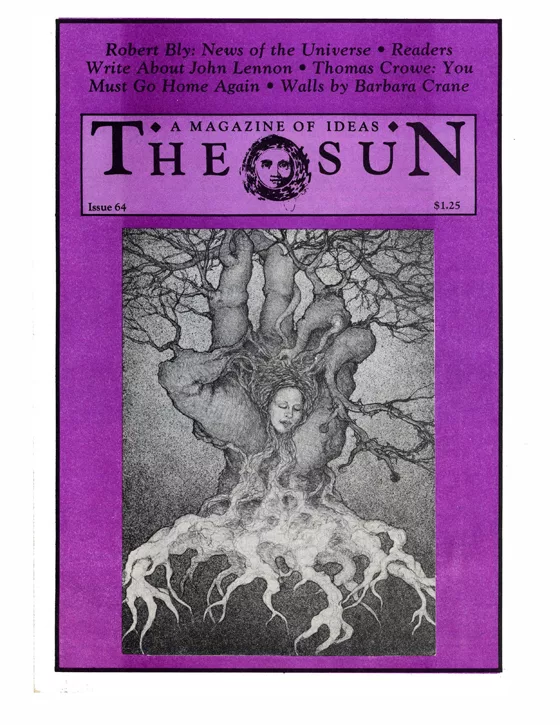
News of the Universe: Poems of Twofold Consciousness is about the varieties of non-human consciousness in the world, expressed in some of the richest language I’ve ever read, and it is ultimately about the marriage of the human psyche and nature.
My hat is off to Robert Bly for bringing together this anthology of 150 poems from different cultures and eras, and for his penetrating essays tracing an evolution in poetry from what he calls “the old position,” in which humans are alienated from nature, towards poems that seek the sources of all consciousness. Thanks to Robert Bly for permission to reprint these excerpts from News of the Universe.
Bly is one of the most important and genuinely interesting writers alive today. He is the author of nine books, including the National Book Award winner Light Around the Body, and has translated and introduced to American readers many foreign poets. (See THE SUN, Issue 37, for an interview with him.)
— Ed.
I decided to begin at the eighteenth century, when poets were least interested in nature. It was the peak of human arrogance. Bushes were clipped to resemble carriages, poets dismissed the intensity and detail of nature and talked instead of idealizations or “goddesses,” empires were breeding, the pride in human reason deformed all poetry and culture. The conviction that nature is defective because it lacks reason I’ve called the “Old Position,” and I begin this book with seven poems of condescension, reflecting an eighteenth century attitude and much in line with Descartes’ statement, “I think, therefore I am.”
By the end of that century, an explosive reaction had taken shape. Some German and French poets mounted an angry attack on this pride in single consciousness, the smugness of human reason. This storm of anger, oddly, was later called “Romanticism.” The German poets, chiefly Holderlin, Novalis, and Goethe, felt the anger most and were willing to grapple with the Old Position ideas; the French poets, particularly Gerard de Nerval, did well there also. Seeing Romanticism only through the poems of the English Romantics is misleading; much of the intellectual excitement—except in Blake—is missing. The German poets developed a sensual, elusive, augmentative, argumentative, musical, suggestive, resonant language for their attacks. I was astonished, translating, to realize how much of the associative point of view that Freud and Jung would develop was born then. The German and French response to the Old Position, from which there are examples in Part Two, I imagine as an enormous upwelling of water, and that water is still fresh and drinkable. When one reads Novalis and Goethe, the ancient union of the day intelligence of the human being and the night intelligence of nature become audible, palpable again. It is a great advance. Of course, in other areas of European culture—pragmatic science, utilitarianism, Protestant dogmatism—the Old Position simply went on without interruption. Descartes’ ideas act so as to withdraw consciousness from the non-human area, isolating the human being in his house, until seen from the window, rocks, sky, trees, crows seem empty of energy, but especially empty of divine energy. The Novalis vision and the Descartes vision ran side by side through the nineteenth century, and Freud inherited both. He inherited respect for the integrity of nature, which sustains the Sierra Club still, and he inherited “scientific” reductionism, which longs to flood the Grand Canyon behind a concrete dam.
As people begin again to invest some of their trust in objects, handmade or wild, and physicists begin to suspect that objects, even down to the tiniest molecular particles, may have awareness of each other as well as “intention,” things once more become interesting.
All of us, since the rise of technology, have been torn into parts so often that we can hardly grasp what an interior unity could be. High school rips body and mind apart, science rips the perceiver and the thing perceived apart, the Industrial Revolution rips man and woman apart, rips father and son apart, racism rips soul and mind apart, imperialism rips the governors and the governed apart, our firm houses separate weather and person. So I’ve chosen a few poems from other cultures in which I sense a deeper union than the post-Industrial Revolution psyche has yet achieved.
What I’ve called the Old Position puts human reason, and so human beings, in the superior position. The Old Position may be summed up, or oversimplified, this way: Consciousness is human, and involves reason. A serious gap exists between us and the rest of nature. Nature is to be watched, pitied, and taken care of if it behaves.
If the details of nature were not worth observing closely, we can expect that the psyche of women will not receive much attention either. The cellar of consciousness opens to receive both. Then, with the rise of imperialism, Asians and Africans are put in to keep them company. The people of Asia and Africa, who lived in closer union with nature than the Europeans, were perceived by them as living in some state of unconsciousness, as animals are imagined to do. As soon as the cellar is full, the work of the Empire can seriously begin. Holland, Spain, England, Germany compete with each other in condescension toward Asian and African religions, and compliment each other on their invasions. I’m not saying that Cartesian ideas caused invasion; there were invasions long before Descartes; but that the formulation, “I think, therefore I am,” has political meaning, and made things easier for King Leopold, General Custer, and the Boston Puritans who traded in slaves.
Because I have oversimplified the Old Position so far, it may appear that only stupid people could believe it. On the contrary, many intelligent men and women have held that view for centuries, and hold it still. Distinct intellectual viewpoints are possible within this position. The viewpoints share a certain lofty attitude toward nature, often expressed by imagining hierarchies inside nature, with man at the top. A favorite device among literary people is to regard nature as a storehouse of symbols. The person who does this does not experience the tree or the pelican first as a tree or a pelican, but forces it to labor right away as a symbol.
I don’t mean that the Catholic Church alone teaches this condescension: the Protestants teach it vigorously. Most high schools in the United States teach it without being aware of it. The Old Position has its own language, heavily dependent on the rational lobe, and involves abstraction, the use of true-false questions, sociological jargon, the search for symbols in poems and myths, and learning that takes place within rigid rules. Politicians use the language, as well as many ecologists. When an ecologist says, “The maximum input we can have of non-organic materials before the system reaches its saturation point is about 30 per cent,” he is using Old Position language. In such language the body is exiled, the soul evaporated, the mind given executive power.
. . . the dominant tradition since World War II has been the human-obsessed art of Norman Mailer and Roth and the confessionalism of Robert Lowell. By “life studies,” Lowell really means a study of himself, not of pears or apples, which is what the French painters meant by the phrase. The movement didn’t turn out well for Plato or Sexton, who both ended as suicides. One suicide was associated with an oven, the other with the poet’s mother’s old coat; and I think that these details mean that confessional poetry traps women precisely where they don’t want to be, in the domestic. By concentrating on anger they lose their thirst for mountains. The investigation of anger is important, and yet the work of confessional poets is remarkable for the absence of tree-detail or praise of landscape. Berryman’s work likewise becomes concentrated on the human; he too dies a suicide.
When a country wins a war, the victory increases the arrogance of its writers, and I feel we are still suffering the results of the victory of 1945. The American writers who take European masters are fewer than in the Twenties. Antonio Machado remarks:
This modern narcissist of ours
cannot see his face in the mirror
because he has become the mirror.
Narcissism is an elegant form of the Old Position, and the whole culture of the Seventies shows wide traces of it. Machado suggests that narcissism has taken a step beyond the well-known dandyism of the nineteenth century. The outer world now no longer provides a mirror for the human being to see himself in; instead, the human being puts himself out there, and replaces nature with his own body or his “consciousness.”
In another, related development, American poetry has finally begun to draw on the mood of the ancient Chinese poem. Perhaps the greatest obstacle that faces a poet who is trying to develop the transparent poem is the fascinating power of the rhetorical style. We take in the style through Milton and Donne, so pervasively studied in school, and through American poets such as Whittier. It is the sort of style teachers like, touched with obvious craft. The example of ancient Chinese poetry, originally introduced by Arthur Waley, and continued lately by Robert Payne and others, has suggested to recent American poets that to be a poet may not mean throwing yourself like an enormous wave up a cliff, raging against Heaven, as Milton did, but may instead mean flowing quietly, almost transparently, as water flows over grass. This possibility comes as a surprise, usually, to the person trained in the rhetorical style; the surprise is beautifully captured in a story about an imaginary character developed by the Sufis named Mullah Nasrudin, around whom various teaching stories gathered. It seems Mullah had always lived inland, and one day, when he was thirty or so, visited the sea for the first time. The wind is high; he is astonished, waves come smashing on the rocks, the noise is strong, foam flies around, water explodes. Mullah then kneels down to taste it, and says, “Amazing! That something so pretentious should be undrinkable!”
Novalis thought there were two stages in an artist’s life:
Self-expression is the source of all abasement, just as, contrariwise, it is the basis for all true elevation. The first step is introspection—exclusive contemplation of the self. But whoever stops there goes only half way. The second step must be genuine observation outward—spontaneous, sober observation of the external world.
Putting the words “sober” and “spontaneous” together is interesting. The Sixties longed for spontaneous observation, but didn’t understand the sober part; the longing to be excited all the time is probably a form of narcissism. If a poet remains stuck in the first stage, the introspective, narcissistic stage, he or she is essentially a sun surrounded by dead planets, to borrow Novalis’ concept “Man is a sun, and his senses are the planets.” Psychologists often are suns surrounded by dead planets. We all use our senses, but if the senses are called upon only to embody intuitions about ourselves, they die. The senses long to experience objects and things on their own; they don’t want to be slaves of our intuition.
It’s possible that mass culture traps people in the first stage or even in a pre-firststage, a pre-introspective state. We develop a “culture of narcissism.” Advertisements on television encourage the human being to follow his body’s whims, and finally one believes that the Montana hills were created to provide oil for central heating. Mass culture encourages the comfort of not-seeing.
Ponge says that true poetry has very little in common with “what one sees in the poetry anthologies of today.” Reading anthologies, we notice that the vast majority of poems written in this century pay no attention to any object, do not evoke objects or give them honor. The poet dispenses with the object and begins immediately with “I.” “There is a kernel of hate in me,” or “My grandmother in her old picture resembles me.” If the poem does begin with an object, the poet usually—I have done this often—leaves it part way through to return to the “I.”
In 1952, Ponge published an essay on poetry called “The Silent World Is Our Only Homeland.” I’ll quote a part of this rich essay, which can be found in entirety in Beth Archer’s book, The Voice of Things.
In these terms, one will surely understand what I consider to be the function of poetry. It is to nourish the spirit of man by giving him the cosmos to suckle. We have only to lower our standard of dominating nature and to raise our standard of participating in it in order to make the reconciliation take place. When man becomes proud to be not just the site where ideas and feelings are produced, but also the crossroad where they divide and mingle, he will be ready to be saved. Hope therefore lies in a poetry through which the world so invades the spirit of man that he becomes almost speechless, and later reinvents a language. Poets should in no way concern themselves with human relationship, but should get to the very bottom. Society, furthermore, takes good care of putting them there, and the love of things keeps them there; they are the ambassadors of the silent world. As such, they stammer, they murmur, they sink into the darkness of logos—until at last they reach the level of ROOTS, where things and formulas are one.
This is why, whatever one says, poetry is much more important than any other art, any other science. This is also why poetry has nothing in common with what appears in the poetry anthologies of today. True poetry is what does not pretend to be poetry. It is in the dogged drafts of a few maniacs seeking the new encounter.
I don’t agree with his remark about relationships, but everything else I like.
This book asks one question over and over: how much consciousness is the poet willing to grant to trees or hills or living creatures not a part of his own species? I think it is possible to say that every city culture, sooner or later, develops its Descartes; I mean a thinker who encourages the gap the citizen already feels between himself and nature. When the gap develops, the human being changes. The change shows itself practically in an emphasis on perception—what Kant calls the noumena—rather than on the object that has drawn forth the perception. Rather than working to describe a sea urchin, people prefer to say, “The sea urchin is beautiful,” or “The sea urchin is ugly.” Because of the human being’s hugging of his own perceptions, which Descartes’ ideas encourage, the energy, both sexual and spiritual, tends to become interiorized inside the body. It circulates “harmlessly” inside the human body, and does not leave it. Rilke in an early poem describes this locked-in situation well, using the metaphor of house-bonding.
Whoever you are: some evening take a step
out of your house, which you know so well.
Enormous space is near, your house lies where it begins,
whoever you are.
Your eyes find it hard to tear themselves
from the sloping threshold, but with your eyes
slowly, slowly lift one black tree
up, so it stands against the sky: skinny, alone.
With that you have made the world. The world is immense,
and like a word that is still growing in the silence.
In the same moment that your will grasps it,
your eyes feeling its subtlety will leave it. . . .
Rilke says clearly that the problem is to “leave the house.” But human beings are eaters of consciousness, hungry for it; why leave the house if you’re convinced there is consciousness only inside your house, or inside your own species? Rilke’s poem says that if you make the effort to use your entire imaginative power to see one tree, you’ve essentially granted the whole world its being. Giving yourself to that one tree is crucial.
Rilke in this poem is describing a practical way to heal the Descartes wound; it involves imaginative labor, and that labor cannot be done by the collective. Each person has to do it alone.
We all use our senses, but if the senses are called upon only to embody intuitions about ourselves, they die. The senses long to experience objects and things on their own; they don’t want to be slaves of our intuition.
If a writer is bringing news of the human mind, and he feels that much of the news has been told, then what? Then he will have to bring more extreme news. This news must be sensational, to catch our interest. The writer may gather material for it by making his life extreme: breakdown, rage, madness, suicide. He will not really do it for material, but the literary longing for the extreme may affect his life. . . . some of our greatest talents and intelligences have become caught in a dying stream, and thresh about in it, suffering, as a large fish in the Platte River. For the extreme poet, anything less than a disaster doesn’t justify the poetic machinery. A poem becomes a tank that can’t maneuver on soft ground without ruining it. And American readers, becoming coarsened by extreme art—murders on television—mistake the tank marks on grass for evidence of inner strength, and encourage the poet to be more extreme, to have another breakdown. . . . Yet . . . I am not prepared to give up all extreme art, and have it replaced by short poems. . . . I don’t think the Vietnam War can be understood if we try to get rid of our extreme states of mind.
I have not yet made up my mind how much consciousness there is in stones or plants, or what kind. And I have not said what I mean by “consciousness,” as in the sentence, “There is a consciousness in trees.” I have used it without defining it, because what we are talking of falls between all the words in English. What is inside a cottonwood grove or a hill is not exactly consciousness, nor psyche, nor intelligence, nor sentience. The psychic tone of nature strikes many people as having some melancholy in it. The tone of nature is related to what human beings call “grief,” what Lucretius called “the tears of things,” what in Japanese poetry is called mono no aware, the slender sadness. Buddhists associate the “slender sadness” with the incessant wheel of reproduction, going on without pause. James Hillman in The Dream and the Underworld suggests that the consciousness of nature is related to Hades.
I don’t want to imply too great a unity in nature’s consciousness. The varieties of consciousness inside things can be suggested by the way a ray of light unfolds into a certain abundance as it passes through a prism, from red, through yellow and green and blue to violet. One could say that the consciousness inside the badger belongs to the violet band, with much night-vision and melancholy. Trees belong elsewhere in the spectrum.
To me, the main quality of consciousness is that it gives off energy. The greater the consciousness, the more intense the energy it gives off; and it is possible that the more the consciousness moves over toward the red, the more perceptible the consciousness is. To become aware of the consciousness inside an object, we need to become aware of the underworld and the dream, and become aware of energy leaving an object and entering our body. So we become involved in the whole area of energy leaving and returning.
All the poems we’re reprinting were written or translated by Bly, or are what he calls versions — adapted from several other English translations. Some of the other contemporary authors included in the anthology are Wallace Stevens, Gary Snyder, William Stafford, Pablo Neruda, Wendell Berry, Galway Kinnell, Marianne Moore, Denise Levertov, and Robert Frost. In all, 75 poets are represented.
— Ed.
The Second Hymn To The Night
Does morning always have to come? Will earthly influence always go on? Doing this and that is secular and smashes the holy approach of Night. And the substance Love burns on the altar, secretly, does it have to go out? Daylight has got limits and hours, but the hegemony of Night penetrates through space and through time. Sleep does not end, sleep lasts. God-like sleep: often give those obsessed with daily tasks, but inwardly mistresses of night, your joy. Only the shallow man sees nothing in your face, he knows only of the shadow-sleep, that you in human mercy throw over us in the anteroom of true night. Divine sleep, they do not know that you live in the golden ocean of the grapes, in the almond with its other-worldly oil, and in the poppy’s brown substances. They have no idea that it is you who subtly embrace the breasts of the young girl, and turn her darkened cave into the Garden of Delight, and have no clue that you are the one who opening the world of delight meets us at the edge of old stories and carries in your hand the key to the mansions where the completed ones live, you are the messenger who opens mysteries that unfold forever, but avoids words.
Novalis (1800) | Translated By Robert Bly
Casida Of The Rose
          The rose
was not searching for the sunrise:
almost eternal on its branch,
it was searching for something else.

          The rose
was not searching for darkness or science:
borderline of flesh and dream,
it was searching for something else.

          The rose
was not searching for the rose.
Motionless in the sky
it was searching for something else.
Federico Garcia Lorca | Translated By Robert Bly
Golden Lines
“Astonishing! Everything is intelligent!”
                                                                  Pythagoras

Free thinker! Do you think you are the only thinker
on this earth in which life blazes inside all things?
Your liberty does what it wishes with the powers it controls,
but when you gather to plan, the universe is not there.

Look carefully in an animal at a spirit alive;
every flower is a soul opening out into nature;
a mystery touching love is asleep inside metal.
“Everything is intelligent!” And everything moves you.

In that blind wall, look out for the eyes that pierce you:
the substance of creation cannot be separated from a word . . .
Do not force it to labor in some low phrase!

Often a Holy Thing is living hidden in a dark creature;
and like an eye which is born covered by its lids,
a pure spirit is growing strong under the bark of stones!
Gerard de Nerval (1854) | Translated By Robert Bly
The Great Sea
The great sea
Has sent me adrift
It moves me as the weed in a great river,
Earth and the great weather move me,
Have carried me away,
And move my inward parts with joy.
Eskimo Woman Shaman | Quoted By Rasmussen
The Simple Purification
Student, do the simple purification.

You know that the seed is inside the horse-
        chestnut tree,
and inside the seed there are the horse-chestnut
        blossoms, and the chestnuts, and the shade.
So inside the human body there is the seed, and
        inside the seed there is the human body again.

Fire, air, earth, water, and space—if you don’t
        want the secret one,
you can’t have these either.

Thinkers, listen, tell me what you know of that is
        not inside the soul?
Take a pitcher full of water and set it down on the
        water—
now it has water inside and water outside.
We mustn’t give it a name, lest silly people start
        talking again about the body and the soul.

If you want the truth, I’ll tell you the truth:
Listen to the secret sound, the real sound, which
        is inside you.
The one no one talks of speaks the secret sound to
        himself,
and he’s the one who has made it all.
Kabir | Version By Robert Bly
The Origin Of The Praise Of God
for Lewis Thomas, and The Lives of the Cell
My friend, this body is made of bone and excited protozoa . . . and it is with my body that I love the fields. How do I know what I feel but what the body tells me? Erasmus thinking in the snow, translators of Virgil who burn up the whole room, the man in furs reading the Arabic astrologer falls off his three-legged stool in astonishment, this is the body, so beautifully carved inside, with the curves of the inner ear, and the husk so rough, knuckle-brown.
As we walk, we enter the fields of other bodies, and every smell we take in the communities of protozoa see, and a being inside leaps up toward it, as a horse rears at the starting gate. When we come near each other, we are drawn down into the sweetest pools of slowly circling smells . . . slowly circling energies . . . The protozoa know there are odors the shape of oranges, of tornadoes, or octopuses . . .
The sunlight lays itself down before every protozoa,
the night opens itself out behind it,
and inside its own energy it lives!
So the space between two people diminishes, it grows less and less, no one to weep, they merge at last. The sound that pours from the fingertips awakens clouds of cells far inside the body, and beings unknown to us start in a pilgrimage to their Saviour, to their holy place. Their holy place is a small black stone, that they remember from Protozoic times, when it was rolled away from a door . . . and it was after that they found their friends, who helped them to digest the hard grains of this world . . . The cloud of cells awakens, intensifies, swarms . . . the beings dance inside beams of sunlight so thin we cannot see them . . . to them each ray is a vast palace, with thousands of rooms. From the dance of the cells praise sentences rise to the voice of the man praying and singing alone in his room. He lets his arms climb above his head, and says, “Now do you still say you cannot choose the road?”
By Robert Bly
Archaic Torso Of Apollo
We have no idea what his fantastic head
was like, where the eyeballs were slowly swelling. But
his body now is glowing like a lamp
whose inner eyes, only turned down a little,

hold their flame, shine. If there weren’t light, the curve
of the breast wouldn’t blind you, and in the swerve
of the thighs a smile wouldn’t keep on going
toward the place where the seeds are.

If there weren’t light, this stone would look cut off
where it drops so clearly from the shoulders,
its skin wouldn’t gleam like the fur of a wild animal,

and the body wouldn’t send out light from every edge
as a star does . . . for there is no place at all
that isn’t looking at you. You must change your life.
Rainer Maria Rilke | Translated By Robert Bly
Why Mira Can’t Go Back To Her Old House
The colors of the Dark One have penetrated
        Mira’s body; other colors washed out.
Making love with Krishna and eating little—those
        are my pearls and my carnelians.
Chanting-beads and the forehead streak—those are
        my bracelets.
That’s enough feminine wiles for me. My teacher
        taught me this.
Approve me or disapprove me; I praise the
        Mountain Energy night and day.
I take the path that ecstatic human beings have
        taken for centuries.
I don’t steal money, nor hit anyone; what will you
        charge me with?
I have felt the swaying of the elephant’s
        shoulders . . . and now you want me to climb on
        a jackass? Try to be serious!
Mirabai | Version By Robert Bly
The Holy Longing
Tell a wise person, or else keep silent,
because the massman will mock it right away.
I praise what is truly alive,
what longs to be burned to death.

In the calm water of the love-nights,
where you were begotten, where you have begotten,
a strange feeling comes over you
when you see the silent candle burning.

Now you are no longer caught
in the obsession with darkness,
and a desire for higher love-making
sweeps you upward.

Distance does not make you falter,
now, arriving in magic, flying,
and, finally, insane for the light,
you are the butterfly and you are gone.

And so long as you haven’t experienced
this: to die and so to grow,
you are only a troubled guest
on the dark earth.
Goethe (1814) | Translated By Robert Bly
Schubertiana
I

Outside New York, a high place where with one glance you take
    in the houses where eight million human beings live.
The giant city over there is a long flimmery drift, a spiral galaxy
    seen from the side.
Inside the galaxy, coffee cups are being pushed across the desk,
    department store windows hold out a begging cup, a whirlwind
    of shoes that leave no trace behind.
Firescapes climbing up, elevator doors that silently close, behind
    triple-locked doors a steady swell of voices.
Slumped over bodies doze in the subway cars, catacombs in
    motion.
I know also—statistics to the side—that at this instant down
    there Schubert is being played in some room, and for that
    person the notes are more real than all the rest.

II

The immense treeless plains of the human brain have gotten
    folded and refolded ’til they are the size of a fist.
The swallow in April returns to its last year’s nest under the
    eaves in precisely the right barn in precisely the right
    township.
She flies from the Transvaal, passes the equator, flies for six
    weeks over two continents, navigates toward precisely this
    one disappearing dot in the landmass.
And the man who gathers up the signals from a whole lifetime
    into a few perfectly ordinary chords for five string musicians,
the one who got a river to flow through the eye of a needle
is a plump young man from Vienna, his friends called him “The
    Mushroom,” who slept with his glasses on
and every morning punctually stood at his high writing table.
When he did that the strange hundred-footed notes started to
    move on the page.

III

The five bowers are bowing. I go home through warm woods
    where the earth is springy under my feet
curl up like someone still unborn, sleep, roll on so weightlessly
    into the future, suddenly understand that plants are thinking.

IV

How much we have to take on trust every minute we live in
    order not to drop through the earth!
Take on trust the snow masses clinging to rocksides over the town.
Take on trust the unspoken promises, and the smile of agreement,
    trust that the telegram does not concern us,
    and that the sudden ax blow from inside is not coming.
Trust the axles we ride on down the thruway among the swarm
    of steel bees magnified three hundred times.
But none of that stuff is really worth the trust we have.
The five string instruments say that we can take something
    else on trust, and they walk with us a bit on that road.
As when the light bulb goes out on the stair, and the hand
    follows—trusting it—the blind banister rail that finds its
    way in the dark.

V

We crowd up onto the piano stool and play four-handed in
    F-Minor, two drivers for the same carriage, it looks a little
    ridiculous.
It looks as if the hands are moving weights made of sound back
    and forth, as if we were moving lead weights
in an attempt to alter the big scale’s frightening balance, so that:
    happiness and suffering should weigh exactly the same.
Annie said: “This music is so heroic,” and she is right.
But those who glance enviously at men of action, people who
    despise themselves inside for not being murderers,
do not find themselves in this music.
And the people who buy and sell others, and who believe that
    everyone can be bought, don’t find themselves here.
Not their music. The long melody line that remains itself
    among all its variations, sometimes shiny and gentle, some-
    times rough and powerful, the snail’s trace and steel wire.
The stubborn humming sound that this instant is with us
upward into
The depths.
Tomas Tranströmer | Translated By Robert Bly
News of the Universe is published by Sierra Club Books in San Francisco, California and costs $7.95 (paperback).
©Copyright 1980 by Robert Bly.
“Schubertiana” also appears in Truth Barriers by Tomas Tranströmer, just published by Sierra Club Books. “The Origin of the Praise of God” also appears in Robert Bly’s Light Around the Body (Harper and Row).