My job is a drag — like most nine-to-five gigs, I imagine. But, oh, the commute! The commute is a golden border at the beginning and end of each workday, shedding some of its shimmer onto the leaden expanse in between.
I am a New Yorker, so riding the subway to work is a given. Subway travel provides, in miniature, all the charms of long-distance train travel, minus the view: There is the unencumbered time, a commodity beyond price for those who sell their waking hours in order to afford a place to sleep. There is the heady state of in-between-ness, a brief release from all worldly entanglement. There is the fact that subway travel is, for now, incompatible with e-mail and cellphones, and that it will always be incompatible with vacuuming, dishes, and laundry. There are about half a dozen things, tops, that you can do on the subway: think, observe the people around you, doze, listen to music, read — things we should all do more often.
I was not always a commuter. I used to be self-employed. I worked from home, and when I traveled, my conveyance of choice was the jet plane. I was a translator and interpreter of Russian. State banquets at the Kremlin, mafia trials, forgotten literary masterpieces, KGB files declassified under Yeltsin (soon to be reclassified under Putin) — I translated them all. It was a halcyon time. The border between working and not working was porous: when work was slow, I took a walk or a yoga class; when a deadline loomed, I worked weekends or evenings. As to why people dreaded Monday and thanked God it was Friday, I was innocent of all understanding. When I heard others speak of their commutes, I listened as to an account of some quaint foreign ritual.
But in my midthirties panic bore down. My health-insurance coverage was patchy, my retirement savings meager. My income blossomed and shriveled with the seasons. I began planning for the transition from free spirit to commuter. Getting the steady job on which I had set my sights required boning up on my French, which had not advanced since high school. Other than the expense, there was nothing onerous in this, involving as it did spending a few months in Paris immersing myself in the language of Molière and Serge Gainsbourg, a dream I had nurtured and then set aside almost twenty years before.
French mastered, I returned to the United States and prepared to take up my new job as an interpreter of both Russian and French into English in a tall green-glass building at midtown Manhattan’s watery eastern edge. And now unforeseen things began to happen. I was diagnosed with a degenerative illness, and it became difficult, then impossible, for me to perform the demanding job I was being hired to do. A seemingly firm job offer went limp.
Through a series of short contracts within the organization, I tumbled down and down in status and job satisfaction (though not salary) until I landed in a permanent position that called for no more than a passing acquaintance with French — or, for that matter, with any foreign language. Movement up the hierarchy, I would come to understand, was the reward for a different sort of language skill altogether; upward career movement in this place occurred in direct proportion to the climber’s ability to say nothing while offending no one, in the most elegant way possible and at great length. Shortly after I began working there, I was copied on an e-mail from one higher-up to another (its contents presumably affecting my future in some way) that embodied this style so utterly I must reproduce it here: “While I do not think that your concern is misplaced,” ran this missive,
I would say that it may be premature to suggest that the guidelines would apply uniformly as they stand to all staff. I hope I am not being overly sanguine about this, but I tend to think that just as our specificities are being taken into account to a large extent in the interim, they would readily be accommodated in the long term. In other words, the guidelines only state the policy, which will no doubt allow for some special dispensation. However, I do not dispute for a second that yours is a legitimate concern.
But, I reminded myself as I printed out the e-mail and taped it to the wall over my computer between a map of the Economic Community of West African States and another of the former Yugoslav Republic of Macedonia, I was lucky. At last I had a permanent job. It came with health insurance, which saved me thousands of dollars each month on crucial prescriptions, medical-equipment rentals, and doctor visits; the promise of disability benefits if I became unable to work, a possibility I now had to consider; dental coverage so dazzling that even the receptionist at the dentist’s office was impressed; liberal sick leave, of which I would take full advantage; a sun-splashed office with a view of boats chugging up and down the East River; access to a cafeteria, post office, cappuccino bar, bank, credit union, medical services, international newsstand, yoga, dancercise, Pilates, a fancy restaurant with enormous bowls of whipped cream and raspberries on the all-you-can-eat dessert buffet; special employee-only low-interest mortgages; nine levels of instruction, at no cost, in my choice of Spanish, Arabic, or Chinese; and high-school choirs visiting from the heartland singing songs of international peace and brotherhood — all this right on the premises, all mine in exchange for spending my days doing nothing, or what felt like nothing. Where would I find something better?
Indeed. I often ask myself that question.
My newly acquired French is, as I’ve noted, superfluous in the job where I’ve ended up (my Russian too), although, mysteriously, the hiring process included an eight-hour language-proficiency test, and the word translator figures prominently in my job title. With some luck, in a few years I might transfer back to a post where foreign languages will prove useful. In the meantime I’ve decided to read Marcel Proust’s Remembrance of Things Past. All of it. Seven volumes. In the original French. On the subway. Standing up.
Here’s the drill: In the morning I get to the subway platform, pull out the book, and open to the page where I left off the previous evening when the subway doors glided apart at my stop. It is a fine edition with the thinnest of paper, the title tooled in gilt on the spine, and a slender grosgrain bookmark attached, also gilt. Failure to get the volume into position before the train pulls in means I may not get to do any reading that morning, as the train is often too crowded for me to fumble in my bag for the book after I board. Other things to do before I push my way onto the train: lay my hands on a pen in my bag or pocket, and make sure the Post-it note inside the book’s back cover has not come unstuck and fallen out. The pen and the Post-it are for writing down French words I don’t know. If I don’t have a pen at the ready, or if the Post-it note is missing or already filled with scrawls from previous commutes, I will go back later, reread the pages, and write down the unfamiliar words I didn’t capture on the first pass. Then I will look up these words during the slow moments at the office that add up to a workday, and another, and another. The office with the river view is awash in battered foreign-language dictionaries that appear to have languished there for decades. I don’t know what they are doing there. If it weren’t for Proust and my compulsion to look up every single unfamiliar word I encounter, they would get very little use indeed.
Here are a few entries from my Proust word list: maussade, minaudier, ondine, alambiqué, mièvre, oeillet, allegrèsse, goûter, gazouiller, tapissier, scélératesse, entremetteuse, bristol, and lévrier. Meaning, respectively: sullen, simpering, water sprite, convoluted, mawkish, carnation, jubilation, tea party, to warble, interior decorator, villainy, brothel keeper, calling card, and greyhound.
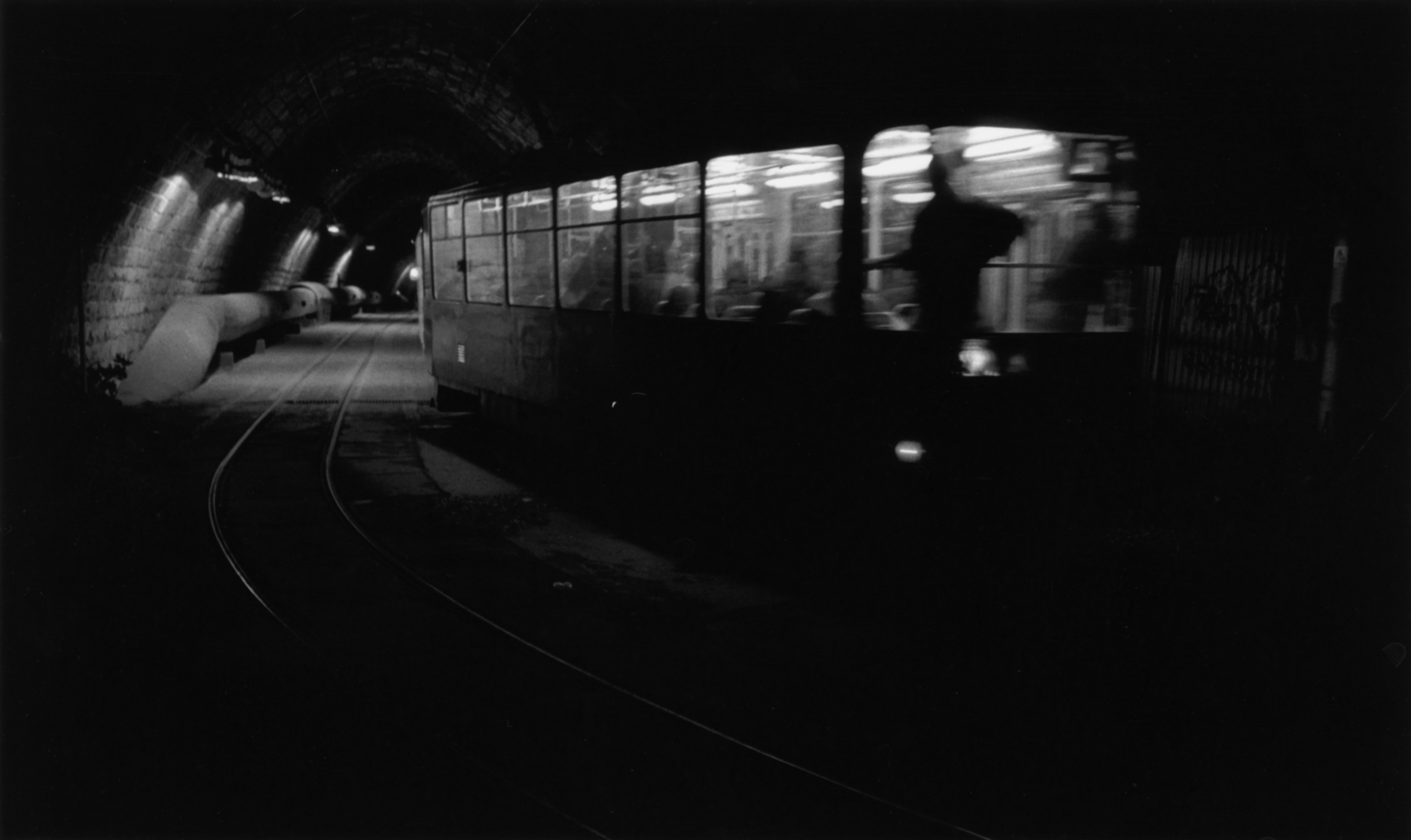
So now I am on the Seventh Avenue Express, heading downtown during morning rush hour. In one hand I hold the book and in the other, the pen, so I cannot properly be called a “straphanger.” I assume a wide stance, bend my knees, and ride the train like a skateboard. In the twelve minutes or so it takes for the train to barrel down the line from 96th Street to Times Square, as I fight inertia’s pull toward free fall into some stranger’s lap, I plunge into the bucolic French village of Combray, or the Paris salons and cafés where the lives of the haute bourgeoisie and the demimonde intersect.
I read Proust almost exclusively on the subway. On the weekends I rarely pick the book up at all; the little volume with the grosgrain marker lies untouched on my desk from Friday evening (time of unseemly rejoicing) until Monday morning (time of dread beyond reason). This runs counter to my notion of myself as someone with an almost religious reverence for literature and its greats. But there it is: my life yields up few moments that are conducive to the concentration and discipline reading Proust requires. When I am at home, I am prey to a restlessness that is incompatible with Proust. I putter obsessively, trying to prevent the detritus of daily life — bills, dishes, phone messages — from accumulating until it topples over and crushes me beneath its weight. So, month after month, I commute and read, read and commute, and now — nine months since I started — I find myself creeping up on the seven-hundred-page mark.
Every three or four weeks I indulge in a dalliance with some other author. When I read on the down-low, it is always in English (no need to keep a running look-up list, with the attendant pen and Post-it notes), usually the work of some contemporary writer whose style is relatively terse (although, compared to Proust, everything seems terse). I can tear through a novel of two to three hundred pages in the time it takes me to read twenty-five to thirty pages of Proust. Often I read these other books while sprawled on the couch. You might think that I deliberately reserve Proust for the subway because Proust and the subway are in some way uniquely compatible. Perhaps I do; perhaps they are.
There are those who might think that reading in bursts of twelve minutes or less while standing on a subway train is no way to absorb Proust’s leisurely cadences and looping syntax; the minutely detailed observations and perceptions captured and sliced fine to reveal their delicate innards and seeds, like julienned vegetables. In Proust’s day there were those who said that no serious literary work could result from writing while reclining in bed and wearing a dressing gown. Proust paid them no mind. He wrote in bed in his dressing gown; I read on the subway. Back and forth I ride, back and forth, and slowly I advance, boring through the book, like a termite through wood, at the rate of five pages each way; sometimes ten; or sometimes, after an exhausting day of insignificant busyness, none.
Read in brief spurts, Proust’s three thousand pages reveal themselves to be a series of hundreds and hundreds of linked, discursive essays two to five pages long. Here is a description of the chrysanthemums in Madame Swann’s chambers, which segues into mention of a sunset whose color is similar to that of the flowers, which doglegs into a discussion of how her former life as a kept woman (with a sideline in prostitution) has nurtured in Odette (as she is known to her intimates, of whom there are many) a taste for a variety of luxury consumer goods delivered to her door from exclusive establishments spanning many arrondissements. Here is an examination of the difference between the face a famous writer presents to society at a dinner party and his interior life as laid bare in his books, and the astonishment of Marcel, the young narrator, at the contrast between these two aspects of the man whose work he has long admired — a contrast so marked that he thinks the party guest must in fact be some other writer who coincidentally has the same name. Here is a meditation on a musical phrase that lodges in Swann’s memory after repeated hearings, expanding his soul as the aroma of a rose does one’s nostrils; the fragment of melody coming to signify happiness, love, moonlight, the sea, rejuvenation, a newfound interest in life, and the abandonment of a habitual tone of detachment and irony. Here is . . .
Here is Times Square. I have almost missed it, engrossed as I am in a description of the acacia trees and the public toilet on the Champs-Élysées near where Marcel and Gilberte meet to play hide-and-seek after school. I pause in midsentence, ride the human wave off the train, and come to rest on the platform. Later, when I resume reading, I will cast around in the middle of a two-page paragraph to find my place — although it must be said that in a three-hundred-page stretch that places under a microscope the narrator’s love for a playmate; his pain when he decides to cut himself off from the girl because she does not love him; the brief conversations he has with her parents when he visits her house (at hours carefully chosen so that the girl will not be there and, upon hearing about his visit later, will perhaps be intrigued); and how Odette (that same Madame Swann) accessorizes the kimonos she wears when receiving guests, whether I resume exactly where I left off, inadvertently skip ahead, or reread half a page without realizing it right away is of almost no consequence.
I come up the stairs and cross a wide underground space on my way to board the shuttle to Grand Central, and before I see them, I hear them. The warm, almost mischievous sounds they produce evoke an involuntary smile, and I follow the music to the top of the stairs, around the corner, and behind a pillar, where the men are performing. I stop to soak up some of the feeling that rolls off them. They are playing a washboard, a dulcimer, a fiddle, a tambourine, cymbals, drums, a banjo, and a bass, though not all at once, as the instrument-to-player ratio is about two to one. Dollar bills and CDs spill out of an open instrument case. The men are wearing odds and ends reminiscent of other worlds and times: a bolo tie, a bandanna, a striped railroad cap, a cowboy hat, a stocking cap pulled down low over dreadlocks. With them is a woman who wears her excess flesh like an ermine stole and passes out flyers to the sparse audience, which is constantly dispersing and replenishing itself. When she runs out of flyers, or of audience, she shimmies to the music in a manner deeply introspective.
The flyers and the handwritten sign propped in front of the instrument case announce that these are the Ebony Hillbillies. The men are not young. The calm they radiate is not a natural fit with Times Square at rush hour, but they carry it off. They are utterly at home in their music making. Their attitude toward the world is what captivates me: warm, never rushed, each one engrossed in his playing and simultaneously adjusting to his partners in infinitesimal ways. They are doing their thing and doing it to perfection.
Soon I will hasten toward the low-cost mortgages, the cappuccino bar, the Arabic lessons, the Pilates, and the raspberries with whipped cream — I am always precisely ten minutes late, and no one in the office ever seems to notice — but for the moment I am swept up. Where do these men live, I wonder. It is always the first question a New Yorker asks; the answer reveals so much. Do they ride the A train in from Far Rockaway? Maybe they’ve come in from Jersey City on the PATH train? I doubt anyone has ever gazed admiringly at these men’s dental-insurance cards. Do they have day jobs?
They play. They strum, click, scrape, and saw. One of them taps his toes; another stamps his heel; a third does something like singing but less melodious. They do not look like the kind of street musicians who interrupt their playing to bob their heads and say, Thank you, ma’am, when a passerby drops a few coins into their case. No, they are not that kind. I stand off to the side, watching and listening for as long as I can before running to make my connection.
I head for the shuttle, which goes endlessly back and forth, back and forth between Times Square and Grand Central Station. I have my choice of three trains on parallel tracks numbered 1, 3, and 4; they all go to the same place. Someone once explained to me why there is no track 2, but I have forgotten the reason. There is a track 2 elsewhere in the system, but it peters out before it reaches Times Square. Or something like that. I clutch the little volume in one hand, preparing to open it again and regain my place, midsentence. Behind me the men — Did they all grow up somewhere in east Tennessee? Did their group coalesce in a bar in Brooklyn before Brooklyn was hip? Are they Harlem born and bred? — are still at it. On the shuttle I will read one more page, maybe two if I recognize all the words, about Odette and the ladies who come to her Wednesday afternoons and discuss where they have their dresses made; or about a brothel where the madam always urges Marcel to try out a Jewish prostitute with messy hair who is better educated and a better conversationalist than the others, and Marcel always demurs: No, thank you. Maybe next time.
I will get off the shuttle at Grand Central with all the other passengers and traverse the station’s cathedral-like expanse. There are easier, faster routes to work, but a day that begins with a sense of awe, head tilted back to take in that vast space, is a day not yet entirely lost. I will admire the old-fashioned, pearly-faced clock that anchors the center of the grand hall; go down a narrow, marble-floored passage where vendors sell grilled Hawaiian tuna, peppercorn sausage, cheeses that verge exquisitely on the foul, mangoes, bananas-Foster cupcakes (whatever they are), tiramisu cake, and other treats with names fancy beyond recall, wrapped in crinkly paper or packed in bright tins and dripping with snob appeal. I will emerge from underground into the city and the shadow of the green-glass building. I cannot hear the music anymore.