In April of 1784 Wolfgang Amadeus Mozart had just completed his Piano Concerto No. 17. He’d also recently acquired a pet starling he named Vogelstar. Some scholars believe Mozart cribbed the melody for his allegretto from the bird’s song; others think Mozart taught the melody to the bird, who sang it back to him perfectly. We know for certain that, when the starling died three years later, Mozart wrote a poem to commemorate his passing.
Like Mozart, the author and amateur ornithologist Jennifer Ackerman has a great affection for birds—from her family’s pet parakeet, Gri-Gri, who joined her for breakfast when she was a little girl, to the herons near her home in Charlottesville, Virginia. She’s traveled extensively to watch birds in their habitats, delighting in Eastern Australia’s Superb Lyrebird, whom she calls a “champion sound thief,” and the California Scrub Jay, a food-storage expert with an impressive memory. With characteristic humor, Ackerman writes, “The misguided use of ‘bird brain’ as a slur has finally come home to roost. One by one, the bellwether distinctions between birds and our closest primate relatives seem to be falling away—toolmaking, culture, reasoning, the ability to remember the past and think about the future, to adopt another’s perspective, to learn from one another. Many of our cherished forms of intellect . . . appear to have evolved in birds quite separately and artfully right alongside our own.”
Ackerman graduated from Yale in 1980 with a BA in English, and her early articles and books covered such subjects as the work of visual artist Chuck Close and the science of the common cold. She has been awarded many research and literary grants, including a 2024 Guggenheim Fellowship, and has published essays in The New York Times, Scientific American, and National Geographic. Ackerman’s most recent book, What an Owl Knows, extends the playful but erudite scholarship on display in her previous works The Bird Way, The Genius of Birds, and Birds by the Shore.
I met her in person during a quick trip to Charlottesville last fall, and we continued our conversation by video chat a few weeks later. The International Ornithologists’ Union estimates there are more than eleven thousand species of birds in the world, but we had time to discuss only a handful of them, laughing and sharing amazement over these wondrous creatures.
[Not all conversations are as linear and succinct as they appear. This interview has been condensed and edited for clarity.—Ed.]
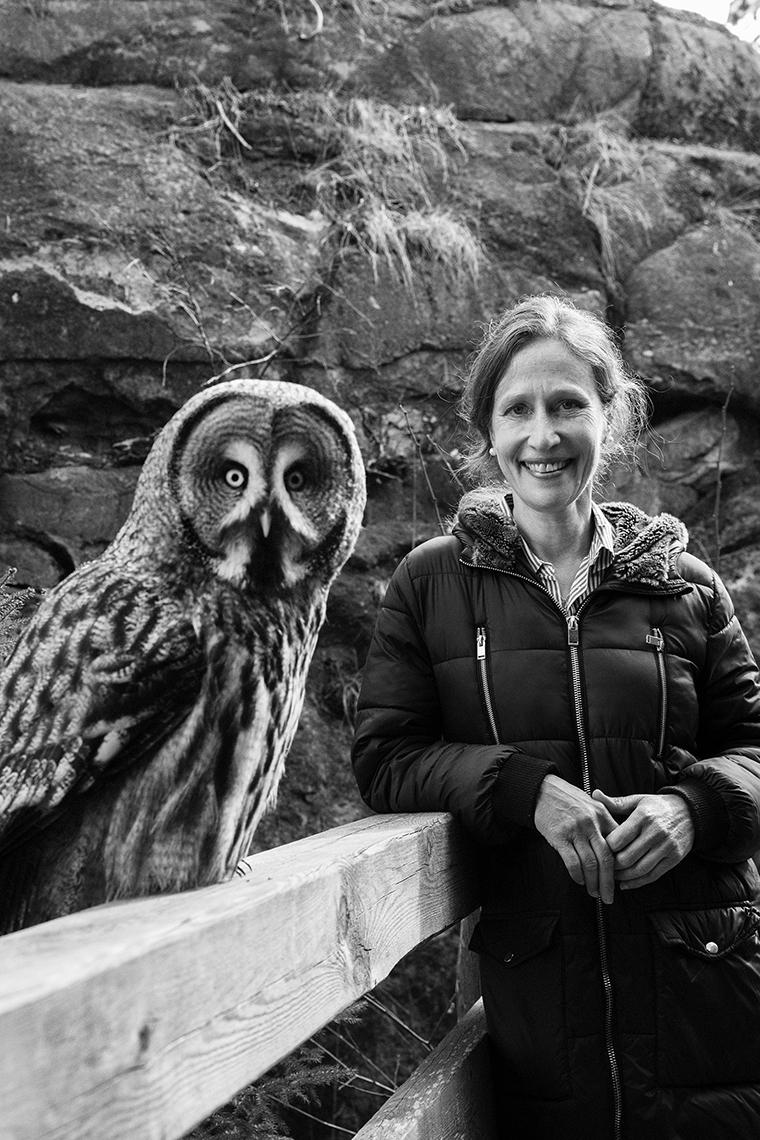
Jennifer Ackerman pictured with a Great Gray Owl.
© Sofia Runarsdotter
Leviton: You first became interested in birds at seven years old, when your father took you bird-watching in the Washington, DC, area. What was it about birds that intrigued you?
Ackerman: My dad had a big job at the Department of Health, Education, and Welfare, and I was one of five girls, so it was hard to get time alone with him. But he loved to go bird-watching on weekends, and being allowed to go with him was pretty special. He and I would get up before dawn and head to the Potomac River, to a spot on the C&O Canal there, and we’d stand in the dark and just listen. My dad had learned to bird-watch as a Boy Scout from a man named Apollo, who was virtually blind but had an incredible ear for birdcalls. So my dad was good at birding by ear. He taught me to pick out the witchity-witchity-witchity of a Common Yellowthroat, for instance. I was just enchanted by that. Then the sun would rise, and we’d start to see the birds. My dad gave me my first Peterson Field Guide to Birds of North America, which became a very well-thumbed volume. I just loved spotting birds and identifying them and figuring out what family they belonged to.
My dad was also responsible for my first exposure to a very smart bird. We had a family pet parakeet, a budgerigar named Gri-Gri, who was allowed to fly around our house, for better or worse. [Laughs.] He’d perch on our fingers and shoulders and was very sociable and smart. During breakfast he’d perch on the edge of my cereal bowl and peck at the wheat flakes. I’d build a sort of wall of cereal boxes around my bowl to try to keep him away, but he always found a way up and over the boxes to splash around in my bowl.
The other person who was really influential for me was Bill Frech. He was an elderly man who lived in Lewes, Delaware, where I lived for three years while writing my first book, Notes from the Shore [reissued as Birds by the Shore—Ed.]. He’d go bird-watching for three or four hours each morning and was really good at identifying birds by their behaviors, their habits, and their ways of flying. Bill was nearly deaf, but he was skilled at spotting birds at a distance. He and I would go bird-watching, to see what we could see, and he taught me to spot the dipping flight of an American Goldfinch, or the way a Spotted Sandpiper will rock its rump, how a Black Skimmer will fly low across the surface of water.
Those two people nurtured my deep love of birds. Toward the end of his life my dad had some dementia, and it was somewhat difficult to carry on a conversation with him, but whenever I mentioned birds, he would light up. It was like that part of his brain was still preserved. Bird-watching was a lifelong connection between the two of us.
Leviton: Where I live, in the Sierra foothills, I’ve been awakened many times by birds making a racket as the sun comes up, but it quiets down pretty quickly. What’s going on with their reaction to first light?
Ackerman: I don’t think scientists completely understand what we call the “dawn chorus.” One theory is that, if you’re a bird, it’s a way of announcing that you made it through the night. You’re still alive, still occupying your same territory. It communicates to other members of your species—and probably other species, as well—“I’m still here, and this is my turf.”
Leviton: I can’t help but think of a morning prayer that observant Jews say, the Modeh Ani. It’s a prayer of gratitude that basically says, “Thank you, God, for returning my soul to me so I can see another day.”
Ackerman: I love that. That’s fantastic.
Leviton: This brings up the subject of cognition and intelligence in birds. How do we evaluate their intelligence without viewing them as feathered versions of ourselves?
Ackerman: Anthropomorphism is a real sticking point in the field. I think that’s changing because a lot of behaviors in birds are in fact similar to human behaviors. But any scientist will tell you it’s not easy to probe the mind of another animal, especially when they have kinds of intelligence that differ from our own. We know how to measure things that we’re good at, like solving physical problems. Scientists may give a bird food in a container that it has to figure out how to open in order to eat. The scientists observe how long it takes the bird to solve the problem and whether it’s showing “behavioral flexibility.” In other words: Can it shift its strategies? Can it innovate when confronted with new challenges? That’s pretty easy for us to measure, but birds also have social intelligence, musical intelligence, and other kinds of intelligence that are harder to measure. For example, we’re still trying to figure out how birds know where they’re going. Humans don’t have the innate capacity to navigate using the earth’s magnetic fields and other information sources.
Leviton: There are more than eleven thousand species of birds—almost twice as many as mammals—and birds live everywhere on Earth, in virtually every kind of environment. Why are they so successful?
Ackerman: I like to say the real question is not “Are birds smart?” but “Why are they smart?” Evolutionary success depends on how you define it. Birds have been around for a very long time, since about fifty-five million years ago. Birds are dinosaurs. They evolved from small predatory dinosaurs, cousins to the big dinosaurs that went extinct. The brain of a bird is very dense with neurons, and neurons are real energy hogs; they’re calorically expensive to run. What is it about the lives of birds that calls for such an expensive type of intelligence? I think it’s because they have had to solve some major problems, just as we have: How do you find decent shelter? How do you get food under difficult circumstances? How do you defend your territory? How do you find your way to wintering and breeding grounds? How do you find a good mate? How do you get along well with others? How do you elevate your status in your group? How do you communicate with your mate and your flock? Birds had to evolve an impressive mental capacity to deal with these issues and spread as successfully as they have.
Leviton: It’s such a simplification to use the single word bird to describe such an immense variety of creatures. You write that about 20 percent of birds can open their eyes when they hatch and fly off and start looking for food within a day or two, while others need a lot of attention from parents before they can manage on their own.
Ackerman: The birds that hatch from the egg and are almost immediately able to fend for themselves are called “precocial.” The Australian Brush Turkey is one. Brush Turkeys bury their eggs in enormous mounds, which males build to attract mates and can be up to five feet tall and thirteen feet in diameter. The materials used to make the mound will begin to compost, and the eggs are incubated by the heat of that process. When they’re ready, the hatchlings dig their way out, and the father who built the mound basically doesn’t recognize them. He boots them off as if they are something he needs to get rid of. These newborn birds can hunt, escape predators, basically do everything right off the bat.
The other 80 percent of birds, known as “altricial,” require parental care for months or even up to a year. The New Caledonian Crow, which is probably the smartest bird on the planet, has a really long juvenile period. The young sort of tag along with their parents for a long time, learning to make tools that help them get grubs out of trees. So there’s a transmission of knowledge across generations. To some scientists, a long juvenile period is a sign of high intelligence. Great Horned Owls also stay with their parents a long time.
Leviton: Is it accurate to say that, the more helpless the infant is after birth, the smarter an animal will eventually be?
Ackerman: It’s hard to generalize. Certainly precocial birds seem to be a little less intelligent in the ways we define intelligence.
Leviton: You went to New Caledonia specifically to study the crows there.
Ackerman: Those birds are truly remarkable. Their ability to make and use complex tools is on par with that of big primates like chimpanzees and orangutans. These corvids can craft tools by combining two or more elements and can use one tool to secure another, called “meta-tool use”—a feat that has otherwise been found only in humans and great apes. The crow dubbed “007” by Dr. Alex Taylor completed an eight-stage puzzle, using one tool to get another, until it finally obtained the tool that could then be used to access the food. This crow had seen the stages of the puzzle before, but never in that order. And 007 solved the puzzle in three minutes. It’s quite amazing. You can see him do it on YouTube.
The New Caledonian Crow is the only species other than humans that makes hook tools, which the birds use to fish grubs out of holes. They make these tools from sticks and also from the leaves of the pandanus plant. They actually carve the tools from the leaves with their beaks. They seem to have the image of the tool in their minds before they begin.
The day I arrived in New Caledonia to meet Alex Taylor, I stepped out of my hotel and saw a New Caledonian Crow in the shrub right in front of me. I felt like saying to it, “You may look like a regular crow, but I know you are so friggin’ smart!”
These corvids can craft tools by combining two or more elements and can use one tool to secure another, called “meta-tool use”—a feat that has otherwise been found only in humans and great apes.
Leviton: Do they learn from observing peers, or are they taught toolmaking by their parents?
Ackerman: The word teach is tricky to use in the animal world. They certainly observe their parents, but whether the parents are actually showing them what to do is up for debate. Without question, though, they are observing and imitating.
Leviton: I also learned from your book The Genius of Birds that some corvids have a unique way of cracking nuts.
Ackerman: Yes, in Japan, Carrion Crows will drop nuts on the roadway when the stoplight is red. When it turns green, the cars roll over the nuts, cracking them open. The crows then wait for another red light before they swoop down and pick up the nutmeats.
In New Caledonia I saw crows dropping candlenuts from a great height in order to crack them on the pavement. This isn’t exactly tool use, but Taylor and I also saw a crow land on a newly built wooden barrier that had a large metal bolt in it. The crow lodged a nut in the bolt hole to hold it firmly while he pried it open with his beak. That is tool use.
Leviton: Corvids will cleverly hide food to prevent other birds and predators from finding it.
Ackerman: You’re talking about California Scrub Jays, which are particularly good at this. They are “caching” birds, meaning they hide food to save it for later. And they remember where they put their caches months later. But they are also thieves and will steal the caches of other jays, observing where those caches are and waiting for opportunities to dig them up. If a jay thinks another jay is watching, it will deliberately “fake-cache” its own nuts and seeds, pretending to put them in one place, then actually putting them someplace else. This suggests they possess what scientists call “theory of mind”—the ability to imagine things from the perspective of another.
Leviton: Are these the same type of birds that learned how to get the cream from the top of milk bottles during World War I?
Ackerman: No, those were Great Tits and Blue Tits in England. In the 1920s the tits started attacking the glass milk bottles people would have delivered to their stoops. The birds learned how to pierce the cardboard caps to drink the cream floating on top of the milk. This started in the South of England, but, in what appears to be an example of social learning, it was soon happening all over the UK. It threw the dairy industry for a loop.
Leviton: Animal behaviorist Louis Lefebvre believes “smart birds innovate,” like the Gray Kingbirds he observed that switched from eating insects to eating guppies trapped in tide pools after a storm, something they’d never been observed doing before. Are some birds cleverer than others?
Ackerman: Lefebvre is a Canadian scientist at McGill, but he does fieldwork in Barbados, where he’s created a sort of natural laboratory. When I visited him there, Carib Grackles would dip their beaks into little pools of water on his porch, eating pieces of dog kibble he’d left in them to soften it.
Lefebvre developed the first scale to measure intelligence in birds. He went through the professional ornithology journals over dozens of years and found more than 2,300 examples of birds showing innovative behavior. Some of the instances are just wonderful. He found a report of Bald Eagles chipping holes in the ice on a lake. There were minnows frozen just under the surface, and after chipping the holes, the eagles jumped up and down on the ice, which pushed the minnows up through the holes so they could then feast on them.
I also love the sparrows in New Zealand who learned how to activate the electric-eye sensors to open and close the doors of the cafeteria at Dunedin Hospital. They’d pop in, eat the crumbs on the floor, and pop back out. These are all examples of birds using innovative behavior to exploit the resources of their environment.
European Starlings and Zebra Finches can contract and relax their vocal muscles a hundred times faster than the blink of a human eye. Marsh Warblers have a song that includes pieces of songs from seventy or eighty other species.
Leviton: Let’s talk about birdsongs and calls. They’re not the same thing, are they?
Ackerman: There’s a murky distinction. Songs can serve several purposes: to attract a mate, to establish the boundaries of a territory and protect that territory, and to communicate with members of your flock and also rivals. Calls are often used as a warning to other birds that there’s a predator nearby, but there are also mobbing calls, which actually draw in other birds, including other species of birds, to harass the predator or intruder.
Leviton: Spectrographic studies have shown that even the best human speakers cannot replicate a sound as accurately as birds can over and over.
Ackerman: Right. And some, like the mockingbird and canary, can actually sing two notes at once. They use a syrinx, which only birds have: an apparatus composed of delicate cartilage and two membranes that vibrate with airflow at superfast speeds. European Starlings and Zebra Finches can contract and relax their vocal muscles a hundred times faster than the blink of a human eye. Marsh Warblers have a song that includes pieces of songs from seventy or eighty other species.
Some female birds choose their mates based on how accurate and precise their songs are. The females are listening closely for auditory distinctions that we can’t even make. They are very attuned to minute differences in the performance.
Leviton: What are the males trying to convey? That they are good providers? That they are healthy and capable of siring lots of babies?
Ackerman: It’s often: I have good genes. I’m robust. Just listen to me strongly singing in this way. In a way they are also saying, I have a good brain. I should say here that many species of female birds also sing. Birds learn their songs through “vocal learning,” which is the same way we learn to speak: by listening and imitating. It’s very rare in the animal world and occurs only in birds, humans, bats, cetaceans, seals, and elephants. The bird’s song may be executed by the syrinx, but nerve signals from several brain areas control those muscles. Their brains also need to be able to differentiate the song to be imitated from all the other background noise, like when you are trying to hear someone at a cocktail party.
Leviton: Some birds imitate the sounds of car alarms, cell phones, or airplanes. What’s that about?
Ackerman: Mimicry of nonbird noises is fascinating and a bit puzzling. Why would any creature devote so much time and mental energy to making random sounds?
The Superb Lyrebird in Eastern Australia is a champion sound thief. I went there to see lyrebirds in the Blue Mountains, and they will imitate chain saws or a camera clicking, but a lyrebird can also imitate a whole flock of parrots, or the two parts of a duet that certain birds sing. The male stands on his mound and just spews this fountain of mimicry in an effort to impress the female.
I got to witness this in the Toolangi Rainforest with Andrew Skeoch, who’s a wildlife-recording specialist. He really knows his birds. He’d hear the lyrebirds imitating another bird and say, “Ah, that’s an Eastern Whipbird!” The volume of the lyrebirds’ performance was almost deafening.
Leviton: I understand birds will also imitate a predator to protect their food sources.
Ackerman: Blue Jays will do that. They can imitate the calls of a Red-tailed Hawk, for instance, to scare away their fellow Blue Jays and have the feast to themselves.
Leviton: Tell me about the bowerbirds you saw in Australia. They exhibit behavior that is quite creative and a little crazy.
Ackerman: Bowerbirds are an extraordinary family of birds native to New Guinea and Australia. Male bowerbirds build special bowers to woo females. These are structures made of sticks, sometimes forming little archways, with “avenues” or “courts” that are display areas for the shiny or colorful items they collect—pebbles, bones, shells, bits of glass, metal or glass objects, ribbons, and more. These are not nests. [Laughs.] There’s no rearing of young taking place there. They are almost like theaters for seduction, the stage the male uses as a kind of backdrop for this incredibly elaborate song and dance he performs for the female. The females are very picky about which males they’ll mate with. They are looking for superbly crafted bowers: symmetrical and dense, with uniform-size sticks. The poor hopeful male has to find hundreds of sticks that are just the right length, then build two curved walls. It’s craftsmanship at its finest.
If the bower looks good enough, the female will pop into the little archway and watch as the male launches into this wild performance to impress her. It’s a frenetic ballet of hops and stances and songs. He picks up objects and tosses them in the air. He flares his wings and bulges his eyes. He runs dramatically back and forth. And bowerbirds are really good mimics, so he’ll imitate the crazy, laughing calls of Kookaburras or the shrieks of cockatoos. All this time, like an Olympic judge, the female is viewing the performance with a critical eye, as if mentally comparing it with all the other performances she’s seen. Only the male with the best performance will win the opportunity to mate with her.
Leviton: I’m picturing John Travolta in Saturday Night Fever, on the lit-up disco floor, cocking his hips and pointing at the sky.
Ackerman: It’s true! In Australia I found a Spotted Bowerbird’s “stage” packed with green glass, little bits of jewelry, and glass marbles. One of the scientists who studies this bird found a bower near the house of a stained-glass artist, and the bird had repurposed shards of stained glass for his bower, sorted by color and laid out like a mosaic. The Spotted Bowerbird likes shiny things, while Satin Bowerbirds like blue objects; their bowers are often filled with blue plastic straws and pieces of blue thread. If they see something blue in another bowerbird’s bower, they may try to steal it.
The Great Bowerbird favors bleached snail shells, stones, and bones. I have one picture of a bower near a cemetery, and I think the bowerbird found some human bone fragments to use.
Leviton: Are there any examples in the bird kingdom of females putting on such displays to attract males?
Ackerman: There are some. The Alpine Accentor is a sparrow-like, mountain-dwelling bird in Europe and Asia, and the females of the species will sing to attract a mate. But that’s unusual in the bird world.
Leviton: Folk tradition says that birds mate for life, but I understand this is not true.
Ackerman: It depends on the species. For instance, the common wisdom once was that owls, and Great Horned Owls in particular, were monogamous. Then, through the study of their vocalizations, researchers learned to identify individual owls; their vocalizations are almost like a signature or a fingerprint. This has allowed scientists to keep track of the pairings between birds, and, as it turns out, there’s a lot of mate-switching going on. It’s a regular owl soap opera out there. [Laughs.]
Scientists can eavesdrop on many social aspects of bird behavior, thanks to improvements in technology. Radio tagging and satellite-transmitter tagging have really expanded. Now scientists can track birds over long distances. Another amazing tool is nest webcams. They give us a round-the-clock view of the intimate relationships: all the feedings and interactions among siblings, and between parents and young. It’s really shed a lot of light on the bird world.
Leviton: There are birds that don’t build nests at all, right?
Ackerman: Owls don’t build their own nests; they commandeer the structures of other animals. The Burrowing Owl, for example, nests in the burrows built by prairie dogs, skunks, squirrels, armadillos, or badgers. Some of these owls will decorate the outside of their burrows using corncobs, corn husks, and bits of fabric or concrete. This is not about attracting a mate. The male decorates only after the female has laid eggs in the burrow. Scientists think it’s a way of signaling to other males: I’m a tough guy. This burrow is taken.
Leviton: So a badger comes home and finds his house occupied?
Ackerman: Mostly the owls pick an abandoned hole. Other types of owls take over nests that have been abandoned by crows, hawks, magpies. Smaller owls nest in cavities excavated by woodpeckers.
Leviton: Do birds generally use a nest to raise several sets of offspring?
Ackerman: Sometimes they will return to the same nesting site, if it was successful. But if the nest wasn’t successful—and a lot of nests aren’t; there’s often loss of nestlings and fledglings to predators—they’ll find a safer site.
Leviton: Getting back to bird-human interactions, you’ve written about Throckmorton the parrot, who seems quite an extraordinary animal.
Ackerman: He’s an African Grey Parrot belonging to a couple I knew. I’d say parrots, along with corvids, are the Einsteins of the avian world. African Grey Parrots are just mind-bogglingly smart. One bird named Alex worked with Irene Pepperberg, and there are YouTube videos of him titled “Smartest Parrot in the World.” Alex could grasp the meaning of more than a hundred words, understand abstract ideas, and do basic math. You could ask Alex, “How many objects are on this tray?” and he would count them correctly.
Throckmorton would use his talent for mimicry to tease his family mercilessly. He could imitate both his human parents, Bob and Karin, perfectly. He could do their voices so well he could fool one of them into thinking they were being called by the other. He could also imitate the rings of their cell phones. One of his favorite ploys was to summon Bob from the garage by imitating the ring of his cell phone. Bob would drop everything and come to answer the phone, and there would be Throckmorton, talking in Bob’s voice, saying, “Hello? Uh-huh.” Throckmorton enjoyed this game; Bob, not so much.
Leviton: It’s hard to understand this as anything other than play.
Ackerman: Yes, he was obviously having fun and enjoyed the attention. I wrote about birds’ playfulness in The Bird Way. Ravens love to do acrobatics in the air. They’ll throw snowballs around, play with sticks, and engage in rough-and-tumble play with each other. The New Zealand parrot known as a Kea is another bird that’s often looking to have fun.
The traditional view is that play has a single function: to hone important life skills. But it’s hard to see how Throckmorton’s pranks could be explained that way. Scientists believe that other purposes of play among avians are to promote social bonds, to create a community, and to train for unexpected events. Play increases your versatility and ability to recover from mishaps, and it might even provide relief from stressful situations.
The large parrots called Kea are known as the “clowns of the mountains” in their native New Zealand. They behave more like small children than birds. Scientists think they use play to keep the peace in big flocks. They even have a special “play call” they use to defuse conflict: If one of the birds issues that call, the conflict is dropped, and they start playing. I had the privilege of visiting an aviary full of Kea in Austria. Before I went in, I was told to remove all my jewelry and even my eyeglasses, because the playful Kea will just go after all of it. I did, but I forgot I was wearing lace-up sneakers. As the Kea came flocking all around me like children asking, What’d you bring me? some went straight to my laces, untying and shredding them.
Leviton: You mentioned flocking. How do large groups of birds manage to fly in formation together? Is a leader dictating the direction? Are they reading each other’s minds?
Ackerman: Scientists used to think that murmurations of starlings—those cloudlike flocks that seem to move all at once—had to have a leader or that the birds were practicing thought transference. The behavior looks coordinated, but we now understand it as an “emergent phenomena,” something that happens spontaneously because each bird is following a few simple rules, such as keeping a certain distance from one another.
And remember: birds process sensory information much more quickly than we do. What looks instantaneous to us may be more like slow-motion to them.
Leviton: What about migration? How do they manage that?
Ackerman: The birds are using information from sun, stars, smells, sounds, magnetic fields, landmarks—all of it to help them tell where they are going. I think my favorite example of the astonishing navigational abilities of birds is an experiment done with White-crowned Sparrows on the West Coast. These birds migrate from their breeding grounds in Alaska to their wintering grounds in Mexico. Scientists in Washington State gathered thirty of the birds while they were en route—fifteen adults and fifteen juveniles—tagged them, and then shipped them across the country to Princeton, New Jersey, where they were released to see if the birds could reorient and find their way to Mexico.
Within hours, the adult birds were headed across the country toward their wintering grounds in Mexico. The young birds that had never migrated before, however, just flew directly south. Scientists believe that a genetic program tells a young, inexperienced bird to migrate in a certain direction for a certain number of days. The bird doesn’t begin to use all the tools available until it has had a successful migration experience.
Leviton: You are also particularly fond of herons. What attracts you to them?
Ackerman: Great Blue Herons live on a river right down the street from me in Charlottesville, and I visit them every day. They’re almost prehistoric looking. When you see one, you can understand how birds evolved from dinosaurs. In flight they look like feathered dinosaurs. I also got addicted to a webcam installed by the Cornell Lab of Ornithology on a heron nest on top of a dead oak tree. I watched five Great Blue Heron nestlings hatch and learn so much so fast. At night I’d watch them sleep. We know birds experience slow-wave sleep and rapid eye movement (REM) sleep just as humans do.
I have to say, the webcam was a huge time drain! [Laughs.] I’d keep the feed running on my laptop while I was working, and anytime I heard a squawk, I’d switch over to that screen to take a look. The related chat room became a virtual community I joined.
Leviton: Speaking of the connection between dinosaurs and birds, you actually went to China to study that.
Ackerman: Yes, when I was writing for National Geographic magazine in the late 1990s, I went to the tiny village of Sihetun in Liaoning Province. They had discovered some of the first transitional fossils of feathered dinosaurs. There was a theropod named Sinosauropteryx, or “Chinese dragon feather.” Those fossil beds have produced many specimens from 120 to 130 million years old.
You could barely see the outline of the feathers in the rock, but the photographer I traveled with would use special lighting that made the feathers pop out. The smaller predatory dinosaurs are the ancestors of all the modern birds we have today.
Leviton: What is the evolutionary advantage of having feathers?
Ackerman: They are not only essential for flight, they’re also useful for insulation. The individual adaptations of certain birds’ feathers are true marvels. The feathers of owls, for example, evolved to give the owls virtually silent flight, so they can hear their prey and sneak up on it. Owl feathers have a velvety coating that quiets the rustling sound feathers usually make. Their wings also have features that silence air turbulence, so there’s no swoosh when they fly. But there’s a trade-off: the owl’s feathers are not waterproof. Those majestic, puffed-up owls look incredibly scrawny when wet.
Leviton: Lucy Aplin studies the social connections among the small species known as tits, and she says it’s obvious to her that birds have personalities: some are curious, some meek, some nervous, some slow learners. She writes, “The variation in personality is thought to reflect a difference between individuals in their response to risk.”
Ackerman: We tend to think all birds of the same species, like the Black-capped Chickadee or Blue Jay, must be alike, but there’s great variation within a species. For instance, some chickadees are very bold when seeking out food, and others are very timid.
One scientist I know is trained as a rehabilitator and keeps two injured Long-eared Owls. He’s told me that one is grumpy, while the other is completely unfazed by anything. Aplin studies the social nature of big flocks at Wytham Woods near Oxford in England. She and her team have tested the exploratory behavior of individual birds and found quite a bit of variation. The bolder birds flit between groups, getting better information about potential food sources by expanding the size of their social network.
Overall, the variation and different capacities among members of a flock can lead to more resilience and better survival chances for the group as a whole.
The feathers of owls . . . evolved to give the owls virtually silent flight, so they can hear their prey and sneak up on it. Owl feathers have a velvety coating that quiets the rustling sound feathers usually make.
Leviton: Teresa Iglesias and her team of researchers at UC Davis staged a “funeral” for the California Scrub Jays they were studying. Do birds show grief? Do they perceive the distress or emotional states of other birds?
Ackerman: For scrub jays and crows, when a member of a flock dies, the others may gather around it and produce a cacophony of sound. They are obviously acknowledging the death of one of their flock mates, but whether they are mourning the way we do, we really have no idea. One thought is that this “funeral” is a way of gathering information: Is there anything the birds can learn from this situation? Is there a predator around? Is there a sickness?
When one member of a mated pair of birds dies, the other often appears to feel something. We don’t really know what. The bonds between mates can be very powerful, so it makes sense to me there would be some form of mourning or grief.
Leviton: Vincent Hagel, former president of the Whidbey Audubon Society, says he once saw twelve crows hopping around the body of a dead crow. Then one of them flew off and returned with a twig it placed on the dead body. One by one, the others did the same, each returning with a twig or blade of grass and dropping it on the body.
Ackerman: Tony Angell and John Marzluff, the authors of Gifts of the Crow, suggest that crows and ravens routinely gather around their own dead, both to learn the cause of death and to mourn their loss.
Leviton: Getting back to owls for a bit, I was amazed by the way they regurgitate unwanted, undigested food in pellets. Why do they do this?
Ackerman: Owls often eat their prey whole. They’re eating fur, bones, and teeth, none of which they can digest. All the indigestible parts get compacted in their stomachs, and they push this bolus up through the esophagus and out of the mouth. I have photographs of this happening. You wouldn’t believe these cigar-shaped things could come out of the beaks of birds. It’s pretty gross, but the pellets themselves are a great source of information about their diets.
Leviton: Why are owls so good at hunting in the dark?
Ackerman: In addition to the silent flight I mentioned before, they have amazing eyesight. Their eyes are huge for their body size. If our eyes were in similar proportion to our bodies, they would be about the size of an orange and weigh four pounds. An owl’s pupils can swell to just about the entire size of the eye, taking in about twice the light humans do. They also have a superabundance of rods, the light-detecting cells in the retinas. Night-hunting owls have about a hundred times the light sensitivity of, say, a pigeon. Also, owls have forward-facing eyes, which is unusual in the bird world. Most birds have eyes on the side of their heads, giving them better peripheral vision to spot predators. Forward-facing eyes give owls better binocular vision, which helps them zero in on moving prey. An owl’s eyes are locked rigidly in place, however, so it has to move its head to keep something in its field of vision. That’s why you see owls swivel their heads. And, no, they can’t turn them 360 degrees. But some species can turn their heads about three-quarters of the way around, or about three times the twisting flexibility humans possess.
And then there’s the owl’s hearing. Some can hunt just by sound. Roger Payne, who’s more well-known for his study of whale songs, was the first to show that an owl can actually catch a mouse in pitch-dark conditions relying only on sound. The heads of barn owls and Great Gray Owls are tailored for listening: They have these flat facial discs that act like a satellite dish, collecting the sound and channeling it to the ears.
Some people think those tufts on the top of a Great Horned Owl are its ears, but they are there for camouflage. An owl’s ears are just holes in its head. The cochlea, the hearing organ, in barn owls is three or four times as long as the cochlea in other birds. And it’s packed with hair cells, the hearing cells of the brain, giving barn owls hearing that’s almost unequaled in the animal world.
Great Gray Owls and Boreal Owls have asymmetrically placed ears, with one being higher than the other. This gives them the ability to precisely locate sounds, even the faint rustling noises made by mice and voles.
Leviton: What an Owl Knows made me want to visit Serbia. You write about Serbian ornithologist Milan Ružić, who studies Long-eared Owls. They roost in urban areas, villages, and towns from November to March, and Ružić has counted a world-record 743 in one small area. He compares the sight to a tiger walking down the middle of the road: You think, All these owls don’t belong here. They should be out in the woods. Why do they gather this way?
Ackerman: We think of owls as difficult to find, hard to see, and very solitary. The ones who roost in the villages of Serbia are sort of breaking all the rules. It’s uncanny. Some scientists think these communal roosts are information-gathering centers. The birds are learning from each other where the good food sources are. There’s also good hunting in the agricultural fields around these villages. Farmers there are not using agricultural techniques that keep the rodent populations down, so there are plenty of mice and rats in the area. The owls are also less likely to encounter predators in these villages, so it makes sense to use them as a refuge.
Leviton: Do owls eat only living prey, or do they also scavenge?
Ackerman: Mostly living things. There have been reports of owls feasting on dead wolves, even the carcass of a whale, but it’s very unusual. They are skilled hunters and prefer their prey live.
Leviton: How has climate change affected birds? Are extinctions increasing?
Ackerman: The big threat is definitely loss of native habitat due to development, agriculture, and climate change. It’s been devastating to grassland species. Any birds that depend on old-growth forests, too, are falling by the wayside. There are areas in Australia and the northwest of the US where the loss of old-growth trees has had a huge impact. Some species really are suffering, with the hardest hit being the specialists who inhabit a narrow ecological niche and small geographic range. Island species are under great threat.
Also at risk are migratory birds that depend on precisely timing their trips between wintering and summer habitats. They stop to feed at staging grounds along the way, where insects emerge and plants bloom at a certain time. If the insect emergence happens earlier or the plants bloom earlier because of climate change, the birds might miss a vital source of food to fuel their journeys.
There are adaptive success stories too. Barred Owls and Burrowing Owls have adapted to different kinds of environments. Both have even found success living in sections of cities like cemeteries, parks, botanical gardens, even suburbs—anywhere there are big trees for roosting.
But many species are threatened or endangered. If people want to help, I suggest they support the research organizations that are doing the hard work to understand birds so that we can conserve them and their habitat. Also find out what birds live in your area and ways you might protect their habitat. Good resources are the Cornell Lab of Ornithology and the American Bird Conservancy. Watching birds will expand your sense of wonder and awe and give you a window into why we should preserve as many species as we can.