Inside the Whale
Adapted from Frontier: A Memoir and a Ghost Story
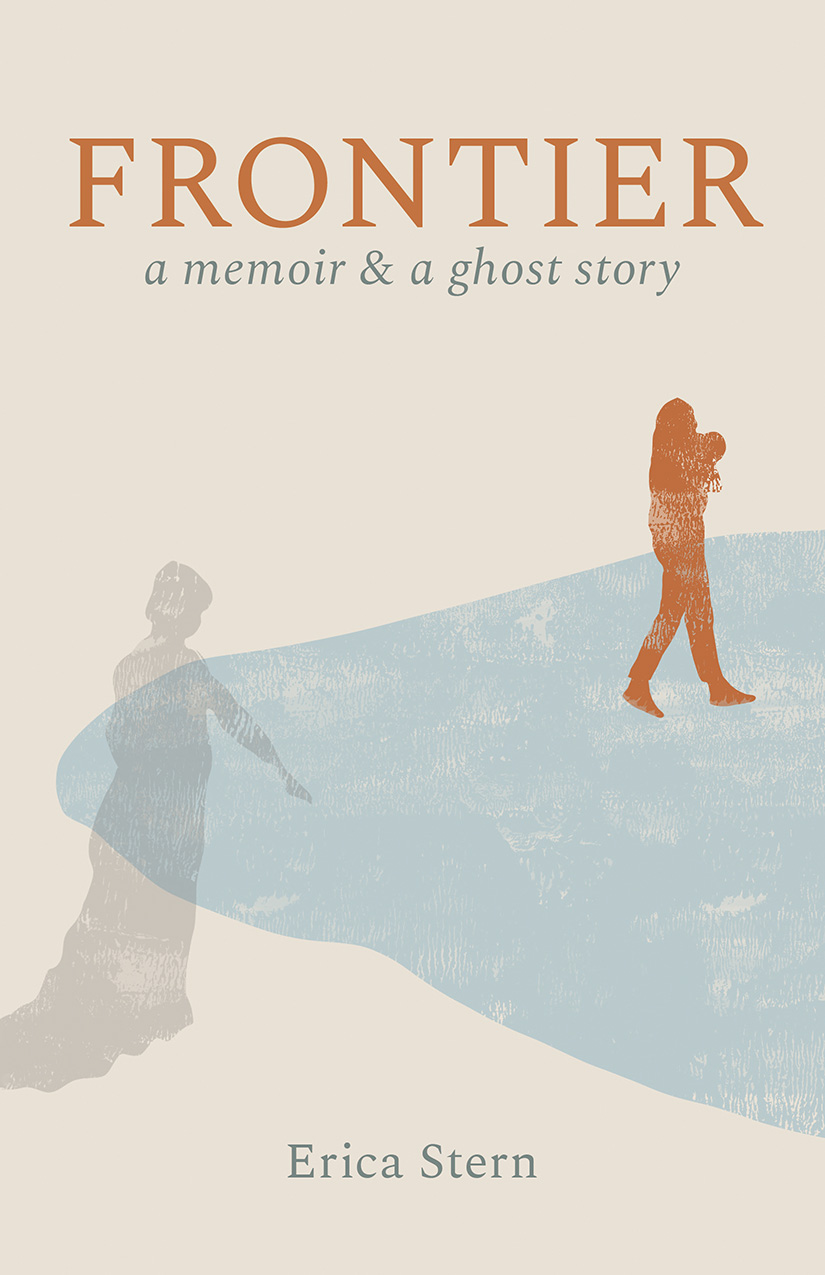
We are pleased to share an exclusive online excerpt adapted from Erica Stern’s new book. In Frontier, Stern transforms her harrowing childbirth experience—marked by life-threatening complications and her newborn's NICU stay—into a hybrid memoir that weaves together her hospital ordeal with a parallel Wild West ghost story of a mother who died in childbirth. Blending personal narrative, fiction, and research on historical birthing practices, Stern exposes the raw realities of motherhood that are often sanitized in popular culture, offering an examination of the profound transformation that accompanies bringing life into the world. “Inside the Whale” is drawn from chapters of the book detailing the author’s labor complications. Frontier: A Memoir and a Ghost Story, published by Barrelhouse, is available now from your local bookstore.
My levels begin to even out. While I was sleeping, nurses spirited away vials of my blood and urine, ferrying them through winding hallways somewhere in the hidden center of the hospital, dropping them behind white doors where hunched-over lab technicians, eyes shielded behind thick plastic goggles, spooled them through machines and examined my cells under microscopes.
The report says the HELLP syndrome was indeed cured by expelling the child from my womb, with the worst symptoms held in check by the magnesium drip they’ve only recently disconnected me from. My liver enzyme levels and blood pressure are falling—not normal yet, but trending in the right direction. When the new OB on call bounces in to tell me the good news, I cry out, a wail I don’t feel emerging from my belly or throat but hear pummeling against the bare walls of the room, because it means having to leave this place that has whisked away my child and refuses to let go. Back in the delivery room, where birthing books promised crucial bonds would be magically forged, the forceps pulled Jonah from me, and I glimpsed his bluish greenish body for mere seconds before the huddle of doctors and nurses hurried him out. It doesn’t feel like he’s mine. Proximity—staying in the same building—is the only way I might find out who he is.
This is a positive trend. The OB smiles in a small way that only involves her lips and not her eyes, a way that acknowledges the suffocation of the room, a force qualitatively different from sadness. Insurance won’t cover an inpatient bed if you’re bouncing back. I remember this from birthing class: vaginal deliveries get you two nights in the hospital; C-sections get you four. The hospital was spoken of as a precious commodity, a chance to recuperate for a handful of nights before returning home to navigate new parenthood alone while also tending to one’s own healing body—a daunting task. Try to deliver after midnight, the instructor joked, explaining how the clock starts after the baby is born, and all that happened before doesn’t count. Couples jotted down notes, like they could somehow game the system.
It’ll be good for you to get out, my family says—parents and in-laws and Jed, who is fulfilling dual roles as supportive husband and invisible patient alongside me, sleeping on a bed that does not count as a bed and slips silently back into its slot in the wall. I am in the real bed tethered to the IV pole with nurses assigned to my care, though his vacant stare bores through the object of focus—the consent form or the window or me—searching for something that doesn’t exist. Every so often he swipes a hand through his oil-slicked black hair, unwashed now for more days than our son has been of the hospital, as though to remind us, to remind himself, he hasn’t been washed away.
Everyone must have forgotten that I am as frozen as the baby in the NICU. Floors away, Jonah wears a blue cap like a bicycle helmet, complete with a chinstrap to hold it in place. Ready for adventure, stuck in his glass box. He’s a museum artifact on display. Eyes sealed shut, mouth clamped around a breathing tube. Everything about him is closed. Through the cap runs liquid, chilled to keep his body temperature down.
Back in the delivery room, the small, mild-mannered doctor tried to explain that the cap was necessary because the brain injury itself was not over, or that there was one injury and then that injury could cause more injuries, but it didn’t make sense, that an injury could be stopped and also keep going. Also it didn’t make sense that my body had injured the baby in the first place, silently and without my knowledge, while doing the thing it was, according to the birthing books, designed to do.
After three days, the cap will come off and the baby will get an MRI, the doctor told us. After three days, he seems to say, we will understand something of the moment of tightening that occurred deep inside me, undetected—not so long ago but also in another era, part of an alternate history. We traveled one path and the road veered and took us with it. A Robert Frost poem of labor. After three days, they can hazard a guess about what lies in store for the baby. No one explicitly says his future will be my future, too, because that’s assumed. I’m a mother now. The three days are a whale’s belly, deep under the sea. We’re both there, Jonah and I, and we cannot leave. The three days preclude the existence of anything beyond. The three days hold us inside.
Listen to every molecule of your body, whispered the yoga teacher in those weeks before I went into labor. The studio was heavy with incense and waiting pregnant women. She said it as though we could break the self down into component parts, turn each piece over in the palms of our heart-clasped hands. As though we could see what was happening inside and control it. We were coming out of one pose, slipping into the next.
The OB takes a breath and says, If you want, we can try something. I haven’t asked, but she seems to have heard me anyway. She pats the edge of the bed as if to indicate we are friends, collaborators, and pulls a sheet of paper from under her arm. Are you in any distress? she asks.
Yes. (Who wouldn’t be?)
Are you having trouble sleeping?
Yes. (Again, who wouldn’t be?)
Do you think it would be dangerous for you to go home?
I know what dark center these questions hurtle toward. I wouldn’t have the energy to hurt myself, though, for the first time, the end of my life does not terrify me. Only the future I can’t see does. I don’t tell her this because there’s too much noise for nuance.
If we can make the case that you’re in too much distress to go home, we can appeal to your insurance to extend your stay. But we’d need documentation. At this point, there’s no medical reason to keep you, and we’d need to submit a code for coverage.
I have forgotten the distinction between medical and not. Between body and other. I exist in a great mass of undifferentiated matter. When Jonah came out, I felt myself float up into the vent above the delivery bed. From above, I saw his misshapen head, the nurses scrambling around him. I have still not come all the way back down into my body.
No, I say, gripping the pilled sheet beneath me. I’m OK. I can leave. The OB lets her hand rise slowly off the bed. It hovers for a moment, midair, then plunges to her lap. She doesn’t believe me, not completely, but she knows her work here is done, that there’s nothing more for her to do. Due diligence complete. No way to read a mind. She is letting me go.
I know too much of what happens to patients with SUICIDE RISK tattooed on their medical records. The ink doesn’t wash away. Once, when I worked as a research assistant at a university, I met people on the inpatient unit of a psychiatric hospital and watched as they approached the medication window, where a nurse would dispense cups of pills and observe the pump of their throats as capsules descended—just as the nurses here watch me swallow pills from paper cups—before allowing them to retreat back to television game shows and plastic couches and small, square windows of thick glass. The patients could see out, but no one could see in. They could watch the street, but they couldn’t walk out onto it. Even after discharge, feet firmly on cement, I’m not sure they would fully return to the outside world.
The OB leaves, feet hitting the floor in slow clunks, as though I might change my mind at any moment and she would be forced to turn around. Better to take her time. Once they escape, no one wants to come back into the containment room, sealed off from the rest of the postpartum floor with two double doors. They have placed me here in spite of the fact that I have no communicable disease. The room shields me from the balloons and flowers and healthy baby cries, and also shields all of that from me.
The nurse, typing something beside the now untethered IV pole, looks up. I’ll go ahead and get your discharge paperwork in order so it’s ready when you are. Then she extracts herself, too.
I imagine outside air hitting my face as I leave the hospital’s sliding doors, a wind hurling me back in, the hospital shoving me out again, my body in limbo between two worlds that don’t want me.
The most difficult segment of labor is transition. The cervix completes its dilation. The body feels itself breaking down the middle. The woman hovers excruciatingly between incubator and mother. In Natural Childbirth, Frederick W. Goodrich, Jr. writes, “From four-fifths to full dilation is the time when you are apt to experience the most pain in your entire labor. At this time you are apt to become frustrated, tired, and discouraged.” To counter this, he offers guidance, however flimsy (“At this point it is important that you redouble your efforts to relax”) along with a reminder that this too shall pass (“It will probably take about ten more contractions to effect full dilation, at which time you will be in the second stage and you will find that you feel differently.”)
When transition is over, the pushing phase begins. But, like water breaking—a burst and then a trickle that continues and continues—transition does not end. Dr. Goodrich doesn’t say it, but I know. I’m still hovering between incubator and mother. Leaving the hospital will be another ongoing state as well as a finite action, just like matter is a wave and a particle at the same time.
You don’t have to vacate immediately, the postpartum nurse says when she comes in with the discharge forms for me to sign. It’s a small mercy. The hospital is always offering up bargains of time.
So we stay, squatters, until the cleaning staff make their way to our floor, round the bend, enter our containment room, plastic waste bins and mop handles clanking. Our final cue.
It’ll be better to get out of here, Jed says, lowering the bedrail to help me out. He offers his hand. Is he speaking to me or trying to convince himself? Our bags are already packed because we didn’t bother to open them. A laminated checklist on the wall lists the newborn discharge requirements (Hep B vaccine, hearing screen, bath), but none of it applies if the baby can’t go home.
I have to leave, I tell Jonah, on our way out. I have to go.
You can call all night long, the NICU nurse tells us. You can check in any time.
When we exit through the doors into the warm air, my in-laws are waiting in the car, parked in the circular driveway at the front of the hospital, beside that beloved doorman in a red vest, the one who sings “Happy Birthday!” to all entering women. This time, to us, he says nothing.
I have to leave, I tell the baby again, looking up at the lines of dark windows where I think the NICU might be. I can’t remember the floor.
Jonah’s ventilator utters: I know, I know, I know.
After his shipmates heave biblical Jonah overboard in order to save themselves, it only takes until the end of the next chapter (a handful of lines) before the whale spits him out. Jonah is a man of swift transition: boat/sea, belly/land. The narrative doesn’t linger in the between. For him, for the writers of the Bible, presumably men, for Goodrich and the other male proponents of natural childbirth, transition is not endless and ongoing. It’s a finite span of time. Before I gave birth, I would have been in this camp, understanding transitions writ large as fleeting by nature: temporary states, bridges between two more solid domains. After giving birth I know that transitions persist, running below the surface. My body will be preparing for labor long after I leave the hospital; I will be leaving the hospital for months and years after returning home. Part of me will stay in the delivery room vent, no matter what else I am doing or where else I exist.
Once discharged, we don’t go home—not yet. We are steadfast in our refusal to return, despite reasoning vague and flimsy. The shift from the hospital back to our lives will be drawn out, elastic. If we were in the Book of Jonah, we would wind our way to Ninevah, avoiding the straightforward route. I’m not sure I can handle the stairs, I say, since we live on the third floor. We need to be as close as possible to Jonah in case the hospital calls, I say, ignoring the fact that our home is only two miles away. Jed tacitly agrees. No one pokes holes in the logic. What I know: when I return, I will walk through the rooms of my former life and will almost recognize them, but not quite. The worst sort of unfamiliar.
Someone books a room for us at a Hilton Garden Inn a few blocks from the hospital, on a busy street beside some chain restaurants and a bus stop. The hotel is sterile in a way meant to make its inhabitants forget the imperfections of the outside world. Its refusal to let in emotion is welcome; adherence to a blueprint leaves no room for human messiness. But quickly we degrade the façade. In the empty minifridge I store vials with drops of the liquid I begin to extract from pumping in strict three-hour intervals through the night while sitting under the desk’s halogen bulb. I litter postpartum contraptions across the carpet—a sitz bath and cold packs that activate when cracked in half and inflatable cushions and plastic squeeze bottles—sterile parting gifts handed over at the containment-room doorway. I drip blood on the toilet seat, then smear it into the plastic when I try to wipe it up. There’s so much more blood than I was prepared for. Totally normal, the postpartum nurse said, back in the containment room. The discharge instructions tell me not to worry unless the clots grow to the size of golf balls or I soak a pad faster than every hour. This seems extreme, but who am I to argue? The sticky, organic smell burrows into the clean, folded towels on the bathroom shelf. A card on the nightstand tells us to dial 0 if anything falls short of our expectations. Perfection is their priority!
Biblical Jonah found himself propelled through the whale’s gullet and into the warmth of its belly, nestled inside the pulsing tissue of a breathing, swimming, bellowing being. While we attempt to transition to the sterile hotel room, to reassemble our lives without the scaffolding of the hospital schedules and protocols, our Jonah waits in the automated equivalent of the whale. From a distance, the blue roundness of the cap resembles a whale’s back arching out of the water. Move closer, though, and it’s inorganic and stiff. Very little of the baby’s skin peeks out from the mass of tubes and wires and gauze and sensors, the syringes churning medication into his veins.
The three days of cooling therapy pass, and the blue cap does indeed come off. The NICU team begins to rewarm Jonah like he’s a microwaveable meal from the freezer, plastic wrapping peeled back at the edge. But something is not right. The doctors consult their screens, their files, and whisper to each other. Jonah’s transition is not going according to plan.
His brain has begun to seize again, the small one says, leaning toward us like he did days ago when he announced the injury. This time we are having some difficulty getting the seizures under control. Sometimes this happens. Cooling can suppress epileptic activity. The baby: a collection of latent impulses blocked by an artificial whale. But he cannot stay forever in his blue cap. Jonah the prophet can’t stay forever in the whale. The whale’s belly and the cap and the containment room are holding cells, temporary by design. At some point Jonah has to emerge into the world. This goes against what I know now about transitions and their ongoingness, but I am learning to accept that there are some rules that aren’t evenly applied and for which there will be glaring discrepancies in logic.
The doctor points to a screen beside the bed where signals sent from neurons, to scalp electrodes, to machine alert him to hidden chaos. We watch as they load Jonah with one medication, and, when the first line fails to block the stampede, another. He doesn’t move.
The baby stays completely still, in spite of the seizing, which makes the seizing hard to believe.
We can’t take a seizing baby off the floor, the doctor explains. He’s too unstable. If they can’t take him off the floor, they can’t wheel him from his NICU suite into the MRI machine that will pierce the shield of his skull and survey the damage.
My magnesium drip successfully spared me this fate of electricity shooting random, pinging signals in an escalating cascade, sending me into the convulsions that can come with untreated HELLP Syndrome. But it isn’t as simple as one brain seizing while the other remains calm and unprovoked. The I is bound up with the baby, our fates twined. Pregnancy, it turns out, is not a state that resolves with birth. With the cap off, Jonah is slipping from property of the hospital to child of parents, whether or not we are ready. His dark brown hair whorls around his scalp, visible in patches between the electrodes. It’s thick enough that, in another timeline, if we were home, I could wash it in the baby bathtub I purchased at the store, using the pink plastic pitcher to rinse it with lukewarm water. Without the cap we are inching closer to the moment when I can hold him. I can almost imagine what he will feel like in my arms, the heft of him—he’s a healthy seven pounds four ounces, they tell me—but not quite. We’re inching closer to the moment when a picture of his brain is taken and the extent of the damage is revealed, which means we’re inching closer to some glimpse into our collective future. We’re being reabsorbed back into each other. The transition is reversing. Jonah is fleeing shore and returning to the belly of the whale.
Can multiple bodies share one self? This is the problem of pregnancy, the push and pull of linked but separate systems which sometimes buckle under the weight of competing demands, as Jonah and I have already demonstrated. I am discovering it’s also the problem of birth. The child is technically outside the mother, but still the mother feels that she must encompass the child. The child, too, shares in the confusion. Theory of mind—the understanding that another person has a consciousness distinct from one’s own—does not develop in an infant for many months. The baby may see itself in the curl of its mother’s mouth, in the tired bags under her eyes. Mother as self and self as mother.
The whale swallows the prophet Jonah, who improbably stays whole, alive and well. Three days later, spat onto dry land, he brushes himself off and travels onward. The story doesn’t follow the whale, a kind of mother to Jonah, protecting him from the tumultuous sea, who may be mourning Jonah’s departure, nursing the hollow space inside.
He’s beautiful, Jed says, peering down at the still baby in a glass case. He means: Look, our baby exists without his crown of blue. Now, though, this bundle of electrodes and wires shrouds his skull. Slowly, slowly, his body temperature rises to that of a living being. Together we are exiting that liminal space in between life and death. Are we parents yet? Will someone tell us when we are? We’re exiting the in-between, but we’ll always have one foot stuck there.
His head is swollen from the cold, a nurse who exudes warmth and comfort tells us. She speaks gently but doesn’t pander. It will take time for its natural shape to emerge. She warns us not to get used to what we see, not to grow attached to this face, which is not the true face of our baby. It’s a kindness, for her to start from the assumption that we aren’t already attached, that we are only beginning to piece together our connection.
While we wait for the seizing to stop, she makes arrangements for us to hold Jonah. She has decided it’s time for us to dip a toe into the sea of parenthood. She knows we’re in no position to take this step of our own accord. That we might stand on the shore indefinitely if left to our own devices. First she argues with the technician who wants to change the position of some of the electrodes on his head. No, she says, not now. You can come back later. She insists some things can wait.
She pages the respiratory therapist, a wiry, bald man with a pulsing forehead vein and maroon scrubs, for assistance with his tubes. Together they rearrange chairs, press buttons on his pumps, untangle cords. Finally she reaches into the glass box for the baby. Shh, she says to him as she lifts, though he is absolutely silent.
I suspend Jonah atop my arms in what might look like a cradle but is too rigid to be an embrace. He needs to be held at exactly the right angle, so my arms must remain as flat as a surgical table. The blue ventilator tube, plunged into his mouth and held in place by a toothed plastic clamp, and the IV lines speared into his hands and arms cannot be disturbed. His nose is mercifully spared: a perfect set of tiny nostrils, flattened by gestation and compression and descent. Wires measuring his oxygen saturation and heart rate and electrodes charting brain misfirings must remain slack and unkinked, and bags connected to his respirator must remain flat, for the smallest fold could disturb the flow of medication or oxygen in or the flow of toxins and information out, setting off the beeps and alarms that populate the NICU halls, alerting and lulling its inhabitants both at once—the whole place a serene emergency.
How do we track this time, which exists somehow apart from all other time? How did Jonah in the whale track time? Did he tick marks against the walls of the whale’s stomach with the edge of a fingernail, counting the rocking of the waves, or did he rely on some internal sense like hunger or thirst that might map minutes passing? Or did Jonah give up time altogether because it stopped mattering in that growling belly under the sea—briny waves lapping at thick blubber like some distant lullaby, his body tossed from side to side inside the sticky gut—and only impose the stamp retroactively, for the sake of narrative? Modern religious scholars sidestep the bulky inconvenience of time by arguing, for example, that each day of biblical creation stands for thousands or millions of years. Time watered down to metaphor. This way, they reconcile history and myth, science and belief. This way, they approach something they call truth.
Were my Jonah’s days—his three days in the cap—truly days, or are they weeks or months or years or something else entirely that the word time and all its associated measurements and contraptions cannot begin to describe: a presence removed from known rhythms, an existence in heaving folds, a hovering, neither life nor death?
We do not move. The nurse secures Jonah’s ventilator tube to my collarbone with a tear of medical tape. It’s an action endowed with humanity, the way she smooths the adhesive to my skin, binding me to him. One electrode dislodges from his scalp and clinks against my arm. I’m surprised at how cold it is. Don’t worry about it, she preempts. We can reattach it later.
I hold the body, but not too tight. He emits a viscous smell: glue-clumped hair and blood-caked stump of umbilical cord. The skin of his calf is flaky and dry against my arm, which is still swollen from my own syndrome. It’s a reminder that he isn’t all medical contraption kept alive by the whirring, hissing ventilator, that he’s organic and living, whatever that means. He isn’t fully wire.
The ventilator heaves a small sigh, continues on with its work. Jonah feels half baby and half machine—an entity I do not know how to nurture yet cannot discard as entirely mechanical.
I don’t think I can do this, I say into the glass box when no one else is looking. I can’t hold Jonah again because to hold him too long or too often might confer too much stimulation on his rattled body. I press two fingers gently to his arm, the way the nurse taught, to avoid overstimulation. I don’t think it’s possible for me to do this, I tell him again, in case he did not understand me the first time. He moves his lips into an o and as I lean in for his reply. His fist begins to knock-knock-knock against the invisible door—not a response but an electrical takeover of his mind.
After another load of Fosphenytoin—a powerful seizure medication brought in when the phenobarbital alone fails to do its job—dampens Jonah’s brain, smashing chaos into a flat line, we go to a Chinese restaurant near the hospital. I walk slowly, holding Jed’s arm, and our families wait at the busy corners for me to catch up. Jed carries the plastic bag with my stash of supplies in his other hand: pads and squirt bottles and the donut pillow, which I need in order to sit. We cross the bridge over Michigan Avenue, and I witness the world preserved: cars run yellow lights; mannequins stare from windows; clouds threaten rain. This preservation has taken place in a jar. I can see the contents, but the seal is tight, and I can’t enter.
Inside the restaurant the owner hovers over our table and tells us about his award-winning Peking duck, which must be ordered in advance. You didn’t call ahead, he scolds. What a shame. It’s OK. You’ll come back. You’ll order it next time. He flashes a smile I don’t trust.
Our food arrives. People pass dishes of dumplings and chicken and broccoli. Spoonfuls of oil erupt on the white tablecloth. The tea is lukewarm and pale. When we finish and stand to leave, the owner is waiting by the door, thumbing through receipts. He turns to me and says, Congratulations!
It catches me off guard. What could anyone possibly be congratulating me for? I walk through the door as quickly as I can hobble.
Did someone tell him about Jonah? I ask, once we are crammed outside under the restaurant’s awning. The rain comes now in thick sheets. I can’t see across the street. For a moment no one answers. We stare at the rain.
My father-in-law says finally, I think he assumed you’re still pregnant.
And I look down and see that my stomach has not returned to its usual size, as though it’s still waiting for my son to emerge from under the briny foam of the dark sea.
Excerpted from Frontier: A Memoir and a Ghost Story by Erica Stern. Available via Barrel House. Copyright © 2025. All rights reserved.
Erica Stern is the author of Frontier: A Memoir and a Ghost Story. Her work has been published in The Iowa Review, Mississippi Review, Denver Quarterly, and elsewhere. She has received support for her writing from the Vermont Studio Center and the Virginia Center for Creative Arts. A New Orleans native, she lives with her family in Evanston, Illinois.
 PREVIOUS
We’ll mail you a free copy of this month’s issue. Plus you’ll get full online access—including more than 50 years of archives.
Request a Free Issue