Lots of people have heard of a carbon footprint, but fewer are aware of the phrase’s debt to an older, broader concept: the ecological footprint. It was introduced three-plus decades ago by ecological economist William Rees, who at eighty-one still publishes regularly in academic journals, despite being retired from a long career teaching in the School of Community and Regional Planning at the University of British Columbia. Back in the late 1980s and early 1990s, in collaboration with then-PhD student Mathis Wackernagel, Rees developed an accounting system—a quantitative tool—to measure and communicate the sustainability, or lack thereof, of the human enterprise. Their analysis yielded a grim picture that has undergirded all his research and advocacy since: Humanity is in a state of overshoot, demanding more resources from our planet annually than it can give and producing more waste than the land, air, and water can absorb and recycle. According to the Global Footprint Network, cofounded by Wackernagel, we’re currently using the resource equivalent of approximately 1.75 Earths. The situation is unsustainable and, argues Rees, will eventually become catastrophic.
Before Rees became a fierce critic of modern techno-industrial [MTI] culture—“In a very real sense,” he writes, “the MTI world has become a civilization of death and destruction”—he earned a PhD studying songbirds in the boreal forests of Canada. To this day he frames his analyses in the context of basic biological science. Globalization and trade, climate change, renewable energy, 8.2 billion Homo sapiens: Rees argues that to seriously engage with these topics requires accepting our status as entirely natural creatures dependent on healthy and finite habitats. He insists that most of us, especially business and political leaders, are in denial, ensnared by the pernicious myth of human exceptionalism. The belief that we are exempt from biophysical constraints, that we can grow our numbers and our GDP indefinitely, is at the root of not just our environmental and societal problems, but also our inability to respond successfully to them.
Rees is a fellow of the Royal Society of Canada and the Post Carbon Institute, a founding director of OneEarth Living, and the recipient (jointly with Wackernagel) of both the Blue Planet Prize and the Boulding Award for Ecological Economics. He’s authored hundreds of peer-reviewed and popular articles. Many of his lectures and presentations, which incorporate a great deal of data and often employ graphs and charts to illustrate his ideas, can be watched on YouTube. His Substack newsletter is @standstoreeson.
When I emailed Rees and proposed an interview, his reply surprised me: “Sounds like fun.” I’d been reading his recent work—scholarly papers with titles such as “Why Large Cities Won’t Survive the Twenty-First Century” and “The Fractal Biology of Plague and the Future of Civilization”—and getting less sleep each night as a result. But discussing with him the unraveling biosphere and the potential collapse of life as we know it was actually quite fun, because he typically laughs instead of growls at stupidity and reckless behavior, and because his intellectual curiosity is energizing. His book Our Ecological Footprint: Reducing Human Impact on the Earth, which he coauthored with Wackernagel, ends with an exhortation to focus on how things are, as opposed to how bad they are, and to consider what we might do to counteract overshoot. Rees spoke to me via video chat from his home office in suburban Vancouver, British Columbia, for nearly three hours, then for another thirty minutes after I powered down my audio recorder. “OK,” he finally said, “I’m heading to my local park to look at birds.”
Not all conversations are as linear and succinct as they appear. This interview has been condensed and edited for clarity.—Ed.
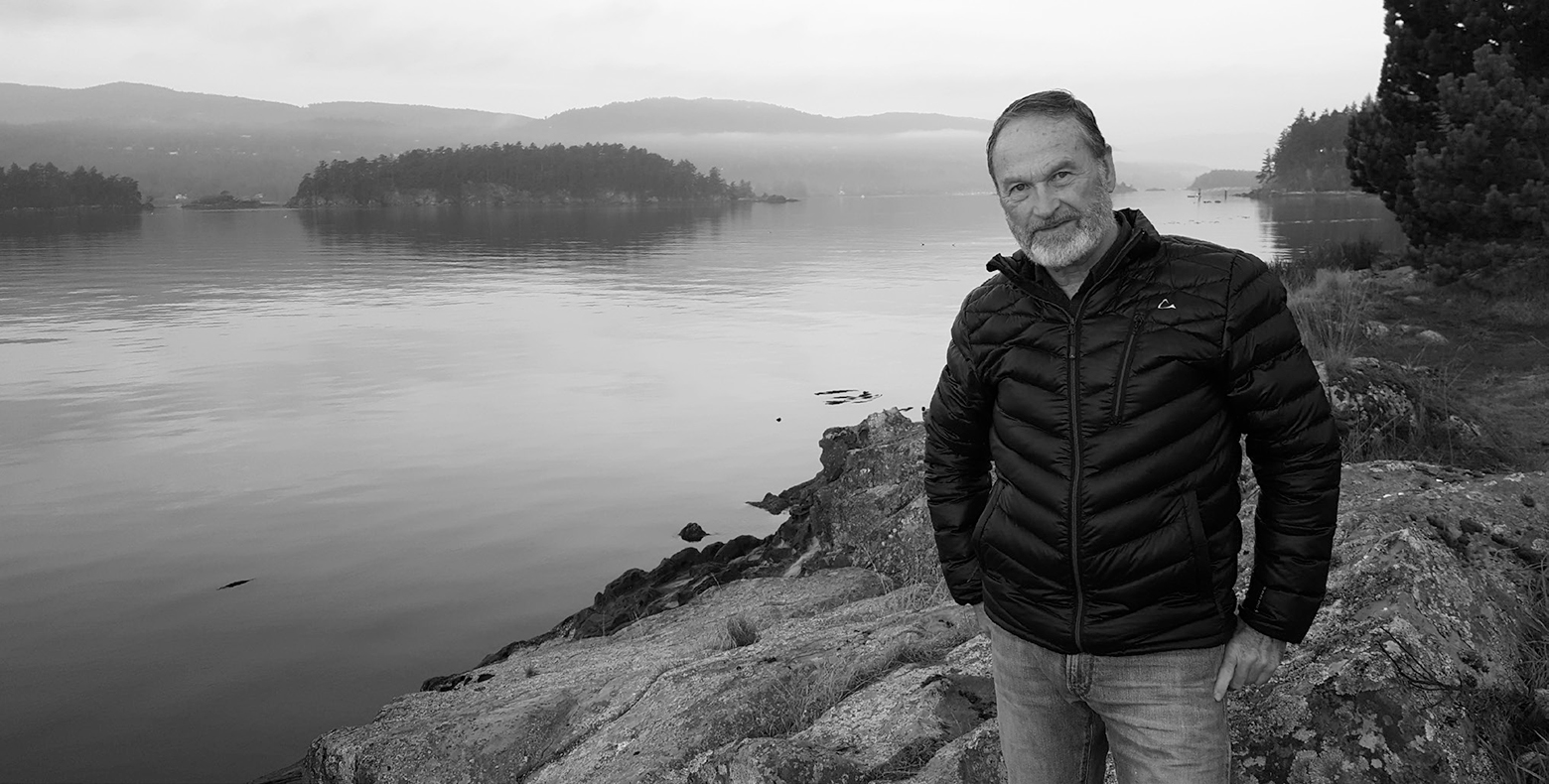
William Rees
Tonino: I’d like to begin with a line from Gary Snyder’s book The Practice of the Wild: “Do you really believe you are an animal?”
Rees: I don’t merely believe we are animals; we are animals! One major problem with humans is that we don’t live in reality. We live in constructed fantasies. Someone once quipped: “Human beings are the only species known to mistake their worldview for the world.” Sociologists say human beings “socially construct” their realities. We make up fantasies about the world and give them all kinds of fancy names: religious doctrines, political economies, even scientific theories. They’re all products of the human mind, massaged into agreement by discussions among certain groups of people and turned into received wisdom.
Most of the ways we moderns approach the world spring from the exceptionalist idea that we are different from other animals—for example, that we have a soul and are not “of nature.” Even modern economics is founded on the notion that the economy and the environment are separate systems. Of course, we use the ecosphere for resources and the disposal of wastes, but, for economists, human ingenuity is the most important resource. Technology can free humans from a dependence on any material good provided by nature. If you believe this, you’ve laid the foundation for a belief in unlimited economic or material growth. And if most of us believe it, we’re done for, because that belief is completely incompatible with reality. As animals, we are embedded in the world.
Tonino: What is carrying capacity? What’s the textbook definition?
Rees: Carrying capacity is the number of individuals that can be sustained indefinitely in a particular habitat without permanently damaging that habitat. Every animal farmer knows this: You keep too many cows in the back forty, they’re going to overgraze and wreck your pasture. When I first started teaching at the University of British Columbia, I gave a seminar on the human carrying capacity of the region in which I live, the Lower Mainland of British Columbia. Based on the productivity elements and current standard of living and diet, I estimated that the region might support about fifty thousand people. After that session, I was taken aside by one of the most famous economists in Canada, who essentially told me, “That was all very interesting, but if you pursue this line of research, your academic career will be nasty, brutish, and short. How could you stand in a room full of senior academics and say the carrying capacity of this region is fifty thousand when there are already over a million people living here?” By the way, that number is over three million today.
His argument was that we don’t depend on carrying capacity; we depend on human ingenuity. Economists agree the concept of ecological carrying capacity might apply to deer or cattle, but certainly not to human beings, because with technology we can overcome any local impediment to population or economic growth. And we have trade. Why should this region be restricted to living off its productive capacity if we can import everything we need from somewhere else?
I’d never explored these ideas before. As a siloed ecologist, I hadn’t been taught that kind of stuff in any biology class. So I went away with my tail between my legs, but in the back of my mind, something bothered me: His response implied that humans were detached from nature, and therefore from reality. I woke up one night thinking, What if we turned the standard definition of carrying capacity on its head? Instead of asking, “How many people can this area support?” we should be asking, “How much area is required to support this many people?”
That was the beginning of the concept of an ecological footprint. By looking at an average person’s annual consumption, we can estimate the area of productive land required to produce their material goods and assimilate their basic wastes. The ecological requirements to sustain a whole region or nation can be estimated using productivity and international trade data.
My graduate students, particularly Mathis Wackernagel, helped develop the method, and we discovered that many parts of the world are utterly trade dependent. Right now something like 80 percent of the world’s people depend at least partially on imports. A large majority of nations run what we call an “ecological deficit”—consuming more food and fiber than they can produce domestically—and they obtain the excess by importing from countries producing a surplus, of which there are relatively few left. Economics has not abolished human carrying capacity; it’s simply created the means by which we can shuffle productive capacity around. Look at a country like Japan: It could not support its capital, Tokyo, on the biocapacity of the entire nation. The Japanese ecological footprint per capita is something over four hectares. Multiply that by the population of Tokyo, and you get a number larger than the entire productive land-base of the country.
There’s another dimension to this. Almost all living species on Earth depend on the constant flow of solar energy, a small portion of which is captured via photosynthesis by green plants. Those plants help transform very simple molecules—water, carbon dioxide, trace nutrients—into the complex chemicals of life: fats, carbohydrates, proteins, and so on. Animals and humans are made from the biomass those plants produce, and humans are appropriating more of that biomass than any other species. Ten thousand years ago we humans were a fraction of 1 percent of the mammalian biomass on Earth. We are now 36 percent of the mammalian biomass, and our domestic animals—the sheep, cattle, pigs, and so on that we use to feed ourselves—are another 60 percent of mammalian biomass. So we and our domestic livestock together comprise something like 96 percent of the mammalian biomass on planet Earth. And poultry now comprise 70 percent of Earth’s avian biomass!
The so-called success of humans has resulted in the displacement of nonhuman life. We measure this both in terms of losses of biodiversity—due to extinctions—and in total numbers of animals. The remaining populations of the few thousand vertebrate species that are monitored fell by 73 percent between 1970 and 2020. Further growth of the human enterprise will mean the continuing extinction of wildlife on Earth. When I hear politicians say there’s no inherent conflict between a healthy environment and an ever-growing economy, I shake my head. It’s complete and utter nonsense. Our victory is ultimately self-destructive. We need to sustain the integrity and functioning of the ecosphere that sustains us.
Tonino: What happens when a species exceeds its carrying capacity?
Rees: Every species is capable, under ideal conditions, of exponential growth. There’s an innate reproductive rate that will result in a constant doubling over time. Two-percent annual growth sounds minimal, but it actually means that every thirty-five years you double—from two to four to eight to sixteen to thirty-two to sixty-four, and so on. Maybe every now and then ideal conditions occur: There’s an exceptionally good supply of whatever food this animal eats, and its population booms. But in nature no species expands indefinitely. If you get too large a population, various negative feedbacks kick in—resource depletion, competition, predation, disease—and the boom leads to a bust because of overshoot: The species is consuming vital resources faster than they regenerate and also producing excess wastes. The latter is now especially apparent with humans—the pollution of everything means we have exceeded natural assimilation and recycling processes.
Agriculture was a huge step for humans because we created food surpluses, which led to the complexification of society, population growth, division of labor, and the emergence of civilization. Even so, it took three hundred thousand years for us to reach our first billion humans on planet Earth, in around 1810. We’re now at 8.2 billion.
Obviously something remarkable must have happened about two hundred years ago. It was the increasing use of fossil fuels. This allowed us to produce the unprecedented supplies of food and other resources necessary for an exponentially expanding human population. Meanwhile, the scientific revolution was relieving many of the old negative feedback loops that were keeping our population in check. Germ theory, for example, gave us more control over disease, and death rates plummeted spectacularly, while birth rates did not.
We are now in overshoot. Climate change is the most obvious manifestation of this, but it’s not the only one. We’ve destroyed around a third, some would say half, of the world’s arable agricultural soil, and the only way we can maintain our current level of food production—which, by the way, may be nearing its peak—is through the application of industrial chemicals and irrigation, which are further destroying the soil. Overshoot is also the cause of plunging biodiversity, land and soil erosion, tropical deforestation, and declining mammalian fertility— including a dramatic drop in human sperm counts caused in part by the chemical contamination of food supplies! All of these trends are co-symptoms of overshoot.
There has been a boom, and soon there will be a bust, in global human population. And no advanced civilization will be able to reemerge because we will have used everything up. There will be no oil and gas and other supplies of that nature to maintain any civilization that might emerge from the ashes of this one.
Tonino: We may not be tackling overshoot, but we are tackling some of the symptoms. Is that helping or just making our situation even worse?
Rees: We’ve known about anthropogenic global warming for fifty or sixty years. In 1992 the United Nations Framework Convention on Climate Change set up the Conference of the Parties (COP), which is dedicated to reducing carbon emissions and stabilizing atmospheric greenhouse gases. Since then, we’ve had twenty-nine COP conferences at which solutions are put forward. We’re supposedly going to see a massive increase in energy production by so-called green alternative energy: wind turbines, solar panels. We’re going to see the development of carbon-capture-and-storage technologies. We’re going to see the displacement of the internal combustion engine by electric vehicles, and so on.
What has been the result of all these “solutions”? In the last thirty-three years we’ve seen a large increase in fossil fuel use and a 63 percent increase in carbon emissions. I’m almost eighty-two. Ninety percent of the fossil fuel ever used by humans has been used in my lifetime—half in the past thirty to thirty-five years! So the impact of mainstream efforts has been zilch in terms of reducing atmospheric carbon dioxide. In fact, if you plot the increase in atmospheric concentrations, you can’t detect implementation of COP agreements or technologies in the accelerating upward trend. Meanwhile wind and solar electricity still represent only about 3 percent of global energy supply.
Politically feasible solutions to the climate crisis are all technological “advances” committed to perpetual economic growth, and that compounds overshoot. Solar panels, wind turbines, electric vehicles, and so on are techno-solutions rooted in the same fundamental misunderstanding of reality that produced the problem in the first place. And you cannot build any of those things without fossil fuels. They’re also not renewable: After fifteen or twenty years a wind turbine has to be replaced; a solar panel might last a little longer, but it too has to be replaced. You go through that whole cycle of mining, transportation, refining, manufacturing, installation, and so on, using more fossil fuels.
Tonino: How did we manage to deny a problem like this for so long?
Rees: We’ve talked about the social construction of reality—living within our invented constructs as if they were real. Consider “The Earth is flat.” Seven hundred years ago nobody would have argued with that—“Obviously the Earth is flat!” We know today that it’s not, but you can live out of a completely erroneous social construct with no consequence if it doesn’t matter.
But sometimes it does. Bruce Wexler, author of Brain and Culture, compiles the evidence showing that repeated experiences and thought patterns develop synaptic circuits in the brain. This is how musicians learn to play. You don’t have to think about what note to hit; it’s just automatic. So if you’ve heard over and over and over again the same stories, they literally acquire a physical presence in the form of synaptic circuits in the brain. Once an important preset is established, we tend to seek out experiences and people that reinforce it and reject, forget, or simply ignore countervailing information.
We live in a culture convinced that humans are exceptional and in control; we ignore, forget, or deny contrary evidence and therefore don’t act upon it. Which is why, when we confront climate change, we address it instead through one of the fundamental assumptions of our ingrained cultural narrative—namely, that technology and human ingenuity can solve the problem.
The only effective way to address overshoot is to reduce our consumption of resources and the amount of pollution we are causing. The Earth can bounce back, because the fundamental rules of life are still in play. New species will evolve, and the planet will be a green, verdant place once again. Granted, humans aren’t likely to be around for this. The average species only lasts about a million years, and at the current rate we’re going, we’re going to prematurely self-extinguish.
And, by the way, what’s happening in the US today is the reinforcing of this constructed reality. Donald Trump’s administration is digging in on radical exceptionalism: “Humans can do anything, and screw everything else. We’re going to abolish all environmental regulations!” The science-denying ideology of the far right is embedded in their neural circuitry; it’s now running the US government and leaking into the rest of the world. I’m beginning to think of these times as humanity’s last gasp, a desperate attempt of committed exceptionalists to assert themselves on a planet that’s beginning to crumble all around them.
There has been a boom, and soon there will be a bust, in global human population. And no advanced civilization will be able to reemerge because we will have used everything up. There will be no oil and gas and other supplies of that nature to maintain any civilization that might emerge from the ashes of this one.
Tonino: And the response is to say, “We’ll annex Greenland and take their minerals.”
Rees: That underscores resource dependence: Many have argued that the invention of agriculture was the single most horrible thing that ever happened to nature. But you could argue that globalization and free trade are at that same level. The breakdown of trade barriers enabled rich populations to use the marketplace to access remaining pockets of resources anywhere on Earth. It’s also a huge money pump. The amount of wealth flowing out of low-income nations into high-income nations is vastly greater than the amount moving in the other direction in the form of investment and loans. Globalization has greatly accelerated the rate at which the human enterprise drains nature, simply by giving a cadre of increasingly wealthy people access to a diminishing supply of natural resources wherever they are found on Earth.
Tonino: And there’s a big difference between the ecological footprint of a high-income nation and a low-income nation, not to mention between individuals within a given nation.
Rees: On Earth today there are about 10 billion hectares of ecologically productive land—a hectare is 2.47 acres—capable of supporting crops or forests, and 2 billion hectares of water capable of supporting fisheries. There are 8.2 billion people. If you divide the available biocapacity among that population, the average person would be “entitled” to about 1.4 hectares of biologically productive land and water. We’re not even talking about the thousands of other species that depend on the same biologically productive land and water. The average consumption by humans on Earth today is about 2.6 hectares. The difference is a measure of overshoot. We are consuming Earth as if it were about 78 percent larger than it actually is.
Now let’s look at the shopping basket of the average North American. It takes about seven or eight hectares to fill that shopping basket on a continuous basis. So we’re using something like four or five times our fair share. We’re not doing this because we’re bad people. It’s just the way the world system is set up. Western Europeans use four hectares apiece. People in very poor countries live on much less than a hectare, so they’re not getting anything close to their equitable share. If all 8.2 billion of us lived like North Americans, we’d need four additional Earths to survive.
Within countries, the gap is even bigger. About half a century ago in the US, the average CEO’s salary was twenty times that of a shop floor worker. Today it’s three hundred times larger. This enormous increase in the wealth gap comes with a massive increase in the ecological footprint of those at the top. For people who fly a lot, their ecological footprint is off the charts.
Tonino: In How the World Really Works, scientist Vaclav Smil says the average energy use—how much fossil fuel individuals have at their personal disposal—for the global population is something like six barrels of crude oil annually, or 1.5 tons of good bituminous coal. He writes: “When put in terms of physical labor, it is as if sixty adults would be working nonstop, day and night, for each average person; and for the inhabitants of affluent countries this equivalent of steadily laboring adults would be, depending on the specific country, mostly between 200 and 240.” So in the next twenty-four hours I will have the equivalent of two-hundred-plus people working round the clock to support me. I’m like a pharaoh!
Rees: Up until a couple of hundred years ago, almost all the energy used by humans was “endosomatic”—within the body. It was human or animal labor, plus some exosomatic biomass energy, like burning wood. With fossil fuels, we went to almost all exosomatic energy, which liberated us from all kinds of labor.
What Smil’s talking about is a concept that came up decades ago called “energy slaves”: How many people would it take working full-time to provide you with the goods and services on which you live? The average North American has, as you said, two-hundred-odd energy slaves working 24/7 producing goods and services. But there’s no quantitative substitute for fossil energy in the foreseeable future, so, as we phase out of it, material lifestyles are going to significantly decline. Peak fossil fuel use will probably occur in the next few years, and then it’s downhill from there. We can expect a major contraction of the economy as that happens.
Incidentally, if we just stopped using fossil fuels today, the global economy would implode, almost everybody would be unemployed, and billions would face starvation. We can’t do it. Agriculture and transportation are fossil fuel dependent. Every city on the planet is supplied and sustained by a constant flow of trains, planes, and trucks, mostly powered by fossil fuel. And there’s no bioproductivity in cities. The real productivity takes place in rural areas, growing the food and biomass needed to sustain the cities. Forests and soils assimilate our carbon wastes. The average modern city has an ecological footprint hundreds of times larger than its geographic or political area; the hinterlands supply the resources needed to sustain the urban population. From this perspective, cities are parasites on the ecosphere, and in the absence of fossil fuel, they would die. We could only support towns of a few thousand people, and even that’s a stretch given the current situation.
Tonino: Why can’t renewables and the electrification of everything get us out of this bind?
Rees: One of our mythic constructs is the green renewable-energy transition. Most people think it’s well underway, that this country or that country is getting 30 or 40 or 50 percent of its energy from renewable resources. But this confuses electricity with total energy; electricity is only about 20 percent of our overall energy consumption. In 2023, the most recent year I’ve seen the data for, wind and solar electricity amounted to less than 3 percent of the global energy supply. In 1992, when the UN Framework Convention on Climate Change was signed, the world was about 80 percent fossil fuel dependent, and that’s about where we still are. Moreover, the total use of energy has increased dramatically since then, so fossil fuel consumption has similarly increased. The annual increase in demand for electricity alone exceeds the rate at which we’re putting new renewable-energy supplies in place. The difference is made up with fossil fuels. I think it’s fair to say there’s no possibility of net zero by 2050.
Tonino: What does the future look like if we fail to tackle overshoot?
Rees: Someone once said it’s very difficult to make predictions, especially about the future. [Laughs.] Here’s one possibility: We have a nuclear war that extinguishes our species. Barring that, we’re going to see a long descent from the level of complexity that we enjoy today to something much simpler. I have no doubt that fifty to a hundred years from now renewable energy will dominate—but it will be human and animal labor, not wind and solar. We should be breeding oxen and draft horses right now to get ready.
It’s important to put this in the context of previous civilizations. Joseph Tainter wrote a book called The Collapse of Complex Societies, in which he argued that societies are problem-solving systems. We run up against a problem, such as feeding ourselves. So we invent agriculture, which helps grow our population, but that kickstarts civilization, which means division of labor, armies, and priesthoods; we complexify. Then we run out of arable land, so we have to conquer other places or develop fertilizers and irrigation methods to increase the food supply. Every major advance comes in response to a problem of some kind or other, but every solution further complexifies the system until at some point you reach diminishing returns and increasing system fragility.
I think we are moving in that direction. We’re investing more and more with less and less results. There’s corruption at the top while ordinary people lose confidence in the regulatory mechanisms and in governance generally. At some point, according to Tainter’s argument, society becomes top-heavy, vulnerable to “perturbation.” Think of the United States today. And when the next big problem comes along, society can’t cope—so the descent begins. This is a repeated pattern we’ve seen twenty-five or thirty major civilizations go through in history. But now, for the first time, we have a global civilization. Absent fossil fuel or a viable substitute, overpopulation, increasing costs, global competition for resources, the rise of oligarchs, popular disenchantment, and simplification are inevitable.
Suppose we found an infinite source of energy to replace fossil fuels. Because we have this mindset of expansionism, of limitless growth, we would then use that source of energy to continue the destruction of the planet until we reached a new tipping point, and we would implode there. There’s no virtue in having an unlimited source of energy if there are no constraints on the way we use it. What we are going to see are increasing constraints and diminishing returns: Various social safety nets will go, major international transportation networks will start to fail, people will have to become more and more reliant on local resources, and there will be a major population correction.
But how are governments today reacting to declining populations in high-income countries? By pronatalism—trying to pump population numbers up, keep growing: We’ve got to have more people! That’s a huge mistake. We should be celebrating the decline in birth rates, because it’s going to make the descent easier. Let’s encourage population degrowth, along with economic degrowth, and try to manage the descent. We can have a chaotic, catastrophic implosion, or we can have a controlled, planned descent that makes the experience relatively tolerable.
Tonino: So how do we make the necessary adjustments?
Rees: I think a great question for students to be looking at is this: How well could the average person live on their equitable share—the 1.5 hectares to which you would be entitled if we were to equally divide the world’s biocapacity? Because that’s all there is.
If we were really smart, we’d get a grip on the population problem. Because even if there were total equality on the planet, we’d still be in overshoot. We’d also have to shrink our per capita use of energy and resources.
So let’s assume that we could all get behind that. We might then reorganize human settlement patterns and move people into small urban areas surrounded by enough land and water to sustain them at an adequate living standard. In many places this would be impossible without a population reduction. And cities are still a massive conundrum. Cities bleed landscapes without replenishing them. They turn circular ecological systems—in which all the nutrients recycle infinitely—into throughput systems. Here in Vancouver we’re bleeding the landscapes of Alberta and Saskatchewan and California and pumping the nutrients out to sea. We need to change our lifestyles so that we can sustain ourselves on our regional ecosystems.
For the sake of argument, let’s say we get down to a billion people on Earth, living in relatively small, urban-centered eco-regions: a town in the middle of an area of agricultural and forest land sufficient to sustain the food and fiber needs of the population. We’d have a complete recycling system in the sense that human and nonhuman animal waste would be taken back to the land it came from. But that ain’t going to happen unless we’re willing to accept that it’s necessary.
Politically feasible solutions to the climate crisis are all technological “advances” committed to perpetual economic growth, and that compounds overshoot. Solar panels, wind turbines, electric vehicles, and so on are techno-solutions rooted in the same fundamental misunderstanding of reality that produced the problem in the first place.
Tonino: In your 1996 book Our Ecological Footprint, you write: “Economics at last becomes human ecology.” Is this what we’re talking about?
Rees: Exactly. Ecology is the study of organisms in terms of the resource flows to and from their ecosystems—in a sense, it’s material economics. In the economy of nature, every organism extracts resources and puts its wastes back into the system, even plants. They extract resources in the form of nutrients, and waste is expelled as oxygen and infrared solar radiation, degraded solar energy. Ecosystems are dynamic steady-state systems because they are driven by solar energy, and the solar throughput is constant and steady; the sun’s radiation doesn’t change significantly even over thousands of years. So nature’s economy is a steady state—but not the human version. The human material economy is driven by fossil energy, which means it can channel hundreds or even thousands of times more energy and material than can be sustained by the ecosystems it exploits.
Neoliberal economics agrees that, yes, nature is valuable. But rather than ask how we can preserve the priceless, it asks, “How much is it worth?” We’ve been putting a dollar value on nature and exploiting it rather than acknowledging that the ecosphere is an irreplaceable, complex system of which we are a part. Eventually, if you deplete nature and pollute it, then you die. It’s not that complex, but people just can’t seem to get their heads around it.
One reason we don’t understand it is trade. This goes back to my economics colleague who told me we don’t have to worry about local carrying capacity because we can import goods from elsewhere. To show the flaw in that logic, I developed what I called the “regional capsule concept”: I asked my students, “What would happen to our region of one million people if we enclosed it in a glass bell jar?” Their answer: The place would starve and suffocate at the same time because the jar excludes all the imports and prevents all the exports of waste that enable our survival. This thought experiment led to the eco-footprint concept.
Similarly, imagine being stuck on an island out in the Pacific that has 150 hectares of productive land. How many people could survive indefinitely on that island, assuming the island can’t trade with anyone? In short, what’s the island’s carrying capacity? We’d have to match the population and per capita demands to this trivial amount of productive landscape, right? Well, Earth is an island!
Tonino: It strikes me that we have to really feel our interdependence, our embeddedness in our habitat. Do you have any concrete practices, whether for an individual or for a community, that can draw us into that feeling?
Rees: That’s how I felt when I stayed on my grandparents’ farm at ten years old: It hit me when I was just a kid sitting at the table, eating the food I had helped to grow, that we truly are what we eat and that what we eat comes from the land. Until people feel that connection in their bones, nothing much is going to change. How many young people today have the opportunity to grow up on a farm or otherwise experience directly their connectivity with Earth? Modernity has obliterated the capacity to “feel in our bones” that we are part of nature. We live in urban artifice, and we identify more with the artifice than we do with the ecosystems that sustain it. Technology has torn us, one step at a time, from our ecological roots until we no longer feel them. AI is the latest example. I think reconnection will come the hard way. We will crash, and people will either learn to reengage with the remaining ecosystems or they’ll be done for.
Back in the 1970s we saw the beginnings of the environmental movement. The Limits to Growth had been published, and Silent Spring, by Rachel Carson, was becoming a classic. A great number of environmental regulations were put in place, including the US National Environmental Policy Act. But there was a massive reaction against this by the corporate sector, characterized by the Powell Memorandum in 1971. Lewis Powell, a corporate lawyer, wrote a memo to the US Chamber of Commerce in which he said, in effect: “Look, we’re threatened by the civil rights movement and environmentalism. We’ve got to change that political dialogue because it leads to socialism and communism. What we need to promote are corporate values and individualism.” Ronald Reagan’s administration picked up on this—and Margaret Thatcher in Britain, and Brian Mulroney in Canada—and the great political move to the right was underway.
When I was a kid, most politicians in Canada ran on a platform of promoting the “common good” or the “public interest.” You never hear that language anymore. It’s all about what’s in the corporate interest. This movement toward corporate values off-loaded responsibility for everything onto the individual in order to deny corporate or government responsibility. “It’s the individual who’s at fault here,” they said. This makes the problem of unsustainability unsolvable, because it’s actually a collective problem. You’re not unsustainable, nor can you be sustainable, on your own; it’s society that’s unsustainable. There are hundreds of books with titles like 101 Things You Can Do to Protect the Environment, but even if you did all those things, it wouldn’t make a damn bit of difference unless everybody else was doing them too. This is a collective problem, and we need collective actions that we can all participate in, or be forced to participate in. This requires a coordinated effort to support the common good, and that means government intervention. Ecological tax reform, for example, might make a huge difference to the structure of the economy, but you as an individual can’t impose pollution taxes or resource-depletion charges. You as an individual can’t implement a better public transit system in whatever city you live in. You can’t do any of the things necessary to make great leaps forward in reducing our consumption.
Individuals are confined by something called the “public-good free-rider problem.” Suppose I voluntarily simplify my life: I live in a tent in the woods and minimize my ecological footprint. I make a huge personal sacrifice in terms of my quality of life and, in doing so, make a small improvement to air quality, water quality—to the public good. But my share of those already minuscule benefits is almost nothing because they are distributed among 8.2 billion people. I take on the entire cost of my sacrifice, and everybody else gets a free ride. We’re all caught in that trap. Entire nations are caught in it: When it comes to reducing carbon emissions, no country wants to go it alone. Why should we give up fossil fuels and raise our prices if China doesn’t do the same? This ensures that nothing gets done, because responsibility has been off-loaded onto individuals, or individual nations. Solving a systemic problem requires systemic action from the top, and that means more government involvement and unprecedented cooperation in the economy, I’m sorry to say.
Perversely, the US is currently engaged in the single biggest deregulation effort in the history of the nation—the abolition of almost all the major steps forward taken by, for example, the Environmental Protection Agency. The country is moving in exactly the wrong direction, because it’s being guided by a faulty model that off-loads responsibility onto individuals and the marketplace. It denies the existence of a common good. Margaret Thatcher said there’s no such thing as society, just a bunch of individuals flailing around, each pursuing their own selfish interest. She claimed, following Adam Smith, that this would make things better for everybody. That’s bullshit. We’re living on a limited planet that is about to impose constraints on all of us.
Tonino: We may be living at the peak of a three-hundred-thousand-plus-year curve—the apogee of a growth in population, wealth, energy use, and much else. And the curve might very well drop out from under me in my lifetime. That boggles the mind, the heart, everything. Can you think of a moment in history that’s analogous to the one we’re living through?
Rees: I haven’t found a human analogy that works any better than the reality itself, but here’s a situation that comes close: During World War II the US Coast Guard introduced reindeer to St. Matthew Island off mainland Alaska. This was a verdant island rich with the lichens that provide food for reindeer or caribou. It was a paradise for reindeer because they had an “unlimited” supply of food, with no major predators. The Coast Guard hoped the reindeer would provide a food source for sailors stationed there. Over the next two decades the reindeer population expanded exponentially into the thousands until it ran out of food and faced a harsh winter. The population crashed until only a few dozen were left.
That cycle may well happen to humans. Fossil fuel is our lichen, and we have used it to expand in absolutely mind-boggling ways. But we’ve overgrazed. We’re not only running out of fossil fuel; we’ve depleted the natural systems we rely on. People should be aware in their bones that the implosion is likely to happen in their lifetimes. Ten years ago, I didn’t think I’d witness it, but if I live to ninety, I might see the beginning of the descent.
Tonino: Really comforting thought, thanks.
Rees: People say this is a gospel of despair. It’s nothing of the kind. If we are truly Homo sapiens—“wise men”—we will take advantage of what we know. We will draw on our limited capacity for foresight and systems analysis and recognize what’s happening. Raising enough people’s consciousness of the problem might give us some faint hope of a revolution—a mental revolution, because it really is a mental change that’s needed. We have to transform our worldview from an individualist, growth-oriented techno-fantasy to something compatible with the real world we actually occupy, with its limited capacities.
Tonino: What does it feel like to have been hammering home this basic message for five or six decades only to see the graphs continue to climb?
Rees: I don’t take it personally. I have been called every bad name in the book, from a neo-Malthusian to an eco-fascist. That doesn’t make me wrong. People don’t like the message because it implies that they have to change significantly, and that conflicts with their neural presets about the world. I recognize that human beings have acted exactly as you would expect them to in a time of abundance, given that we are an animal species. The problem is that we have a Paleolithic brain that isn’t adapted to the scale or pace of change we ourselves have created.
Think about how many years of denial addicts have to go through before they recognize in their bones that they have a problem and eventually try to move beyond it. They have to hit rock bottom, to be slammed in the face with their predicament, before they are sufficiently shaken to contemplate change. Einstein supposedly said, “You can’t solve any problem at the same level of thinking that created it.” We must up our level of thinking. That’s what I’m really saying here. And keep in mind that you and I speak as very privileged people: an American and a Canadian. There are still around seven hundred million folks globally who are living in abject poverty, and slightly more who don’t get enough food every day. They’d like to, but can’t even hope to live the kind of lifestyles that you and I have enjoyed. Even so, we’re all on this ship together, one way or another. One thing about life is nobody gets out alive.
Tonino: Taking it to a very large, almost philosophical level—
Rees: I have a simple mind, Leath!
Tonino: [Laughs.] As you’ve been saying, the crash, the contraction, the simplification has to happen. There are different ways it can happen, and we can be proactive about trying to create a softer landing, but it is coming. It makes me think of Robinson Jeffers, the twentieth-century West Coast poet who developed a philosophy called “inhumanism,” which he described as a “shifting of emphasis and significance from man to not-man” and a “recognition of the transhuman magnificence.” He took the long view and saw a kind of savage beauty in the inevitability of our civilization coming apart and an underlying elemental reality persisting. I wonder if we have the ability to look at our situation and see an appropriateness to it. It’s aligned with nature. An out-of-control deer population coming back down into balance means a lot of dead deer, which is really ugly, but we do see that as some sort of holistic return to balance that isn’t just purely horrible. So maybe one of the tasks before us is to see and feel and talk differently about overshoot.
Rees: I guess that’s what we’re doing here, isn’t it?