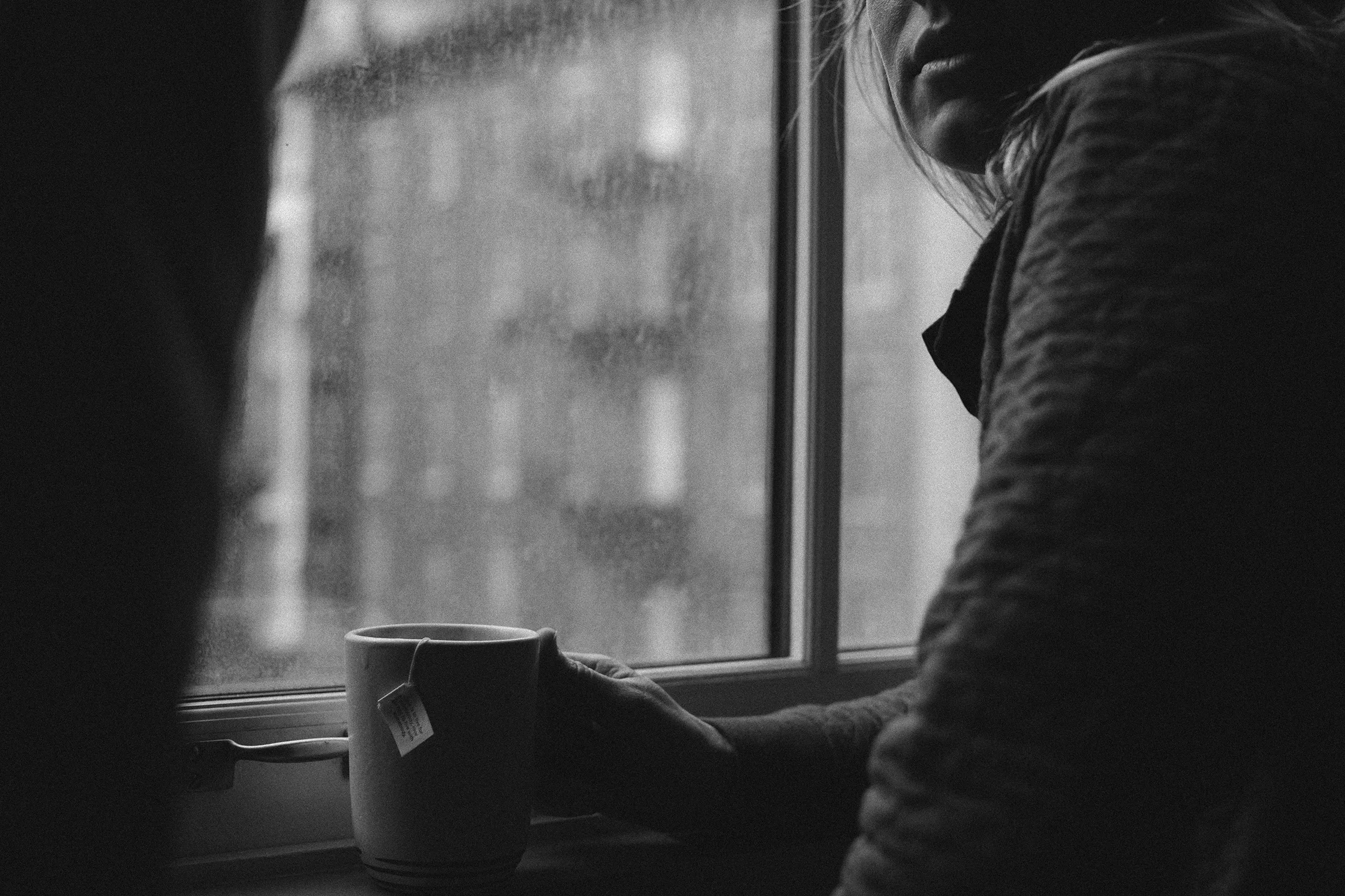
Having the Sunday newspaper stolen off your front steps every second or third week is a small thing, but small things are often connected to bigger things, even when we’re not aware of it. Which is why, early one September morning after a summer of cursing whoever kept making off with our New York Times, I woke at 6 AM and leapt out of bed as if the house were on fire.
I was sure I’d heard our front gate squeal and rattle. We live on a tree-lined Chicago street where 6 AM on Sunday is the time for arriving home from the night shift or heading out to the early shift or, in the case of a very few early risers, walking a dog. When I pressed my nose to the window screen in the front guest room, the roof of our porch blocked the steps from view, so I couldn’t tell if anyone was there. It was a pretty morning: the sun low over Lake Michigan a mile to the east, the sounds of birdsong, the chattering of a squirrel high in a maple tree, the faint rumble of a jet headed for O’Hare Airport. I held my breath, suspended between belief and doubt, aware of how the senses sometimes trick us. And then there he was, the paper thief, heading back toward our gate.
The phrase “aging professor” came to mind: pale skin, thin gray hair, glasses. He wore black pants and a corduroy jacket. Each of his hands gripped a plastic bag, as if he’d been to the farmers market, only it wasn’t open yet. He looked for all the world like someone who might spend his Sunday reading The New York Times.
I put my lips close to the window screen and called, “Hey, put the paper back.” But not too loud. I didn’t want to wake the neighborhood.
The man didn’t look around to see where the words had come from, just lifted the latch, slipped through the gate, and closed it behind him.
“Hey!” I called, louder this time. “I took your picture!” This was a lie, but it was also a good idea, so I grabbed my phone and pulled on a pair of jeans.
By then Kevin was beside me, blinking like a mole. “Was that him?”
“Yep,” I replied, before stepping into my flip-flops and racing down the stairs.
Later a police officer would admonish me for this. “Don’t ever go after someone,” she’d say. “You can always get another paper, but you can’t get another life.” But of course this wasn’t about a stranger slipping through our gate and helping himself to our paper. What it was about, and what propelled me down the block even while I wished I’d taken an extra moment to put on a bra, was a chance for things to turn out differently.
Sometimes, in the middle of the night, I hear the handsome man out for a walk, tap-tap-tapping along the sidewalk. He’s tall, with military posture and a friendly expression. Dark skin, dark clothes, white cane with a few inches of red at the bottom. He walks around and around the block, always in the same direction. Some nights he taps by our house half a dozen times, keeping fit.
I can’t hear him from our bedroom, which overlooks the backyard and is where I crawl under the covers every night. I hear him from the front room, where I wake in the morning. Mine isn’t classic insomnia. I can always fall asleep within minutes of getting into bed. Instead I suffer from the maddening habit of waking sometime after midnight—often between 2 and 4 AM—and remaining awake and exhausted for hours. Rather than disturb Kevin with my constant repositioning, I move to the guest room at the front of the house, from which I can hear whatever’s happening on the block, especially on warm nights when the windows are open.
The handsome man’s tapping rhythm soothes me. I like knowing that someone else is up at this hour, and I understand why he’d prefer to walk then, when the streets are empty, than during the day, when the sidewalks fill with kids and dogs and electric scooters. But I also wonder whether a blind man is at greater risk of being mugged. Someone could notice the small backpack he carries and decide it’s worth stealing. And then what would the police say? That he shouldn’t have been outside at 3 AM? You can always get your exercise during the day, sir, but you can’t get another life.
Down the block I jogged, across North Ravenswood Avenue and under the train tracks to the corner. The paper thief was walking at a pretty good clip up the other side of North Ridge Avenue. A jolt of adrenaline raised the hairs on my arms and propelled me into the street, crossing against a red light, which didn’t matter at 6 AM on a Sunday. Oh, I thought, this guy is caught. I felt powerful, in charge. All summer he’d been stealing from us, and today would be the last time.
When I got within fifteen feet of the man, I slowed my pace to match his. We were alongside the empty tennis courts of Emerson Park—which is to say, away from residences except for an apartment building on the corner up ahead. I noticed that the man’s shoes looked like slippers with thick rubber soles, and I wondered if he might be homeless. But his clothes seemed clean, the corduroy jacket unwrinkled. I imagined his living room, small and tidy, with a wall of books and old New Yorkers on the coffee table. Maybe he had a disability. Maybe he lived on social security. Maybe he couldn’t afford to buy the Sunday New York Times.
That paper had long been an indulgence for me. In graduate school I’d bought it from the Hy-Vee grocery store on Saturday evenings and waited to read it until Sunday morning, when I’d go through section by section, ending with the magazine. Sometimes it took all day or even part of the week to read that paper; I’d dip back into it during meals and when I got home from campus. For a while I subscribed to other publications too—Rolling Stone, Harper’s, Vanity Fair, The Atlantic—but the Sunday Times was my longest, most steadfast reading companion, a way of staying connected with the world. Once Kevin and I finished our degrees and settled into careers in Chicago, my first splurge was a subscription to the Sunday Times. Over the years we’d shifted to doing most of our reading online, but I insisted on the real Sunday paper. I loved spreading it out on the table at breakfast, taking the magazine into a bubble bath, reading the folded travel section in bed. The pleasure I got from opening the door every Sunday morning and seeing the blue-wrapped paper on our stoop was deep.
So the paper thief wasn’t just taking money from me; he was taking peace of mind. Consistency. A pleasure I had earned over many years. And, underneath that, he was tapping into the host of emotions that had recently not only awakened me in the middle of the night but sometimes kept me awake until morning.
I’ll get to those emotions in a moment. Right now, I was about fifteen feet behind him, matching my pace to his. “Hey!” I called. “Give me back the paper.” My tone implied: Come on, man, knock it off.
At no point had it occurred to me not to confront the guy. Why shouldn’t I expect him to return what he’d taken? Later, at the police station, I would humor the officer, pretending to agree that I should have called the police instead. About a stolen paper. In Chicago. A city where more than four hundred people had been murdered so far that year, and it was only September.
Startled, the paper thief glanced over his shoulder, and at the same time the thick rubber sole of his left shoe caught the sidewalk. This caused him to stumble and step out of that shoe, then fall to the ground in extremely slow motion. Maybe he hadn’t really fallen at all, but only performed a fall so as to take a position in the grass between the sidewalk and the street. I thought, Oh, for crying out loud.
Still, people can be frailer than they look. I didn’t want to see him get hurt. I just wanted my paper. And if the guy enjoyed the Sunday New York Times but couldn’t afford to buy it, I could finish with mine by early afternoon, and he could have it then.
“Are you all right?” I said, stepping forward for a better look, but almost before the words were out of my mouth, the man was raising his torso and turning toward me with a guttural “Ungghh,” his face squeezed with anger as his hand pointed toward me.
I was still a good eight feet away when the liquid hit, cold and shocking. As I backed up, the stream kept landing on my face, neck, chest, stomach. Orange oil ran down my arms, but fortunately I had shut my mouth, and my glasses kept the spray out of my eyes.
The stream hit me again, and the words erupted from my mouth: “You motherfucker! What is wrong with you?”
I thought of the chili peppers Kevin grows in our backyard. How often, while chopping hot peppers, had I touched my face or arm or eye and felt the excruciating burn? It’s OK, I thought. Pepper spray will hurt, but it won’t kill you.
The man got to his feet. My inner ear burned; it had taken a direct hit when I’d turned my head. I was fumbling with my phone, trying to open the camera, when I remembered his shoe on the sidewalk: If I got hold of the shoe, I thought, I’d gain some kind of power.
This is not a reasonable plan. If your understanding of the world is that your safety comes first and justice will ultimately be served, then it’s irrational to try to grab the shoe of a man who has just pepper-sprayed you in the face. But that has never been my understanding of the world.
As a child in Upstate New York, in a neighborhood filled with boys whose fathers worked at the factory with my father and who, for reasons I couldn’t fathom then, felt compelled to intimidate and dominate smaller or weaker kids, I learned another way of thinking. On the playground across the street from our house I kept an eye out for Rick and Teddy and the less troubled boys drawn into their orbits—boys who would sneak up behind other kids and kick the back of a knee to send them to the ground or practice the eye gouges they’d seen on World Wide Wrestling or just walk up and slap someone for the pleasure of watching their face turn red and their eyes fill with tears. Both during and after school I learned to take a punch and stare down the kid who’d thrown it—so much so that, in fourth grade, when a boy named Wesley ran up during recess, grabbed both my breasts, and twisted hard to see if they were real, I stood tall and cursed him out and didn’t tell anyone, because my parents were already nervous about how late my father worked at night, leaving my mother home alone with the kids. My father had once told Teddy not to trample the flowers in our front yard, and nine-year-old Teddy had responded by doubling back and stomping through the garden, middle fingers raised. Later I overheard my father say to my mother, “I wouldn’t put it past that little bastard to burn the house down.”
The first part of my life, in other words, was spent in a defensive stance camouflaged to seem like courage. In that world you were always looking for leverage, a way to make the perpetrators stop or at least understand that you wouldn’t be intimidated by them. That wasn’t my life any longer, but all it took was one petty thief to fire those cylinders.
So I lunged for the shoe, but when the guy pointed the pepper spray at me again, his finger on the pump, I stopped and backed up, stretching one leg to at least kick the shoe away so he’d understand who he was dealing with, that I would fight dirty if I had to, and that he was going to give my paper back, goddamn it, because I was sick and tired of men taking what was not theirs.
II.
This essay is not about a paper thief. I mean, the paper thief is there. He’s real. The pepper spray is real. But just as I wouldn’t have called the police over a stolen paper, I wouldn’t write about this experience in and of itself. Everything I’ve said so far is not what I really want to say. The handsome blind man, for example. What does he have to do with anything?
The real story here is about a murder.
Well, two murders.
Let’s back up. Start again.
It was the last Monday in August, one week before Labor Day. My son, Andrew, was about to start fifth grade. He was ten years old, small for his age, with freckles smeared across his cheeks and hair tinted auburn by the sun. He loved baseball, Legos, and video games. That summer he’d spent two weeks at sleepaway camp and come back with new card games and self-confidence. He was fun to be around.
At 9 PM we were getting ready for bed. Andrew was picking up Legos in the living room, and I was helping gather tiny plastic bricks into a plastic bucket when Kevin—sitting at the dining room table, looking at a laptop—gasped.
“What?” I said.
He glanced at me, shook his head in a way that said, Andrew can’t know, and Andrew, who is usually as observant as an owl, somehow missed this exchange.
What Kevin told me later—after I’d put Andrew to bed and listened as he processed the day, the week, the end of summer and the start of fifth grade, can you believe it?—was that two of our son’s schoolmates, a twin brother and sister also on the cusp of fifth grade, had died.
I immediately imagined a car accident on the highway, their family returning from Michigan or Wisconsin at the end of summer when tragedy struck, but the truth was worse. So much worse that Kevin could barely say it aloud. He whispered it instead: Their father. He’d shot them and himself. That morning.
They lived west of us, past Andrew’s bus stop and the Walgreens where we buy cold medicine and the Indian restaurant where we get saag paneer and masala dosas, on a quiet street of houses and apartment buildings. The twins had been spending the weekend with their father, who must have stayed up all night, deciding what to do about his life and theirs.
That’s why, three weeks later, I was sleeping in the guest room at the front of our house when the paper thief arrived. Anguish propelled me in the middle of each night to the doorway of Andrew’s room, where I stood long enough to hear his sleeping breath before crossing the hall to the guest room. In opposition to the most basic rule of sleep maintenance, I opened my phone in the darkness and filled my head with celebrity gossip and trivial Facebook posts, anything to occupy my mind.
Tap-tap-tap went the handsome man around the block.
We’d known the twins since preschool, when Mason’s enormous eyes greeted us at the morning drop-off and Addison’s curls bounced through the play area at afternoon pickup. For kindergarten both the twins and Andrew got into an arts-and-technology magnet school, where their mom and I comforted each other during orientation, assuring ourselves that these tiny kids would be fine in a school of nearly 1,500 students. After that, she and I saw each other a couple of times a year, at open houses and report card pickups. In first grade, when Andrew and Mason were in the same class, the twins came to our Harry Potter–themed birthday party, at which Kevin dressed as Voldemort and the kids threw water balloons at his head. It was the first truly warm day of spring, so we’d bought extra beer in case folks stayed longer than the three hours on the invitations, which they did. The party began at 1 PM, and the last guests left around 9:30 that night. Somewhere in between, the twins got dropped off by one parent and picked up by the other. Were their mom and dad separated at that point? Their father seemed uncomfortable—nervous or in a hurry or as if he expected people not to like him.
Once, I saw the twins and their mom in the grocery section of Target, and Mason’s eyes immediately lit up. “Andrew’s mom!” he called. “Where’s Andrew?”
I admitted he was in the toy aisle on the other side of the store.
“Can we go?” Addison asked. Their mom nodded, and after they raced away, I confessed that I’d been letting Andrew hang out in the toy aisle alone since he was four. We’d practiced what to do if anyone bothered him or showed him a body part or tried to lure him away by saying his mother needed him, and I felt confident in my parenting decision. But I also knew how judgmental other parents could be.
Not the twins’ mom. She just smiled and shrugged. “I mean, I always figure someone could take my kids,” she said. “But they’ll bring them back before long.”
How we laughed, there in the Target grocery section, because our kids were handfuls and we were good, thoughtful parents, and even with all the horrors of school shootings and kidnappings, we knew that statistics favor safety. We weren’t thinking about the other statistic: that kids are far less likely to be shot at school or snatched by a stranger than they are to be harmed by a family member at home.
The twins’ father killed them early on Monday morning. Around dawn. A downstairs neighbor heard all three shots. A newspaper reporter described the scene outside the apartment door: on a carpeted landing sat a pair of black roller skates with pink wheels and a pair of sneakers with bright-blue laces.
Every night and a hundred times each day I thought about their mother.
A father had killed his children, along with their mother, in Colorado two weeks earlier. Two weeks before that it was Houston. A month before that: Sydney, Australia. And these are just the news articles I read that summer. Such tragedy shouldn’t be worse when it involves people you know, but it is. There’s a world of difference between reading about the deaths of strangers and having to tell your son that his friends are dead, seeing the blood drain from his face as he shakes his head slowly and whispers, “How?”
To put his shoe back on, the paper thief had to balance for a second on one foot. I recognized the perfect opportunity to shove him hard, actually knock him down this time, kick the pepper spray out of his hand, and give him a taste of his own medicine.
But cameras are everywhere now, and in a split second I saw my image in a viral story about a middle-aged woman attacking an older man on the street. More important, when the guy had been in the grass, pushing himself up on one hand and making the “Ungghh” sound, the skin of his lower jaw had fallen slack enough to remind me of my father not long before he died, when he was often frightened and furious because I wouldn’t do what he wanted me to do: get him out of that nursing home, despite the emphysema that made him cough so hard he’d fractured his spine, despite the diabetic neuropathy that left him unable to walk.
So when I could have seized the upper hand, with adrenaline numbing my burning skin, I thought, Maybe he’s in a phase of life when ridiculous plans are the only option. Maybe if I knew his story, I’d understand.
But fury kept me from turning around and going home.
How do you talk to a child about the death of his friends? That’s a rhetorical question, but there are real answers. This kind of thing happens often enough that when you google the question, even adding “murdered” and “by a parent,” you get plenty of advice.
Use plain words and keep them general. Say “killed,” not “shot” or “drowned” or “stabbed.” When the child asks how, state the fact, and if the child asks again, don’t lie or obfuscate, but don’t offer more information than necessary. Explain that the parent was mentally ill and that mental illness is common, but the kind that causes a parent to kill his children is rare. Don’t say that fathers kill their children more often than mothers do. Don’t mention how often the father kills the children’s mother as well.
When the child says, “Why would he do that?” return to mental illness. Don’t say what you’re thinking: Because some men can’t stand it when women leave them and make new, happier lives for themselves and their children.
And when your son shakes his head, eyes wide, and says, “But Mason really liked his father,” what should you say in response?
Two days after his friends died, Andrew and I drove past the park where a memorial had been held the previous evening. I’d broken the news to Andrew by then because we didn’t want him to miss the service, if that was something he felt drawn to attend.
He did not, although he thought for a few hours before making that decision.
That day the park was nowhere in my mind until I saw it outside the car window. I watched in the rearview mirror as Andrew took in the piles of flowers, stuffed animals, and signs near the playground, and I remembered another piece of advice I’d read on the internet.
“Honey?” I said after we’d turned a corner and the memorial site had faded from view. “Listen to me, OK?” I told him that when we got the news about Mason and Addison, one of the first things I did was ask myself whether Kevin could be capable of such a thing.
Andrew turned his head, eyebrows raised, and met my eyes in the rearview mirror. I would never have thought of this on my own, that my child might question his safety after learning of a friend’s murder. I told him the truth, even though it’s hard to grasp truth in the aftermath of such horror, when everyone and everything can seem suspect.
“Sweetie, deep in my heart I truly believe that’s impossible. Your father is not a man who could do that, even if he were mentally ill. I feel really, really sure of that.”
Andrew looked out the window again and nodded. “Yeah. You’re right.”
Three blocks later he said, “I wish Dad didn’t have to teach today. I don’t know why, but for some reason I really miss him.”
In the news stories about the killing, neighbors on the block where the twins died were heartbroken, incredulous.
“Very happy kids.”
“All the kids around here played with them.”
“I saw [depression] in his face and his tone, so, me being friendly, I’d try to give him a couple of words, crack a joke.”
“It makes no sense.”
“My question is if it was something I could’ve done, prayed for him or prayed with him.”
“He loved those kids.”
Mason really liked his father.
And, honey, by all accounts their father really loved them too.
With both shoes back on his feet, the paper thief continued up the street as though he’d dismissed this irrational woman who was inconveniencing his morning.
I followed at a careful distance, haranguing him. “That was assault!” I called. “You pepper-sprayed me? After stealing my paper? What the fuck is wrong with you?” I kept it up, my voice growing louder because maybe the neighbors should wake up after all. “I saw you take it, dude. I’ve got your picture. And it’s going on the internet.”
He stopped. I stopped. He reached into one of the plastic bags, pulled out a newspaper, and flung it behind him, onto the sidewalk. Then he reached into the other bag and flung a second paper, each of them snug in their plastic wrappers. I waited while he walked away, then grabbed both The New York Times and a Chicago Tribune. “Hey!” I shouted. “This Trib isn’t even mine! Are you stealing from the whole goddamned neighborhood?”
At the next corner, he turned left and paused, digging another newspaper out of a bag and throwing it onto the stoop of an apartment building, as if he had a paper route. He kept going down that street, which runs between a tree-lined park and the back side of a care facility for developmentally disabled adults. It wasn’t a street I was familiar with, although I’d glimpsed it from the basketball court where Andrew and I played H-O-R-S-E. Still, I continued following the paper thief because if he was willing to sneak through a gate and lash out when he was caught, then he had all the leverage. This guy knew where I lived. He could come back anytime. He could burn the house down.
More than my stolen newspaper, I wanted to level the playing field. I planned to follow this guy to his home and take a photo of the address, which I would then use to find out his identity. If anything strange happened at my house, I’d know where to send the police.
But the paper thief had his own plan, stepping off the sidewalk and disappearing between two parked SUVs. I crossed to the opposite sidewalk, trying to see him. The back of the care facility reverberated with the sound of an HVAC system. There were no more apartment buildings on the street, so he couldn’t live there. He was just hiding. Or lying in wait. The chest of my thin T-shirt was soaked with pepper spray. My lips had begun to swell, and fire danced across my cheeks, my ear, and down my arms. I thought about dialing 911 but decided to turn back.
The streets were still mostly empty. A young man walking a chocolate Lab eyed me warily until I stared straight at him, holding my stinging arms out with a newspaper in each hand. The sun was fully up now, sparkling off the canopy of trees. A train rumbled down from Wisconsin, crossing the tracks at our street just as I entered the underpass. I emerged onto our block, with its close-set houses and shallow front yards. As I approached our front gate, which I’d left open in my rush, Andrew beamed from the front door. Barefoot and bare-chested, he called, “Mom!” and began to laugh the way we would laugh all that day at the audacity of the guy and the audacity of me, the crazy woman who took off after him, eager to right a wrong. I was Andrew’s hero—exactly who I wanted to be.
On the first day of school my son’s principal called an assembly to discuss what had happened and introduce a team of counselors. That afternoon I asked Andrew how things had gone. He was sitting on the basement rug, clicking Legos into place, his brow furrowed with concentration, and I was in an armchair, petting the cat and trying to be nonchalant. Andrew shrugged in response and scrunched his freckled nose. He said a few kids had cried, and Brianna, who was good friends with Addison, was a mess. I asked whether he’d talked with a counselor, and he shot me a look that said, Yeah, right.
He sighed, then said, “The way I see it, what happened happened, and there’s no changing it,” and he snapped a set of wheels onto what was beginning to look like a car. His intonation was so mature, in contrast to his ten-year-old’s body, with its missing bicuspids and soft, perfect skin, that for a moment I couldn’t breathe. He still slept with the stuffed dog we’d been gifted before his birth, but now he shook his head like an adult and said, “We just have to accept it and move on.”
Soap neutralizes pepper spray pretty well, but that didn’t help my inner ear. While I showered, Kevin did some research and brought me a cup of milk and a Q-tip, which helped. Then I decided to file a police report. Not because I thought the police would care about a paper thief or because I wanted the man arrested, but in case he made a habit of using pepper spray on people.
I walked four blocks to the station and told my story. The police officer who took my statement was not impressed by my heroics. Her eyebrows shot up when I got to the pepper spray. After she gave me the line about being able to get another paper but not another life, I stared her down and said, “I think we both know this isn’t really about the paper.”
Throughout the day, as Kevin, Andrew, and I repeated the story to one another and to friends, I enjoyed being the heroine who returned home victorious, newspapers in hand, and I enjoyed being a badass, too, having taken a dose of pepper spray the way a pit bull takes whacks on the head without letting go. I’d shown that guy.
But when night rolled around, something shifted. At bedtime Andrew begged me to scratch his back as he fell asleep, and I agreed out of gratitude that my boy was still here, and what wouldn’t the twins’ mother give to scratch her children’s backs as they fell asleep? An hour later I got in bed and closed my eyes, and soon there we were again, the paper thief and I, on North Ridge Avenue. He lay curled in the grass where he’d fallen, and as I approached to ask, “Are you all right?” he turned and made that “Ungghh” sound, his hand coming up and pointing not a bottle of pepper spray but a pistol. I jumped back, heart thumping me awake.
This happened again and again, until I realized that the police officer was right. Just as easily as the paper thief carried pepper spray, he could have carried a gun. My son could have lost his mother that day.
Why did that occur to me only in retrospect? Maybe because even now, when I close my eyes and remember what it felt like to pull on my jeans and take off running, adrenaline floods my muscles. Even though I am exhausted from lying awake each night, trying to think of something other than which twin was shot first and did the second twin know what was coming and how will their mother ever sleep or laugh or eat or experience joy again—beneath all that, and because of all that, deep in my stomach burns a white-hot fury. No, my body is saying, absolutely not. Another man will not take what is not his.
The New York Times has absolutely nothing to do with this.
For a long time after his friends died, Andrew refused to talk about them, maintaining a stoicism that concerned us. But once high school began and students asked one another which elementary school they’d attended, he often had to answer the somber question “Did you know the kids who . . .” He answered it so many times that something loosened inside. He started wondering aloud what Mason would be like today, whether they’d still be friends. Once, he told me that the twins’ death had been the first time he’d realized that there could be weapons in the homes of his friends. And the first time he knew that being a kid didn’t protect him from anything.
More recently, Andrew said that the twins dying the way they did has been the most impactful event of his life so far. “It’s why I’m so mature,” he told me. And he is. But I hadn’t realized that the shift in his personality—from an exuberant and emotional kid to someone whose demeanor is mostly impassive—happened in the first half of fifth grade. How many other students from that elementary school, not to mention friends and neighbors and family members, carry the lasting effects of a father’s selfish and horrifying choice?
During the pandemic lockdown, about a year after I first encountered the paper thief, I saw him in Target. He wore the same corduroy jacket and rode a motorized scooter, accompanied by a younger woman who retrieved groceries from the shelves and placed them in his basket. As I walked by, the man’s eyes met mine above our masks, and he said a cheerful hello. I nodded, noticing the hospital bracelet hanging from his thin wrist.
For a long time, our paper was on the steps every Sunday morning. And then not. Over the last couple of years I’ve caught him in the act of stealing it twice more. Once, I photographed the license plate on his car and took the image to the police station, where they told me to call 911 the next time a crime was in process. Undeterred, I asked a private investigator friend to run the plates, and in half an hour I had the thief’s name, birth date, and address. I’ve read his parents’ obituaries. I know what his siblings do for a living.
The next time I caught him, I called 911 to report the theft in progress of a New York Times. I have no idea what happened as a result of that call.
I do know this, though: the paper thief has aged considerably. His gait is unsteady. He’s hunched over. His hair is almost all gone. One recent morning Kevin watched the guy scope out an empty stoop across the street from our house, then said to me, “You’re battling Gollum!” We had a good laugh. After that, I canceled my subscription and started buying the Sunday paper at the grocery store, just like I did in grad school. Sometimes I walk the dog past the paper thief’s apartment building, where his car sits in a handicapped space out front. If I ever see him on the sidewalk, I plan to say hello.
At sixteen, Andrew is taller than me, with a deep voice and a driver’s license, while the twins remain frozen on the cusp of adolescent transformation, smiling and laughing in pictures and in memory. Every year I grow more deeply aware of what was taken from them and their mother and all of us who knew them.