I t is difficult to defend Israel and Zionism these days. Since the failed peace attempts of the 1990s and early 2000s, Israel has evolved into an increasingly undemocratic and oppressive nation. Under Benjamin Netanyahu’s leadership, the government has become dominated by far-right politicians whose ideology of Jewish supremacy equals the extremism of Hamas. Since the events of October 7, 2023, when Hamas militants crossed into southern Israel and killed nearly 1,200 people, the Israeli army has killed more than 50,000 Palestinians and displaced almost the entire population of Gaza. Meanwhile, in the United States, a bitter divide has formed between pro-Palestine activists who question Israel’s legitimacy and pro-Israel activists who interpret any criticism of Israel as anti-Semitic.
I have no doubt that Israel deserves criticism. But it pains me to hear American college students use the term “Zionist” as if it were a great evil. I associate Zionism with the ideals expressed in Israel’s Declaration of Independence, written in 1948, which proclaims that the state of Israel “will ensure complete equality of social and political rights to all its inhabitants irrespective of religion, race, or sex.” I emigrated from Amsterdam to Israel as a teenager and eventually married an Israeli. We’ve since moved to the United States, but we still speak almost daily with our friends and family in Israel and have been cheering their efforts to protest the war and the Netanyahu government. I want to believe in the Zionism that, at least in theory, promoted equality and tolerance, not the vision of Jewish supremacy that Israel’s extreme Right—which includes the aggressive, messianic settler movement in the West Bank—has embraced.
Shaul Magid’s relationship to Israel is very different from mine, and he is less hesitant than I am to declare Zionism’s time over. “I think Israel is a settler state now,” he told me. “Left-wing progressive Israelis are trying to resist it, but the ideology that’s running the state is the settler ideology.” He described this ideology as a fusion of secular right-wing Zionism and religious, messianic Zionism. In his 2023 book, The Necessity of Exile, he argues that Zionism has outlived its ideological usefulness and that it is time for Jews to once again embrace the idea of exile.
Born in 1958 in New York City, Magid grew up in a secular Jewish family. As a teenager he arrived in Israel on a spiritual quest and embraced ultra-Orthodox Judaism. Moving between Jerusalem and Brooklyn, he became a disciple of the anti-Zionist Hasidic Rabbi Dovid Din (who was interviewed in this magazine in 1984). He studied in Modern Orthodox and ultra-Orthodox yeshivas in Jerusalem and Brooklyn for six years, receiving ordination in Jerusalem in 1984. Magid was later drawn to the nationalist ideology of the early settler movement and even considered moving to a settlement in Gaza. Eventually he turned away from both settler ideology and ultra-Orthodox Judaism, returning to the US to complete a PhD in Near Eastern and Judaic Studies at Brandeis University.
Magid has taught at several American universities and is currently a visiting professor of modern Jewish studies at Harvard. He is the author of numerous books on such topics as Hasidism and Jewish thought. He has written a history of the far-right American Israeli Jewish supremacist Meir Kahane and recently finished a two-volume work about Rabbi Joel Teitelbaum, the founder of the anti-Zionist Satmar movement, the largest Hasidic community in the world. Outside of his academic career, he is a musician and serves as the rabbi of the Fire Island Synagogue.
I talked to Magid in his office at Harvard, one day after Donald Trump announced his intention to establish US control of Gaza and turn the region into the “Riviera of the Middle East.” We were both stunned by this plan, which was interpreted as the removal of all Palestinians from Gaza—a criminal act of ethnic cleansing and a gift to the ultranationalist settlers. At a time like this, when violent and extreme ideologies dominate global politics, it’s hard to imagine a peaceful future. But Magid and I found some hope in the few people—Jews and Arabs, Palestinians and Israelis—who, amid war and unspeakable horror, manage to cross divides of ideology to promote peace. And that is how I understand Magid’s concept of exile: that we can coexist peacefully only by abandoning the false certainty of dogma and embracing the unpredictability of life.
Not all conversations are as linear or succinct as they appear. This interview has been condensed and edited for clarity.—Ed.
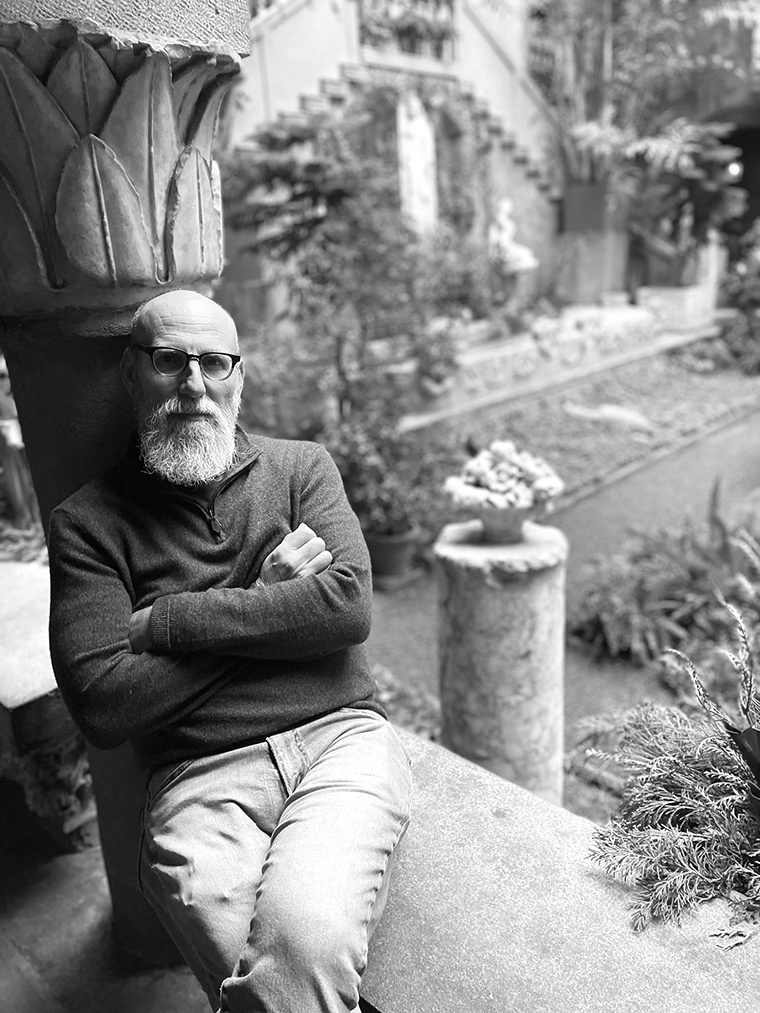
Shaul Magid
Hertog: Your latest book caused quite a stir in Jewish American communities. Can you explain your argument against Zionist ideology and how people have misunderstood your concept of “counter-Zionism”?
Magid: I define counter-Zionism as anti-Zionism that’s not anti-Israel. From my point of view, Zionism did its work: for all its problems, it created a viable alternative home for Jews escaping a collapsing Europe. But I think that Zionism, at its core, is an ethnonational ideology that can’t really create an equitable society in a country where almost 25 percent of the citizens are not Jews—and close to half the population is Palestinian, if you count Gaza and the West Bank. The transformation of Zionism into this radical right-wing ideology was perhaps not inevitable, but it was very likely from the beginning.
Hertog: So you think it’s time to shelve the ideal of Zionism?
Magid: I will put it this way: I would be happy if Zionism would just make room for non-Zionism or even anti-Zionism. I don’t think that Zionism, as an ideal, should disappear. There are people who are going to be Zionists, including left-wing Zionists, and for me that’s fine. People can choose whatever identity they want. What bothers me is that it doesn’t allow space for anything other than itself. The goal of the project I’m involved in among some on the Jewish Left is not to erase Zionism or claim that it is illegitimate, but to say that we need to have space for those who do not want their Jewish identity to be tied to the Israeli nation-state, and who just want to live their lives as Diaspora Jews.
In much of the American Jewish imagination, I fear nationalism is supplanting or has already supplanted Judaism; to be a Jew in good standing in the US today means to be a Zionist. Israeli nationalism has become a substitute for religion for many mainstream American Jews, and this is something that I find lamentable, distasteful, and, in my view, not healthy for the Jewish people or for Judaism. These American Jews aren’t choosing to live in Israel. They can go there if they want, but they don’t. Yet it takes up most of the oxygen in discussions of Jewish faith, and I see that as a disaster for the tradition that I’ve devoted my life to.
Hertog: Having grown up in a secular, left-wing New York Jewish family, how did you end up embracing religious Zionism as a young man?
Magid: Growing up in the 1960s and ’70s, I really embraced the counterculture. In the mid to late seventies, as the New Left transitioned to New Age spirituality, I was living in a small community in New Mexico, studying acupuncture and shiatsu and things like that, when I became interested in Jewish spirituality and decided that I wanted to go to Israel, a place I’d never been to and knew very little about. I had no relatives there. My father’s parents were socialists who worked in Bundist circles. [The Bund was a secular Jewish anti-Zionist socialist workers’ movement.—Ed.] It was just curiosity that led me to Israel. I arrived in Jerusalem when I was nineteen and ended up falling in with a group of young men around my age who were studying at a yeshiva. It was all very romantic and Orientalist, and I swallowed it whole. I thought I had found the answer to all my questions. [Laughs.] I transitioned into the ultra-Orthodox life and started wearing only black and white and grew my payos [the sidelocks that Orthodox Jewish men wear—Ed.]. For a few years I moved back and forth between Hasidic communities in Brooklyn and Jerusalem. I stayed in the ultra-Orthodox world for five or six years. In Brooklyn I studied with Dovid Din, who introduced me to Israeli rabbi Moshe Hirsch, the leader of Neturei Karta, an anti-Zionist ultra-Orthodox movement. I would spend Shabbat lunches at Hirsch’s house in the ultra-Orthodox Meah Shearim neighborhood in Jerusalem. He was a kind man and never tried to convert me to his circle. I felt I got a taste of an older Jerusalem that was quickly fading.
Neturei Karta was established in the 1930s by Amram Blau, a Jerusalem rabbi who opposed the creation of a Jewish state in Palestine. Blau was part of what was known as the Old Yishuv, the Jewish community that had been living in the Land of Israel under Ottoman rule since the eighteenth century, long before the Zionists arrived. And the Old Yishuv was very opposed to Zionism. The Neturei Karta tried to separate themselves from the state of Israel as much as possible. In Meah Shearim, when I lived there, there were still residents who didn’t use Israeli electricity. They had their own generators. They didn’t ride in Israeli buses. They didn’t have Israeli citizenship. When the Palestinian Liberation Organization was founded, some people in Neturei Karta began communicating with Yasser Arafat because they saw themselves as part of the Palestinian cause. Eventually Moshe Hirsch became an adviser on Jewish affairs for the Palestinian Authority.
Hertog: What are the theological reasons for this ultra-Orthodox opposition to Zionism?
Magid: In their view, it’s God’s plan for the Jews to live in exile until the coming of the Messiah—and, for them, even living in the Land of Israel is still living in exile. This is actually the standard Jewish theology that most Jews adhered to until the rise of Zionism. From their perspective, it was Zionism that was heretical and deviant, because the Zionists basically said: “We’re not going to wait for the Messiah. We’re going to take matters into our own hands.” Those in the Old Yishuv didn’t love the land any less than the Zionists. Distinguishing between the land and the state resonated with me a great deal. It still does.
Hertog: Has that ultra-Orthodox anti-Zionist viewpoint influenced your current thinking?
Magid: It has. I mean, I obviously no longer agree with the theological precepts of that position, or I would still be living in that world. But it offers an alternative model of Judaism that challenges the hegemony that says Zionism is in concert with the Jewish tradition. Nowadays Jewish anti-Zionism is deemed crazy, when it’s actually deeply rooted in a Jewish consciousness that goes back for millennia. For them, the land is Eretz Yisrael (the Land of Israel), and the state is an artificial implant on that land.
Hertog: What caused you to move out of the ultra-Orthodox world and become a religious-Zionist settler?
Magid: In the 1980s I had moved back to Jerusalem and was starting to feel alienated from the xenophobia of the ultra-Orthodox community, its separation from the world at large, its misogyny—all things that are hard to take for somebody who grew up in liberal New York. I still loved the tradition, but the social structure no longer fit me. I started to reach out beyond the yeshiva and discovered the writings of Rav Kook [the father of religious Zionism—Ed.]. I became enamored of the romanticism of the early settler movement and the idea of a Greater Israel, which included all the territory that had come under Israeli dominion in 1967, after the Six-Day War. I never actually became a settler, but my then-wife and I did look into moving to a settlement. The settler movement was still very young then, and it was all very exciting and had a strong spiritual component to it. Many of the settlements that now are cities were just small, idealistic communities at that time. We felt as if we were living on the precipice of history. The religious-Zionist community believed the settler movement was part of a divine plan and that God was going to take care of everything. The violence and militancy that you see now in the settler movement existed back then, for example in the Jewish Underground, but it was not as tolerated or as common. This was the first period after the right-wing Likud Party took power in 1977, and there was strong optimism that redemption was unfolding. The settlers were winning the ideological battle. The violence increased when that optimism waned and the talk of “land for peace” emerged.
Hertog: And how did you turn away from the settler ideology and eventually reject Zionism altogether?
Magid: My then-wife and I were visiting settler friends in Atzmona, in the Gush Katif region in southern Gaza. [The Gush Katif settlements were later evacuated by the Israeli army when Israel disengaged from Gaza in 2005.—Ed.] It was a beautiful place near the beach. We were thinking of moving there. But during that visit I came to feel something was just not right. Everyone was so nice, enthusiastic, and embracing, but there was something off about the way they related to Palestinians, as if the Palestinians were not people but just part of the landscape. As in: “There’s a tree, there’s a rock, there’s an Arab.” It didn’t even feel aggressive—though it became aggressive later on—just weirdly dehumanizing. Settlers had this sense that the Palestinians were in the way, and that God was eventually going to solve the problem of their presence. So, as much as I was drawn to the settler movement in theory, I became repulsed once I realized that the spirituality and generosity were very ethnocentric and didn’t allow for the possibility that there were other people who had a right to be there as well.
Hertog: So you went from sympathizing with the settler movement to writing a book against Zionism.
Magid: Yes, but that took some time. I ended up returning to the US to pursue a PhD in Jewish thought at Brandeis University. It was easy to slide from ultra-Orthodoxy into Jewish academia. I knew the material, the world, the languages. I was still living an Orthodox Jewish life, though I gradually moved further and further away from that. Writing about Zionism and anti-Zionism came later.
I was initially interested in Kabbalah and Hasidism, but as the Israeli-Palestinian conflict became more prominent, I wrote a number of essays about it, and then I wrote The Necessity of Exile, which threw me into the center of the debate. In some way, intellectually, I’m actually much less interested in Israel than I am in Zionism as a Jewish political and intellectual project and as a part of modern Judaism. And I strive to make a distinction between those two, though it is very hard for some people to recognize. Some say that I’m anti-Israel, but I don’t think Israel should disappear any more than any other country should disappear. I’m a citizen of Israel. I served in its army. I have a lot of love for the land, less so for the state as it exists. I believe Jews should be able to live there, along with Palestinians. They just have to figure out a way to do so without the ideology of an ethnonational state that to me lies at the very root of Zionism.
Hertog: So you want to abandon Zionism without necessarily abandoning the state of Israel, which it produced. How do you define Zionism?
Magid: Zionism is a political ideology that was at war with itself from the beginning of its existence. If you go back to the early Zionist congresses of the late nineteenth and early twentieth centuries, there was deep disagreement and vehement debate, which was healthy. There were a lot of different options on the table, ranging from the cultural Zionism of Ahad Ha’am, who opposed Jewish nationalism; to the humanistic Zionism of Martin Buber, Gershom Scholem, and Hannah Arendt; to the socialist Zionism of Ber Borochov; to the militant right-wing Zionism of Ze’ev Jabotinsky. There were even vibrant non-Zionist and anti-Zionist Jewish movements. But the rise of Nazism, and ultimately the Holocaust, swept a lot of those alternatives off the table, leaving the statist Zionist position—the idea that the goal of Zionism is to establish a Jewish state in the Jewish homeland—as the default. Cultural Zionism and humanistic Zionism continued to exist, but they came under the umbrella of the state. Israel has created a vibrant Hebrew culture, Hebrew language, and the merging of the Ashkenazi and Mizrahi cultures. Those things are incredibly important and productive. But ultimately the dominant ideology today, certainly in the political sphere, is Jabotinsky’s idea of Jewish supremacy. And for me that’s the problem. Already in 1935, David Ben-Gurion, Israel’s first prime minister, saw the danger of Jabotinsky’s vision, which later became a foundation of the settler movement. Ben-Gurion basically tried to kick Jabotinsky out of Palestine, but he failed. Now we’re living in Jabotinsky’s Israel. Benjamin Netanyahu’s father was literally Jabotinsky’s secretary in America.
Hertog: In the early twentieth century many American Jews opposed Zionism. Why?
Magid: Until the 1930s most American Jews saw Zionism as a threat to what they called “Americanization.” In the 1910s and 1920s American Reform Jews considered America to be the new Promised Land, and they intended to integrate here. They were anti-Zionists because they worried they would be accused by other Americans of dual loyalty. Meanwhile, the socialist Bundist Jews opposed Zionism because they were anti-nationalist and wanted to be part of a global workers’ revolution. Well into the 1960s many American Jews remained ambivalent about Zionism.
Hertog: Now many American synagogues display Israeli flags in their sanctuary. How did attitudes shift to an uncritical pro-Israel stance?
Magid: Educators at American Hebrew schools came to the conclusion that the best way to assure the continuity of Jewish identity in America was through Zionism and fidelity to Israel and Holocaust remembrance, because religion wasn’t going to do it. By the 1960s American Jews were mostly secular. Even if they belonged to synagogues, they were, in practice, secular Americans: They were not observing Halakha [the religious commands for Jewish day-to-day behavior—Ed.], and religion wasn’t at the center of their lives. So educators switched to focusing on Holocaust remembrance and Zionism as Jewish heritage. That’s how we ended up with an entire generation—and I’m very much a part of that generation—who went to Hebrew schools where all we really learned about was Israel, and how to read Hebrew without understanding what it meant. The rituals became a shell, and the real content was Zionism, which really just meant supporting Israel.
But, again, that didn’t actually have much to do with the place over there. To give an example: The purpose of Birthright Israel [a program that finances free ten-day tours to Israel for young Jewish adults—Ed.] wasn’t to get American Jews to immigrate to Israel. The idea was that, after a ten-day trip to Israel, with all the Birthright propaganda, participants would want to marry a Jew when they came back. They might even meet someone on the trip. And even if they didn’t marry within the faith, they would have developed a greater attachment to their Jewish identity from that experience. So, in a certain sense, Israel has become an instrument American Jews use to ensure their own continuity.
You have to make a distinction between saying, “Zionists don’t deserve to live,” or, “All Jews are implicated in this Zionist genocide,” which is clearly anti-Semitic, and saying, “Israel is committing genocide.”
Hertog: Then what is Judaism? A religion? A culture? An ethnicity? A nation?
Magid: Judaism has always been a religion that Jews practice in different forms. But once secular Judaism enters the picture, once you sever religious practice from the idea of Jewishness, there has to be another definition. Then it becomes an ethnicity. A professor of Jewish studies at Princeton, Leora Batnitzky, wrote a book called How Judaism Became a Religion—meaning a faith-based religion in the way that Christianity is. She says this happened sometime in the nineteenth century. She says Jews used to observe the mitzvoth [the ritual practices prescribed by Jewish law—Ed.] simply because that’s what they traditionally did. For Jewish people in the ancient and medieval world, the practices of Judaism were simply ancestral traditions, part of the culture they were born into. That’s a little different from the way religion is commonly understood in America, as a set of beliefs that can be adopted or abandoned. That definition came out of Christianity.
Hertog: American Judaism is very much based in the Ashkenazi—or European—tradition, while in Israel the majority of Jews are Mizrahi—Middle Eastern Jews who come from countries like Iraq, Libya, and others in North Africa. Do you think that difference in background makes it hard for American Jews to understand Israeli Judaism?
Magid: I think that the non-Ashkenazi nature of Israel attracts many American Jews because it’s seen as different, exotic. I was drawn to Israel because I was the product of an American counterculture rebelling against the Western rationality of our parents, and we romanticized Indian religion, Buddhism, the Middle East, and Arab culture. Israel fit right into that. But I would argue that Israel is still an Ashkenazi-dominated society in terms of its structure and its politics. Ashkenazi Jews hold the majority of the power and wealth there. Of course, Mizrahi Jews were living in the Land of Israel long before modern Zionism. There was, for example, the Yemenite Sharabi family, who had settled in Jerusalem in the eighteenth century. For them, living in the Land of Israel was a spiritual practice. The old Jewish residents in places like Safed, Hebron, and Jerusalem saw themselves as subjects of the Ottoman Empire. Zionism was a European Ashkenazi project, and the Mizrahi Jews got pulled into it when Jewish communities were expelled from Muslim countries after the establishment of the state of Israel.
Hertog: What is the historical connection between Zionism and nineteenth-century European nationalism?
Magid: That’s where Zionism is born. Zionism is a branch of Western European nationalist ideology. French thinker Ernest Renan’s 1882 essay “What Is a Nation?” was very influential for early Zionists. After emancipation [the process by which European nations gradually granted Jewish people full citizenship rights—Ed.] Jews realized that they were still not integrated into the nations of Europe. Nationalist ideologies of the time had no room for them. So the Jews basically said, “Why not adopt this ideology for ourselves?”
Initially it was hard in the Land of Israel, then called Palestine, for the Zionist newcomers. First of all, it was unrealistic to try to create a nation-state out of nothing; and, second, the idea of moving en masse to the Land of Israel posed problems. The first and second attempts, which took place from the late 1800s to the First World War, weren’t very successful. Over 50 percent of those people returned to Europe, because life was just too hard for them in Ottoman Palestine. They came from cosmopolitan places like Vienna or Berlin and struggled to adapt to what was then basically still a preindustrial world. But starting in the 1920s and ’30s, Jewish immigration to Palestine became more permanent because there was no safe place to go back to in Europe. On top of the devastation and death from World War I, there was the increasing anti-Semitism; the 1924 Johnson-Reed Act, which curtailed immigration to the US; and, ultimately, the rise of Hitler in Germany in 1933. As Europe collapsed around them, Zionism suddenly went from an abstract ideology to an emergency exit. And that’s when all nuance got lost, because who has time for nuance when you’re worried someone’s going to kill you?
In May 1948, right at the time of Israel’s Declaration of Independence, Hannah Arendt wrote an essay called “To Save the Jewish Homeland,” in which she opposed the establishment of a Jewish state at that time. She wasn’t against the eventual establishment of a state, but she thought that Palestine should have gone into United Nations trusteeship for a period of time, just to let things settle after World War II. She didn’t understand how victims of genocide could just be placed in a country where the current residents didn’t want them. How was that not going to be catastrophic? They were taking people from Europe, dumping them in the Middle East, and expecting people in the Middle East not to see that as colonialism. But the UN supported the establishment of Israel for at least two reasons: First of all, they recognized the extent of what had happened in the Holocaust, and, second, there was this tremendous Jewish refugee problem in Europe. The European nations didn’t want to take these refugees in, so establishing a Jewish state elsewhere was a better solution.
Hertog: How do we disentangle anti-Semitism and anti-Zionism?
Magid: I certainly don’t think that anti-Semitism is the only reason people are out in the streets protesting the war in Gaza. You just have to look at the pictures of the utter devastation in Gaza to see what they are protesting against. They are protesting against the systematic destruction of an entire society, and with TikTok videos—posted by Gazans and Israeli soldiers—we are all watching it in real time. Media censorship no longer works in our era of social media. I don’t think Israel quite understands that. Anti-Semitism exists in some of these protests, for sure, but it’s not the primary impetus. If that was the case, why weren’t there campus protests against Israel for decades? You have to make a distinction between saying, “Zionists don’t deserve to live,” or, “All Jews are implicated in this Zionist genocide,” which is clearly anti-Semitic, and saying, “Israel is committing genocide against the Palestinians and murdering children.” We can agree or disagree about what constitutes genocide, but opposition to what’s happening is not anti-Semitic. It has a moral justification. In my view, saying it is all anti-Semitism is just using anti-Semitism as an excuse for destroying a society. Yes, Israel had a right and a duty to respond to a horrendous, murderous act. But destroying a society in response is, in my view, a horrific choice we Jews will live with for many years.
Last year I listened to a Hillel rabbi give a ninety-minute webinar about the campus protests. After it was over, I realized he’d never once mentioned that there’s an actual war going on, and that the protests are against that war. Of course, one can find anti-Semitic things that are said at the protests, but the protests themselves are happening because children are being killed. And this rabbi never mentioned it. He never even mentioned the word war. Afterward I contacted him and asked him about it. He didn’t really give me an answer.
We cannot treat all criticism of Israel as anti-Semitism. When someone like [Anti-Defamation League director] Jonathan Greenblatt says that anti-Zionism is anti-Semitism, it’s a weaponization of the term, which doesn’t help diminish anti-Semitism. It arguably expands it.
Hertog: But there has been an undeniable rise in anti-Semitism.
Magid: Right, because the anti-Semitism that exists will always find an excuse to come to the surface. But that is different than saying opposition to Zionism is anti-Semitism. That is irresponsible and misinformed.
Hertog: What do you say to Jews who argue that, because of the rise in anti-Semitism, it’s more important than ever to ensure the existence of a strong Jewish state?
Magid: I say, “Fine, but don’t destroy another people.” Our right to live on that land there is no greater than their right to live on that land. This will not be resolved by mass death. Not by Hamas, and not by the Israeli Defense Forces.
Hertog: You wrote that criticism of the state of Israel is actually much more robust and more tolerated in Israel than it is among American Jews. And of course it’s ironic when American Zionists accuse left-wing Israelis of being traitors. Why do you think American Jews are sometimes more pro-Israel than the average Israeli?
Magid: For many American Jews, being pro-Israel really has little to do with Israel. It has to do with their own identity as Jews in America. To them, if you’re criticizing Israel, you’re criticizing their identity as Jews. Israelis don’t have that problem. Israelis can be as critical as they want of their government. In a way, Israelis are much less threatened than American Jews by someone who identifies as a non-Zionist or even an anti-Zionist. So in Israel you have groups like Matzpen (the Compass), a left-wing anti-Zionist organization founded by Jewish and Arab Israeli activists. And there is even room in Israeli politics for non-Zionist political parties such as Balad [a left-wing party that represents Palestinian citizens of Israel—Ed.] and the communist Hadash Party. And many ultra-Orthodox Jews in Israel are still anti-Zionist.
Hertog: Maybe lived reality forces Israelis to deal with more complexity than Americans who support Zionism from far away.
Magid: Yes, because Israeli Jews, whatever their politics, see the domination of Palestinians firsthand. Americans don’t see the checkpoints where people are waiting three hours to get to work. Israelis can’t help but see it. They may say it’s inevitable. They may say they don’t care. But it gets to you. It’s like living as a white person in the Jim Crow South. You can’t help but see what it does to a human being to be dominated like that.
Hertog: Initially Zionism was an explicitly secular movement. Religious Zionism is a newer phenomenon. And messianic religious Zionism is even more recent. Can you talk about that?
Magid: Original Zionism was not just secular; it was in many cases anti-religious, and saw itself as a replacement for Judaism. By that I mean that for many early Zionists, Zionism superseded Judaism. The great Zionist writer Micha Josef Berdyczewski famously said, “I am the last Jew and the first Hebrew.” The ultra-Orthodox antipathy towards Zionism was basically a response to that. Rav Kook, who died in 1935, was groundbreaking because he translated the secular-Zionist project into religious and messianic language. But his writings weren’t widely read until the 1960s. He became the hero of the settler movement, which developed into this messianic Zionism that sees Jewish supremacy as a divine mission. I’ll give you a pretty horrific example of that outlook: Sometime at the end of October 2023, when everything was still very raw, I saw a video of a settler rally near Jerusalem in which a religious Zionist dressed in an army uniform said that October 7 was a “great day,” because “now we can do what we’ve always wanted to do.” From that messianic perspective, October 7 was part of the divine plan, an indication that the Messiah may come any day now.
Now, with Netanyahu building a coalition with the messianic-Zionist settlers, we are seeing secular right-wing Zionism and religious, messianic Zionism coming together. I think Israel is a settler state now. Left-wing progressive Israelis are trying to resist it, but the ideology that’s running the state is the settler ideology.
Hertog: In his book Altneuland, Theodor Herzl, the official “father” of modern political Zionism, describes a very inclusive society.
Magid: Yes, but you have to remember that Herzl only spent about a week in Palestine. So his Zionism was really a kind of fantasy. And he died in 1904, so he didn’t get to see what happened to his idea. Herzl was the visionary, and Ben-Gurion was the political genius. And Ben-Gurion’s view, the liberal labor view, was all about statehood and nationalism.
Hertog: Why did the messianic settler ideology become so powerful in Israel?
Magid: I think it filled a vacuum that was created after the socialist kibbutz movement started to fall apart. In the early days of Israel the kibbutz movement wanted to create a just, socialist society of Jews. And for a while this was the ideological and economic spine of the state. But then Israel moved away from that ideal to become a neoliberal capitalist start-up nation. It embraced globalization. At that point, the socialist project fell apart, and religious Zionism filled the gap. Meanwhile, many ultra-Orthodox Jews were becoming more sympathetic to Zionism. The more Zionism became attached to religion, the less foreign it was to many in the ultra-Orthodox camp. And many young ultra-Orthodox Jews began moving to settlements for practical reasons, then got swept up in the religious-Zionist vision.
But the rise of messianic Zionism has a lot of causes, including demographics. When a community has five to seven children per family, over a few generations that community will gain influence in a democracy. And many moderate or leftist Israelis are moving to Europe or the US because they can’t take it anymore and just want to live their lives. It’s a perfect storm of all these conditions. The settlers are brilliant tacticians. They know exactly what they’re doing, and they have been doing it slowly and under the radar for decades. The yeshivas have been producing new generations of people who are ideologically committed to the cause. I think it’s incredibly dangerous. A lot of secular people in Israel know this, but many American Jews don’t realize what is happening to the social fabric of Israel. The November 2022 elections were a real wake-up call for many. Settler domination began to bear fruit.
Hertog: What about the huge anti-government protests in Israel over the past few years? Isn’t that an indication that other strains of Zionism are still relevant? To make the case that Netanyahu’s interpretation of Zionism is not legitimate, protesters have been quoting the Israeli Declaration of Independence, which states that “freedom, justice, and peace” are core values of the state of Israel.
Magid: The protests were mostly a centrist movement opposing Netanyahu’s attempts to erode democracy by limiting the power of the courts and empowering the prime minister and government. I was asked to sign a letter supporting the protests, which I certainly do, but the entire two-page letter never mentioned the occupation or Palestinians. So I refused to sign it. The Israeli academic who had asked me to sign explained that they intentionally avoided mentioning the occupation, because it’s such a divisive topic in Israel. She said they’d lose half their constituency if they brought it up. The fact that the Israeli political center is not willing to include the occupation as part of the anti-government protests says to me that there’s been a normalization of the settler point of view. Of course, some protesters did carry Palestinian flags and banners that said things like “Occupation is not democracy.” But they were a small segment. At this point, the Zionist Left in Israel has shrunk to almost nothing. The extremist vision of Zionism has won. In a sense this is exactly what Yahya Sinwar [the former leader of Hamas in Gaza, and one of the masterminds of the October 7 attack, who was killed in October 2024—Ed.] wanted. He wasn’t interested in compromise. He wanted to make it a zero-sum game and Israel took the bait. But in a zero-sum game it is often the case that both sides lose. Unless, of course, the Messiah comes.
Hertog: Old-guard Zionists might argue that the messianic settler movement is not even Zionism.
Magid: I have seen some of the radical “hilltop youth” [militant ultra-Orthodox settlers—Ed.] openly say that they don’t even consider themselves Zionists anymore, because they see Zionism as a secular project founded on democracy. I was talking to some of these hilltop youth at a conference in Jerusalem and asked what they are studying these days. They said they no longer study Rav Kook, because they feel he’s too focused on the nation-state, and they no longer believe in democracy. They call themselves Land-of-Israelists (Eretz Yisraelim), and they believe in Jewish supremacy and a Jewish messianic kingdom. So religious Zionism can reach a point where it becomes anti-Zionist and anti-statist.
Hertog: Is it true some white supremacists in the US have become avidly pro-Israel?
Magid: Yes, definitely, because Israel has become a kind of white autocracy in their eyes, which they admire. In 2017, when Richard Spencer—the American white supremacist who coined the term “alt-right”—was interviewed on Israeli TV, he said he considers himself a “white Zionist” and urged Israelis to support his white-nationalist project in America. He argues that Israelis have created a white ethnonational state, and that’s what he wants to do in America; but here it’s going to be a white ethnonational Christian state.
And then there are the white nationalists who are pro-Israel because it’s a great place to get rid of the Jews, which is nothing new. Look at Lord Balfour, the British Foreign Secretary who in 1917 officially declared that Palestine was to become the “national home for the Jewish people.” He didn’t write the declaration out of love for the Jews. He was a racist and an anti-Semite who supported British legislation to prevent the immigration of Jewish refugees from Eastern Europe to England. For European anti-Semites like Balfour, Zionism was simply a solution to the “Jewish problem.” If you want Europe to be free of Jews, then Zionism is perfect. Herzl knew this about European anti-Semites, and he was going to use it. The relationship between anti-Semitism and Zionism in early-twentieth-century Europe is complicated.
Hertog: To what degree do American special interests like the American Israel Public Affairs Committee and the Evangelical Christian lobby influence what’s happening in Israel?
Magid: Evangelical Zionist groups such as John Hagee’s Christians United for Israel have a tremendous influence. Many Evangelicals have decided, largely as a result of 9/11, that the Jews are going to be on the front lines of the Christian war against Islam. It’s all about dispensationalism [Evangelical teachings that claim we are nearing the End Times—Ed.]. Part of that theology is the belief that the Jews must return to Israel before the Second Coming of Christ. According to their interpretations of the Book of Revelation, Jews will be given the opportunity to convert, and if they don’t, the earth will open up and swallow them. For many Evangelical Zionists, Jews play a utilitarian role; they are a tool of the Second Coming. There’s no love there for Jews. These Evangelicals want to use Jews to bring about this event that they believe will ultimately destroy the Jews. Anti-Semitism is deeply embedded in Evangelical Christianity, and John Hagee himself has said some pretty anti-Semitic things. Yet when he comes to Israel, he gets to meet with all the dignitaries and officials because his organization gives millions of dollars to Israeli and Jewish charities every year.
Of course, Israelis will take the money from the Evangelical Christians because they think these prophecies will never come true. Everybody is using everybody, which is just politics. As a result, we now have this odd but growing alliance between Zionist Orthodox Judaism and Christian Evangelicalism.
Back in the early twentieth century, mainline and left-wing Christians were the pro-Zionist ones. The fundamentalist Christians of that era were not pro-Israel. Now it has switched: The mainline Protestants are pro-Palestinian, and the Evangelical Christians see Israel as a tool for their own messianic vision.
Hertog: You’ve written that the Boycott, Divestment, and Sanctions (BDS) movement and the Israeli settler movement are, ironically, aligned in undermining the liberal Zionist narrative, which argues that the state of Israel is legitimate while the occupation is not. Can you explain?
Magid: On a very structural level, BDS and the settlers both say that the Green Line [the border between UN-recognized Israel and the occupied territories—Ed.] doesn’t exist. I understand why BDS supporters don’t want to buy products from illegal settlements. I get that. But why are they boycotting Tel Aviv? Their position is that it’s all the same; it’s all a part of Israel. The settlers, too, think the Green Line is arbitrary because they consider all of it—Israel and the occupied territories—to be the Land of Israel.
Hertog: Is a two-state solution still possible?
Magid: I don’t think so. As an Israeli friend in Tel Aviv said to me, the two-state solution is something that American Jews talk about to feel good about themselves. Because if the two-state solution is off the table completely, liberal Zionism collapses. That’s why President Joe Biden kept promoting the two-state solution, even though nobody in the US government really believed in it anymore. They have to promote it, because there’s nothing else. Now Trump has basically said America will take over Gaza and ethnically cleanse it to build some sort of resort. In a twisted way, this is clarifying. It says to American Jews, “Wake up! A two-state solution is not going to happen.”
Hertog: The title of your book is The Necessity of Exile. Why do you think exile is necessary?
Magid: What I mean by exile is not necessarily a geographical exile. It’s not Diaspora. I think of exile as a mentality. It’s both the belief that the story is not over and the realization that ruling over others is a very precarious position to be in. So it doesn’t matter if one is in exile in the Land of Israel or in New York City. The state of exile creates the potential for a humanistic approach to the other. The ethics start to diminish, however, once you think the story is over. This whole idea that there’s going to be an end of exile, an end of the Diaspora, which is at the heart of Zionism, is actually very pernicious. It encourages a dogmatic, nationalistic mindset. False messianism has always ended tragically for Jews. And just as dangerous is abandoning the idea of messianism and just opting for power, becoming survivalists. If we have sovereignty, the argument goes, who needs redemption? For me that is the end of Judaism. Obviously many disagree.
Hertog: Does this mentality of exile have to do with humility?
Magid: Yes, exactly. I think that’s why the religious-Zionist vision is so dangerous. You could say that Zionism was originally about finding a safe place for Jews to live, a refuge. But once you get into a religious, messianic vision of Zionism, it becomes absolutist and has no room for other views. Exile thinking acknowledges the dangers of power when it becomes unbridled; and that’s where we are now. That’s what the war in Gaza is: Unbridled power. Vengeance. I don’t know how we’re going to survive this. What is Jewish life going to look like in the next generation, in the aftermath of the utter destruction of another society?
Hertog: Do you think it could still be possible for Arabs and Jews to coexist together in a democratic nation?
Magid: In the long term I think that’s the only way. But if you look at the number of moderate Israelis who are currently leaving the country, and the number of Orthodox Jews who are immigrating to Israel, and the birth rate among the ultra-Orthodox in Israel, who are becoming more and more right-wing, and the American support for the Israeli right wing, I think it’s clear that for the next fifty years or so Israel is going to be a full-on nationalist Jewish state in constant war with its neighbors and that it will annex the Palestinian territories. Apartheid is almost a given at this point. Fewer in Israel even contest it, and after October 7 many say it is necessary.
Hertog: Can you envision any possibility of a different outcome?
Magid: There are people in the settlements who are trying to rethink their relationship to the Palestinians and to the land. There’s an organization led by Hanan Schlesinger and others that has been influenced by the ideas of Rav Shagar (1949–2007) and Rabbi Menachem Froman (1945–2013), two settler rabbis who believed in coexistence. Rabbi Froman collaborated on a draft of a peace agreement that was endorsed by Hamas. He said that, if there were to be a Palestinian state, he would be happy to stay in his home in the Tekoa settlement and be a citizen of Palestine. He realized that his relationship was to the Land of Israel, not to the state of Israel, even as he remained a Zionist. Both Rav Shagar and Rabbi Froman died too soon to see their ideas come to fruition, but their students are trying to implement their vision. Some of them talk about the creation of a Jewish-Palestinian confederacy. They are still a fringe group, but Gush Emunim [an ultranationalist, right-wing Orthodox movement—Ed.] started off as a marginal fringe group back in 1974. I think some of the most creative thinking in Israel today is coming from these organizations in the settlements. It is ironic, but not inconceivable, that a solution will come from the religious sector and not the secularists.
On the secular side there’s a newer Arab-Jewish solidarity movement for peace called Omdim Beyachad/Naqif Ma’an [Standing Together]. So some people are trying to think beyond either occupation or a two-state solution, which I find encouraging.
Hertog: So there may still be a little bit of hope?
Magid: There’s a famous quote from Franz Kafka. When Israeli writer Max Brod asked him, essentially, if there was a “world that knows hope,” he answered, “Oh, there’s plenty of hope, infinite hope—just not for us.” As for me, I am a hopeless optimist, even against my better judgment.