A decade ago, when the Left protested the presence of far-right speakers like Milo Yiannopoulos on college campuses, conservatives defended the speakers’ rhetoric as a matter of free speech. Around that same period, some on the Left called for an increased use of trigger warnings in classrooms, urging professors to flag material that might be upsetting to students in lectures and assigned readings. Those conversations often framed language itself as something that needed careful management to prevent harm. Today, however, it’s conservative politicians at both the state and federal levels who are imposing a range of limitations on speech at universities. In October 2025, the Trump administration released the Compact for Academic Excellence in Higher Education, a proposal that threatened to cut funding for several prominent universities if they did not remove institutional units critical of conservative ideas, including those regarding race, gender, and sexuality. Diversity, Equity, and Inclusion (DEI) offices have closed at schools such as The Ohio State University (OSU), the University of Florida, Syracuse University, and Missouri State University, and even the word diversity has become politically fraught, acceptable to the Right only when advocating for conservative voices in traditionally left-leaning spaces. The future of academia in America feels uncertain to many. How much power do these new restrictions have? How will college campuses change? What happens if a professor refuses to adhere to them?
Pranav Jani, an associate professor of English at OSU, has been active in supporting student-led campus movements since he arrived at the university in 2004. Along with other faculty, he has spoken up against the new legislative constraints in Ohio’s Senate Bill 1, which, among other things, banned faculty strikes and DEI activity on campus. He’s also against the administration’s tendency to preemptively comply with some of these laws, like the prohibition on land-acknowledgment statements that recognize the Indigenous people from whom the land was taken and the ban on the use of chalk on campus sidewalks after students expressed support for Palestine. Jani has also avidly defended the rights of Palestinian and pro-Palestinian student activists and faculty to speak out without fear of punishment. In 2016 he supported the student-led Reclaim OSU movement, which included a sit-in at the university president’s office to demand financial transparency and divestment from fossil fuels, Israel, and prison labor. He was also involved in the 2012 protests that began after racist graffiti was painted on OSU’s Black Cultural Center—specifically the words “Long Live Zimmerman,” a reference to George Zimmerman, the man who had shot and killed Black teenager Trayvon Martin in Florida earlier that year.
The child of Indian immigrants, Jani moved with his family from India to northern New Jersey when he was nearly one year old. He comes from a long line of teachers but had no activist aspirations as an undergraduate at Yale University. When a protest against the Gulf War took place on campus, however, he felt compelled to attend out of the respect for Gandhi instilled in him by his family: If one was committed to nonviolence, he reasoned, one should also be antiwar. Even then, he stayed on the sidelines, not yet seeing himself as the protesting type. Later, while he was studying for his PhD at Brown University, he began to examine the relationship between anti-colonial movements and Marxism, and he came to believe that, although university spaces often encouraged discussion about radical politics, they rarely translated those ideas into practice.
In his early days of activism, Jani focused on socialist politics, anti-racism, and labor solidarity. This expanded to include the anti-globalization and anti-war movements, the struggles for reproductive justice and immigrant rights, and support for gay marriage and transgender individuals. He eventually became president of OSU’s chapter of the American Association of University Professors (AAUP), serving from 2021 to 2025. He now serves on the chapter’s board and is part of Faculty and Staff for Justice in Palestine. He has been named Professor of the Year by the English Graduate Student Organization twice and received a Diversity Enhancement Faculty Award from the Ohio State College of Arts & Sciences. In November 2025 he received the inaugural John McNay Memorial Award for Outstanding Service from the Ohio Conference of the AAUP. Currently Jani is at work on a book provisionally titled The 1857 Rebellion and the Indian Political Imagination. He is also the creator and host of the podcast Together We Rise: Solidarity Stories from Central Ohio.
I met Jani in July 2025 on the fourth floor of the English building at OSU. Campus was quiet because it was summer, and he was easy to spot in his T-shirt that read, “Professors are the enemy—Richard Nixon, Dec. 14, 1972.” He had just had an upsetting encounter on his way to meet me: A self-identified local Zionist had yelled at him from a car window, holding up his middle finger and shouting obscenities. Although surprising to me, Jani later told me the incident was “kind of the day to day” for him.
Not all conversations are as linear and succinct as they appear. This interview has been condensed and edited for clarity.—Ed.
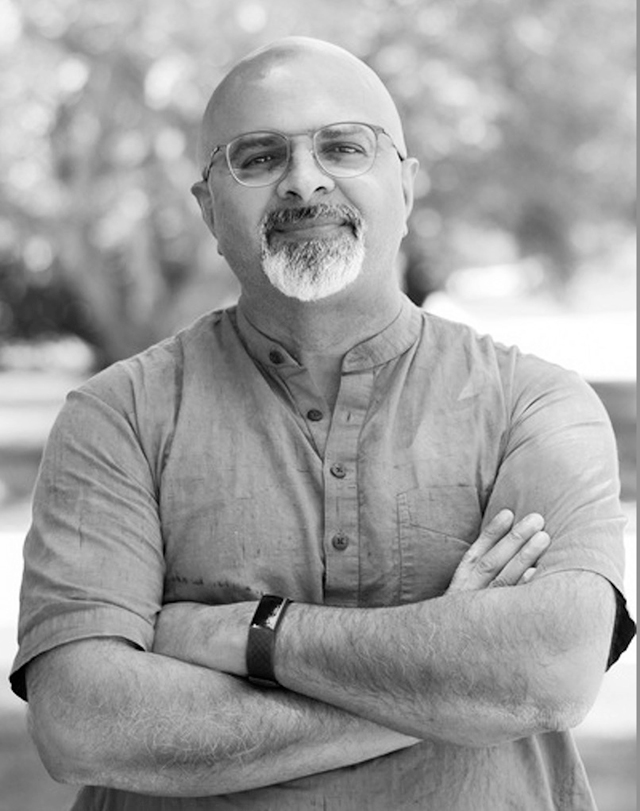
PRANAV JANI
Risak: As someone who identifies as both a social-justice activist and a professor, how do you see these two roles working together in light of recent federal measures to remove politics from the classroom?
Jani: All faculty members, regardless of what they teach, can be activists. That’s a basic right of free speech. If I were teaching chemistry, I could be an activist for Palestine if that’s where my politics led me. I could also be a right-wing activist. Teaching and activism are separate parts of one’s identity, and maintaining that separation is important for me despite the fact that what I teach—post-colonial and ethnic studies and issues around colonialism, race, gender, and sexuality—overlaps with my activism.
When I started teaching as a young graduate student, I made the mistake of thinking I could use my classroom as a tool for activism, to influence students in the right way. But I realized early on that, as authorities in a position of power, teachers have a responsibility to put students, not themselves, at the center. I would get these final papers in which every student wrote like a revolutionary, but none of them turned up at a protest. They were just doing what many students do: giving the teacher what they want and hoping to get a good grade in return. So I wasn’t building future activists, nor was I being a very good teacher. I had to outgrow the idea that I was somehow going to recruit my students to the right causes.
Because I teach about people who were colonized by Britain, of course I’m going to talk about racial discrimination and its ties to colonialism in the classroom. But I approach these topics objectively and investigate the tensions between different works. You can have one anti-racist writer who’s very patriarchal and another who’s a feminist. We study these tensions. The vast majority of students are there to learn and get a degree and exercise their mind, and so I separate what I do on the ground as an activist from what I teach in the classroom.
But the other mistake I made as a graduate student was thinking I could hide my personal life from my students. They are interested in the whole person who’s teaching them. I’m not just talking about politics. They want to know if you have children, what sort of music you like—so they can criticize it. [Laughs.] Transparency is important to them. They love that I have social media accounts and political opinions. And they want to hear about them: not to swallow them unthinkingly, but to engage beyond the classroom material. Politicians say, “Stick to the syllabus,” but students actually want to think about how to apply what they’re learning to the real world.
Risak: How do you practice political transparency without alienating those who disagree with your views?
Jani: There’s a notion that critical thinking means we don’t have opinions on anything. That’s not true. Professors take stands on issues, and I want to model for my students what that should look like. They know exactly what I think, but they also know that they’re not graded on whether or not they agree with me. You can be really conservative and do very well in my class; you can also be a left-winger with a lot of room for improvement. I don’t grade based on a political litmus test.
Still, politicians will say I’m indoctrinating my students, but that’s because they can’t imagine talking to an audience without pontificating. If I did set out to indoctrinate my students, it would go against my values of democracy and my goal of teaching students to think for themselves. I tell students to hold me accountable and to speak up if they think I am pushing a certain belief. On the other hand, it is true that there are certain established truths in the field of ethnic studies, such as the existence of systems of white supremacy. They’re free to disagree with me, but they’ll have to navigate the boundaries of the field on such matters of fact. It’s like a Christian who takes a biology class not believing in evolution; they’ll still have to learn about evolution to pass.
I make it clear to students that they have room to express their opinions, and I also don’t see them as fixed in their thoughts. If someone told me I should hold the same beliefs as a fifty-three-year-old that I held when I was twenty, I would laugh at them. I see my students as people who are capable of shifting how they think and grasping new ideas. I’m going to tell them about many ideas that might go against some they already hold, but that’s life, not indoctrination.
Risak: A significant talking point on the Right is the denial that systems of white supremacy exist and the insistence that America is not a racist country, and some people just don’t capitalize on the opportunities it provides. How do you handle these arguments from students?
Jani: One of the fictions on the Right is that students are clamoring to share these right-wing ideas; that they are banging down our office doors to argue that white supremacy doesn’t exist. This is not happening. Even the most patriotic students understand that America was built on slavery and that slavery is wrong. I’m generalizing here, but I think the average student comes to my class with the sense that America is great because we got rid of slavery, because of people like Martin Luther King Jr., because America can “correct its flaws.” Students are also open to the evidence that the impact of slavery, Jim Crow, and redlining produces racial inequality today. When questions do arise, they are usually around what to do about structural racism today.
Even those who feel there is structural racism aren’t always sure about the movements that respond to it. That’s where debate happens: What kinds of resistance to racism are legitimate in their minds, and what kinds are not? We talk in class about how it is easier to look back at movements of the past and agree with them but much harder to judge movements today. Many students, for example, will say they support Martin Luther King Jr.’s actions, even though they involved direct action and civil disobedience. But when similar protests against police brutality and genocide in the current period come up, there is much more debate, because society is still contending with ideas about means and ends, about race, power, and state violence. When these questions arise, we wrestle with them in a fair and honest way, including a number of different points of view from students. We are there in the classroom to learn. It’s not an ideological battle like the Right tries to say it is.
Politicians will say I’m indoctrinating my students, but that’s because they can’t imagine talking to an audience without pontificating. If I did set out to indoctrinate my students, it would go against my values of democracy and my goal of teaching students to think for themselves.
Risak: How would you define academic freedom, and why is it important?
Jani: I’m speaking here as a member of the American Association of University Professors, which has established definitions of academic freedom nationally for over a hundred years. The AAUP Statement of Principles from 1940 outlines the definition of academic freedom. According to that document, which was amended slightly in the 1970s and which universities still abide by, academic freedom is the idea that scholars and professors are free to follow the evidence wherever it leads them: to conduct research, to teach, and to complete work at their university based on their research and without pressure from politics, government officials, or the university administration. We should be able to teach the truth, even if it’s a hard or unpopular truth.
The whole point of tenure is that professors can pursue their work without fear of getting fired, unless they do something egregious. One could make the argument that the increase in nontenured faculty is actually a way to tamp down on academic freedom, because more and more teachers can be fired easily, especially when the political winds make their ideas unpopular. One way to defend academic freedom is to defend tenure and increase the number of tenured faculty at universities.
It’s also important to note that academic freedom is not the same as free speech. Free speech is the right of an individual to say anything, with or without evidence, and not be silenced by the government. There are higher standards for academic freedom. It’s not just the government but the university administration that shouldn’t be able to limit what you say—even though your peers definitely can. They will always ask: Do you have research to back up your statements? This reliance on peer review sometimes has a downside. If you say something that’s unpopular in your field, you might be prevented from publishing it. Nevertheless, despite its flaws, peer review is designed to keep academic publishing rigorous. Free speech has none of these restrictions.
Risak: How do you determine whether a controversial topic is worth discussing in class?
Jani: “Controversial” is relative: When and for whom? One of the first conversations I have with new students is about what is and isn’t controversial, and what they’re going to hear in my classroom. I tell them that a hundred years ago, I wouldn’t have been teaching an English class. I wouldn’t even have been in the US because there were bans on Asian immigration. If I ask them, “Who thinks women should have the right to vote?” everyone raises their hand. Then I ask, “What if this was fifty or one hundred years ago?” What was controversial to some people then is no longer controversial because we’ve settled the matter as a society. Critics say professors need to present both sides to an argument, but society and history shape which sides are legitimate. If my curriculum includes one author who is a queer Palestinian and another from Palestine who holds more conservative beliefs, those authors will look at life under occupation differently and talk about different issues. So I might get the class to discuss different views of freedom and society through that lens. But the critics might say that, because I didn’t also have Israeli writers, I’m not presenting both sides. In fact, I talk to students about this in class, so they understand that the curriculum does include a variety of perspectives.
Having said that, I’ve also learned the importance of choosing the right text and basing my lectures and classroom discussions on the assigned reading. I want students to ask, “What is this novelist saying? What is this poet saying?” not, “What is Pranav saying?” Sure, I picked that book, but when we root conversations in the text itself, we do the analytical work together. That makes for a much richer conversation. When they read a story that’s centered on undocumented immigrants, they are approaching the topic in a very different way than it’s usually talked about in the news—not just “What do Republicans and Democrats say about undocumented immigrants?” And I encourage them to read it their own way. I want them to bring what they believe into the classroom.
This generation has a much greater understanding of the need for mental health awareness and an ethics of care. Prior generations felt more comfortable attacking others for their opinions. It’s a real relief that students today would rather listen to what someone is saying.
Risak: How accountable should professors be for the personal views they express publicly or on social media? Should those views impact their professional lives?
Jani: If there is evidence of harassment by a professor on social media, I understand not letting them teach students. But many academics in this country have been fired or suspended for expressing pro-Palestine views, and I think that’s wrong. People should be able to express their opinions without it being automatic grounds for firing. If someone can show that those opinions have harmed students, in terms of grading or violence or something else, then there needs to be due process that is rigorous and not politically influenced. There needs to be a high bar for firing someone.
Risak: What about conversations that take place in the classroom? How do we ensure evenhanded discussions without infringing upon a professor’s academic freedom?
Jani: We already have monitoring systems in place. At Ohio State there’s an annual performance report that is used to assess the quality of our work and make judgments about salary, and part of that report includes our student evaluations. There are also peer reviews in which another professor comes into our class and watches us teach. Then there is the Rate My Professor website that, for better or worse, allows students to freely offer assessments of their instructors. How much more evaluating do we need?
I don’t think we need cameras in the classroom. Students in Ohio have the right to record anything they want, because it’s a one-party-consent state for that. But recording can break trust. Sometimes at the start of the semester I have my students vote on whether they think they should be able to record what happens in the classroom. The vote is nonbinding, but it helps create a community of trust.
If you have excessive classroom monitoring, forget about the professor—students will feel hesitant to speak. Classes will become like social media, with students asking themselves: What if I say something wrong? I have learned the most from the times I have said something wrong. The classroom should be a space where people can comfortably speak their mind and know that, if they are wrong, they won’t be punished for it. It’s a chance for them to learn. We need to create more of those spaces.
Risak: Most students today have grown up in a world where anyone’s opinion can be broadcast. As you mentioned, this creates a great fear of being wrong, because you’re wrong in front of everyone. Have you seen this change students’ willingness to speak up for a position that the rest of the class might not agree with?
Jani: Definitely. But I also find that students are quite tolerant of each other when they open up. This generation has a much greater understanding of the need for mental health awareness and an ethics of care. Prior generations felt more comfortable attacking others for their opinions. It’s a real relief that students today would rather listen to what someone is saying. In my experience, even when students hear something they disagree with, they are more likely to respond in a positive way in a classroom setting that encourages discussion. Sometimes I have to tell them it’s OK to say you disagree—it’s not the same as saying you hate the other person. This is speculation, but I wonder if that’s because of how harsh and impersonal the digital universe is. They aren’t used to seeing the person who is speaking, and when they do, they see that this person cares, that they are speaking out of their own knowledge and experience, and it’s not right to tear them down.
Risak: In early 2025 Governor Mike DeWine signed the Advance Ohio Higher Education Act (SB1). Included in the bill are the elimination of DEI programs, restrictions on classroom discussions, and a ban on faculty strikes. What consequences have you witnessed as a result of the bill?
Jani: This goes all the way back to the spring of 2023, when SB1’s predecessor, SB83, was introduced. Despite GOP majorities in the Ohio House and Senate, SB83 failed. But with MAGA and the shifting Republican leadership in the House, Ohio State began cutting programs even before it legally had to. Before SB1 was even passed, the administrators cut the Office of Diversity and Inclusion, and they closed the Center of Belonging and Social Change, replacing it with the Buckeye Commons.
There’s been a lot of obedience in advance, and obedience beyond the letter of the law, and it’s caused a chilling effect on campus these past two and a half years. I’ve had regular conversations with graduate students and faculty members about what they can and cannot say, what will get them in trouble, and whether they should stay under the radar or push back against the bill. SB1 uses words like intellectual diversity and free speech when, really, people feel constrained by it. They feel worried. They feel like they may lose their jobs just for talking about diversity, equity, and inclusion. Just today I came to my office and saw that my poster for an anti-SB1 rally had been ripped from my door. It could have been an individual who tore it down. It could have been the university. All I know is that plenty of flyers on other subjects remain on other professors’ doors.
I’ve been directly targeted by Ohio politicians for my opposition to SB1. It’s not insignificant that these are white politicians going after a professor of color. In an article about how we need to keep our students safe, State Senator Jerry Cirino implied that I am dangerous, citing the nasty Canary Mission, which has called me a terrorist. [The organization claims to track people who “promote hatred of the USA, Israel, and Jews on North American college campuses and beyond.”—Ed.] Brian Stewart of the Ohio House of Representatives has referred to me on X as “Professor Long Live the Intifada.” These people say they’re for academic freedom, but they’re against us talking about gender and sexuality; they’re against critical thinking about militarism. They seem to want to take us back to a pre-civil-rights model of education. And along the way they’re going to attack people like me in hopes of creating an atmosphere of fear.
Academic institutions are some of the last places in our society where you can openly talk about a wide range of topics. And that’s a threat to these authoritarian types. They’re afraid of what students might think. And they have good reason to fear that. Students who read the material love to ponder. They love complexity. They love learning new things. They might not accept what they read right away. They don’t have to. They don’t ever have to accept it. But they love wrestling with it, and that’s what a university education should be about. That’s why I love actually being in the classroom and teaching rather than just defending my right to teach.
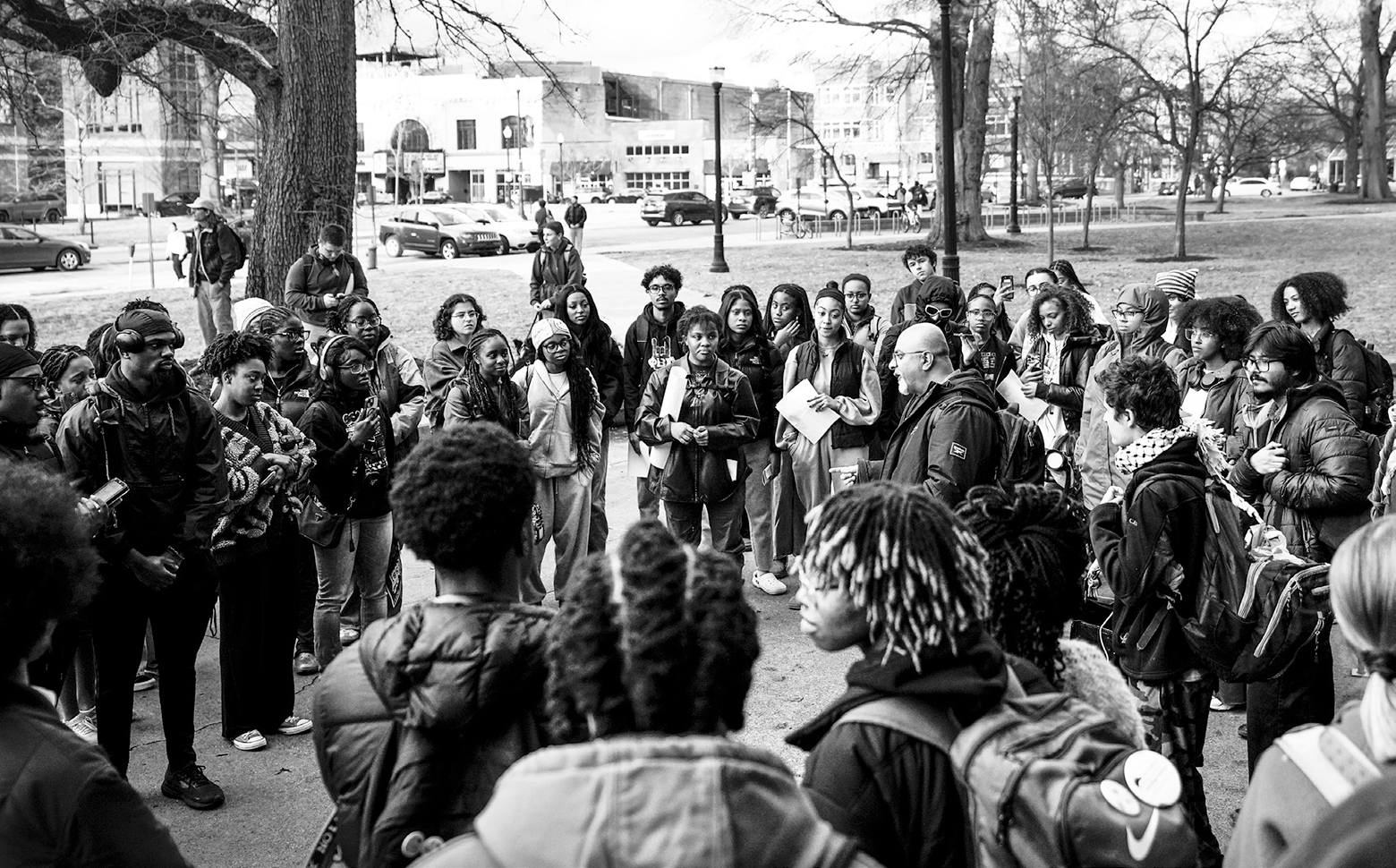
Feb. 27, 2025, Columbus, Ohio. Pranav Jani, center, at a protest of students and faculty after an Ohio State University Senate meeting at Drinko Hall. The university would later shutter two campus offices focused on diversity, equity, and inclusion, and eliminate more than a dozen staff positions.
© Samantha Madar via Imagn Images
Risak: What if the students want to espouse anti-immigrant, white-nationalist views? Do you think that a campus in 2025 is still a place where there can be healthy debate about these ideas inside or outside the classroom?
Jani: I think the idea that conservative students are victimized comes from MAGA influencers. I haven’t heard of any conservative students at Ohio State who have been arrested, who have faced down police, who have been unable to do their work as students, who have been disciplined or expelled or suspended for their political views. Given how much the Right uses the language of victimization these days, I think I would have heard about that if it were happening.
If right-wing students want to organize, they can. I think they’re freer to do so than people who hold views opposed to those of Republican legislators at the state and federal level. OSU is not, by any means, a left-wing campus. For instance, the school has a chapter of Charlie Kirk’s Turning Point USA. I’m sure they contributed to my getting on their organization’s Professor Watchlist. Baptism events now happen regularly in the fall at OSU, and although I don’t want to conflate those with MAGA, I think it’s fair to say that the events go off without a hitch.
All students should have a right to demonstrate and express themselves freely. If you have an anti-immigrant stance, I wouldn’t shut you down in the classroom. I would say we should all discuss these views in relation to the novels by immigrants we have read, or the theories of nationalism and definitions of home that we’ve learned about. I once had a student who wouldn’t read a Palestinian author because they said the author is a racist. They wouldn’t even buy the book. I told them it was their right to express that, but the book was required reading for the class. So I asked the student to make a class presentation on why we shouldn’t read this author, as an alternate way for them to fulfill the requirement. The student made their presentation, and when they were done, the other students had a chance to respond. Though they had listened patiently, most of them made hard arguments against the idea that the author was racist. It was a tense discussion and a lesson for everyone: Difficult debates can happen. But things took a wrong turn when the student, now out-argued by their classmates, tried to launch a personal attack on me. I stopped the conversation and told the student they were out of line. They had done the required work for this unit, and I appreciated it. I want people to think for themselves and give them chances to express their views, but I also want them to take responsibility for what they say. At the end of the semester, that same student actually thanked me for the chance I’d given them and apologized.
Risak: College campuses have a long history of serving as sites of protest. What is it about the university environment that encourages collective action?
Jani: First and foremost, youth want to spread their wings. They don’t want to be stuck with the values and models of the previous generation. And that isn’t limited to politics. It could be about culture, sexuality, or identity. They are no longer in their parents’ houses, but most don’t yet have all the responsibilities adults do. Universities are vibrant spaces of creativity and energy and growth, and politics is a place where many young people direct their energies. Ohio State has a long history of activism. The Office of Diversity and Inclusion came out of a massive student protest here in 1970, which demanded support for students of color. So when politicians and university administrators shut down institutions like that, they’re reversing the gains of student protest that made this a better place.
Activism comes in waves, too. We’re in the middle of a big wave of protests supporting Palestine. There was a previous protest wave in the early 2010s, after the recession of 2008, the Arab Spring, and the Occupy movement, and again after the killings of Trayvon Martin in 2012 and Michael Brown in 2014. Students are constantly told, “Be involved in what’s happening in the world. Read the news, put things into practice, develop empathy.” They’ve shown tremendous empathy toward the people in Gaza over the last two years, but they’ve been attacked for it. On April 25, 2024, for example, the pro-Palestine solidarity encampment at OSU was met with riot police and a sniper. At first the university denied having a sniper, but The Lantern [OSU’s student newspaper—Ed.] reported it, and you can find photos of the sniper online. Since then, they have come back to say that there are snipers at football games, too, which raises a whole additional set of questions.
Faculty members responded as best we could. The week after April 25, we had a march with about two hundred faculty and staff. I have never seen that kind of mobilization from faculty and staff on any issue, and many of those people came not because they agreed with the student protesters’ political positions, but because they defended their right to have those positions. I was part of organizing and leading that march. I was the faculty adviser to Students for Justice in Palestine (SJP) from 2010 to 2025, and I’ve sat in with students during their code-of-conduct hearings. I’ve met with many students, with the head of student life, even with the university president.
I would like to add, though, that because I’m tenured and have been doing this for some time, my involvement is sometimes more public than the involvement of many other faculty—often women, often faculty of color—who do a tremendous amount of work behind the scenes. Without that work, we never would have been able to support students. I’m proud of how I’ve participated, but every year it’s the students who take the lead. We faculty are privileged to be able to do something to help student movements where we can. It’s one of the joys of working on campus.
Risak: How have you seen what constitutes “free speech” evolve over time?
Jani: A few years ago Ohio Republicans passed a bill that called for a sort of free-speech absolutism: the idea that the university should not ban any speech on campus. It was coming from the Right, but they wanted to show that it was for everyone—communists, socialists, anyone could come and speak at a university. For instance, a few years ago a nonstudent group paraded through campus, openly carrying their guns, and some of us protested saying that marching on campus with weapons should not be allowed. But under state law they were allowed at a public university. Compare that to the rally against SB1. We had around one thousand people but couldn’t use a megaphone because of noise rules that were passed in response to pro-Palestine protests, forbidding amplified sound before 5:30 pm. The police were basically threatening to arrest us if we picked up the megaphone.
There are similar examples of hypocrisy. In fall of 2024 more than eight hundred people gathered on campus for a large Christian baptism ceremony hosted by the football team. The Lantern reported that the university told them to leave at 10 pm, but they stayed until around 10:30 or 10:45. Whereas the second a Palestinian protest went past 10 pm, the police were dragging people away, people who were out there praying. When asked about the discrepancy in enforcement, the university said those involved with the Christian event weren’t intending to stay overnight, whereas the people in the Palestine protests were. So then you enter the territory of intention, of what people are thinking or planning to do. Could you imagine a scenario in which police come and take football players away to jail? Not that I want that to happen, but again, it’s the hypocrisy.
Two days after Ted Carter started as university president in 2023, the SJP leaders and I met with him. He was blaming students for creating havoc on campus and raising the temperature of the debate, so I sarcastically asked, “Do you want to give us a list of words that we shouldn’t use?” He actually started giving me a list! Things like intifada, which is often mistakenly used as an equivalent for terrorism but actually means consistent, determined struggle against oppression. The students and I insisted that it was a political interpretation to equate intifada with terrorism. But he was not open to any of those discussions. The bottom line is: Does the university administration believe in free speech or not? It seems like they believe in it only when it’s politically convenient. If they believe in free speech, why not come down to the encampment and talk to students instead of getting the riot police and a sniper? Is that the way to run a university?
Risak: Some critiques of protests call them cathartic but often ineffective. What purpose do you see in a protest?
Jani: We engage in all kinds of activities hoping that they work. We vote for a candidate thinking they will do better than the last person, but they could end up being worse. In the same way, we protest even though our voices might not be heard by many. A protest is performative. And that’s not a knock on it. It’s important to perform our anger and suffering publicly rather than vent privately. We gain strength from being part of a group and hearing from those who’ve been there before. A protest often gets covered by the media. People will honk as they drive by a protest. It sends a message to those on the fence that there’s something they can do.
For a protest to be effective, though, you need to organize. And after it’s over, you need to find people who can organize the next one. They need to have discussions about further action: How do we build on this? What’s the larger strategy? What didn’t work at the protest? Which slogans need improvement? Then you start building a network, a coalition that can become the basis of a movement.
For me the first question is: Were people able to come together? Did they find people to commiserate with, to build solidarity with? Were they able to get the message out at this event? I’ve seen people find support through a protest, and I’ve seen organizations build and grow this way. And sometimes you see changes in policy as a result. For example, there was a Black-student-led protest at OSU after the killing of Trayvon Martin, and one of their demands was to change the language of campus-police alerts. These alerts often included a description of a suspect based almost entirely on race, something like “Watch out for a Black man wearing a hoodie on High Street.” If you are a Black man wearing a hoodie, this could be you. It’s not a useful description of a person. Since that protest, at least for a time, the campus police changed these alerts to be less dependent on race.
Risak: When every day is filled with one piece of bad news after another, it can be hard to stay engaged. What are some tools that help you maintain momentum?
Jani: If you’re an activist, you can’t afford to turn away from the news, but you also can’t let it be your everything. We engage in these fights in order to live happier lives. It can’t all be about politics. My family keeps me going. My community keeps me going. Singing in my choir gives me peace. And so does paying devout attention to the Cleveland Cavaliers and the NBA. [Laughs.]
We also have to remember that, while there’s a lot that’s exceptional about the current moment under Trump, there was also a lot that was exceptional under Bush and Obama. We talk about elections and politics as though none of this has ever happened before, but some of it has. Today students are being abducted off the streets because they’re immigrants, and this is horrific. There’s a real threat against international students everywhere, including at OSU. I was on the Master of Arts committee for a student who was arrested at the April 25 protest. He wasn’t allowed to continue as a student because his visa was revoked. This is unfathomable, but similar things have been happening to immigrants and people of color in this country for hundreds of years. Think about slavery and the Jim Crow era. Think about the attacks on Asian immigrants in the early twentieth century, the ban on Asian citizenship, or the internment of Japanese Americans during World War II. Think about how police and federal forces have been used in undemocratic, authoritarian ways. Looking at history reminds us that people have faced struggles like ours before.
In the current moment, we have to keep our lofty goals of social justice and transformation while also recognizing what needs to be done. But my task now is to pass on what I’ve learned to the youth. Staying engaged in activism allows me not to get bogged down in every deliberately shocking action taken by this administration. We need to stay grounded in something deeper than the daily news.
Risak: Even prior to recent government measures, universities weren’t exactly equitable spaces: Class, race, and numerous other identity markers play a large role in one’s access to higher education. What makes the university as an institution worth defending?
Jani: One of the toughest parts about defending DEI is that we have always wanted way more than that, and here I am fighting for it tooth and nail, because it’s under attack. But these attacks did not start with Trump. And by attacks, I mean the long-standing idea that humanities classes aren’t necessary, that we should all be in science or tech or some kind of training program to learn a skill that is “useful.” I mean the attack on tenure, with increased hiring of part-time lecturers and contingent faculty who are paid less and who don’t have academic freedom because they can easily be fired. I mean the whole corporatized culture of college athletics. I mean the way they build fancy dorms to attract students, and when the tuition goes way up, they blame faculty, even though our salaries have stayed down. I mean the way universities have been connected to Big Oil and the destruction of the environment, the way they’ve participated in the military-industrial complex. Ohio State just signed a big contract with the defense contractor Anduril, which now has its ads on campus. The argument is that they’re going to bring jobs to the people of Ohio, but why should a university be tied to the defense industry? How can we discuss war and its costs in such an environment? Everything has become more privatized. There’s less public money put into universities, and instead we’ve seen a rise in endowments and private money from corporations. Taken all together, these issues are the products of neoliberalism.
So when people talk about universities as bastions of the Left, I ask, “Then why has it been so hard for me at OSU as a leftist?” When there’s a demonstration, it’s not like the faculty from all of our departments come out. We’re a minority. But a university is worth defending because it’s where these discussions can take place. How many times have you read about somebody who transformed the world, and the beginning of their awareness and desire started in a classroom? What we do in the classroom still matters.
Academic institutions are some of the last places in our society where you can openly talk about a wide range of topics. And that’s a threat to these authoritarian types. They’re afraid of what students might think.
Risak: What do you say to the view that universities are nothing more than a capitalist venture: just enormous businesses funded by taxpayers and a donor class?
Jani: In a capitalist society, everything is a capitalist venture. Our political systems are set up so that people with the money call the shots. Even in K-12 education, teaching has turned toward the standardized test, which benefits the corporations that make them at the expense of students who might have knowledge that can’t be shown in that format. As Karl Marx says, under capitalism, “all that is solid melts into air, all that is holy is profaned.” Factories produce commodities; universities produce students who then sell their diploma to the highest bidder. Education is essential to capitalism because you need to train the next generation of workers to run an increasingly complicated system. And yet, capitalism’s contradiction is that it sorts people into classes. Sometimes the members of a class decide they have more in common with each other than with the small group at the top who run the whole thing, and they decide to raise their voices a bit. The great sportswriter Dave Zirin says we can look at sports as an institution of capitalism, but then you’ve got athletes unionizing or Colin Kaepernick using his fame to make a statement. People who are exploited and oppressed by the capitalist system can come together to create something new. So, yes, the university is a capitalist institution, but it’s also a place where people can see that there’s more to the world than money.
Risak: Do you think universities in general are trying to limit such ideas?
Jani: I think politicians fear the openness of ideas at a university. They are afraid people might move beyond the conformity that they’re trying to implement. That’s why they attack critical race theory, gender studies, ethnic studies, and the faculty who teach them. The Right and I agree on the potential of universities as a space in which students develop ideas that can transform the world. The difference is, they want to stamp it out, and I want to encourage it.
Risak: Could you foresee a future in which it is no longer worth fighting for the university? How do you decide when it’s time to leave?
Jani: There’s never going to be any government or university policy that prevents me from doing what I need to do in the classroom. They can even tell us what books we have to teach, but my students and I will find our way to the truth. Students will learn regardless of what draconian laws are passed. I’m going to continue to do what I do. If they don’t like it, they can throw me out.
Rumors and the climate of fear stoked by repressive laws can sometimes make the laws being passed sound worse than they actually are. For example, SB1 bans universities—meaning their administrations—from taking positions on so-called controversial topics. It doesn’t ban those topics from being taught in the classroom. Still, there’s that chilling effect, because of the increased surveillance. We need to be really clear about the law so that we’re not self-censoring.
The battle over education and justice has been going on for a long time. The field of ethnic studies came out of protests by students who wanted to study their own histories and see themselves in the books and subjects taught in the classroom. There will always be a struggle to defend education, which is really about defending people. And I think an increasing number of people are up to the challenge. We’ve seen a rise in AAUP membership, and more faculty no longer feel it’s enough to stay silent. They are taking a stand. We are taking a stand.