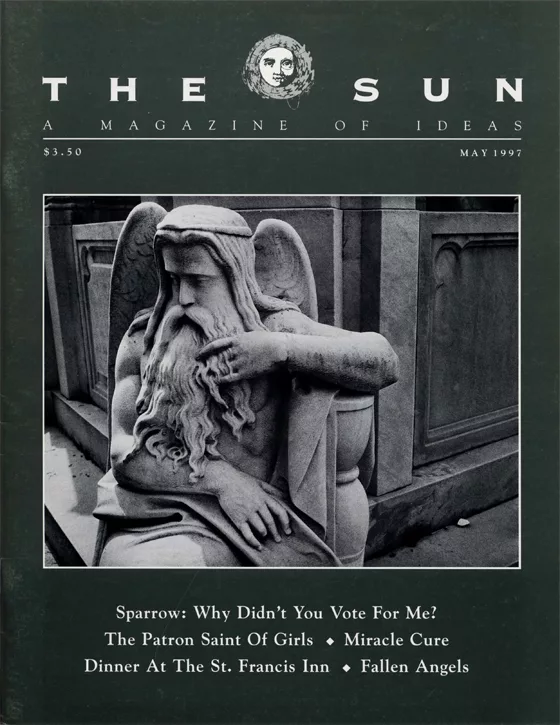
Longtime readers of The Sun will remember that Sparrow, a poet whose work has appeared often in our pages, staged a very independent campaign for president in 1992. But probably few heard that he ran again last year. This time around, there were two small differences: (1) he had corporate backing from Mouth Almighty Records, which had previously recorded one of his poems for its compilation The United States of Poetry; and (2) he ran as a Republican.
— Andrew Snee
In 1992 I ran for president as the Pajama Party candidate, because I wanted to write great poems. And somehow I did write great poems.
In the four years after I lost that election (as far as I know, I got zero votes), I’d see my campaign manager, Hal Sirowitz, occasionally. “You should run again next time,” he’d say. “You wrote such great poems last time.”
But you can’t write great poems two elections in a row, I knew.
So I wasn’t going to run in 1996, until Pat Buchanan won the New Hampshire Republican primary. For ten days, the leftist agony came over me — the certainty that Bakunin was right: the ruling class does wish to extinguish us! I saw vividly a white-supremacist army occupying the White House, closing our borders, and setting up Christian reeducation camps. I knew I had to act swiftly. So, on March 4, I declared my candidacy for the Republican presidential nomination.
And the next week, at CBGB’s Gallery in the Bowery, I gave the following oration:
Why I Can Beat Bob Dole

I can beat Bob Dole because anyone
can beat Bob Dole — anyone, that is, except Steve
Forbes, Lamar Alexander, Pat Buchanan, Alan
Keyes, and Richard Lugar. In a bizarre twist
of fate, the only five people on earth who
cannot beat Bob Dole are running against
him. [Pointing to an audience member:] You,
for example, could beat Bob Dole
easily. [Pointing to another audience
member:] You could beat Bob Dole by a
landslide. [Pointing to a third audience
member:] And you, if you chose to run against
Bob Dole, could reduce him to vomiting
and tears. [Pointing to all three:] But you, you, and you
are not running against Bob Dole, to my knowledge,
and I am. That is the difference between us.
Some humans look at the possible and say, “That is too
easy,” then look at the impossible and say, “That
is too hard” — but I am different.
I say, “Do the possible; then do the
impossible; then do the unthinkable,
the unimaginable, the unspeakable, the
un-Christian.” Bob Dole wants to make this
country great again, but I say no. This country
has tried being great, and it
has failed. I want to make this country small,
embarrassed, slightly befuddled. I
want this country to hum to itself as it cleans
its glasses. I want this country to try hopelessly
to learn to play the tuba. I want this country to
watch Jeopardy every day and get most of the answers
right. I want this country to mumble,
to be shy, to give a limp handshake, to
go days without combing its hair, to
have bad breath. I want this country to
smile awkwardly while carrying a book. And I will
beat that fucker Dole, with his war stories and his
“courage.” Who needs courage? Courage
is for cowards. I have something greater
than courage: I am a failure.
One day, a week before the California primary, I looked in the newspaper and realized it was over: Dole had won. My campaign had ended. The Republican Party would limp to defeat without my help.
June 5
Today Bob Holman, poet, impressario, and head of Mouth Almighty Records, asked me to tape several of my presidential poems for his label’s Web site.
“Sure,” I replied.
June 16
“Would you like to organize a demonstration as part of your presidential campaign?” Bob Holman asked.
“Sure,” I said. “What am I demonstrating against?”
“NBC.”
June 17
“Why are you running as a Republican?” Bill Adler, another Mouth Almighty operative, asked.
“When I was a kid,” I said, “I found this book, The Speeches of Abraham Lincoln, put out by the Communist Party, and it had all these wild quotes in it — Lincoln denouncing capitalism, and envisioning a utopian future. He sounded like an Illinois version of Karl Marx.”
“You have to find that book,” Bill Adler said.
June 19
“I found it,” I told Bill Adler on the phone.
“Read it to me,” he said.
“ ‘Inasmuch [as] most good things are produced by labour, it follows that [all] such things of right belong to those whose labour has produced them. . . . To [secure] to each labourer the whole product of his labour, or as nearly as possible, is a most worthy object of any good government.’ ”
“Great,” Bill Adler said. “Now read it again slowly, so I can write it down.”
June 20
“Do you mind wearing a stovepipe hat at the demonstration?” Bill Adler asked.
I called Nestor’s Novelties. “Do you have a stovepipe hat?” I asked.
“Yes, we do.”
“How much is it?”
“Thirty-four dollars.”
“I’ll be right there.”
But it wasn’t a Stovepipe hat at all. It was black and had a brim, but was only about fourteen inches high.
“I need a really tall hat,” I explained.
“Well, there’s that one.” The man pointed to a high plasticine hat with red and white stripes.
I put it on and looked in the mirror. “I look like the Cat in the Hat,” I told him.
“You could paint it black,” he said.
I stood in a corner of the store, under three severed limbs dripping blood, thinking.
“I’ll take the hat,” I said.
“Number 1061,” the man told his assistant.
The assistant brought back a flat plastic package.
“It’s flat,” I said.
“You have to steam it,” the man said. “It’s very simple. There’s instructions inside.”
“OK,” I said, and handed him twenty-three dollars.
June 21
I held my hat over a pot of boiling water.
“It’s a good thing I’m running for president,” I mused, “because otherwise I would never have steamed a hat.”
June 22
My five-year-old daughter and I sat on the floor, painting my hat black. “I’ll do the top and you do the sides,” Sylvia said.
When we were done, I put on my hat and looked in the mirror. You could still see the red and white stripes under the paint. I looked like Abraham Lincoln if he had formerly been the Cat in the Hat.
June 27
Standing on an overturned plastic bucket in front of the statue of Atlas at Rockefeller Center, I began my oration before a crowd of young poets, Mouth Almighty functionaries, and innocent passersby:
Why are we here?
We’re here because we want time!
And what kind of time do we want?
TV time!
And what kind of TV time do we want?
Free TV time!
And whom do we want free TV time for?
Me!
And why do I need free TV time — from
NBC, which is giving it to all presidential candidates?
So I can denounce TV!
I have proof that television is the most
fear-inducing, community-exploding, mind-
boiling device in history. But
how can I communicate this message to the
American people so that they will
listen carefully, and how can I reach
them in their own homes, where they
are most vulnerable?
I must go on television.
Which is why I am demanding equal time, completely
equal time, with the other candidates.


Besides, all the other candidates
are speaking prose — vast, uninterrupted,
listless prose. Only I am speaking a flowing,
lyric, olive-colored poetry.

This is a contradiction. I am the only
poet candidate, yet I am shut out of the
dialogue — or trialogue. Where are our checks
and balances? When prose predominates, the
earth becomes too flat. When poetry is
overweening, the world becomes too round. And
which would you rather have, my sister and
fellow tourists — a world too flat or a world
too round?
I went on to describe my platform, which has only two planks. Plank one: the near abolition of money, through the establishment of a One-Time-Investment Economy. You pay for something once — groceries, for example — and for the next fifteen years all groceries are free. Plank two: the declaration of a Jubilee Year, a year in which all debts are forgiven and all slaves are freed.
Lincoln freed the slaves,
and I will free them again —
but this time I’ll free more slaves than he did.
I’ll free all wage slaves, prisoners, soldiers
who changed their minds and now want to be
botanists, slaves to religion
and luxury and greed,
slaves to the patriarchy —
all you slaves, you will be free,
thanks to me, Sparrow, the president
who breaks the evil chains of slavery,
who destroys moribund capitalism and replaces
it with the tranquil, foresty happiness of the
One-Time-Investment Economy!

Now, a lot of people say to me,
“Sparrow, you’re running for the Republican
nomination for president. Why, then, are you
so concerned about getting equal time
at the Great Debates of ’96, as either
you will be the Republican nominee,
and be assured a debate role, or you will
fail and not deserve such a role?” To
which I reply, “I fully expect to receive
the Republicans’ nod — they would be clowns
not to nominate me — but one must be
prepared for a rogue convention. In that
case, I will found the True Republican
Party, which adheres to the policies of True Republicanism.

I propose the following exercise: Close
your eyes and envision Abraham
Lincoln, the greatest Republican. Then
visualize Bob Dole. Then envision
me. Then open your eyes. Now consider: Who carries
the mantle of the Republican
Party? Who is lanky, bearded, eccentric,
humorous, wise, biblical, literary, radical,
and self-taught, and who is a vicious
imposter from Kansas? This is the
question I pose to you, my sister and
fellow tourists, on this fine Friday
morning in June 1996!”
Then I stepped down from the bucket, and Bob Holman announced that I would entertain questions.
“If there is no money, who will do the disagreeable work?” a twelve-year-old girl asked.
“In the future,” I replied, “people will only do the work they enjoy — except for those who don’t wish to enjoy their work — and luckily there will be exactly enough of them to sustain our world.”
June 28
It is sad and instructive to watch Dole advance toward his doom. It’s like watching a man meticulously wash his hands, iron a shirt, write a note, pick up a shotgun, and blow his brains out. Dole has the calm happiness of a man who has given up.
He is seventy-three years old, the oldest presidential candidate in history. For thirty-six years he has helped to govern this nation in Congress. Now he has retired. His career is over. All he has to do is continue running for president until November, and then he can retire forever. Bob Dole has had a good life. He is at peace.
July 8
Bill Adler called: “Would you like to address the crowd at Lollapalooza?”
“Sure.”
“You won’t be on the main stage.”
“OK.”
“You won’t be on the second stage.”
“OK.”
“You won’t be on the third stage.”
“OK.”
“You’ll be in the Chill-Out Tent. But you’ll get a big crowd, ’cause it’ll be air-conditioned.”
July 11
In the Chill-Out Tent at Lollapalooza, the bass player from Ouijipig introduced me: “And now, a presidential candidate who definitely does inhale, please welcome . . . Sparrow!”
I haven’t smoked a joint in sixteen years, I thought, then delivered my oration to fifty-eight beer-drunk metal-heads, who responded with tepid applause. I spent the rest of the afternoon writing letters to friends.
Jacquie,
I am leaving the Lollapalooza concert early, though I feel guilty for leaving, as if I’m deserting rock-and-roll, the cause in which I once believed. In particular, I’m fleeing Metallica, who have become a tyrannical presence in my life these last fifty-eight minutes. Soundgarden was very boring, the Ramones were washed up, and Beth Hart did an unimpressive Janis Joplin imitation.
I have begun to understand the lonely, somewhat paranoid mind-set of the metal-head; theirs is a loveless world, beset by peril, whose strongest emotion is sadness — nostalgic sadness. During the more intimate songs, they all rock their heads forward, like Orthodox Jews praying.
Love,
Sparrow
Marcus and Kate,
Because I am a bearded old hippie carrying a large, multicolored bag from Puerto Rico, the Lollapaloozers immediately recognized me as a drug dealer. Here’s what they said to me:
“Do you have any acid?”
“Do you have any smoke?”
“Do you know where I can get mushrooms?”
And, late in the day: “Do you have an aspirin?”
Love,
Sparrow
Thaddeus,
At the Lollapalooza Festival, there was a “mystery band” on the program. It turned out to be the rap group Wu-Tang Clan, which alienated the largely Metallica-leaning audience. Sitting in the stands, I felt a certain arms-folded hostility among my neighbors. I was very happy with Wu-Tang, and must have shown it, because a beefy, drunken, red-faced guy with a blond mustache asked me, “You like that stuff?”
“Yeah, I like it.”
“Tell me this: are there any musicians on the stage?”
“Hey, everyone’s a musician. If your heart beats, you are a musician.” (I was paraphrasing John Cage.)
“Where do you live?” the guy demanded.
“The East Village.”
“I’m from New York, too.”
He offered his hand, and we shook hands.
“You ever smoke crack?” he asked.
“No.”
“I bet it must be great to smoke a lot of crack and listen to this music. You know what I mean?”
“I guess.”
“I could do that, too,” he said, pointing to the stage, “if I had big pants and some crack.”
“So do it, then!”
“I won’t,” he said, his puffy, beery face suddenly close to mine. “And you know why?” he asked.
“No,” I said fearfully.
“Because I’m civilized.”
The soul of America was speaking to me, and I was choked with fear.
Love,
Sparrow
July 25
Dole has finally revealed his economic plan, which cuts taxes by 15 percent while eliminating the deficit. The exact mathematics of this plan is somewhat unclear, so I have attempted to fill it in, in this Op-Ed piece, which the New York Times has, oddly, failed to publish:
The Fine Print Of The New Proposal
Few people have read Bob Dole’s new economic plan in its entirety. Those who have find some extraordinary methods proposed for making up the budgetary shortfall created by the 15 percent tax cut. For example:
1 ) The government will find money lying on the ground. IRS agents will scour city streets and suburban malls for coins and bills our citizens have dropped. If they are lucky, they will add $3.1 billion to our nation’s coffers.
2) Some people will feel compelled to pay extra taxes. A rare obsessive-compulsive disorder will force its sufferers to send extra money to the government. Dole’s experts are hoping this disorder will net $9.2 billion.
3) Dead people will win the lottery. If all our state lotteries are won by people who then die suddenly, leaving no heirs, the government will be $7.8 billion richer.
4) The Japanese will feel sorry for us. President Dole will visit Tokyo and pout, and the Japanese, to save face, will hand him $139 billion.
5) Money will grow on trees. The adage “Money doesn’t grow on trees” will soon be disproved, according to researchers at Lindy-Ellman Biologic Labs in Heyville, Kentucky, where genetic engineering will allow ordinary pear trees to grow five- and twenty-dollar bills: $19.8 billion.
6) Mrs. Dole will record a hit album. Elizabeth Dole took singing and piano lessons throughout her childhood. With the right producer, she could record a best-selling album (without, of course, compromising her Christian beliefs): $300 million.
7) The government will get a new mascot. Uncle Sam is woefully passé in this age of merchandising tie-ins. A warm, huggy governmental symbol, similar to Barney the dinosaur, could net $38.1 billion at the White House gift shop and other outlets.
Whether or not one agrees with these proposals, they represent creative American thinking at its best. Good work, Bob Dole, and your team of experts!
August 8
I feel a longing to be in San Diego, where the Republican convention is about to begin. The imaginative exercise of running for president has taken its toll: I’m starting to feel like a Republican. Reading the daily tabloids (where Newt Gingrich has resurfaced like a U-boat commander to shout, “We are unified, we are together, and we are going to win the election this fall!”), I wish I were there to lend a small note of post-Marxist discord. The ghost of Abraham Lincoln is unquiet! The souls of the oppressed moan!
What most shocks and fascinates me, though, are the photographs from the preconvention parleys. These Republicans are so white, white beyond white, white as salt, white as sails, white as White-Out. Yesterday’s Daily News showed antifeminist Phyllis Schlafly, Gary Bauer of the Family Research Council (is it possible to “research” families?), and “antiabortion delegate” Betty Lou Martin arriving at a platform meeting. Phyllis had doffed her floppy white cowboy hat for photographers in triumph, and wore a broad, Lucille Ball smile. Gary looked like a smug, twelve-year-old spelling-bee winner. And Betty Lou seemed nervous, in her polka-dot skirt, to be in the company of such heavy hitters in the right-to-life movement. But, man, were they white! I, of course, am also white, but I will never be white like that!
That many white people in one place is scarier than four trucks colliding. They’re white, and they’re grinning, and when white people — really white people — grin, it’s bad news. It means they have discovered a new type of sex, and they’re about to outlaw it.
August 13
While washing the dishes, I listened to coverage of the Republican convention on the radio. I heard the keynote address, by New York Congresswoman Susan Molinari, and a speech by J. D. Watts, the black Oklahoma congressman. Both speeches infuriated me — especially Molinari’s. (As a leftist, I have trained myself never to get angry at black people, so Watts I mostly pitied.) I found myself stomping around the kitchen, picking up dishes from the table, throwing them into the sink, and muttering, “I’ll end welfare as you know it, you little bitch!” Molinari solemnly invoked her hardworking forebears — particularly her Italian immigrant great-grandfather, a barber. (How hard do barbers work, really?) “In two generations,” Molinari said, “our family went from a seat in a barbershop in Queens to a seat in the U.S. Congress.” Yuck!
A murderous, boiling rage took hold of me: “What’s your point? What’s your point? Are you saying that people who don’t work hard should be herded onto ice floes and left to slowly die?”
They were both lying — you could see them lying, through the radio; their soap-opera-style acting was cruelly transparent. Yet I could feel Americans everywhere believing them, believing their sleazy promise of a free ride: no taxes, and lots of money for everyone (except the invisible poor). “Why pay for life? We’ll give it to you free, free. It’s for the children. And for God!” Watts actually said that throwing children off welfare does them a favor, because it “teaches them the valuable work ethic.” And Molinari said, “We Americans are a generous people. But . . .” (Isn’t this the exact phrase the Nazis use in the movies?) She, too, thinks it helps people to throw them off welfare. If you really want to help people, Molinari, here’s an idea: chop off their arms and legs! Want to help children a lot? Shoot their parents!
“We have to send a clear message to God that we want him back in American life!” Watts said.
Oy!
Sparrow’s Message To God

Fuck you! Get lost! I’m sick of
every Republican enlisting you in their
bitter crusade against innocent (and guilty)
children and the impoverished. I’m
one Republican who has the courage to tell you
to take a hike back into the sands of
your sanctimonious biblical locale.
You don’t do anything anyway!
You’re a human construct, God damn it!
If you do exist, you’re nothing like our
image of you. You’re probably a fucking fish!
Swim away, dear God, and let us ruin
the world ourselves! But if you don’t
mind, first make Susan Molinari a
Puerto Rican for two days!
August 15
I didn’t listen to the convention yesterday, because it frightened me how angry I’d gotten the day before. But tonight I heard Bob Dole’s acceptance speech. It was clearly written by Mark Helprin, a magical-realist novelist who is exactly my age. It was a lovely speech, fat with sweeping metaphors about life on the plains: “On the plains, a man never looks large. A man looks small. I will never forget that I am only a man, a two-legged being with ears.” That kind of thing. It reminded me a lot of the speeches I have written for myself in this campaign. It was strange to think of me and another forty-two-year-old guy (and, no doubt, some third forty-two-year-old on Clinton’s payroll) writing this election.
Speaking objectively, I think my speeches are the best, because mine are funny, and have ideas in them, and anger, whereas Helprin’s speech was essentially beautifully rewritten clichés. (“This is your moment, not mine. This is your moment, America,” Dole said.)
Besides, Dole sucks as a speechmaker. I pictured poor Helprin with his head in his hands in front of the TV, thinking, Why couldn’t I have been alive for Woodrow Wilson? Dole wrecked all his crescendos, missed all his commas, and made the speech sound foolish and grandiloquent, because it embarrassed him to give it. Dole doesn’t talk, or think, in long sentences. His speech should have been:
“I’m here.
“You nominated me.
“I’m gonna make you rich!
“Your taxes will be nothing!
“My wife is pretty!
“Kansas is great!
“More money for bombs!
“Except for that, the government will disappear!
“Hey, let’s drop the balloons!”
Dole couldn’t even bring himself to say “president.” It came out “present” — or sometimes “presdent.” And he doesn’t believe in using articles and prepositions and pronouns — all the little words of speech. He talks exactly like George Bush, in the clipped lingo of the CEO — because these guys essentially are the CEOs of bureaucracy: “Gotta push the butter thing. Interest rates are flying. Cut-and-run time.”
The little words are for Little People. Big People have no time for them.
August 24
The success of the Republican convention deepens my fears about this nation. (The Republicans are now even with the Democrats in the polls.) To call this cruel, flat, fictive spectacle “Orwellian” is so obvious as to be almost meaningless. And this inauthentic, soulless, contrived, sanitized, lifeless, badly acted stunt was believed by Americans — who didn’t even bother to watch it. For the first time in history, no one watched the convention, and they still loved it. In fact, Americans loved it more because they didn’t have to watch it. It was so predictable and mindless, you could ignore it. Americans were grateful because it saved them time — time they spent watching Seinfeld. When Americans say they want to save time, they mean they want more time to watch TV.
August 30
In the last election, the Democratic strategist fell in love with the Republican strategist. After the election, they were married as quietly as possible. Americans did not wish to consider what this implied about our political system.
This year, the Republicans are following a Democratic strategy, and the Democrats are pursuing a Republican strategy. (At the Republican convention, Colin Powell denounced “corporate greed”; the Democrats didn’t even mention the poor once.) In the future, I predict, one strategist will guide both campaigns.
September 3
Why, exactly, does Bob Dole wish to lose? Why did he fiendishly, mechanically, relentlessly pursue the nomination, only to run a sleepy, distracted, provincial campaign? I think the answer lies buried in the twenty months he lay in a hospital bed after World War II, and in the arm that hangs useless by his side, always clutching (for some poetic reason) a pen.
The most memorable statement Dole made in his acceptance speech was “It doesn’t take a village to raise a child — it takes a family to raise a child.” And the most affecting story he told was of his father’s standing for nine hours on the train from Kansas — until his feet were swollen — to visit Dole in the hospital. And why did his father have to stand for nine hours? Because no one gave him a goddamn seat! Dole really wanted to say:
“I fought for the village. I died — or half died — for the village. And where was the village for twenty months when I lay frightened in my bed? Where was the village? Sitting on the train, so that my father had to stand until his feet swelled up like sweet potatoes! Fuck the village! The family is all I have, ultimately — my glowering, taciturn father and my nutsy, bubbling wife! Damn it, that’s all I have!”
This election is Dole’s revenge.
October 25
The Yankees are about to play the fifth game of the World Series. It’s dazzlingly, mercurially exciting, even though I don’t follow baseball. They lost the first game twelve to one, which burned my civic pride. The second game they also lost, and I thought, sadly, Gee, I expected more of the Yankees. Then they won the third game. During the fourth, I happened to hear on the radio that the Yanks were losing in the sixth inning. But, walking my daughter to school the next day, I saw the headlines: the lovely, impetuous Yankees had come from behind in extra innings and triumphed by two runs!
Last night, I went so far as to research what team the Yankees are playing. It’s the Atlanta Braves, Atlanta being (according to Andrea Peyser in the Post) a tedious, demoralized town whose main attraction is the Coca-Cola Museum, and whose residents tiresomely brag about what a short commute they have to the suburbs. So it’s a war of cultural mores, this World Series: the hipsters against the hicks, the Yankees versus the Rebels. “Sherman Was Right About Atlanta” was Peyser’s headline. The Civil War is being refought, as it often is in America.
Why is the World Series so great and the election so drear? Perhaps because the election is already over. The punditocracy has run out of comments, except to say, “The election is over.” Basically, the problem is that Clinton is a great campaigner and Dole is a terrible campaigner. Clinton could win 122 more elections (if he lived to be 538), and Dole could lose as many. Dole keeps saying, “I’m a nice person — elect me,” which is exactly wrong, and pathetic. He reminds me of a boring old salesman who says, “In my thirty-nine years in retailing, I never once, not once, made a sale without giving a receipt.” Who cares?
Clinton, though a narcissist, understands the election is about the voters, not the candidates. You can’t brag about yourself. You flatter your customer if you want to make a sale.
October 27
Last night I was coming home from a movie as the waves of joy and exaltation spread over the city from the Yankees’ victory — cars honked, men waved, women trilled. A drunken, surly delight reigned.
This was a tribal victory, celebrating the power of a city not unlike (I imagine) when ancient Rome beat Thebes in war. Our civic gods have beaten off all contenders! was the unspoken message. Why is politics so less joyful? Because in America we rule by consensus, so no tribe entirely wins. The partisan heroes — Goldwater, McGovern — always lose. Or if they succeed — Kennedy, Reagan — they “move to the middle,” where no triumph is. In sports, life is unfair: Atlanta utterly loses; New York totally wins.
I am trying, in my campaign, to return this sportive spirit to government. Friday night I read my inauguration speech at a benefit for Refuse and Resist at the Clemente Soto Velez Cultural Center, down on Suffolk Street, deep in the real Lower East Side. I was a huge success, as I defended our island, which floats outside the continental U.S. (We mirror Hawaii, in a sense.) East Villagers happily cheered their hatred of the rest of our nation, and their pride in this locale.
Sparrow’s Acceptance Speech (For The Nomination Of The True Republican Party)

Who am I who stands before
you today? Who am I who rises
above you to be your god?

My name is Sparrow, but my name
was not always Sparrow. It was
originally Michael Daniel Gorelick,
and I was born on an island
at the mouth of the Hudson River.
The name of that island is
Manhattan. I was born in
Lenox Hill Hospital, in 1953, and
since then I have lived most of my life
on that island, except for brief
stints flunking out of Cornell
University, being a hippie in Gainesville,
Florida, working in telemarketing in
Denver, and visiting my guru in
Calcutta. (Also, I sometimes go upstate.)

When you live on an island,
you know one thing: that you
are surrounded by water. If
you go far enough east, you will
find water. If you go sufficiently westward,
water will be there. If you
go north or south, voilà —
water!

To reach beyond our island,
one must employ a ferry, tunnel,
or bridge. (A strong swimmer could
succeed, but this is rare, as the
“rivers” around us are actually estuaries
and fjords, with swift currents.)

Manhattan grows no food — except
perhaps nineteen tomatoes, and a few chickens
in apartments on Avenue C. I and
the 1.1 million other Manhattanites
are dependent on distant farmers
to grow our grain, and to milk
goats for our goat cheese.
A certain faith is required
to live on an island. We in
Manhattan produce television shows
and give dance recitals, and the
rest of the nation feeds us.
They curse us, but they feed us.

Yes, America hates our island.
People at weddings in Pennsylvania tell me:
“They ought to drop a bomb on
Manhattan, just level the whole place,”
and I nod and smile. Why do Americans
hate us? Manhattan consists of numerous groups —
Jews, blacks, queers, the rich, illegal
immigrants, college professors, therapists,
drug dealers — that are despised
in America. But even that may not
explain why they revile us so. I think
we are hated because we are an island,
floating separate from the continent,
with our own customs and mysteries.

There is always an apocalyptic
terror in Manhattan, a fear
that the Revolution or some nuclear
bomb will appear suddenly in the
roiling clouds above our island. Here, one
learns to live with doubt, with terror,
with the hatred of one’s nation.
One goes to one’s therapist,
or drug dealer, or yoga instructor (or all
three), and one pulls through. Here in
Manhattan, we all pull through. Even our
friends dying of AIDS, or heroin overdoses, or
police violence — we pull them through,
into the Other World. The Other World
is very close in Manhattan, because
we are an island, at the edge of a
great continent, living without farms.

I bring all this to my candidacy:
my fear, my faith, my farmlessness.
I thank you, America, for feeding
me, even though you hate me. I write
poems for you (including this one),
even though I hate you.
November 4
Recently, when Dole began to rave and shout at the American people, “Wake up! Don’t you realize what’s happening? Are you all asleep?” it saddened me.
Dole does not understand himself. He thinks he is a public servant, a kind of hero, whereas he is actually a businessman. Our nation is all a business to him, and he speaks of it the way a store owner speaks of his business. He says, “If they want me to be Ronald Reagan, I’ll be Ronald Reagan,” the way a candy-store owner might say, “If they want porn, I’ll give them porn.”
But America hates to see itself as a business. We were founded during the Enlightenment, and we are still an Enlightenment nation, a noble experiment in democracy, equality, and other abstractions. In our nation, we identify with an Enlightenment God: a God of no particular religion, a God of civic virtue and cool ethics. The God in whom “we trust” on the back of the dollar bill isn’t Jesus Christ. It’s God the Architect, whose Masonic symbols — the pyramid and the compass — adorn the bill. God the Architect designed America, the most architectural nation, the only nation founded on a particular date and built from the ground up.
Bill Clinton speaks this Enlightenment lingo. “We must build a bridge to the twenty-first century,” he says, a bridge that everyone may walk on. In his description, we are still architects designing a holy architecture. Americans like that.
Dole, on the other hand, has actually administered the nation’s government for thirty-six years. He knows how our government really works. The government is like a soda machine: the corporations put money in the slot, and out comes the legislation. Every nuance and phrase of Dole’s campaign says, implicitly, “C’mon, get real! The presidency is a job. The best I can do is give you some of your tax money back. There is no vision. We don’t need a vision. It’s a soda machine.” For daring — inadvertently — to shatter Americans’ illusions, Dole will go down in an ugly, disastrous defeat, and for years his name will be synonymous with failure. All this has hit Dole in the last two weeks, and he has begun to go gumbo.
Being a cynic, he reacts with even deeper cynicism — he attacks the New York Times, and shouts in public, “Where’s the outrage?” over and over again, sometimes dropping to a whisper. The outrage is against him, of course, but, like the victim in a Greek tragedy, he can’t see it.
Why is Dole such a cynic? Anyone who lies in a hospital bed for twenty months learns either one of two great human truths: (1) no one cares; or (2) someone cares. Dole learned the first truth, and learned it well. To survive his wound, he had to abandon a small section of his psyche — the part that feels pain. With that excised, he could indulge his ambition, and his desire to work. These brought him great success, but they cannot bring him the greatest success, because Americans demand that their chief executive dream (or pretend to dream). And without pain, one cannot dream.
Dole has exposed himself now, to the nation and the world, as a man who cannot dream. For this he is being cruelly taunted. But it is unfair to make this man suffer for his dearth of dreams. It is the tragedy of Nixon all over again. (And Dole saw Nixon, of course, as a kind of father.)
Election Day
Yesterday, there were Indians in our window. They were repairing the wall of the building next door, rubbing cement over it. They stood on a wooden platform suspended by thick ropes, and spoke in Bengali. Sometimes one of them sang a gorgeous Indic tune. They never actually looked in, as far as I could tell, but the closest one was eighteen inches from our window.
My wife hugged me, and I said, “I feel strange hugging you with the Indians in our window.” Then she gave me a haircut, and I worried this would seem a comical Occidental ritual to them, and they would snicker and point through the glass.
When it was time for my bath, I saw that the Indians had descended to another story, and I could walk naked through my apartment.
And so it is today. The election is over, except for the actual electing, and my public life is ending. The nation has been in my window for six months, and now it is descending to another story.
Now I can walk naked through my life again.
Sparrow’s Presidential Campaigns
1992 — “My Campaign Diary” [September 1992]
2004 — “Why I Am Not President” [January 2006]
2008 — “Buy One, Get One Free: A Journal of My Presidential Campaign” [December 2008]
2012 — “Please Don’t Vote for Me” [November 2012]
2016 — “Embarrassed to Be an American: A Diary of My Presidential Campaign” [October 2016]
2020 — “Future Generations Will Thank Me: My Campaign (Sort of) for President” [August 2020]
“Why Didn’t You Vote for Me?” is an excerpt from Republican Like Me, Sparrow’s book about the campaign, to be released next month by Soft Skull Press, 21250 East Third St., New York, NY 10003, (212) 533-6152, www.softskull.com. It appears here by permission of the publisher.