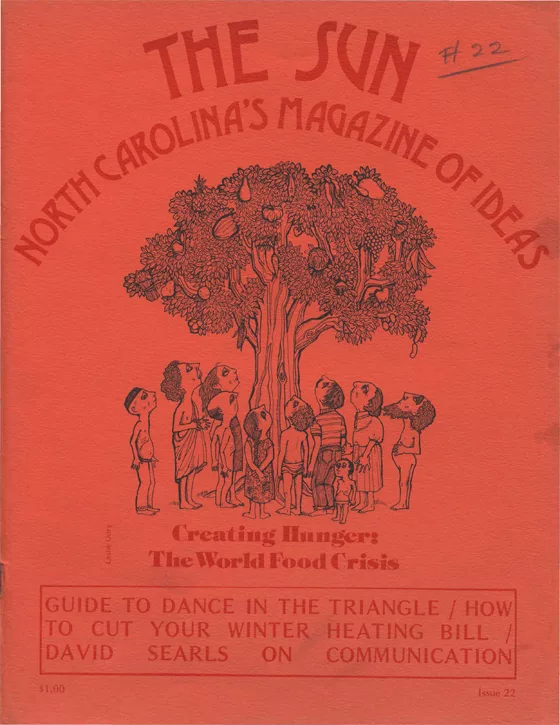
This article is adapted from a lecture given at Fayetteville State University on “Food Day” earlier this year. Cary Fowler is the junior author of Food First (written with Joe Collins and Frances Lappé, author of Diet for a Small Planet), to be published in April by Houghton-Mifflin and Ballantine Books. He is also the co-director of the Chapel Hill-based Agricultural Resources Center.
In 1974, Newsweek magazine stated that one-half of the world’s population was living in “perpetual hunger.” The president of the National Academy of Sciences, Philip Handler, estimated that 15 million people worldwide have died from starvation this century and that the death rate has now increased to 10,000 a week. Here at home, the Senate Select Committee on Nutrition and Human Needs has found that 40 million Americans are malnourished. Many are starving.
We have all become aware of the problem. The question is: How have we become aware? How has the world hunger problem been presented to us? Many Americans educated themselves about the “food crisis” by reading the headlines in the morning paper. What do the headlines tell us?
“Population Bomb & Food Shortage: World Losing Fight for Vital Balance” (New York Times, 8/14/74)
“World Food Crisis: Basic Ways of Life in Upheaval from Chronic Shortages” (New York Times, 11/5/74)
“Grain Exports Threaten Consumers” (New York Times, 8/17/74)
And then there are books such as Who Will Eat?, by Michael Allaby, and How to Be a Survivor, by Erlich and Harriman. We see advertisements from organizations concerned about the problem, such as the UNICEF ad that pictures a big juicy hamburger in full color and asks: “Can’t you spare a bite to save a life?”
If we listen to government spokespeople talk about the food crisis, we hear Earl Butz say, “We have always had hungry people in the world. I think the situation is tight and it’s serious, but it’s not a crisis.” On another day Secretary Butz explains the real problem: “For that part of the world’s population that goes to bed hungry most nights, can we make eating an exciting experience?” (Address before the Economic Club in Chicago, 12/9/75)
Finally, we hear people advocating Triage. They are saying, “Let’s get used to watching people die — moreover, let’s get used to deciding who’s going to die.” All for the good of the human race! (As if these decisions are not already being made.) Triage advocates are, as one person put it, offering novocaine for an uneasy soul.
The person exposed to such a barrage is likely to feel overwhelmed and confused. The headlines scare many people and threaten others. Advertisements that connect the bite you just took out of your hamburger with someone’s death will surely produce feelings of guilt. If you are overwhelmed, confused, scared, threatened and guilty, chances are you also feel helpless. The ultimate reaction — that of having no feeling at all — is only a short step away. If one feels helpless — or worse, has no feelings — then no action is possible. Only action, however, will help solve the problem that we all know exists.
Hunger is a process, not a statistic. If all were fed tonight, there would be millions of hungry people tomorrow and more the next day. Hunger is created.
I am sure I can numb you with more statistics or with images of dying babies with bloated bellies, but what would this accomplish? If it makes you feel despair, it will be counterproductive. Only through informed action will we begin to solve the problem of world hunger.
Hunger is a process, not a statistic. If all were fed tonight, there would be millions of hungry people tomorrow and more the next day. Hunger is created. It is a process.
Too Many People
“If there is a world food crisis, if there is too little food to go around, it must be because there are too many people. Overpopulation means less food for everyone.” This is a common view. It seems quite logical. But do the facts support it?
The world is now producing 700-750 pounds of grain a year for each person on the planet. This is more than the average Japanese consumes annually. A quick look at the United Nations’ Production Yearbook should be enough to convince anyone that the world produces enough food. In fact, in 1972-73, when there were famines in Africa and droughts and food shortages in many other places, the world was producing 8½ to 9% more food per person than it was in 1960, which is not a year we associate with famines.
The idea that the press of population on a fixed amount of food is the cause of the world hunger problem has no validity in a system that has the means to produce enough food for everyone, but the motivation to produce only for those who can pay. Can you actually think of a system that could be worse? Can you think of a system more efficient in denying food precisely to those most in need?
As long as food is bought and sold in a society with great income differences, the degree of hunger will tell us nothing about the density of population — only something about the maldistribution of wealth and power.
Scarcity is our economic system’s reaction to overproduction! Historically, U.S. farm programs have had to restrain the productive capacity of the American farmer. These cutbacks, which helped create scarcity, were designed to prevent overproduction that would flood the food markets and bring lower prices and lower profits. Another way to eliminate the possibility of overproduction of food is to grow more non-food crops and less food. Finally, we get much less protein from the meat we eat than we would if we ourselves consumed directly the grains fed to cattle. Grain-fed cattle are very inefficient converters of protein — but they do eliminate the possibility of grain surpluses.
The real scarcity is not of food, but of people who have the money to buy food or the means to grow their own food.
But perhaps, you say, there are particular places, particular countries where there are too many people for the land to support. Let’s see.
- Of the Seven Sahelian nations, only one has less arable land per capita than the United States. And the U.S. has five to ten times more per person than most western European countries.
- China has only one-half the cultivated land per person that India has.
- Japan has one-fourth the cultivated land per person that India has.
- Holland has a people-to-people land density twice that of one of the world’s most crowded countries, Bangladesh.
The crucial variables are neither land nor people. When overpopulation seems to be the cause of hunger, ask yourself these questions:
- Is growing food for local consumption a priority?
- What is grown? Food or non-food crops?
- For whom is the food grown? For people or for livestock, for local needs or foreign demands?
It is not a question so much of the quantity of land, but of the use that is made of the land. Not how much land, but who controls it.
People who worry about over-population seem to be more concerned with what might happen in the year 2000 than with what is happening right now. Virtually no one claims to know how to decrease the population growth rate. Even those who spend their days worrying about growth rate curves are baffled. Population programs are notorious failures the world over.
What then is accomplished by focusing on population, other than to place the blame for the poor’s condition on the poor themselves? (Even if we realize that the newborn Indian baby will consume only a fraction of what its American counterpart will.) By talking about “their” population “problems,” have we moved any closer to solving the food crisis? Have we moved any closer to seeing to it that today’s (or tomorrow’s) hungry are fed? Have we contributed to finding a solution or, by stirring up more confusion and feelings of helplessness, have we scared people into inaction?
The population issue too often distracts us from the facts. Even if Zero Population Growth were achieved, could the hungry under our present economic system expect to be any better fed than they are now? If those who spend their time talking about limiting population growth are really concerned about world hunger, let them address that question. Let them address it today, or let us ask them why they are not.
The Weather
In our research for the book, Food First, we have been able to find little correlation between weather and hunger.
The Chinese have kept meticulous records for centuries. We know that over the last 2,000 years they have had a flood or drought or both on the average of once a year. In many cases, these phenomena were followed by famines. Several are among the worst in history. Since 1949, however, there has been only one rather limited famine in China. In 1972 and 1973, when there were droughts, floods and famines in many parts of the world, China was also having a drought — its worst in three decades. But there was no famine.
A drought might “cause a famine” in the Sahel, but it is inconceivable that the same drought would “cause” a famine in Sweden or the United States. This should tell us that the problem is not so simply explained. Droughts and floods are natural phenomena — famines are social phenomena.
The question we need to learn to ask is: how well has society prepared itself to deal with the inevitability of bad weather?
The Gift Of Colonialism
If we want to find the causes of the world hunger problem, we do not look in the maternity ward or up at the sky. We look at society. We start with history.
Most poor countries were colonies twenty-five years ago. Their history has affected their present just as our own history has affected ours. Traditional agriculture was transformed by the colonizer. Cash crops grown for export were promoted. Land ownership patterns were changed. Communal lands became privately owned and small farmers lost control of their land.
The colonizers concentrated on one or two crops — there was nothing in it for them to promote diversified agriculture. Thus countries became dependent on these crops. Thus the “banana republics.”
“Development” promoted by colonialism was concentrated around the ocean ports where the export crops would be shipped to the mother country. Take a look at a map of Africa or South America. Notice that the commercial centers are coastal cities — the ports. If you would like to drive a car from Brazil to Peru, you are out of luck. Countries were underdeveloped internally. They were “developed” in a certain way to meet the needs of the colonizer, not the needs of the local people.
What has this meant to the countries, to their people and their agriculture? How has the colonial pattern of development affected their ability to feed themselves?
First and foremost, export agriculture has meant increased vulnerability. High prices for an export commodity one year often mean increased planting of that crop next year. If cocoa gets a good price this year, plantation owners will be encouraged to plant more next year. But cocoa plants take several years to mature. Who knows what the price will be then? Even if the price is high, who will benefit? Certainly very little of the increased profit will find its way to the plantation workers, or to the hungry poor or landless. Increased production of export commodities can actually result in more hunger. Land that could have been used to grow food will have been taken out of production to grow more cocoa for export.
The population issue too often distracts us from the facts. Even if Zero Population Growth were achieved, could the hungry under our present economic system expect to be any better fed than they are now?
Terms of trade have deteriorated for most products grown by the former colonies. For cocoa, coffee, cotton, jute, rubber, sisal and tea, there was no growth in export value between 1953 and 1972 according to the U.N. Conference on Trade and Development. In 1960, it took three tons of bananas to buy a tractor. In 1970, it took eleven tons to buy that same tractor. Two-thirds of the recent agricultural price increases have gone to the rich nations.
Export agriculture is a colonial legacy to the poor of the world. We have learned three things about it:
- People cannot eat food that is exported, nor can poor people eat export earnings. Good export prices, as we have seen, tend to threaten the position of subsistence farmers. Despite the fact that people cannot eat food that is exported, over one-half of the countries the United Nations says are most seriously affected by the food crisis depend on agricultural exports for 80% of their export earnings. Underdeveloped countries are now net exporters of corn, animal feedstuffs, oilseeds fish, live cattle, fresh fruit and nuts, and fresh and simply preserved vegetables!
- People cannot grow food for themselves to eat on land used for export crops.
- Relieving hunger comes from pursuing policies that allow people to grow food and to eat the food they grow.
Why does export agriculture continue? Because it serves the interests of agribusiness and local elites who are well-represented in governments throughout the world and are able to influence powerfully various national priorities and economic policies. Agribusiness and local elites are in a position to promote and profit from low wages, which many governments (including our own) have insured by blocking minimum wage laws for farm workers. Governments committed to protecting the export agriculture base of the economy can offer tax breaks and other incentives to large farmers and agribusiness corporations. Through credit schemes and regulations, government and private institutions can supply easy money to the “Big Boys” while denying desperately needed funds to the small farmer.
Even well-meaning governments are often forced to promote export agriculture as the only available means to repay their debts. Most of the United States’ foreign aid does not go to recipient governments as a gift, but as a loan. In fact, about half of all American “foreign aid” now goes to repay the interest on old foreign aid debts. Ironically, much foreign aid is designed to encourage export agriculture. Countries find themselves in the position of having to export food in order to repay loans that were supposed to enable people abroad to improve their agriculture and feed themselves.
Focusing On Production
Let us look at some solutions. The term “world food crisis” presupposes shortage. If people do not have enough food to eat, then of course, the problem is how to produce more food. That seems logical enough. But is it? The question you ask determines the answer you get. The question, “How can more food be produced?”, has been answered by the modernization of agriculture — the so-called “Green Revolution.” In seeking to produce more food, many people have thought it best to rely on technology.
Where has focusing on increasing production gotten us? Let’s look at the “solution” and see whether we asked the right question.
For many, the Green Revolution has become synonymous with the new “miracle seeds.” These are the seeds with “high yields.” But these seeds are not neutral. It may strike you as funny, but these seeds do not grow as well for the poor as they do for the rich! Why?
First, the new seeds need more “inputs” — more fertilizer, water, pesticides and land preparation. Also, the seeds are more sensitive to droughts and floods, so they often need elaborate and costly irrigation systems just to survive. Finally, the new seed varieties are more sensitive to pests and disease because they are necessarily genetically limited. A high-yielding variety of wheat developed in Mexico turned out to be highly susceptible to wheat rust when it was grown in Morocco. Rust is not a problem in Mexico, nor is it as much of a problem among local varieties of wheat that are genetically resistant to wheat rust in Morocco. The selective breeding process that goes into developing a high-yielding strain often breeds out genetic resistance to diseases or pests to which we never knew the plants were susceptible. This means that the new varieties are often more unpredictable than the local varieties.
For the most part, the Green Revolution has hurt the people it was purportedly meant to help. Small farmers have not benefited from the modernization of agriculture. Without the necessary inputs — which small farmers cannot afford — “high-yielding varieties” often yield less than traditional local varieties. Even if a small farmer were willing to go into debt to pay for the necessary supplies to support the plants, credit is often not available to small farmers. And even if credit were available, how could subsistence farmers justify going into debt for what would still be a more risky harvest?
Since only the rich can afford to take advantage of the new technology, the Green Revolution has actually widened regional and class disparities. “The rich get richer . . .” — not necessarily because they are better farmers, but only because they have the money or borrowing power to utilize the technology.
What then have been the effects? Modernization has made agriculture big business. It has strengthened the position of big farmers and thus aided in further excluding the poor from production — and from the benefits of production, food.
Land values have soared, making purchase of land by small farmers unlikely. Farm land prices have doubled in this country in the last ten years, and non-farmers now own a third of this land.
Modernizing agriculture has also aided in concentrating land holdings, by giving more power to the rich. Offered the possibility of reaping greater profits by expanding their landholdings, many rich farmers have done just that — expanded their holdings at the expense of the small farmer. In 1935, there were 6.8 million farms in the United States. Today, there are only 2.5 million. Three-quarters of all farm production is sold by one-fifth of the nation’s farms.
Here in North Carolina, the number of black farms has declined over 60%, and the acreage owned by these black farmers has been cut in half during the last twenty years. This makes the black farmer in North Carolina an “endangered species.” There are only 75,000 black farmers in the entire country. They own about six million acres, but they are losing land at the rate of a third of a million acres a year. Simple arithmetic should tell you when we could expect the black farmer to become extinct.
The focus on production and the resulting “modernization of agriculture” have also led to a great increase in landless laborers. In Mexico, between 1950 and 1960, the number of landless laborers increased from 2.3 million to 3.3 million. Back home in McLean County, Illinois, the nation’s number one corn producer and one of the top five soybean producing counties in the country, 70% of the farmers are tenants. (Forbes, 3/15/73)
The question is not “how can we get them to feed themselves?” How paternalistic! People will feed themselves unless they are prevented from doing so. The fact is that the poor of this world are engaged in feeding us and trying to feed themselves.
As the size of farms and profits have grown, laborers have been displaced by mechanization. This creates a very destructive cycle. Large farms often have to expand just to be able to use efficiently a certain piece of machinery. (For example, a tobacco harvester justifies itself economically only on 35 to 40 acres.) The very act of buying costly machinery often creates the need to expand the size of the farm even more to increase farm income in order to pay for the machine. Added size in turn justifies more machinery.
A World Bank study in the Indian Punjab found that farms grew 240% in size in the first three years after mechanization. (It might be noted that in India, 96% of all tractors sold go to the largest 4% of the farms.)
In Mexico, during the period of rapid mechanization, the average number of days worked by farm laborers fell from 194 to 100 per year.
But even if the Green Revolution has had some undesirable consequences, at least it has given us more food, you might reply. But has it? To be certain, we must ask, “Where has the increased production gone? Has the increased production meant more food for the people who need it (even though it has endangered the livelihoods of so many)?”
Some of the increased production is fed to livestock. About two-thirds of the Green Revolution varieties of rice in Colombia are going to livestock and breweries.
Some gets exported. Mexico is now exporting wheat despite the fact that 80% of its people are malnourished. Central America now exports between one-third and one-half of its meat to the United States.
Some of the increased production gets dumped — literally thrown away — because it does not meet certain beauty standards demanded by the agribusiness corporations.
What has the focus on production meant?
- It has meant modern agriculture in certain isolated areas among rich farmers.
- It has meant increased insecurity for the landless and the small farmers due to the loss of jobs and the loss of land.
- Finally, it has meant increased poverty. The latest data on income distribution in rural areas assembled by Keith Griffin shows conclusively that the gulf between rich and poor is widening.
The Green Revolution has been a revolution not so much in technology as in who controls agriculture. Our study has taught us a few lessons:
- Exclusion from production means exclusion from consumption.
- The introduction of technology into a society with great economic differences exacerbates those differences.
- The poor are now less able to feed themselves, precisely because their control over their own lives has diminished.
Focusing on how to increase production must now be seen as a step backwards. It was not the right question. The food crisis exists, after all, because many people do not get enough food to eat. If we want to solve this problem, we must see to it that any increased production of food will not affect the hungry. In fact, the way in which production is increased can just create more hungry people.
Agribusiness: Part Of The Solution Or Part Of The Problem?
Where else can we look for solutions to the food crisis? Do the poor need agribusiness? Can we count on General Mills and John Deere to save us?
Sagging domestic markets and the growing dependency of corporations on foreign markets means that corporations need underdeveloped countries more than those countries need corporations. Corporations depend on poor countries primarily as a source of cheap raw materials.
Agribusiness corporations are now busily transferring production abroad. Castel and Cooke, Inc. is typical. You might think that Dole pineapple comes from the Dole Pineapple Company. Actually, it comes from Castle and Cooke, a large food conglomerate. You might also think that the pineapple comes from Hawaii. You would have been correct about this until recently. But Castle and Cooke reduced its Hawaii division and transferred pineapple production to the “lower cost” Philippine and Thailand operations. (C & C 1975 annual report)
The U.S. Tariff Commission found that Del Monte and Dole (Castle & Cooke) “market the imported product at the same price that they ask for their domestically canned pineapple.” This, despite the fact that the foreign produced pineapple costs the corporations less to produce.
Who gains from such actions? Do U.S. consumers gain? No, they pay just as much for the imported pineapple as for the domestically produced pineapple.
Do U.S. farmers gain? No. Probably some farm laborers were thrown out of work by the corporations transferring production abroad.
Do Thai and Philippine consumers gain? No, they do not get to eat the pineapple — it is exported. Furthermore, producing pineapple for export means that less land is growing food for local consumption — this fuels local food cost inflation.
Do Thai and Philippine farmers gain? I doubt it. Probably some of them lost their land when the corporations came in and established their plantations.
Who does gain? Only the corporations with their higher profits.
It is clear that corporations need underdeveloped countries as sources of cheap raw materials (cheap because they are created by cheap labor). Earlier, it was noted that corporations are moving production abroad — many are now beginning to produce vegetables in Mexico for export to the United States. Mexican soil and labor are already supplying one-half to two-thirds of the U.S. winter and early spring market for many vegetables. This includes, on a yearly basis, 95 million pounds of onions, 20 million pounds of eggplant, 36 million pounds of squash and 142 million pounds of strawberries.
Since 1966, there has been a seven-fold increase in cut-flower imports into the U.S. — 90% has come from Latin America.
Between 1964 and 1972, the volume of fresh fruit and vegetable imports from Central America rose thirteen-fold. Now corporations are going into the production of non-traditional vegetables, threatening to turn some of these countries into cucumber republics! All of this thanks to agribusiness.
In 1975, Costa Rica (population: 2 million) exported 60 million pounds of beef to the U.S. Had the beef stayed in Costa Rica, per capita consumption could have doubled. Instead, it fell from 49 pounds in 1950 to 33 pounds in 1970-71. At that, per capita figures are misleading, because some people are undoubtedly eating 66 pounds while others are eating none. It has been estimated that one-half of the children in Costa Rica suffer brain damage from malnutrition. One side-effect of the multinational corporations’ focus on beef production for export has been a decline in the domestic dairy production and an accompanying rise in the price of milk.
At least you might think that local farmers have made good in this big international food market. But not exactly. The big winners have mainly been the big corporations like United Brands and even Volkswagen. As one Volkswagen executive remarked, “You get a lot more for a pound of sirloin than a pound of Beetle in Tokyo.” This should give you an idea of why people are hungry in Central America.
In Brazil (the world’s largest exporter of orange juice), Coca-Cola takes 97.5% of the orange juice and exports it to the U.S. to make Minute Maid orange juice. The Brazilians are left with Coke’s Fanta Orange Drink, which contains no orange juice — hardly the “real thing!”
But what about markets? Are poor countries needed as markets? By definition, poor people are poor markets. The average Mexican rural worker earns about $60 a year. This hardly makes him or her a very valuable customer. Instead, the people of underdeveloped countries are too often vulnerable, exploited customers of the multinational corporations.
In Brazil (the world’s largest exporter of orange juice), Coca-Cola takes 97.5% of the orange juice and exports it to the U.S. to make Minute Maid orange juice. The Brazilians are left with Coke’s Fanta Orange Drink, which contains no orange juice — hardly the “real thing!”
This is the type of product for which a market can be created in underdeveloped countries. It is a low cost, high profit item. Advertising is designed to give the product great status and thus create a “need.”
Much of the advertising of soft drink firms is aimed at the young. In Brazil, Pepsi changed its pitch to suit the needs of the Brazilian market. The “Pepsi Generation” became the “Pepsi Revolution.” The head of Pepsi’s million-dollar advertisement agency account in Brazil explained the choice:
“In this country the young don’t have protest channels; the present generation didn’t receive any political or social education. So we provide them with a mechanism for protest. It is protest through consumption; the teenager changes from the old-fashioned Coca-Cola and adopts Pepsi, the Pepsi with a young and new image, and he is happy, because he is young and young people drink Pepsi.”
The advertising campaigns have been remarkably successful. Dr. Anne Dias of the Nutrition Institute in Rio de Janeiro surveyed six-to-fourteen-year-old children and found that all but the poorest were drinking one to two bottles daily. Children from rich families had vitamin deficiencies. Middle-class children had vitamin and protein deficiencies. And the poor children had caloric, vitamin and protein deficiencies.
In Ndola, Zambia, 54% of the seriously malnourished children admitted to Children’s Hospital have “Fanta Baby” written on charts at the foot of their beds. The tragedy is that mothers are convinced by the powerful advertisements that rich, healthy, happy people drink Fanta. So they naturally want to spend what little money they have to give their children, even the babies, the “best things in life.” But it is a tragic mistake. Apparently Zambia has now banned Fanta ads — but not Fanta itself.
The harm done by the soft drink corporations does not hold a candle to what can only be called the genocidal practice of exporting baby formulas to the poor in Africa. Coming into the 1970’s, baby food processors faced a decline in the domestic population growth rate and an increase abroad. Abbott Labs, for instance, recently reported that its domestic sales were up 9% and its foreign sales were up 32%.
Breast milk is the perfect formula for babies. It is warm. It is sterile. It is a proven formula (its protein content of 1.3% is just right for a baby’s kidneys — cow’s milk contains 3.5% protein). And it is free — a significant quality for poor families.
The Protein Advisory Group of the United Nations calculated the cost of feeding a six-month-old baby on bottled formula. They found that, in Britain, it took 3.3% of the family’s income. In Peru, it took 23% of the family’s income. In Tanzania, it took 32%. It took 47% in Nigeria and 62% in Pakistan.
How can the poor afford bottled formula? They cannot, so they dilute it.
A study in Barbados found that 82% of the mothers were diluting the formula. In 1969, they were making a 4-day can last anywhere from 5 days to 3 weeks. At this rate a child loses weight rapidly and becomes more susceptible to infection that can result from an unsterilized bottle. Poor families, you see, often have neither good drinking water nor a modern Betty Crocker kitchen in which to sterilize the bottle and properly prepare the formula. Many parents are unable to read the instructions on a tin of baby formula. The Protein Advisory Group at the U.N. stated in one of its reports, “In many instances, placing an infant on a bottle is tantamount to signing the death certificate of the child.” (New York Times, 4/6/76)
Nonetheless, the corporations continue to direct their advertising at the poor. And they are getting phenomenal results. In 1972 (according to the U.N.’s Yearbook of International Trade Statistics — the most complete collection of data available), baby food exports to Niger increased 14,881%. In one year! Niger, you will recall, is one of the Sahelian countries hard hit by famine — one of the poorest countries in the world. Brookings Institution nutritionist Alan Berg has estimated that underdeveloped countries using baby formula imports have suffered economic losses in the billions of dollars.
Nobody knows how many lives have been lost. But a hospital survey in Freetown, Sierra Leone, found that 713 of 717 babies admitted for malnutrition had been fed bottled formula. In rural Chile, deaths of children under three months old are three times more frequent among babies who have been bottle-fed than among breast-fed babies.
This situation shows us the willingness of firms to seek out the most vulnerable populations, distort genuinely positive aspirations of people (their desire to do what is best for their children), and even destroy life, if necessary, for their own profit-making ends.
What does this add up to? First, it adds up to greater and greater control of our food supplies by fewer and fewer corporations. By exporting a system of concentrated wealth and power to underdeveloped countries, agribusiness is building on the Green Revolution model that has been such a serious constraint on production.
Second, it means lower quality, higher priced food, because that is what is profitable. You can buy potato chips full of additives for a couple of bucks a pound, or you can buy the real thing (potatoes) at a fraction of that cost. If you watched TV yesterday, chances are you saw a commercial for some brand of potato chips. When was the last time you saw a TV commercial for potatoes? You have probably never seen one. Though they are far more nutritious, plain old potatoes are far less profitable.
Third, agribusiness gives us distorted land use here and abroad. Land is not used to grow what is nutritionally needed for people, but what is economically needed by the corporations. As the U.S. becomes more dependent on imports, it will become more dependent on distorted land use in underdeveloped countries — land use that is preventing people from growing food for themselves, land use necessarily supported by corrupt governments. The U.S. government will thus become more and more interested in supporting governments that would allow this to happen. More interested than it is now!
Finally, this situation will help foster a U.S. foreign policy designed to repress the efforts of people to reorder their own societies.
Agribusiness cannot afford not to be successful — therefore it cannot afford to help the poor. Agribusiness’s expertise is not in solving the food crisis (there is no profit there) — it is in servicing the global supermarket or dinner table. The way they do it often determines who sits down to eat and who serves. Where does this leave us?
Food First!
Amidst greater concentration of land and resources in the hands of a few, amidst rising food costs, declining quality and even questionable availability, self-reliance is called for. Self-reliance for “them” and self-reliance for “us.” Without self-reliance or self-sufficiency, the powerful are free to manipulate the poor. Self-reliance and self-sufficiency do not imply (and certainly do not necessitate) living at a bare subsistence level. The terms are not synonymous. Self-reliance does imply being free of others for your basic needs on a national or regional level.
It means that poor countries should develop their agriculture towards the end of feeding their own people and not count on agribusiness to do the job. It means counting on your own resources rather than loans or gifts from other countries — countries that can decide to withdraw their support at a critical time to exact some political advantage.
The question is not “How can we get them to feed themselves?” How paternalistic! People will feed themselves unless they are prevented from doing so. The fact is that the poor of this world are engaged in feeding us and trying to feed themselves.
Control over production and self-reliance are the keys to the solution. Only when the hungry control production can they be assured that food is on the way to the people who really need it. This is what we call, “Food First.” For everyone, food must come first.
What are the steps towards “Food First”?
- To begin in a new direction, we have to stop going in the wrong direction — this is a necessary, positive first step.
- Poor countries need to stop exporting food until the needs of their own people have been met. Then they can use exports to complement their economy which will be based on meeting the needs of their citizens.
- Land use should be based on nutritional output considerations and not on profit considerations.
- Naturally, a domestic market for food needs to be created.
- Rural industry should be created that reflects the needs of a self-reliant, labor-intensive agriculture.
- The commitment to making food come first should signal a revitalization of rural areas in health, educational and cultural fields to help decrease rural-urban disparities.
For the most part, the Green Revolution has hurt the people it was purportedly meant to help. Small farmers have not benefited from the modernization of agriculture. . . . The Green Revolution has been a revolution not so much in technology as in who controls agriculture.
As countries pursue food first policies, they will need to avoid several pitfalls. And we will need to avoid them too! We all should avoid the tendency to see development as a question of government resource allocation and government projects. Foreign aid programs and governments set up model programs. By their very nature these programs establish a few isolated showcases, while the majority of the people are left even further behind. The problem will not be solved by a few showcases.
We should avoid seeing the solution to the problem as a technical problem. It is social, political, and economic.
We must avoid thinking that development is possible from the top down in a highly stratified social system. True development does not come on top of social and economic inequalities — it replaces them.
So what do we do? First, we realize how our own thoughts about the problem have been shaped by a society that has the potential to feed a quarter of the world’s population and yet leaves 40 million at home hungry. (This should be a powerful reason to examine our own thinking. It should also be a strong reason to question whether we have any solutions to offer the poor world.)
We are taught to be threatened by all revolutions while the term “military coup” evokes warm, comfortable feelings. We learn not to identify with the peasant, but to identify with the rich with whom we supposedly share some unnamed philosophical orientation to life.
The hungry thus become a threat to our political stability or even our own food supply. We feel like guarding our dinner plates against the hungry. This obscures the fact that they are our natural allies, for we are all victims of the concentration of power and wealth and of a system that channels the profits from the hands of many into the pockets of a few.
In every society, choices are made about who gets to eat. Will it be everyone or just some? Who will make those choices? We need to know.
As long as governments and corporations are part of the problem, we must work to expose their activities. We must expose things like the baby food scandal and the Russian grain deal. We must publicize U.S. military sales which help keep people down. We must expose that part of food aid which simply helps repressive societies cover up and avoid their real problems. And, of course, we must always monitor U.S. Department of Agriculture policies. Any small farmer still alive today will tell you that.
We must engage in legislative battles if only to educate people. I would favor outlawing imports of food from any country with visible malnutrition. Government support of corporations through the Agency for International Development and the USDA should be outlawed. And certainly the export of pesticides banned here should be made illegal. DDT is banned here, but that does not stop the U.S. from being the world’s largest exporter of it.
The government should require all products to display prominently the name of the corporation owning the brand line. This would dispel the myth that we have a competitive food industry. It would tell us when we go to the ice cream counter, for instance, that Breyers, Sealtest and Light ’n’ Lively ice creams are not made by three different companies but by one, Kraftco.
What can you do?
- You could study local agribusiness. You could keep tabs on how much labor the tobacco harvester is eliminating. A USDA report tells us that mechanizing tobacco production will eliminate over 200,000 jobs and that the tobacco harvester will cost individual counties between 200 and 700 jobs depending on how much tobacco is grown.
- Perhaps you could form a group to counter the mass media’s interpretation of the problem.
- You could organize a food co-op and support direct farm-to-consumer networks of your own creation in order to bypass middlemen, provide yourselves with cheaper food and help keep small farmers in business.
- At the most basic level, you could begin to eat in a way that reflects the needs of your body and not the needs of the corporations.
We must realize that the task of bringing self-sufficiency (which is essentially freedom and independence) to ourselves and everyone else will not be easy. It is a long process. We may not see the end of what we begin, but that only means we cannot waste time in beginning.
“Food First!” implies a commitment to challenge the basic notions of our economy that the welfare of all is served when society’s benefits go to a few.
Food is the most necessary of necessities, so it is appropriate that we begin to make this basic need a basic right of all peoples — not through government guarantees of more food stamps or price controls or more regulations, but by a restructuring and a reconstructing of society, so that control and power (the only perfect insurance policy) are put into the hands of each citizen to be used constructively, not for private gain but for the advancement of all.