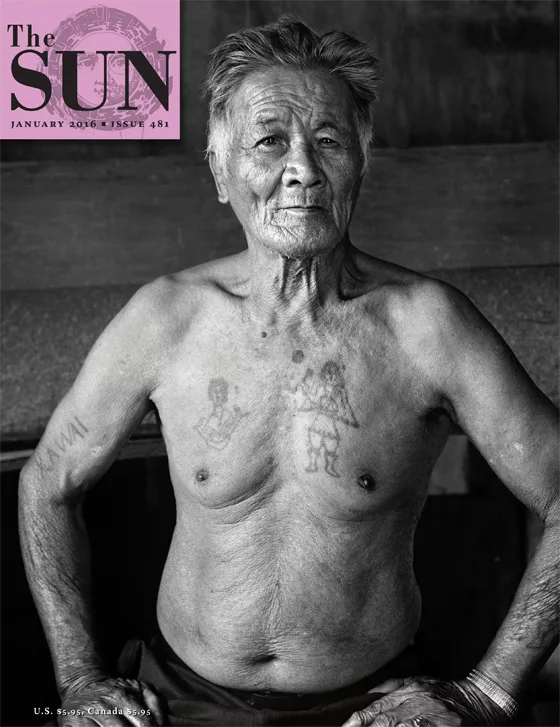
For the past decade, David Romtvedt has worked on his father-in-law’s ranch, forty miles southeast of the Bighorn Mountains and the town of Buffalo, Wyoming. Much of the work revolves around the nineteen windmills that are used to bring water to the dry surface. On the ranch, it is these windmills that allow life to continue.
— Ed.
Coming out of children’s story hour at the library with my daughter, Caitlin, one morning, I stopped to speak with Sally Gordon, who had a ranch seven miles east of town on Clear Creek. As usual, I’d felt a little odd at story hour because I’d been the only man there. The mothers always welcomed my presence, but also seemed to wonder how it was that a man could be at the library at ten in the morning: didn’t I have any work I should be doing? But Sally and her husband, Mark, also took turns bringing the kids to story hour, and we were drawn together by this, and by the fact that our daughters were the same age.
Although we were friends, Sally and I held very different political views, and on this morning we ended up in a terrible argument. Sally accused me of criticizing our government while at the same time being a “parasite” of it. She reminded me that much of my income came from the state arts and humanities councils — public agencies funded by tax dollars — and said that as long as I accepted taxpayers’ money I had no right to criticize. In my defense, I pointed to my involvement in social causes, in peace and environmental groups, but this was just more fuel for her fire.
“Anyway,” she concluded, “I don’t see you doing anything now. You just sit in your house or out in that old sheep wagon doing nothing.”
By “doing nothing” she meant writing. And since it didn’t earn me much money, she assumed it wasn’t even very good writing.
I was stung, and found it hard to defend myself. I could have mentioned that my wife and I shared child-rearing duties and household chores, but Sally knew this and had often dismissed it as not being “real work.” I could have mentioned the upkeep I did on the windmills at my father-in-law Simon’s ranch, but, not wanting to risk hearing that work dismissed, too, I remained silent. Sally and I parted, both shaken by our conversation.
At home, I sat there, unable to do anything, fearing that Sally was in some ways correct. I did think the government was corrupt, so perhaps I was corrupted by working for government agencies. But who among us isn’t tainted by some association with the government? Just how separate from that government can any of us be? Ranchers — Sally included — have long lived on government subsidies, both openly stated and disguised: federal disaster relief, commodity price supports, federal grazing fees set considerably below market value, bargain leases on land from the Bureau of Land Management and the Forest Service.
In our part of Wyoming, the surface of the earth is usually owned by the rancher while the subsurface is owned by the federal government. The government leases its subsurface rights to private corporations, which extract whatever is considered valuable. The ranchers have no say regarding subsurface activity, but receive cash payments for damage done to the surface by roads, pump stations, and drilling rigs. When it’s all over and the checks are cashed, the ranchers still say the government should just get off their backs.
I do not mean to suggest that, because of these subsidies, ranchers are somehow less than hard-working. They work very hard indeed. I know this from personal experience and from seeing Sally and Mark at work on their ranch. And I know that, if all farm and ranch subsidies were abolished tomorrow, many ranches here would go bankrupt and be bought by corporations. Already this is happening. Every time I stop in at the Feed Supply or the Farm and Ranch Co-op or the Busy Bee Diner, I hear stories of another ranch gone under, another piece of land bought by a corporation, another rancher hired by that corporation to manage the land that was once his or her own. Ranchers who turn down such deals often end up becoming real-estate agents, reluctantly helping to move more ranches into the hands of corporations and developers.
I spent all day thinking about my own acquiescence to the government, about the future of ranching, about the kind of life we lead here in the least-populated state in the union. In the end, I had no idea who was a parasite and who wasn’t. I just knew that no matter how hard a family works to keep a ranch or a farm alive, a market without regulations and subsidies will kill it.
This is nothing new: two generations ago, my wife’s maternal grandfather, Poppie, emigrated with his parents from Russia to Wyoming. They settled along Clear Creek and began working in the sugar-beet fields there. The beets were sold to a mill about thirty-five miles away, in Sheridan. When Poppie grew up, he had his own fields of sugar beets. The business never made him rich, but he got by. Then the Sheridan mill closed and the beets had to be delivered to Billings, Montana, 175 miles away. Poppie and the other small farmers couldn’t afford to transport their crops to Billings, and soon there were no sugar-beet fields along Clear Creek.
My argument with Sally put me in mind of other social issues — in particular, the homeless. There are very few homeless people here in Buffalo, and if any show up, the local police escort them quickly out of town, dropping them at the freeway onramp and “asking” them not to return. The local churches, too, sometimes “help” homeless people to move along. And then there’s winter, which encourages all of us here to either move indoors or head south.
But throughout the summer, homeless men appear on the streets. Some are well-scrubbed and tidy, with clean shaves and hair wet-combed into place. Others have bloodshot eyes and unshaven chins and perhaps a little blood caked at the corners of their mouths. Their knuckles are swollen, noses fractured, shoes cracked, trousers shiny.
Anyone walking down the hill into town passes by our house. Sometimes, when I am watering the flowers or mowing the lawn or wondering if I can possibly plant another tree in my already tree-laden yard, a man approaches and asks where he might pass the night. I am ashamed to say I don’t invite these men to stay in my house. But I do give them a little money — not enough to change their lives or mine, but enough for them to buy something to eat or drink, and enough to make me feel better.
My city friends chide me for giving money to street people. “It just perpetuates their poverty,” they say. They tell me I should give the money to a social-service agency that will provide free meals or temporary shelter to the homeless. This way I can be sure the money will be usefully spent. But I don’t want to determine what a homeless man does with the few dollars I give him. Maybe the money goes for a pack of cigarettes or a bottle of wine: so what? Regardless of how it is spent, my “contribution” won’t solve the problem.
One day, a man walked up and down Main Street carrying a hand-lettered sign that read, “Face of the Homeless.” The man wore blue sweat pants, running shoes, a rumpled nylon jacket, and a CAT hat. He sat down on the curb in front of Seney’s Drugstore and let his head fall forward onto his chest. Within moments, our two policemen and a sheriff’s deputy approached him, but, inexplicably, they left without forcing him to move on. As they walked away, the man with the sign looked up and smiled.
Inside Seney’s there’s a soda fountain where the locals gather to drink coffee and gossip. I sometimes buy my daughter an ice-cream cone there. As the old ranchers and retired shopkeepers walked into Seney’s that day, some of the ranchers nodded to the man with his “Face of the Homeless” sign: a familiar, curt nod, neither judgmental nor intimate; just an acknowledgment, a recognition granted a member of the clan. Others passed the man without speaking or nodding or even looking at him. For them the man was invisible. He commanded no more respect or attention than a dead crow.
The night after my argument with Sally, I dreamed that Simon had taken Caitlin and me to visit Fidel Castro in Cuba. Fidel was a very old man on his deathbed, alone in a locked room. To enter the room we had to ring three bells: one for Fidel the father; one for Fidel the brother; and the third for Fidel the leader of the Revolution. Then Fidel buzzed three times for us to enter. I walked into the room nervously, but Caitlin went straight to Fidel and climbed into his bed, snuggling up against his face. His beard was long and disheveled, as if no one was caring for him. He wore hospital pajamas, but on his head was his familiar green fatigue hat. Fidel smiled at Caitlin and asked if she’d ever seen the volcano in Hawaii.
“I’ve never been to Hawaii,” Caitlin said.
“Oh, then you must go,” Fidel told her. “Hawaii is very beautiful, and the volcano is an unbelievable sight.”
When I awoke, I wondered why Simon would take us to see Fidel Castro; Simon is a conservative Wyoming rancher, a lifelong member of the Republican Party, and a strong believer in the sanctity of the individual. But I thought I knew why Fidel had told us we should go to Hawaii to see the volcano. Hawaii, to me, represented a wilderness turned capitalist playground. And the volcano was an explosion.
Over the course of his long life, my wife’s grandfather Poppie has spent a great deal of time dying. In his midforties, he was diagnosed with stomach cancer and given a few months to live. Now he’s approaching ninety. But Poppie can’t cheat Death forever.
Poppie’s son died of leukemia at age three. It was common in those days for ranchers and farmers to spread DDT powder around their doorways to keep insects out of the house. Poppie and Grandmom have always wondered whether DDT caused their son’s death.
Poppie had a neighbor there on Clear Creek whose son had drowned in an irrigation ditch. After the child’s death, the mother would go out every night with a lantern to look for his body. Local authorities had found the body and lifted it from the water, but the child’s mother had said, “That is not my son.” So each night she would continue her solitary search, the lantern light shining in the fields along the creek.
Poppie’s daughter Dollie, now a woman in her midsixties, has been going to see Poppie in the hospital every day this week, sometimes twice or even three times a day. She sits by her father’s bed, and Poppie tells her stories of his childhood in Russia and of his own father, who was an adventurer of sorts and traveled by himself across Siberia. Somehow the other day, Poppie and Dollie got to talking about the woman with the lantern. First Poppie began to cry, then Dollie. They cried for the son who’d died so many years ago, and for the mother with the lantern, who Poppie said is still walking the dark fields, searching.
Later, I sat in Poppie’s hospital room while he slept. His hands and arms quivered at odd intervals. Every few minutes he would seem to awaken and search about for something. “Do you want this?” I asked, handing him the nurse-call box. Poppie gave me a quizzical look, let the plastic box fall back to the bed, and was immediately asleep again.
Once, he sat upright and said, “You’d think they could do something about the damned noise.”
The room was quiet. There was little activity outside in the hall. The only noise was the wheezing of the oxygen machine and a bubbling gasp as the air passed through a bottle of sterile liquid on its way to Poppie’s nose. The doctors had told me that this sound seemed to Poppie a cacophonous rumbling, because it was magnified by the tubing that ran into his body. There was no way to give him the oxygen without the noise, but the noise was driving Poppie crazy. Once, he looked up at me and said only, “It’s a hell of a thing.”
If you work even for a little while on a ranch, you run up against a lot of death. At shearing time last year, one of the dogs, whose job it was to move the sheep slowly from the holding pen to the shearing shed, started working the sheep too fast. Soon the animals were hysterical. A ram took off at full speed across the pen — so fast that when he reached the fence, he couldn’t turn, and slammed into the rails, snapping his neck. It took him a long time to die. Meanwhile, the shearing went on. At the end of the day, the dead ram was sheared, too. It’s much harder to shear a dead sheep than a live one.
Last week, I found two dead raccoons. Someone had thrown them over the cliff into the ranch dump, and a wild animal had dragged their carcasses back out and torn them to pieces. Bits of fur were strewn all around, organs pulled out, limbs ripped off, and splintered bones scattered fifteen feet away.
Another time, I saw a golden eagle flapping ponderously away from a mangled, partially eaten lamb. It was unclear whether the eagle had killed the lamb or had simply come upon it already dead. A group of sheep stood placidly around the dead lamb. One of them was the lamb’s mother.
One summer day, Simon and I pulled down a windmill that hadn’t pumped in more than ten years, and whose water had always been bad; the sheep wouldn’t drink it if there was any other water around. We lifted the head off, then raised the tower into the air, unbolted its legs, and laid it down on the flatbed trailer. Though lightning kept us from finishing the job, before leaving we shoveled a foot of sand out of the stock tank so that we would be able to lift it when we came back. As we shoveled, my kids, Matthew and Caitlin, found three swifts — a kind of lizard — and captured them. “Can we keep them?” they begged. I reluctantly said they could — for a little while, to watch and learn from. The kids whooped and put the three swifts into an empty cardboard container.
When we got home, one of the swifts was dead, and the other two wouldn’t come out of the box. We had to force them into the aquarium we’d fixed up with sand and rocks and a little cardboard cave. The kids wanted to hold the swifts all the time. I worried that the remaining two would die of fear.
But these swifts survived, and two weeks later, when we went back to clean up the area where the windmill had been, we released them. The swifts crouched motionless for several minutes, looked around, then ran like hell. Later, when we lifted the rusted-out metal stock tank, we discovered a colony of mice underneath. The mice scurried every which way, running for their lives as Simon stomped on them with his heavy boots.
A neighbor recently surprised me as I weeded my garden. I was caught up in my work when suddenly I heard a voice say, “Out encouraging one life form at the expense of another, eh?”
It’s true, we favor some creatures over others, just as we like to think we are God’s favored ones.
This week my friend Sally was killed. She was jogging west toward town on the left side of the road, facing the eastbound traffic. Her dog, Jasper, was running with her. Also traveling west was a seventeen-year-old boy in a pickup. I don’t know what happened inside the pickup, but somehow it swerved across both lanes and ran onto the far shoulder, where it bounced off three poles marking the edge of the right of way and hit Sally and Jasper from behind.
Officials said both Sally and the dog were killed instantly. Mercifully so, we told ourselves, hoping Sally had died without pain. But the idea that one could be suddenly struck down in the prime of life was appalling.
When the pickup slammed into Sally’s back, I wonder, was there a moment in which she realized what had happened? Did she remember her entire life? Did she regret not being able to say goodbye to her daughters and her husband? I cannot picture Sally’s last moments. When I try, a shudder passes through me.
A few days before her death, Sally and her family were riding in their VW van, the girls seated all the way in back. When they got home, Sally went to open the rear hatch and discovered it had been unlatched the entire time. Had the girls leaned back, they would have rolled out onto the highway and likely been killed. Sometimes I imagine that Sally realized Death had been cheated that night and would soon return, so she sacrificed herself in place of her girls.
Sally was a classically trained pianist, and had given her last performance about a month before her death. In winter Sally would rise early to feed the cows, spreading hay and grain pellets in the first, frozen light. Afterward, she would go in and play piano as the snow drifted outside. She once wrote to a friend how exhilarating this was, how absolutely grand life was to include both playing the piano and feeding cows.
I think I understand how she felt. I am amazed to think that my own life includes writing poems and repairing windmills. It is as if I have two lives that have mysteriously become one.
Work on a windmill is always the same — the same sticks and pipes and rods, the same oil changes and fan blades and check valves. Yet the mills seem endlessly varied and complex. As the years go by, each windmill is modified by design or necessity: Parts shear off and new parts are fabricated. Shafts bend or give way and are replaced by others that are not quite right but will do. A stick is replaced with a chain. The ground erodes around the base of a tower, so its footings are dug up and the tower replanted in cement. Eventually, each windmill comes to have a kind of individual personality and style. Each pulls water out of the ground at a different rate, and the water that comes up is slightly different at each well.
Finally, when we have replaced or repaired everything we can think to replace or repair, and the polish rod is connected to the pump rod, and the wind blows, and water comes out of the ground, I feel new. It seems as if water is coming up from the earth for the first time, and I drink like a man dying of thirst.
Simon has told me again and again about the days when water ran in the creekbeds and draws, and the reservoirs were full. “We brought the sheep here because we thought there would always be enough water for them,” he says.
Already we have drained much of the Oglala Aquifer, a huge subterranean body of water that underlies the Great Plains up to the eastern edge of the Rockies, spanning Nebraska, the Dakotas, and Wyoming. There are vast oceans underground, and their tides beat ceaselessly in and out, just as in the oceans on the surface. As these tides move, the water that once filled our creeks and draws is pulled into the ground, migrating down and away into the earth’s dark interior, where it struggles to refill the Oglala. I believe that, one day, the water will return, and we’ll see it rushing along under the cottonwood limbs, the bright Wyoming sunlight tumbling down through the leaves and dappling its surface. Even now, as I stand atop a windmill, I can see this.
At about four in the afternoon on Tuesday, Poppie pulled the oxygen line out of his nose. He hadn’t eaten for days, and had been living on a few sips of beer and water. His breathing had slowed, and his eyes had grown increasingly distant, as if he were already far from us. For the last few days he’d been periodically stretching his arms high above his head one at a time, as if reaching for some invisible handhold. About suppertime he quit breathing.
The day before, my father-in-law’s 102-year-old mother had entered the hospital. And on Thursday morning, her four children surrounding her, Amatchi called out, in Basque, “Come here!” The children leaned in close, and she died.
The list grows long. Many friends’ names are on it. Three Sundays ago, Kathy, whom I’d worked with for four years, suffered a stroke and died in her late forties. Around the same time, Walter, the father of a friend, woke up with a little stomach pain and by evening was in a coma; he died a week later. In the Wind River Mountains, Ken was killed in a climbing accident. And finally, Elliott, a musician, died in Arizona this morning. How much pleasure his fiddle gave! I picture Sally, Walter, Amatchi, Poppie, Kathy, and Ken crowding around Elliott, dancing polkas and mazurkas all night to his high, rolling harmonies.
There is a Spanish word, duende, that I take to mean the attitude of being fully alive while simultaneously being fully aware of death. The windmills and water offer this feeling to me. So do the turning seasons. With each change, I am reminded of what came before, and of what is coming. The dead are brought back to me, as I move closer to them.
This year we had our first snowfall on September 13. The next morning, the cosmos in the garden were curled in on themselves, their leaves blackened. Among the soft, spongy vines were twelve large cucumbers I’d missed harvesting, knobbly and green, almost spiny. Nearby, I spotted six large acorn squash — my favorite of the winter vegetables — their deep orange flesh smooth and thick. And last I found, miraculously protected by towering lettuce plants that had gone to seed, a large stand of basil.
I quickly cut the basil, astounded that it was still usable after the freeze. Then I carried all the unexpected bounty inside, setting it down on the kitchen counter. The room fairly vibrated with the smell of basil, an odor so rich it made the air shimmer. I would wash and chop the leaves, dry some, freeze others, and grind up the rest right away to make pesto. But first I sat down and looked at the foods we’d eat in the days to come.
“Alive in the Dying” is excerpted from Romtvedt’ s book Windmill: Essays from Four Mile Ranch. © 1997 by David Romtvedt. It appears here by permission of Red Crane Books of Santa Fe, New Mexico.