A Book That Changed Me
In 1975 I lived in Gainesville, Florida. Two years before, I had flunked out of Cornell University. A hitchhiking trip had led me to this Southern college town, where I roomed with Sharon, a photographer who enjoyed lying in hammocks. We lived at the edge of the black ghetto, in a dusty house with only yellow light bulbs. Above the dinner table was an abstract painting of writhing gray shapes. The living-room ceiling was hidden by a parachute. I worked part time at Mother Earth, a natural-foods store, where I bagged raisins and lecithin. I found I could live on very little money. (According to the Social Security Administration, my total earnings for 1975 were $1,455.) My rent was $45 a month.
I never read the newspaper when I lived in Florida. (Looking back, I cannot remember the Gerald Ford presidency.) Instead, I walked through town, talked to my friends — who had names like “Coyote” and “Jiivatma” — and meditated twice a day. I never wore underwear or watched TV. I cooked millet and lentils in a pot, and sometimes baked lumpy bread. If there was a party, I went and danced to Stevie Wonder and Fleetwood Mac. I bicycled home, beneath broad live oaks dangling fronds of Spanish moss.
One day I found two paperback books in a garbage can: Cherry Boy and The Sound and the Fury. I read them both. Cherry Boy was a book of gay pornography. The Sound and the Fury was by William Faulkner. I had never read a novel like it. Faulkner had created a kind of centrifuge for the mind: “. . . if people could only change one another forever that way merge like a flame swirling up for an instant then blown cleanly out along the cool eternal dark instead of lying there trying not to think of the swing until all cedars came to have that vivid dead smell of perfume . . .” The main character went to Harvard and hated it, just as I had despised Cornell.
Before that, I had thought all serious books were intentionally dull. I never knew one could enjoy literature — real literature, not just comic books and Carlos Castaneda. Suddenly I knew I would not be an ordinary hippie; I would be an intellectual in torn-up jeans.
Looking Like Osama
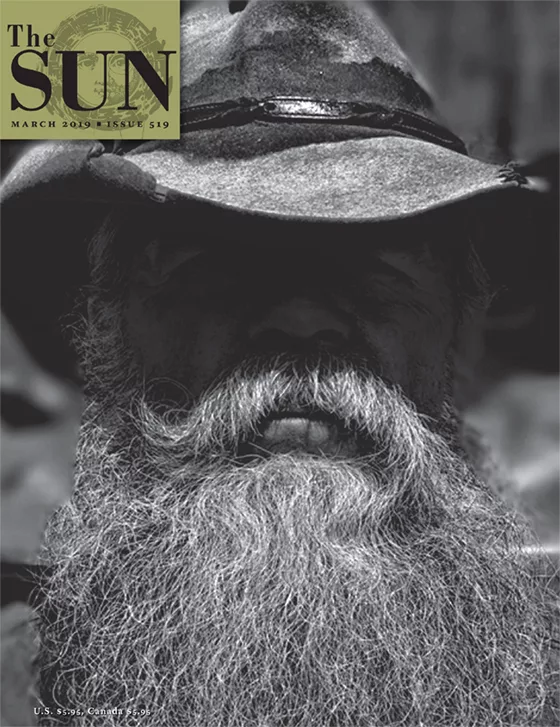
Some lucky people look like Brad Pitt or Sarah Jessica Parker. It is my fate to resemble Osama bin Laden.
Much of this resemblance is due to my beard. When I was seventeen, my father gave me a new Norelco razor. Shaving for the first time, I enjoyed removing my few facial hairs.
The second time I shaved, I cut myself (with an electric razor somehow!). I have never shaved since.
For many years, I had just some downy hairs on my cheeks. Suddenly, when I was twenty-four, these hairs coalesced into a beard.
At one time, great men had great beards. The greatest American poet, Walt Whitman, grew the greatest American beard. When I visited the poet Rabindranath Tagore’s house in Calcutta, India, I was impressed by a photograph of Tagore and playwright George Bernard Shaw. The two philosophical writers sat face to face, pointing their long beards at one another.
I continued growing my beard even during the 1980s, when most men discarded or closely trimmed their facial hair. Gradually, I noticed that no one else in American public life had a beard — particularly an untamed one. One day, in a supermarket, I saw a man with a wild beard staring back at me from the cover of Time. He even resembled me. For an irrational particle of a second, I thought: I have landed on the cover of Time for my achievements in poetry! When I read closer, though, I discovered the photograph was of a terrorist.
In the years that followed, each time I saw a face like mine on Time or Newsweek, I would look hopefully — always to find an angry bomber. It wasn’t until after 9/11 that I knew the name of one of these men: Osama bin Laden.
Strangely, Osama’s beard and mine have aged in exactly the same manner. We both have identical streaks: two long patches of white on either side of the chin.
Osama and I share other resemblances, besides our beards: We are both Semites. (I am half Jewish.) We are both thin. I meditate twice a day; Osama (presumably) prays five times a day. These contemplative practices give our faces an unworried look.
Osama and I are about the same age: he is forty-seven; I am fifty-one. We have similar histories, too. We both had a Western appearance as youths. In a photograph of a young Osama on vacation with his family in Sweden, he looks like a tall, uncomfortable teenager in a seventies-style paisley shirt — just how I looked at that age. In our twenties we both began a spiritual practice: I joined the Ananda Marga Society in 1974; Osama became an orthodox Muslim in 1979. Soon thereafter, he and I began to look like men before the days of capitalism, caffeine, and computers. Our beards connect us to the saints and seers of the ancient world.
In the famous video in which Osama discusses the 9/11 attacks, most of his speech is about dreams. Every morning I lie in bed and remember my dreams.
Bearded men value their dreams.
It’s difficult to hate someone whom you resemble. “An eye for an eye and a tooth for a tooth” applies less to someone who has the same color eyes as you, the same crooked front tooth. I find myself seeing Osama as a not-too-smart, deeply religious man who has been seduced by the allure of violence. (I must say I see George W. Bush the same way.)
My resemblance to Osama has often been a nuisance. Here is an excerpt from a letter I wrote one month after 9/11:
I was in New York City for the first time since the disaster. The bars were full on Saturday night (I was out with friends, although I do not drink), and a very drunk Polish guy thought I was bin Laden. “I’m going to get my shotgun!” he announced. For a moment I thought I would be shot. How strange to die for someone else’s ideals! Instead he marched to a corner of the room and returned with an American-flag sweat shirt.
One day I was riding the elevator in my parents’ building in Brooklyn when a woman got on and gave me a frightened look. I could see her thinking, Oh, shit! Of every elevator on earth, I had to walk into the one with Osama!
But what could I do? If I said, “Don’t worry, I’m not him,” I’d sound insane.
Soon after 9/11, I heard a news story about a Middle Eastern man who ran a restaurant in Texas called “Osama’s Place.” Business had suddenly fallen off. I empathized with this man.
In the spring of 2002, my family flew to Orlando, Florida. On the plane, I felt everyone’s eyes upon me. At one point I stood up to remove my sweater, and several men prepared to tackle me.
I opposed the invasion of Iraq, but personally I benefited from it. Our public villain was no longer Osama bin Laden, but Saddam Hussein, and I look nothing like Saddam.
Still, each time I walk onto an airplane, the flight attendant pointedly engages me in conversation. “How are you today?” she asks, her voice hysterically cheerful, the way one is while conversing with a possible murderer.
“I’m fine, very good,” I reply, in my Manhattan accent, and she relaxes.
If I muttered, “Death to the American infidels,” would she refuse to serve me a Sprite?
The Toe
Night:
I awake at 3:42 A.M., feeling anxious about my toe. I hurt it yesterday in the big volleyball game at my sister’s house. The toe, my left big toe, throbs and is red (almost brown) with swelling. Yet it doesn’t pain me to walk on it. Is it broken? Must I spend hundreds of dollars at an emergency room to learn that it isn’t broken? Did I bring my Blue Cross card with me on this trip? Why did I impulsively play volleyball at my niece’s bat mitzvah? Was I attempting to demonstrate some camaraderie with my Pennsylvania relatives? Could my toe be sprained? Or strained? Can one “strain” a toe?
In the next hotel room, a man snores — the deepest, most seismic snore I have ever heard.
I took off my shoes. That’s why this accident occurred. My archaic, uncivilized impulse to go barefoot has led to my toe pain. What a stupid, broken-toed hippie I am! (Accidents deepen one’s self-disdain.)
The Next Morning:
How public a broken bone is — unlike diabetes.
“Did you hear? Sparrow broke his toe!”
“Ha ha!”
Today the pain is less, though the bruise is worse. A blue-and-purple mark has appeared below my toenail.
My toe is the most distant section of my person — five feet, two inches from my brainstem. If I were the United States, it would be Hawaii.
I speak to my brother and his wife, Deb, who are staying at the same hotel.
“Can you wiggle it?” my brother asks.
I had forgotten the wiggle test!
Wiggling a large toe is not easy, but I seem to accomplish it without pain.
My brother and Deb decide it isn’t broken.
I speak to my sister, a nurse. “Do you think there could be a hairline fracture?” I ask.
“There could be,” she says, “but I don’t think it’s swollen enough. Anyway, all a doctor would do is splint it to the next toe. They don’t give you a cast for a toe.” She giggles.
So I won’t have an obvious broken toe, even if a fracture exists. This will be a private issue, unknown to wider humanity. What a weight has been lifted from my public self! I am learning one thing, at least: public humiliation frightens me much more than pain.
The Next Day:
Today the toe hurts less and is less swollen, but displays a square of deep blue. It is the worst bruise I’ve had since childhood — no, the worst bruise of my life.
The Next Day:
I am going to start a magazine called Bruise. All the writers, editors, proofreaders, and even printers must be bruised. The authors may write on any topic, but they must have a bruise somewhere on their person. (They will send in photos for proof.) I will be the publisher, until my black-and-blue mark heals; then I will hand over the enterprise to a newly bruised successor.
The readers need not be injured.
Seven Days Later:
You know how they say, “A broken bone heals stronger”? I believe my toe is growing more robust than it ever was.
Three Weeks Later:
I have resumed my customary indifference to my toes. My feet could end in tiny wheels, or Scrabble tiles, for all I know.
Two Weeks Later:
Now that my toe is completely healed, I ask myself, What are toes for? I notice when I walk that my feet touch the ground, then bounce. The toes provide the bounce. Toes are what make walking cheerful. Without them, walking would be like stamping out a fire.
“A Book That Changed Me” originally appeared in Chronogram, and “Looking like Osama” was first published in the New York Observer.
— Ed.