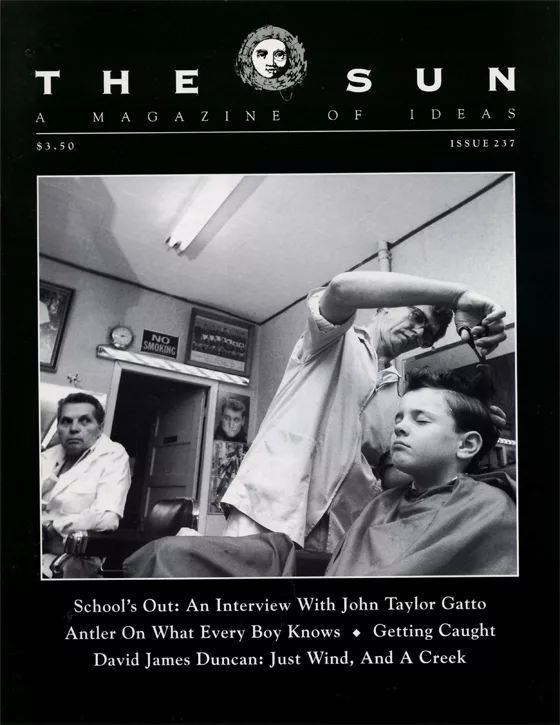
Straight out of graduate school at the University of Chicago, Robert Inchausti applied for a position teaching ninth grade at an all-boys Catholic high school. It was not the intellectual career he had envisioned for himself. He writes, “If I ever taught anybody anything, I imagined it would be in the great tradition of Laotzu, Jesus, or the Buddha.” After a flustering interview (“They asked me what I thought was the essence of Christianity. . . . I said, ‘Love.’ ‘Love?’ they replied, eyebrows arched. ‘Well, by love, I don’t mean gentleness!’ ”), he got the job.
Under the guidance of Brother Blake, a seasoned teacher and practitioner of “the pedagogy of the sublime,” Inchausti learned the art of classroom teaching. Eschewing the behavioral-management methods of school administrators, he worked at stripping away the pressures on students and teacher, so that each could find an individual path toward intellectual and spiritual growth.
— Andrew Snee
I don’t think, amateurs at prayer as most of us are, that we pay half enough attention to pre-prayer. Like all amateurs we see the romance but not the pitfalls, the fears and costly self-giving. We have the audacity to suppose that prayer is something we ought to be able to do.
— Monica Furlong, Christian Uncertainties
At Saint Vincent’s, every class period began with a simple prayer. “Let us remember,” I would say, and the class would reply, “that we are in the holy presence of God.”
We didn’t call it prayer, though; we called it “attempting the impossible.” It was a good description. Just getting the students to be quiet for the three minutes of silent prayer that followed was nearly impossible, never mind connecting with God.
Some of the students prayed with hands neatly brought together, fingers pointing toward heaven, faces scrunched in concentration. Others took prayer time as a wonderful opportunity to be irreverent: making fart noises, pretending to be asleep, or staring around the room at the fools who were taking it seriously.
I really didn’t know how to respond to their varied reactions. Aside from the more boisterous disrupters, I let each student approach silent prayer in his own way, for I myself had yet to fathom the full significance of this practice beyond its status as an official school ritual. But as the year progressed I found more and more value in “attempting the impossible.”
At first I wasn’t very good at it. I would try to remember the presence of God, but really I was striving just to imagine it — to even conceive of it. I knew that this was wrong, so during the prayers I tried to stop thinking altogether, to just stop the chatter of my mind for a few seconds, as in meditation.
I wasn’t able to do this either, so I ended up watching my thoughts course through my mind, and trying not to get caught up in any of them. If I found myself inside some idea or emotion, I would simply return my attention to my breathing. After a while of doing this, I noticed the same set of concerns popping up every day: Will I get some time to relax today? What will I do if Marty acts up? Is my lesson plan any good? What do I have to do next?
These same worries arose so often that I soon had them numbered, so that during prayer I could simply let them go: “Oh, there’s personal preoccupation number four — no need to bother about that again.” As a result, I was eventually able to bring a purity of motive to my prayers that I had never before achieved, and this granted me some profound moments of rest during those three-minute reflections.
But then, beneath those surface concerns, I found another layer of anxiety. During prayer time, I would remember some stupid remark I had made a week ago, or a look of disdain I had seen on a student’s face last month. Or I’d suddenly remember something I was supposed to have done several days ago. During one meditation, I recalled an argument I’d had in high school with my English teacher. It was as if my mind simply refused to attend to the reality before me, as if silence and peace were impossible.
Brother Blake assured me that thoughts and images such as these bubble up in our minds all the time; we just never slow down enough to perceive them. Their logic makes up our moods. When we first try to focus upon God in prayer, we reveal to ourselves the preoccupations of our own pre-conscious minds. He suggested that I not try to move beyond this stage. Rather, I was to enjoy it, learn from it, and catalog my worries as the first step in liberating myself from them.
This was a wonderful time in my prayer life, when every class period began with my opening a package sent special delivery from my deep self: “Oh! I’m still thinking about that? My conversation with Linda affected me more than I realized. . . . Oh, look at this, a fear I thought I had conquered years ago.”
Occasionally I would grow so bored with all my thoughts, feelings, plans, and obligations that my mind would become clear and the chatter would cease. This would usually happen a day or two after a difficult meditation, when letting go of some particular thought had felt tantamount to dying. The students would sometimes have to call me back to consciousness: “Mr. Inchausti, the prayer is over. Mr. Inchausti? Are you still here? Earth to teacher.”
When I would emerge from one of these prayers and look at my students, their presence often struck me as miraculous, and I would listen to them with renewed interest and attention in hopes of discovering who they were and how they had gotten there.
It took me a good three months before my quest for purity of motive got God’s attention, but then — out of nowhere — there it was. There was a presence with me — listening. And with God’s attention, I suddenly got bigger, felt less trivial. The classroom became an authentic battleground. Life, the school, my quest for vocation — everything seemed to matter more.
Students often evaluate their days by whether or not their teachers are in “good” moods. At first I took this as the typical psychological defense of blaming others for one’s own problems, but after a few weeks of silent prayer I could see their point. Events in themselves do not dictate our responses to them. A teacher in a “good” mood handles stress better than one in a “bad” mood. Why not simply resolve never to be in a “bad” mood, since moods are merely the result of invidious interpretations anyway?
So I resolved not to get caught up in my own self-drama or thought processes. I tried to stay true to the memory of the presence of God and see each class as if for the first time. I don’t think I could ever have remembered to do that if not for that opening prayer ritual.
As the semester progressed, I began to see more and more of my life as prayer — that is, as attempting the impossible. I experienced my teaching and my praying in almost the same way: as a quest for perfect, undistracted attention to the task at hand, with each task an end in itself, a door to bliss — infinitely interesting and complex.
Silent prayer was an activity that was admittedly useless, so you could not fail at it. It didn’t produce anything or satisfy any requirements. It didn’t call for elaborate lesson plans, and it couldn’t be graded. It simply stopped everything for a moment, punching a hole in my busy, failed day and in any myth of personal or professional progress. It was done for itself and nothing more. It was a great center of calm in my stormy day, and I began to look forward to it.
Once, I promised my students that as long as they stayed silent there would be no lessons, no assignments, no work. “If you want to,” I said, “we will spend the entire period in silent prayer. But if anyone talks, it’s over.”
The students tried to remain silent, but they could never do it. Someone always spoke before three minutes were up. It astonished me; they were incapable of being silent for more than three minutes — even when they wanted to be. They found self-control exhausting, and were quite happy to get back to the routine of classwork after such ventures into the “impossible.”
I was beginning to see that prayer was one of the most important but least understood elements in the school’s curriculum. It was nothing but silence before the mysteries of life, yet that silence opened one to infinite intuitions. When the obsessions through which one apprehends the world are allowed to dissolve, everything is revealed in a new light.
Of all the discoveries I made that first year, the power of prayer was one of the most important to me. It helped me get out of my mind and attend to the world in its pure, sensuous reality. It provided me with a method that bore in on phenomena instead of carrying me away into abstract speculations. I learned to rest in the presence of things as they were, instead of constantly fleeing from them by “figuring them out.” I learned, in other words, how to let down my defenses long enough to see through my own grandiose misperceptions. I was beginning to break out of my nineteen years of schooling and into a renewed faith in my own native intelligence and its spiritual core. I was at last beginning to see my students, rather than merely think about them, and prayer was my way back to this kind of independent knowledge.
I looked into my past to figure out why it had taken me so long to learn this simple truth, and found that my ambitions and desires had gotten in the way. I had sold my soul for success in school, popularity, approval. But, through it all, there had remained a part of me unconvinced by the world, and this was the part evoked by prayer, by doing nothing, by attempting the impossible. I thanked God it was still there.
I saw now that teaching itself was attempting the impossible, and was thus a form of prayer — provided one did not attach oneself to the fruits of one’s labors, but quietly and continually tilled the soil of teenage awareness, expecting nothing, desiring nothing, and therefore dreading nothing. Just seeing everything and providing a space for spirit to express itself.
Prayer had taught me that, to be a teacher, I didn’t need to act, nor was it enough merely to wait; but I could cause things to happen by opening up a space in my heart to register the subtle movements of the students’ souls toward real change. And I could do this only if I remained unimpressed by the old forms of power — progress, ability, ambition, results — and rested in the creative, unique, never-again-to-be-obtained moment of simple awareness.
My students loved to read the Guinness Book of World Records. They could sit for hours amazing each other with excerpts read aloud. I tried to figure out why they were so enraptured by the longest basketball game or the tallest human. Then it dawned on me what my students were really looking for: concrete examples of human achievements.
To them, these records were “real” accomplishments. Factual. I knew, of course, that the feats in Guinness were merely trivia, that true accomplishments, such as writing a great novel or making a scientific discovery, occur in the mind, and therefore require imagination and abstract thinking to appreciate. World records, on the other hand, are measurable achievements that can be grasped by even the most literal mind. But my students’ interest in them testified, at least, to their longing for excellence, despite the paucity of avenues through which they could seek it.
I didn’t try to change this. I just noticed it.
“Attempting the Impossible” is excerpted from Robert Inchausti’s Spitwad Sutras: Classroom Teaching as Sublime Vocation. © 1993 by Robert Inchausti. It appears here by permission of Bergin & Garvey Publishers, 88 Post Rd. West, Westport, CT 06881, (800) 225-5800.