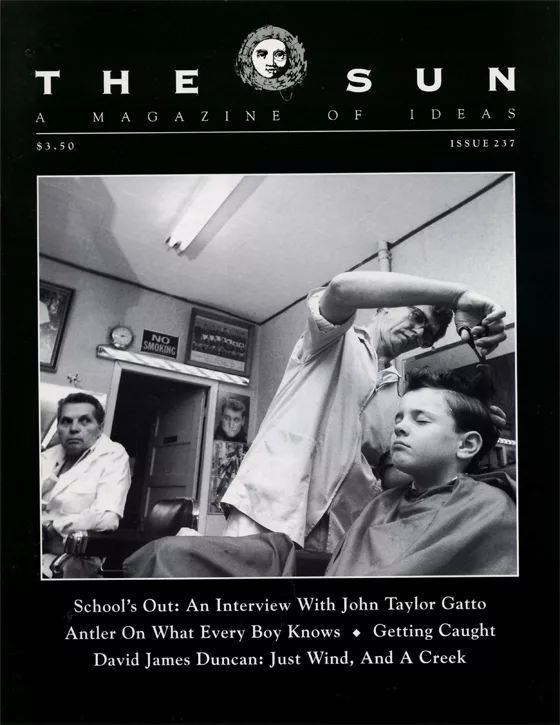
John Taylor Gatto’s first teaching assignment, in 1965, was as a substitute in an eighth-grade typing class in Harlem. But because he wasn’t a certified typing teacher, he was not allowed to actually teach the students. Instead, for the duration of the class, he was to keep them from typing. One frustrated student attacked him with a chair.
Gatto went on to become New York City Teacher of the Year and New York State Teacher of the Year. But he never forgot the lesson he learned that first day: if he was to truly help his students, he could not follow the rules enforced by the school system. By the time he finished his twenty-six-year teaching career, he would advocate doing away with the system entirely.
Early on, Gatto realized that he had to avoid speaking out or drawing attention to himself if he wanted to continue using unapproved methods. When the Teacher of the Year awards put him in the spotlight, he ended his career with a resignation letter published in the Wall Street Journal, accusing public schools of teaching “a curriculum of confusion, class position, arbitrary justice, vulgarity, rudeness, disrespect for privacy, indifference to quality, and utter dependency.”
Gatto now tours the country, and the world, speaking out against school systems designed to create obedient citizens who will unquestioningly fill the slots society assigns them. He is the author of two books, Dumbing Us Down and The Exhausted School, and is working on a third, The Empty Child.
— Andrew Snee
Becker: Did you come to teaching thinking you were going to change the system?
Gatto: No. I came to teaching with the same kind of implanted attitude that everybody else has; for example, I believed implicitly in the bell curve, that human talent distributes itself very neatly and mathematically, and that there is very little you can do about it.
Over time, I discovered how children learn, not from any great personal brilliance, but by trying to repair the internal damage in myself. I intended to teach kids who were exactly the age at which I had taken a wrong step in my own life. I wanted to see them spread out in front of me as in a laboratory — which is very coldblooded, I know. I wanted to see lives at that moment, unfolding, in order to put myself back in touch with who I had been and to find out why I had taken the wrong steps. So, I went into teaching for a selfish motive.
Becker: Now, when you say internal damage in yourself, are you talking about internal damage from the school system?
Gatto: I wasn’t sure where it came from, but I did know that it began to manifest itself in my life at around age thirteen. After that, I was led farther and farther away from my own natural genius — and I use that word not as an intellectual term but as the distinctive spirit and individuality that each one of us has. That’s the way the word was traditionally used.
When I started teaching, I was a long way from my family. I was alone in an alien culture — New York City — with no immediate prospect of leaving, and I was looking for some way to patch myself up. So there I was: “Physician, heal thyself.” I went into teaching to do just that. In attempting to heal myself, I watched children and ran experiments on them — I know that sounds awful — and saw what worked and what did not. I came to a conclusion very quickly. After two years it was clear in my mind that schools were deliberately flouting the way children learn.
Becker: What is it you discovered that works?
Gatto: The first thing I discovered was that the types of learning that are measured by standardized tests are not real learning at all. To do well on a standardized reading test, for example, does not mean that you read well. There are approximately 150 categories of information that a complex passage of reading delivers, and the standardized test covers approximately six of those categories over and over again. So it ignores a vast area. People who score well on standardized reading tests can very easily be made to look like fools if they are asked to extract different kinds of information from the reading. To prove this point, I created my own fairly simple open-book reading test, and kids who were reading at a so-called twelfth-grade level couldn’t get a single question right. The questions were not trick questions, and the kids had the book right in front of them. The problem was they had been taught to look only for certain kinds of information; they could not see other kinds. The book was All Quiet on the Western Front, a classic about the genesis of the First World War and the war between all older and younger generations. It is written in one- and two-syllable words in the voice of German teenagers — very simple language.
Near the beginning of the book, men sitting in the latrine hear a battle going on in the next field and carry their toilets out into the open, under the blue sky, and set them down in the grass. They sit doing their business and watching their buddies being blown apart in the next field. I do not think you could get a more graphic or absurd picture. Yet, in ten or twelve years, there was not a single person, no matter how I phrased the question, who knew what they had done, that they were sitting on their potties watching the battle.
Becker: No one would ever ask a question like that in a standardized test.
Gatto: Right. Kids are taught to read without visualization. If you were to read, let’s say, any page picked at random from Tom Jones, there are a hundred pieces of information that have to be translated into a picture or else in a short time you cannot follow the book; the details cannot be retained. With the loss of the details, all that survives is some outline of what the main character did, which is not what literature is about at all. Every year I would teach Moby Dick in the uncut version in order to train kids in visualization. That is an exceedingly difficult book to read, even for a college graduate. But after a while I had no resistance at all to reading it from thirteen-year-olds, including ones who grew up in Harlem.
Becker: Why do you think that was?
Gatto: Because the hunger to develop the intellect to its maximum power is universal, once you have gotten over the social gulf and the age gulf and the status gulf between student and teacher. If you can eliminate those barriers, you will have kids who are eager to learn.
Becker: How did you get over these gulfs?
Gatto: First I had to break down the various automatic responses that kids had been programmed into. A few thought they could learn in an unbridled way, but most did not think they were capable of learning at all. They deferred to others or had hostile reactions to those who showed interest in learning. The great mass of schoolkids have been told that without immense amounts of assistance and slow progression they cannot learn. So, for the first ninety days, my classes were always very rocky; breaking down this conditioning was an emotional battle from the beginning of class to the end. I would even track students down at home; there was never a kid whose home I did not visit. My presence in their life temporarily became all-pervasive, because I had to provide them with antidotes for this “ranking” poison.
Becker: What were those antidotes? Was it something only you could provide?
Gatto: No, it is something anyone can do, but you cannot do it very easily in a factory-school setting. Outside such a place, I would imagine that it is very natural to do, because the barriers I was trying to remove do not arise in the first place, or arise to a much weaker degree.
But there was nothing I could do about the structure of schooling. What I could do something about was the way the kids regarded the structure. So I made sure that every student learned to think dialectically, to challenge assumptions — and the first assumption we challenged was that school was good for you.
Furthermore, I let it be known that if kids were having difficulty anywhere in the school structure, they could come to me privately and we would try to work out some intervention that would release the pressure on them.
Becker: In other words, you let them know that you had an interest in them beyond the classroom.
Gatto: Yes, although you and I now know that in the beginning that interest was based on an utterly selfish need to solve my own internal problems. So I do not want to present myself as touched by sainthood. I was really hunting for my own sanity and strength. But I was also totally engaged in helping students work out their destinies independent of authority structures. To get kids on their own track, and not just on John Gatto’s track, they first had to understand that the formal track presented by the state is good for the state but is not good for them, unless, by some accident, the two overlap.
Becker: Is this something that you came to fairly early in your teaching?
Gatto: I’d say by the second year. The first year I still believed what most intelligent people believe: that if you run into a problem and you cannot get it corrected, it is because of the people you are working with, and you have to get away from them. I was a long-term substitute teacher, and I found that, in all the schools I went to, there were problems that no one was interested in correcting. Furthermore, when I did correct them without asking permission, I was severely criticized and attempts were made to intimidate me.
To use a well-known example, Jaime Escalante, the schoolteacher who was the inspiration for the movie Stand and Deliver, taught the sons and daughters of Mexican immigrants advanced mathematics so well that they won almost all of the major prizes in the state of California. Was Escalante cherished and lauded for that? Maybe a thousand miles from California, but he was driven out of his high school last year by constant assaults on his dignity, his peace of mind, his reputation. You would make a serious mistake to think that his school must have some group of monsters working in it to do this. The same thing would have happened in any high school in the United States, for the simple reason that teaching disadvantaged kids advanced mathematics is OK as long as you are not successful at it. The minute you are successful, you have demonstrated that the bell curve is a crock, and the system itself could not survive the elimination of the bell curve.
Becker: People are so indoctrinated into that point of view that it is a threat to consider that something else might be the case.
Gatto: It is an amazing threat. What if we operated on the premise that mathematics in its most advanced state is, in fact, fairly easy to learn, so that people with no experience at all with heavy thinking can pretty much master it in about a year? What if we generalized that to difficult reading, to writing, to public argumentation? What kind of society would emerge? Certainly one unlike any that has ever existed in human history, and the people who have a material stake and a status to defend are not interested in knowing such a society.
Becker: You have listed seven ways to “make learning happen”: apprenticeships, community service, field curriculum, independent study, parent partnerships, work study, and critical-thinking exercises. These are all means to get kids out of the straitjacket of classroom teaching.
Gatto: Yes, but it is very important not to apply that as a recipe or a formula. Rather, you need to apply it in ways that are in harmony with who you are. See, kids constantly watch teachers to see whether their performance is bullshit, or whether it is in harmony with who they really are as people.
The way I handled this was to talk to them in the same way that I am talking to you right now, with the same language and the same involved sentences. And there were probably areas that were confusing; but the net result was that the kids quickly came to see I was exactly as I represented myself. My only interest in being at school at all was to be with them. I had no respect — some politeness, but no respect — for the school structure and schoolbooks. I would use analytical tools to demonstrate why the textbook was not worth reading.
Becker: What made teaching a persistent interest in your life?
Gatto: One of the great gifts my family gave me was the ability to be alone for long periods of time. When I got to New York, I found that solitude was considered to be dysfunctional. People always had lists of things that ordered their time. The school obviously keeps kids and teachers under constant surveillance; there are no private places to go. There is no private time, no private space. That was a flagrant violation of what I thought the road to selfhood was. I taught kids to think dialectically, to trust me, then to believe (as I believed) that there was no intellectual challenge, however complicated, that they could not deal with on an adult level.
But there was still the need for solitude. At the time, I was thinking I was confined to the school building, and I was desperate to find places for kids who wanted to rehearse a play, for example, while the rest of us were doing something else collectively. But this school back in the 1960s was the same as schools today: I was told there was no space at all.
One day, after school, armed with an empty-room schedule, a master key, and some enterprising hunches, I set out to enter every room in the building — every corridor, every closet — and to map the empty space in the school. I found there was an embarrassment of empty space, that at any given moment six or seven rooms were temporarily empty. If you have a master key and a class schedule and are not afraid to use the dressing rooms, the basement, or the roof as a schoolroom, there is lots of space. So, by the middle of my second year, at any given time of day my class might have had fourteen kids in it and the other sixteen or eighteen kids would have been dispersed throughout the building in empty spaces, doing independent projects. My only intention was to get them alone. What it did was encourage a whole lot of independent study on projects that the kids had selected. By the third year, it dawned on me that the projects themselves had independent value, and might be used to spring the kids further free of this net, and maybe even get them some credit or an award or maybe a little bit of money.
I do not want to present myself as touched by sainthood. I was really hunting for my own sanity and strength. But I was also totally engaged in helping students work out their destinies independent of authority structures.
Becker: So the first impulse was for solitude and the second was for independent study.
Gatto: Yes, because Manhattan kids, just like their mothers and fathers, all have lists of things to do. I started out with a school that was largely occupied by the sons and daughters of prosperous families in television or publishing or advertising. These kids seemed to be the best and the brightest. It was only under close scrutiny that they turned out to be much less skilled than the labels they carried suggested — and they knew that. They had developed skepticism toward the adult world, because they had seen the discrepancy between our rhetoric and our practice. But what they had not seen was the discrepancy between their self-image and the reality.
Becker: So the thirteen-year-olds who were supposedly elite were suffering from the fact that they had no real skills. They had only become very good at taking tests.
Gatto: Right. They were also suffering from the knowledge that, the way the economic system was arranged, they would be moved along this assembly line and end up as doctors or lawyers or engineers or schoolteachers.
The pathetic part of this is, when you ask kids what they really want to do with their lives, there is a substantial percentage of them who say, for example, they would like to be marine biologists. You can be sure that the desire to be involved with nature and water and animal life is real.
Becker: I wanted to be a marine biologist.
Gatto: There you go; I probably did, too. There is no reason at all why we could not have more people taking care of the water and marine life. Not only would it not damage anything, it would yield a real service for the rest of us. Our marshes and ponds and streams and lakes and oceans would be well tended.
Becker: Would you say that the system has taken over without people being aware of it?
Gatto: Yes, but the potential in humanity doesn’t go away; it bubbles and boils under the surface. If you are willing to go at a group of confined children the way you would go at a rock cliff with a pick, because you knew there was a chunk of gold in there, you can still get down to that bedrock level of tremendous human potential. Once kids are aware of the flow inside themselves, all of the resistance stops. My job became to pass huge chunks of responsibility back to the kid and to the kid’s family — if they were willing to get involved. And I always tried to make sure that what I pushed on a kid was more than what he or she was comfortable with.
Becker: Is that where the seven ways to make learning happen came in, after you had gotten to that stage?
Gatto: Yes, because if you do not have a revolution in thinking, the kids will just accommodate themselves to the new imperatives and beat them, too. To put each kid back in touch with his or her own genius, you have to step out of the way, but you cannot step out of the way until the kid has become completely self-starting. Some kids have developed — through family or personal experience — a readiness to act independently, and all you need to do is cover for them, and sometimes actively intervene to make things happen.
Say I start with thirty kids at the beginning of the year. Inside of one week I’ve identified five who I know can pretty much run by themselves. Now I don’t have a class of thirty anymore; I have a class of twenty-five.
In the next two or three or four weeks, I identify around ten who may need propping up for half the year to come, but by and large they can be on their own or with their parents or in apprenticeships.
Now I am left with fifteen kids belonging to two groups: First are the ones who get the highest scores on tests and get their self-esteem from pleasing a teacher. They sense that there is a new value system at work, and they know that the students who come to school only two days a week are getting a better deal. The other cadre that stays is made up of kids who have been hurt the most, either by the school or their social background or both, and who need tremendous amounts of attention before they feel comfortable enough to move. I cannot give these kids that attention until I get rid of the residual “bright” kids.
Becker: The ones who have done well in the system, you mean.
Gatto: Yes. They realize that they have lost the major part of the audience that envied them for doing well; it’s as though they have been declared irrelevant. So, eventually, one or two or three of them come to me privately and say, “What is going on?” and I say, “Nothing is going on. You are having the same kind of classes you’ve always had.” And they say, “All of these other people are gone,” and I tell them where these other people have gone. And then they say, “Why did you do that for her and not for me?” I say, “I did not do it for her; she did it for herself.” Suddenly, these bright kids decide maybe they can do something for themselves, too.
So now I am down to six or seven or eight kids who have been so severely worked over for so many years that I am looking for a different sort of success with them. If they can do one or two modest things outside of my direction, I am satisfied. If they can learn to really look at each other, instead of looking at each other through the mediation of some outside authority like the teacher, then I think a big step has been taken. I am more gentle, more polite with them. My attention is much greater because there are fewer kids to distribute it among.
Becker: Why was it that, when you got to be New York State Teacher of the Year, you resigned?
Gatto: I learned very early on that you can make a dramatic difference in even the most tightly organized school, but only if the other people there don’t know what you are doing. Awards and honors bring huge amounts of feedback and praise. But I made pains to see to it that all praise got rerouted away from me to the principal or the superintendent or whomever. I did not want attention focused on me because on a daily basis I was breaking laws, let alone breaking school rules.
Becker: So, in fact, the awards actually made it more difficult for you to do what you do.
Gatto: So difficult that by the time I got Teacher of the Year, I was completely paralyzed by the publicity; there were visitors stopping by almost on a daily basis to see me, and film crews were in and out of the building. All of this led to real antagonism on the part of the rest of the staff because school is a kind of guild system, and in the guild system no member is supposed to get much more attention than another, and no member is allowed to use different procedures than another. That’s why Marva Collins was driven out of the Chicago inner-city schools for teaching Shakespeare and Plato to third-grade kids, who, I can guarantee, have no resistance whatsoever to adult literature. Demonstrating that you do not have to be in a gifted-and-talented class in high school to do those things isn’t something that the guild of elementary-school teaching wants to encourage.
Becker: Because the “guild” is based on not wanting to achieve over and above each other.
Gatto: Yes. Take, for example, when one of my kids was invited to represent the United States at an international youth commission at the United Nations. This girl, Wilma, was a highly illiterate transfer student from Miami who grew up in a single-parent family on welfare. She had no record of academic prowess at all, no particular skill in interpersonal relations. Yet she got on the front pages of twenty-four newspapers and got major coverage on the three networks.
How did this happen? As part of one of my science classes, I took the kids to Coney Island to throw bottles with messages in them off the pier. A police chief down in New Jersey found Wilma’s bottle and said he was going to sue New York City for polluting the ocean and thanked her for providing a piece of evidence with her name and address on it. She brought his letter to me, and I said, “Why don’t you take a day off from school and go down there? I will steal the money out of the Coke machine. You apologize to him and say I made you do it, and you will get a one-day apprenticeship in small-town police procedure.”
The police chief was running for office, so there was a brass band to greet her and a helicopter to fly her back to Coney Island, and Wilma became a short-term celebrity. She got national attention, and the UN called and asked her to speak because she had apologized for polluting the ocean. When she was invited, the insult to the gifted-and-talented programs, not only in my school but all over the city, was vast.
Becker: Those teachers and students felt disconfirmed.
Gatto: They not only felt disconfirmed, but Wilma’s speech was published by New York Newsday, which paid her five hundred bucks for it. So each succeeding amount of attention was flagrantly rubbing it in to other teachers that this was not going to happen to kids who were sitting around passing standardized science tests.
The experience transformed Wilma. She was unrecognizable six months later. She was a very effective speaker and had first-rate ambitions and plans. When she got her check for five hundred dollars, she set up a teen modeling agency. She booked modeling shows at old-age homes. After the shows the girls, who for their part got experience in front of real audiences that were totally unthreatening, would sit around and talk to confined elderly people. This is a thirteen-year-old girl who cooked this up — a thirteen-year-old girl with a school record that said she was a functional nonreader and had a low average intelligence and crossed eyes; she could barely speak English. Wilma rewrote her record inside the school year. It was obviously a dramatic lifting of the lid on her.
Becker: What other success stories did you have with your students?
Gatto: I used to teach ghetto kids how to apply for scholarships to great private schools like Exeter, Andover, Lawrenceville, Choate, Groton, Saint Paul’s, Culver Military Academy. The chances of getting a scholarship to one of these places were about one in three thousand, but I taught them how to raise that to about even money just by getting the last ten catalogs the school had issued, and looking at the school’s announced purpose and the pictures that they choose to show of the school in action. From those pictures and the statement of purpose, you will invariably know what to say in the interview to get the scholarship.
My kids were also the best contest winners in human history because they started with the assumption that the purpose of any contest as announced was not true. For example, Ted Weiss, a Democratic politician on the West Side, held a speech contest each year and the winner got to go to Washington and the speech was published. Students would come to me and say they wanted to enter, and I would say, “Throw away the rules.” I said the only one who is going to win the Ted Weiss speaking contest is someone who says what Ted Weiss says. Essentially, all contests exist to make the contest giver’s position stronger, so if you ignore what they say the contest is about and research the contest giver, you will figure out what you will have to say to win the contest. I know how cynical that must sound, but I can guarantee it works.
Becker: No, I believe it.
Gatto: I will give you another example. In the early eighties, Yoko Ono wanted to dedicate a section of Central Park in memory of her husband. She submitted her proposal to the local community planning board, and it was voted down forty-seven to five. A couple of my students, who were themselves part of politically active families, came to me and were furious. I said, “Personally, I am delighted, because what we need in Central Park is more grass and trees, not cockamamie monuments and statues.” But nevertheless, I told them that the best way to upset that decision was not to go to the community planning board and ask them to reverse it. “The final rubber stamp on every decision about a landmark,” I said, “is made by the landmark-preservation commission; they will hear an appeal, but they almost always confirm what the community planning board says. Your chance lies not in giving the best argument but in finding out the names of the twenty-two members of the landmark-preservation commission, and getting a biographical sketch of each one, outlining the undertakings they are affiliated with, and how they got appointed to that board. Because,” I went on, “if you can get all of the kids in the West Side schools to direct specific letters to them based on certain characteristics or weaknesses that they have exposed, you have a chance. They probably never get a mail campaign directed to them individually. And all you need,” I added, “is twelve of them; you don’t need all twenty-two.”
Becker: So did it work?
Gatto: The decision was not only reversed, but the girls who undertook the campaign got front-page coverage in local newspapers. About a week later, Yoko Ono had them over to her house. God knows what they talked about — another corruption in Central Park, probably.
What if we operated on the premise that mathematics in its most advanced state is, in fact, fairly easy to learn? What if we generalized that to difficult reading, to writing, to public argumentation? What kind of society would emerge?
Becker: What impact has public schooling had on you and your family?
Gatto: I would say an immensely destructive effect. Schools taught me to minimize my debt to my parents and relatives, to concentrate on personal gain instead of the welfare of others, and to define myself by grades, awards, and the opinions of authorities. This prepared me to be a confused man, a bad son, a bad husband, and a bad father; it was only by constant painful effort much later in life — perhaps when I was forty-five — that I managed to throw off these effects.
Becker: I understand that, because I got good grades, but I always had the feeling that it was of limited usefulness once I got out of school.
Gatto: Most kids who get good grades become resentful when they discover that only government jobs at the admission level and licenses that are controlled by the government reward good grades. Everyone else rewards performance. You’d be crazy to hire a newspaper reporter because he or she got As in English or journalism.
Becker: I think kids are aware of that. I know I was aware that, although my grades were very good and gave me a certain satisfaction, something else was going to govern once I got out.
Gatto: It’s awfully hard to accept that you spent all of your youth in school and now you are going to have to adapt to a different system that no one has bothered to explain to you. If you are intelligent, you can pick up some of the operational principles of it, but certainly not enough, unless your family helps out.
Becker: In your writings about your childhood, you seem to be saying that it is worse for kids today than it was when you were a child, because forty years ago kids had more time after school to invent themselves.
Gatto: They had more ways to grow up, yes.
Becker: Now they have TV.
Gatto: And TV does exactly what school does, only more seductively. My wife told me she was throwing away the TV about ten years ago, because she often found me watching shows that I had contempt for, but rather than get up and turn them off, I would say, “No, I will just sit here.” I was watching football games, not caring who won or lost, just watching the little figures run back and forth, until she put her foot down. I’m endlessly grateful to her.
Of course, the deepest lesson TV teaches is that your span of attention should be no longer than eight seconds. You will never see a TV image sustained more than eight seconds. Your perception of reality is massively simplified — even by the best shows on PBS. You see the red deer of Scotland, but you are not seeing the red deer of Scotland. You are seeing the red deer that the director wants you to see, from the director’s chosen angle, and only for as long as he or she wants you to see it. The human mind cannot bear up under this constant conditioning for very long. In a child two or three or four years old, the structure of independent thought and categorizing collapses quickly. It doesn’t reform itself easily, and in many cases it never reforms itself. The child is left with a crippled or incomplete mind. I suspect TV alters the brain in permanent ways. I really have not thought long enough about it, but I have seen the distinct difference between the kids who don’t watch TV and kids who do. It’s like they are from different planets.
Becker: So if there were no TV, the impact of schooling would be less damaging.
Gatto: Much less damaging; that, and if the economy had not been taken over by a few hundred corporations that stole all the jobs and used the state to prevent any competition. As a result, the workplace is overwhelmingly asking less and less of employees, not more and more. If you aim to restore independent livelihood to the citizens, you have to free kids’ minds, souls, and spirits. You have to unschool children so that they see how easy it is to make a living independent of either the government or big business. Among the classes of information that have been removed from consideration by schools are money and economics, which were once the most compelling things people thought and talked about. If you learn to watch the people around you instead of watching an authority figure, you can figure out what it is that people need and supply that good or service. Do it either (1) cheaper, (2) better, or (3) first, and you get rich enough to be your own boss. I have seen home schoolers rediscover this ABC principle of economics that was once known to everybody.
The home schoolers have been followed by the charter schools. Sixteen different states have begun to issue multi-million-dollar charters to anyone who designs a school and can pass the screening commission; they do not have to follow the laws that restrict other public schools. About a year or two from now, these charter schools are going to be up and running and attracting media attention. In another couple of years, you are going to see their numbers double and then redouble, and by that point, between the home schoolers and the charter schools, the public-school monopoly will collapse of its own weight; it will not be able to save itself. That will happen whoever wins the media battle.
Becker: These aren’t private schools?
Gatto: They are public schools, but they are run for the most part by private individuals who have some record of success in their own community: engineers, bank presidents, ministers — anyone can propose a charter idea, present it to a commission, and either be awarded a charter or not. I would expect that well before the turn of the century, every state in the union will have charter-school education, and some of the states will take the limits off the number that can exist. The first time that happens in a state, public schools are dead.
Another thing that is happening and has not been reported by the press, but will be soon, is that some local school districts are reaching the limit of their ability to work within their budget and are beginning to use loopholes in the laws to contract out services. Vermont schools have been doing this since the beginning of the century, but it never gets any coverage. About 25 percent of the kids in Vermont go to private schools at public expense.
And voucher schools are coming, too — count on it. There is no way to stop them. But it’s urgent that voucher bills be written to keep the federal government out of it, and leave the decisions to local government and families. If we let national standardized testing drive the curriculum, we’ll get a worse system than the one we have now.
We are going to have to reform the school system from the bottom up. There isn’t any way you can drop a better plan in the top of the system and ever have it reach enough people to matter; each vested interest group will tinker with it on the way down to make sure things stay the same for children.
This interview is reprinted by permission of the Journal of Family Life: A Quarterly for Empowering Families, 72 Philip St., Albany, NY 12202, (518) 432-1578. Subscriptions are twenty dollars a year, or thirty dollars for both the Journal and its sister quarterly, SKOLE, The Journal of Alternative Education.