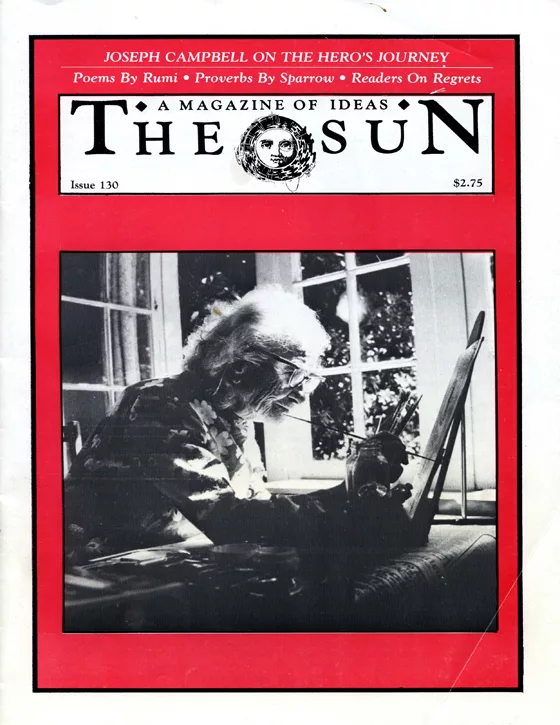
When the mythologist Joseph Campbell turned eighty in 1984, his friends and followers celebrated by staging “A Symposium On The Hero’s Journey” in San Francisco, California. What follows are excerpts from Campbell’s talk at that event.
The author of The Hero With A Thousand Faces, The Masks Of God, Myths To Live By and other books, Campbell is a world-renowned scholar and lecturer who stands in the forefront of the study of mythology.
In his writings — strongly influenced by the work of Carl Jung — he emphasizes the psychological meanings of myth. In The Hero With A Thousand Faces, he searches through all the world’s myths for the common denominators, the timeless symbols that make up the mythic hero’s journey.
He is an eloquent writer. Here, for example, are a few lines from The Hero With A Thousand Faces, describing the return of the hero, who has followed the “call to adventure” and left his home and his family, the world of conventional reality, to endure the harsh tests and challenges that inevitably lie along the path to self-realization: “This deed accomplished, life no longer suffers hopelessly under the terrible mutilations of ubiquitous disaster, battered by time, hideous throughout space; but with its horror visible still, its cries of anguish still tumultuous, it becomes penetrated by an all-suffusing love, and a knowledge of its own unconquered power.”
Our thanks to Paul Herbert, director of the Dolphin Tapes library at the Esalen Institute, who sent us this talk, thinking it might be of interest to Sun readers. It’s an informal speech, rambling but full of profound insights. The excerpts printed here barely suggest the breadth of Campbell’s vision and the extent of his scholarship.
The entire tape of the talk is available for $10, plus $2 for handling and mailing, from Dolphin Tapes, P.O. Box 71, Big Sur, California 93920.
Thanks, too, to Joseph Campbell for permission to reprint these excerpts.
— Ed.
I’d like to talk today about what I’ve learned about the hero journey.
Our society — our way of life — is perfectly good for the people who enjoy it, but for others, who feel a lack here, life becomes boring. One of the characteristics of our world today is an emphasis that is almost exclusively economic and political. What we read in the newspapers all has to do with economics and politics, and with the calamities in the cities — murders, rapes — which are the activities of people who are out of harmony with themselves, propelled to violence. There is something missing here. Very few people can find satisfaction living entirely in this economic and political way.
What happens, for instance, to marriages? You’ve known people who have had families, brought up their kids, and when the children leave, the parents get divorced. They get to the top of the ladder, and find it’s against the wrong wall. Marriage is first biological — breeding, bringing forth a world. When the world is brought forth, we’ve reached the top of the ladder. There is nowhere else to go along that line.
The wall has to dissolve. You have to realize marriage has a transcendent, mystical dimension to it, behind the biological one. That mystical dimension is right there in the marriage asking to be recognized. That’s the second half of life. While the first half has been inevitably concerned with economics and social and political problems, there comes a time to push that off, to build a hermetic circle around you that bounces away the call of the day. In India, after having served the social functions — the duties of the world — one casts them off. In our world today, however, the requirements for individual penetration of the mythical dimension is more demanding than in other societies. In earlier societies, symbology acted to continually refresh one’s spiritual dimension. Religious festivals were a part of social life. Today our religions are so completely out-of-date that they don’t serve us in this way.
I am remembering one particularly interesting conversation, an interview during a radio program. I walk into the studio — the red light to tell you you’re on the air isn’t on yet — and here is this smart-looking young guy sitting there. I learned later he has a reputation for leaving his interviewees all over the floor. Now he says to me, “I’m tough. I put it right to you. I’ve studied law.” Well, I say, “I’m game, come on.” The red light goes on and we’re on the air. “Curious thing to devote your life to myth,” he says. “Myth is a lie.” I say, “No, myth isn’t a lie.” I had been asked what myth was so frequently that I had a definition. I say, “No, myth is metaphoric. Mythology is an organization of symbolic images and narratives that are metaphoric of the possibilities of human experience and fulfillment in a given society at a given time.” “Ah,” he says, “it’s a lie.” We went on in this nonsense way until about five minutes before the end of the half-hour program. Then I realize this guy doesn’t know what a metaphor is. So I say, “I tell you it’s a metaphor. Give me an example of a metaphor.” He disintegrates entirely. Like a kid he says, “Let’s get in touch with a schoolteacher,” and I say, “No, you tell me.” We had about two minutes to go and he says, “So and so runs very fast. People say he runs like a deer.” I say, “That’s not a metaphor. The metaphor is ‘so and so is a deer.’ ” He says, “That’s a lie.” I say, “That’s a metaphor.”
When we say, “Our Father who art in heaven,” it has nothing to do with a father or a heaven. It is metaphoric. Our religions are metaphoric. The Father idea is metaphoric of a psychological relationship. Our relationship to the ultimate mystery is experienced in the way of a parent/child relationship. What does heaven refer to? It is that which transcends all consciousness. Where is the kingdom of heaven? The kingdom of heaven is within you. Who is in heaven? God is in heaven. Where do you look for it? Inside yourself. When myth is understood in a metaphoric instead of a concretizing way, it turns the focus inward, toward those powers within myself that are asking for fulfillment and realization. And these are metaphoric of what I might be.
He says, “So and so runs very fast. People say he runs like a deer.” I say, “That’s not a metaphor. The metaphor is ‘so and so is a deer.’ ” He says, “That’s a lie.” I say, “That’s a metaphor.”
When society gives you an appropriate ritual system, it brings the world of nature together with your own inward nature. There is a wonderful three-fold harmony, three levels working simultaneously. First is the pedagogical level, carrying you harmoniously through the stages of a normal human life in that society at that time. Second is the maintenance of a specific social and moral order. You are brought into accord with it, and it helps you to be in accord with yourself. First the pedagogical, then the sociological or cosmological, which is in accord with the notion of the universe which we have at that time. But behind it all is the mystical — the deep realization of a transcendent mystery behind the whole universe. The universe becomes a holy picture, the society a manifestation of the mystery, and your life a participation in all that. We don’t have this in our society, and yet we all need it. How are we going to reach it?
The visionary or hero journey begins when one feels there is something missing and drops out. It is what I refer to in The Hero With A Thousand Faces as the “call to adventure,” the feeling that we need to go away, that societal rules don’t fit.
My formula for finding your own myth is to follow your bliss. Where is the deepest sense of harmony and bliss?
I remember reading in Carl Jung of his experience back around 1908, when he had just finished writing Symbols of Transformation, in which he discussed the relationship of mythological motifs and themes to dreams. But when Jung asked himself by what myth he was living, he found he didn’t know. So he made it his task of tasks, for the rest of his life, to find out.
He tried to figure out a way to get to it. What had he done as a boy, he wondered, what games had he played, that would transport him into a timeless world? And he remembered that as a little boy he liked to take stones and make little villages of them. So now, as a big boy, he went out to the lake in Zurich and bought himself a piece of property and began building a house of stone. The building of the house activated his imagination. He bought himself a great big blank book and wrote down all the dream material that came to him. He was also a very good artist and could draw and paint the visions that came to him. And finally he worked this thing out.
Like myth, dreams are metaphoric. That is to say, when you dream of some strange adventure, you don’t believe it really happened; it is metaphoric of something that is going on in you.
You leave the world of social achievement and try to find the inner power and harmony that is missing. The problem is, what are you going to do with society while you’re on this trip? When I was a student in Paris, I made the decision to drop my work on a Ph.D. and go my own way. I remember the moment when it occurred to me, “Here I am studying medieval philology, the relationship of Vulgar Latin to Provincial French, Spanish and Portuguese, and still I don’t know how to order a nourishing meal.” That did the trick. I finally did get a Ph.D. from the Institute for Integral Studies in California, a Ph.D. that was really earned. It wasn’t given to me because I had done what my professor asked me to do. I think of the Ph.D. as a very funny kind of celebration; it just proves that up to the age of forty-five you have obeyed orders and haven’t done your own thing.
One of the big problems in the pedagogical transit, you see, is to move from the condition of dependency and obedience, which is proper to childhood, toward authority on the basis of your own evaluations and judgements and acceptance of responsibility. That is the crisis of puberty rites in primitive societies. A person who hasn’t gone through that remains under the ceiling of outside authority. If you are going through the Ph.D. thing properly up to the age of thirty-five or forty, you may never recover. When you see a professor on television trying to make a statement, very often there are hems and haws and all kinds of hesitations; he’s got a whole jury of other professors who he imagines are listening and will catch any point that’s wrong. But listen to a baseball star or football performer. He was a champion on the sandlots when he was a kid. There is no authority over him. You can tell in reading a professor’s writing how much authority he has by the number of footnotes he uses for justification.
So this is the first thing — to break away from this stultifying academic situation and follow your own bliss. You’ll find yourself in a realm of great danger, because there are no guides. It is a path of terrible winds, terrible disasters. But do you know the wonderful thing? If you are on your own path, doors open where there were not doors before, and people appear who help you along.
There comes a point, a threshold crossing, where everything that you’ve been taught is of no use to you whatsoever. This is the moment of dismemberment, of divestiture. It is symbolized in such mythological images as Jonah swallowed by the whale, the god Osiris torn to pieces, the crucifixion of Christ. The trip is going to take you, if it is really your trip, to the moment of decision: follow your way or follow the way of prudence. That is the breakthrough. And what follows are trials which become greater and greater and greater until you come down to an ultimate abyss, and the experience you were seeking.
Mythologically, this is represented in three basic ways. The first image is what I call the divine or sacred marriage, in which the male and female proper to each other come into recognition that each is the other half — that the two are one. When you think you are sacrificing to your spouse, you are not; you are sacrificing to the relationship of which you are a part. I don’t think it is a marriage unless it is the prime thing in your life, because that is what you really are. Everything else has to be second to that.
You leave the world of social achievement and try to find the inner power and harmony that is missing. The problem is, what are you going to do with society while you’re on this trip?
In the male journey, the path is one of action. It consists in finding the female, who might be called the mythological bride. The woman, in the myths, represents the attractive power. She may choose or refuse suitors. Those who represent the popular mode of the environment are not for her. There will come to her either a beneficent deity or some foul demon. Through refusal of suitors, the woman is pitching herself into a field beyond that of social controls and what happens will be either a great blessing or a terrific disaster, but out of it will come the higher life in any case. Out of the blessing comes a child. The nymph is pursued, captured by the god, and a child is begotten. This is called the virgin birth. Mary, refuser of suitors, is brought the Saviour by the Holy Ghost.
In our lives the child to be born is not a physical child, but one’s own spiritual birth. The virgin birth is a metaphor. When it is interpreted concretely, it is misunderstood. Health, wealth, and progeny are the aims of popular religion. But these are the aims of animal life as well. An interpretation of the virgin birth as a metaphor for the birth of the spiritual within the animal may lead people to reject the whole world of health, wealth, and progeny, and then you have a strongly ascetic way. You don’t have to reject them, but they have to serve the spiritual. That is the trick — to make your economic and biological life be of service to spiritual fulfillment.
The sacred marriage is one way. Another is that of the Father and Son. The Father represents the transcendent energy that has given form to your life. The Son represents temporal life. To bring the temporal life in accord with the spiritual is the second way of fulfillment. Often you have a mythology that sees the Father/Son meeting as the prime symbol, and the world of the sexual union as distracting. But they are equally good ways and which is chosen will depend on one’s personal talents, the direction of one’s bliss.
The third way is that of the Buddha, when you realize that you are the divine power. You don’t have to seek relationships. The power is within you.
There is a beautiful story, from ancient India, about a sage and his son. The boy thinks he knows a lot. The father is giving his son instruction to open the way to him. Nearby, there is a great fig tree, and the father tells the boy to bring him one of the figs. The boy does so, and the father tells him to cut the fig in half. “What do you see there?” he asks. “I see all these tiny little seeds,” the boy says. “Well,” says the father, “take one of those seeds.” “Yes.” “Cut it in half, what do you see?” “I see nothing.” “Well,” says the father, “out of that nothing a great tree came. Out of that nothing a great universe came. Out of that nothing, you came. Thou art that.” This is an instruction in the transcendent; that which transcends all knowledge, that which transcends all imaging, is what we are.
My friend in the radio station says, “It’s a lie.” And I say, “It’s a metaphor.” Metaphoric of what? Myth is a double-barrelled metaphor. On the first level the metaphor is psychological. Myth takes you down — away from the social, visible world — down through psychological depths until you break open. There the psychological joins the mystical. “Thou art that.” It is there that the two metaphors come together. A mythological metaphor is at once psychological and mystical. The crisis comes when you realize, “I am that.” All beings are Buddha beings. Or, as Saint Paul says, “I live now, not I but Christ in me.”
Remember that the way to lose the mystical message is to mistake the metaphoric image for the message. This happens when we see the virgin birth as a biological fact; it wasn’t. This happens when we see the promised land as a piece of property to be conquered; it isn’t. It is in the heart. One of the problems with Western tradition is that our religions take their metaphors for facts. The consequence of that is shown to us in Lebanon today, where the three great Western religions of the world — Jewish, Christian, and Muslim — can’t live in the same town together because they have concretized their own metaphors.
I was talking about religion as metaphor one day and there was a priest in the audience. Five years later I met a woman who was sitting beside the priest. She told me that the priest had turned to her and said, “This is blasphemy.” Well, it is blasphemy perhaps in one way of Christianity. However, in 1945, there was found in the Egyptian Desert a jar with a number of Christian and Jewish manuscripts from about the second century A.D. Among these was the Gospel According to Thomas — the saint who was supposed to have gone to India. And in the Gospel is a different way of looking at Christian imagery.
In the Gospel According to Thomas, the Apostles ask, “When will the kingdom come?” That means, when will the end of the world come? And Christ says, “The kingdom will not come by expectation. The kingdom of the Father is spread upon the earth, and men do not see it. It is here, it is here, it is here.” And then he says again, “He who drinks from my mouth will become as I am and I shall be he.” This is sheer Buddhism. And what does the end of the world mean? It is when you have disengaged your fears and desires from the fluctuations in the field of time, when the world of the field of time has lost its power over you. You are transcendent of death. You have gained the realization that you are one with the eternal, and that what happens in time is secondary. Worlds come into being, worlds go out of being.
You’ll find yourself in a realm of great danger, because there are no guides. It is a path of terrible winds, terrible disasters. But do you know the wonderful thing? If you are on your own path, doors open where there were not doors before, and people appear who help you along.
In contrast, let’s take the image of the end of the world as a “fact.” By doing so, we concretize it. It comes in Mark 13 — the end of the world as a terrible thing. And Jesus says that before this generation has passed away, these things will have taken place. Well, they didn’t take place, and this is known esoterically as the great non-event. But still the churches say the end of the world is going to take place. They predicted that the world would end in the year 1000. They tell me that in 1000 a lot of wealthy estate owners in France gave their property to the church to gain merit when the world came to an end, and the courts are still processing the return of that land. And now we wait for the atom bomb in the year 2000.
If you want to meditate significantly on the atom bomb, just meditate on disillusion and ask, “What does it matter?” Transcend the historical to the metaphysical. That is the meditation on death, total death. Then you won’t get too excited. You will find peace in that center which can absorb anything that happens. Everything comes into being and goes out of being. Maybe the world will go out of being the day after tomorrow. My oh my. It is a very interesting meditation. The problem then is to bring these two worlds together, to find the union of the historical with the transcendent.
There is a wonderful little story Dr. Suzuki used to tell. A student asks his master, “Am I in Buddha-consciousness?” And the master says, “No.” And the student says, “Well, I’ve been told that everything, everybody is in possession of Buddha-consciousness — the trees, grass, stones, bugs, birds, animals, all people.” The master says, “You are perfectly correct. Everything is in possession of Buddha-consciousness — the trees, the grass, the stones. But not you.” “Why not me?” “Because you are asking the question.” He who identifies himself with the mental plane has lost touch with his own eternity.
That, then, is the trip away from the world. Then comes the second part: the comeback. That is harder. The image I like is that of a young man, let’s say with artistic talents, who is born in some part of the country where nobody knows what art is. The young man comes to New York to study art. He gets into the mess there with different nymphs and gurus to help him, and finally works out an artistic, aesthetic life of achievement. He brings the product to 57th Street to sell it to the galleries. And there is a cold icy stare: “So what?” The world doesn’t want or need it. So what are you going to do? There are three possible responses. To hell with them. Go up to Marin County or to Connecticut and become that artist who will be discovered 2,000 years from now as the one really worth something in this age. Buy a pipe and a dog and go to work. That is the to-hell-with-them approach. Or you can ask yourself, “What do they want?” You’ve got a skill and you can give them what they want, even if you can’t give them what you have found. This is known as commercial art. I have known so many young people who said, “I’m going to write potboilers just until I get money, and then I’m going to do the work.” Well, you learn to write potboilers and that is what you write. The hand learns certain techniques and doesn’t lose them quickly. The third response is just to stick it out. Stay there on the threshold of the return and produce and try to find little cracks in the armor of the world. There will be people who want to know what you’ve got to give. And gradually you can work yourself back.
What is it that the artist must do? He has to show, through the forms of the world as it now exists, the radiance of the immortal. For the most part, the images that are presented to us in our religious and aesthetic traditions are not accordant with the conditions of life today. We have mythologies from 2000 B.C. that are trying to work but they belong to another place. They tell us the Holy Land is there. The Holy Land is here. I see in what is going on today the beginnings of a realization that “it is here.” The totality of humankind is here. Every mythology so far has grown up within a specific horizon. Those horizons are broken. The totality is the globe. What is going on in Lebanon is happening in a less horrible way everywhere. People are pulling back into their in-group relationships — racial, national, proletariat against employer, and so forth. Nobody comes to the great bold step of recognizing that the organic being today is the planet itself. The energies are not coming from out there; they are coming from the earth, from here. This is the new mythology that has to come. The recognition of your social group is the key to your mythology. With what group do you identify?
Try to find little cracks in the armor of the world. There will be people who want to know what you’ve got to give. . . . What is it that the artist must do? He has to show, through the forms of the world as it now exists, the radiance of the immortal.
When Brigham Young planned Salt Lake City, Utah, it was mythologically composed with that beautiful temple in the center. Shortly thereafter, the political Capitol was built right by the temple, and it is a little bit taller. Today, the main structure is a high office building serving the temple and the political center. The height of the buildings lets you know what the principal interests are in the city. When you approach Chartres, south of Paris, the first thing you see is the cathedral. Approach Washington, D.C. and you used to see the great dome of the Capitol. Approach San Francisco or New York or Chicago, and the highest buildings are economic. It is that economic slant which we are unable to assimilate through our spiritual needs. So we go on the trip — our myth, our dreams leading us deeper and deeper to the metaphysical realization that “I am it.” And then the return consists in seeing it everywhere. That is all it is — to come back into the world and see that in spite of the superficial spectacles, it is life that is living in all of them; it is the organic manifestation of the mystery of humanity everywhere. To bring that forth, then, is the problem of the artist. The prophet of the future myth is the artist of today who can show to the world what a miracle it is.
I am going to conclude with two favorite stories. One is a Western image that appears in the Quest of the Holy Grail, which to me epitomizes the Western individual journey. The knights of Arthur’s Court were seated together in the great auditorium. And while they were there the Grail appeared, brought in by angels, and it hung over the room. Everyone was in awe. The Grail was covered with a cloth. When the angels withdrew it, Gawain, the nephew of Arthur, stood up and said, “I propose a quest. I propose we should all go in quest of that Grail to experience it unveiled.” That is the way a life is. Someone at sometime in your life reveals to you a potential fulfillment journey. But then you have to undertake it.
The knights thought it would be a disgrace to go forth in a group. Each entered the forest of the adventure at the point he had chosen, where it was darkest, and where there was no way or path. Where there is a path it is someone else’s way. What we seek is the fulfillment of what was never on land or sea, namely of our own highest potentials. The myth can help you toward that if you read it metaphorically. It tells you of the spiritual energies that are to be released and brought into harmony with each other. But when you go to a guru who knows “the path” and tells you where you are, you are not on your trip. Individualism doesn’t mean going out and slugging everyone down. It means bringing into fulfillment your talents, your destiny, your potentiality which is different from everybody else’s.
The other story, from The Gospel of Sri Ramakrishna, is about a tigress who was pregnant and starving. She came upon a little flock of goats and pounced on them with such energy that she brought about the birth of her little one, and her own death. The goats had scattered, and when they came back to their grazing place, they found this little tiger and its dead mother. With very strong parental instincts, they adopted the tiger, thinking it was a goat. It learned to bleat and eat grass. The grass didn’t nourish it very well, so it grew to be a pretty miserable specimen. When the little tiger reached adolescence, a great big male tiger pounced on the flock, and it scattered. The little fellow was standing there. The big one saw him and said, “You living here with these goats?” “Baah,” said the tiger. The old tiger was mortified, like a father coming home finding his son with long hair. And he swatted him back and forth a couple of times and all he got were these silly bleats, little nibblings of grass, and embarrassment. So the tiger brought the little one to a still pond. (Now, the second aphorism of yoga is the intentional stopping of the spontaneous activity of the mind. Our minds are in a continuous flux like the surface of a pond, blown by the wind. The forms that we see, those of our own lives and the world around us, are flashing images that come and go in the field of time. Beneath them all is the substantial form of forms. Bring the pond to a standstill, have the wind withdraw, have the waters clear, and you see the image in perfection.) This little fellow looked into the pond and he saw his own face for the first time. The big fellow leaned over him and said, “You see, you’ve got a face like mine. You’re not a goat, you’re a tiger, like me. Be like me.” The little one was getting that message and then he was picked up and taken to the den of the tiger, where there were remains of a recently slaughtered gazelle. The big tiger took a chunk of this bloody stuff and said, “Open your face.” The little one backed away, “I’m a vegetarian.” “None of this nonsense,” said the big fellow, and he shoved a piece of meat down the throat of the little one who gagged on it. The text says, “As all do on true doctrine.” So, gagging on the true doctrine, it was nevertheless getting into his blood, into his nerves. It was his proper food. It touched his proper nature. Spontaneously he gave the tiger stretch, the first one, and a little tiger roar. The big one said, “There, now we’ve got it. Now we go into the forest and eat tiger food.”
Of course the moral is we are all tigers here, living as goats. Mythology, properly understood as metaphor, will guide you to the recognition of your tiger face. But then how are you going to live with these goats? Well, there is a problem here. Jesus spoke about it when he said, “Don’t throw your pearls before swine, lest they turn on you.” But he didn’t think of that soon enough. The same thing has happened to others. Scourged, crucified. After the Sufis got the message, they formulated this: you wear the outer garment of the law, you behave as everyone else. You wear the inner garment of the mystic way. Jesus also said, when you pray, close the door, go into your own room. When you go out, brush your hair. Don’t let them know where you are, otherwise you will be seen as a kook. But how do you live with these people? It is by knowing that they are all tigers, and you live with that aspect of their nature. Perhaps in your art you can let them know that they are tigers.
This brings us to the final formula of the boddhisatva way — the way of the one who is grounded in eternity and moving in the field of time. The field of time is the field of sorrow. All life is sorrowful. If you try to correct the sorrow, all you do is shift it somewhere else. Life is sorrowful. How do you live with that? You realize the eternal within yourself. You participate with joy in the sorrows of the world. You find that place that is transcendent of both injury and fulfillment.