Mark Gerzon’s first book, The Whole World Is Watching: A Young Man Looks at Youth and Dissent, was a bestseller in 1969, while the author was still a senior at Harvard. Gerzon went on to work as a journalist, activist, and workshop leader. Much of his work focused on bringing together adversaries, starting with the older and younger generations. He went on to build bridges between feminism and the men’s movement, and to found the Entertainment Summit, which joined the Soviet and American film industries in partnerships.
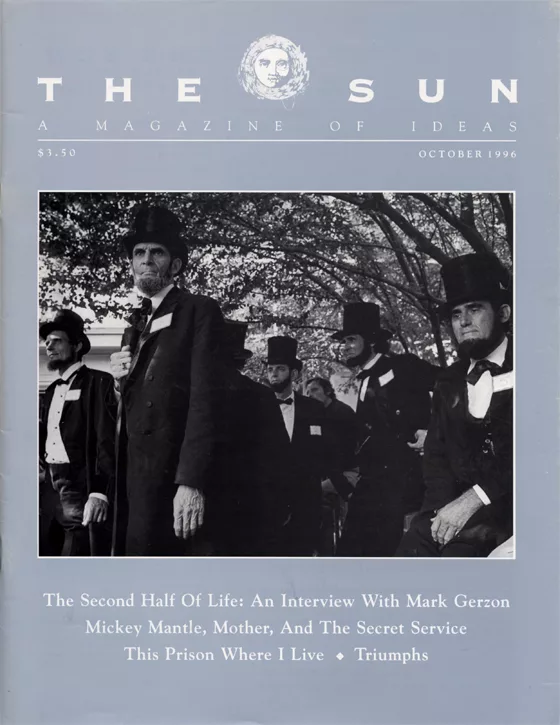
Gerzon arrived at middle age with a great number of accomplishments under his belt, but that didn’t protect him from the anxiety and uncertainty associated with midlife. His attention turned to the conflicts within, and he emerged with a radically different idea of what aging is all about. In his book Listening to Midlife: Turning Your Crisis into a Quest (Shambhala), Gerzon outlines what he sees as the purpose of the second half of life.
Gerzon is cofounder of Common Enterprise, which seeks to rebuild a common ground of discourse in America. His most recent book is A House Divided: Six Belief Systems Struggling for America’s Soul (Tarcher).
— Andrew Snee
Toms: As I get older, I notice that more and more older people are doing things they weren’t expected to do in the past. I think of Nolan Ryan, the great pitcher, who can still throw ninety-five-mile-an-hour fastballs at an age when most ballplayers have retired. My wife and I joke that he must have made a pact with the devil.
Gerzon: Or a pact with God. One of the great surprises for me as I grow older, and as I’ve researched this subject, is the importance of coming to terms with the spiritual in order to understand the second half of life. When I was younger, I didn’t want anything to do with the word spiritual, because I didn’t like people trying to foist their beliefs on me. But as I grew older I found that there was no other way to make sense of what was happening.
Toms: Was there a turning point for you?
Gerzon: I think the turning point was achieving what I wanted to achieve. I wanted to help create a greater level of understanding between the Soviet Union and the United States, so I led a project called the Entertainment Summit. When it was over, I felt I’d made a real contribution to ending the Cold War. But afterward I couldn’t figure out why I also felt so horrible. On the outside it was wonderful; on the inside it was hell.
This, it turns out, was a quintessential midlife experience. You’ve climbed the mountain, and on one level you’re ecstatic, because you’ve achieved your lifelong dream, but you also feel this hollowness. In my case it was because, like a lot of men — not only men, but particularly men — I had defined my goals externally. I’d thought, “If I can help bring peace between the superpowers, I will be a happy man.” But that’s a very incomplete understanding, just as incomplete as that of someone who says, “If I have made a million dollars by the time I’m forty, I will be a happy man.”
I vastly prefer the word quest to the word crisis when describing midlife, because crisis suggests danger, something to be avoided, whereas quest suggests adventure and search.
Toms: You’ve pointed out that Thomas Jefferson, in a draft of the Declaration of Independence, changed the phrase “the pursuit of property” to “the pursuit of happiness.”
Gerzon: Because happiness is more than property. In the deepest sense of the word, happiness involves opening to the spiritual dimension of life. Many of the older people I interviewed for Listening to Midlife really live and breathe the meaning of spirit or soul. It’s one of the great gifts that people in the second half of life can give our culture. If, as a culture, we don’t respect older people, then we don’t respect soul and spirit.
I recently conducted a workshop in which a seventy-five-year-old couple participated. They spoke about their recent physical decline and simultaneous spiritual growth in a way I wish every eighteen-year-old in America could have heard. When they first walked into the room, I’d thought, “There’s a nice old couple.” But by the time they left, I saw them as a fountain of wisdom.
Toms: That brings to mind your story about psychoanalyst Erik Erikson at Harvard.
Gerzon: While I was studying there, I was always puzzled as to why this elderly, Old World analyst had such a following among young American students. I think it was because he was one of the few people who addressed the question of what the second half of life is for, and how we grow as adults. Our generation had a fear of growing old. Our slogans were “I hope I die before I get old” and “Don’t trust anyone over thirty.” And here was Erikson saying, not only can you grow in later life, but you may in that period embrace some of the deepest and most important values of civilization in a way that you can’t when you’re eighteen or twenty-five. He gave us a positive image of our future, which everyone needs, at any age. Eighteen-year-olds certainly need it, but so do forty-eight-year-olds. We need more than just an image of decline and deterioration.
Once, at my doctor’s office, I picked up a book called Aging Slowly. It was full of wonderful information about vitamins, health, exercise. But it gave me this queasy feeling in my stomach, and I couldn’t figure out why. I looked again at the title and realized that was what I didn’t like: Aging Slowly. Its goal was to slow the process of aging, which implied that aging is bad. Right at the heart of this wonderful book was this very poisonous message.
Toms: And we’re surrounded with advertising messages telling us how much better it is to be youthful. We don’t see many old people in advertising, only young people.
Gerzon: And something like 80 percent of the characters on television shows are between the ages of twenty-five and forty, which tells you what television thinks of life after forty. You see the same attitude reflected in birthday cards. For one thing, you rarely find cards for sixtieth and seventieth birthdays, and the cards for thirtieth, fortieth, and fiftieth tend to the tongue-in-cheek put-downs. When I give lectures around the country, I often bring one with me that says on the front: “Congratulations, you’re turning fifty.” When you open it, it says, “Whatever for?” People in our culture have forgotten, or have never known, the purpose of the second half of life. We know the purpose of the first half is to go to school, become educated, find a career, find a mate, have kids, buy a home, and become economically successful. But what’s the purpose of the second half?
Toms: What happened to you after the Entertainment Summit — your pinnacle, as you saw it? Did you spiral downward into depression?
Gerzon: I remember getting off the plane, going home, and feeling very tired. I said to my wife, “This is strange, but I feel as if the first half of my life has ended.” As soon as the words left my mouth, I regretted them, because the idea sounded flaky. But I think I was feeling what Buzz Aldrin, who landed on the moon, called “the melancholy of all things done.” I couldn’t imagine doing anything else. Nothing seemed worth doing. It didn’t feel like simple depression, but something much more mysterious.
Then I read what Carl Jung, Murray Stein, and others had written about midlife, and I realized that I was supposed to be feeling this sense of despair and purposelessness. But I still had to figure out why I was feeling it. I needed to open up to a deeper, inner level.
Toms: Most cultures honor elders in distinctive ways; we, on the other hand, give them mandatory retirement. Just the idea of retirement — that someone should withdraw from life, from doing anything worthwhile — says a lot about our attitude. Why does our culture have such disrespect for growing old and the elderly?
Gerzon: I recently read an interview with Steve Allen, the comedian and entertainer, who said, “I’m old enough that I don’t have to pretend to be modest: I do everything better now. I sing better. I do comedy better. I write better. I make love better. I am better.” And he asked exactly the question you’re asking: “Why do we have such a negative image of old age?” I think the key answer is that, in a culture that doesn’t respect spirit or soul, but only the material, old age is a disaster. Joseph Campbell used to liken an old person to a car: first, the fender starts to fall off, then a headlight, and so on. But, he said, inside the vehicle is a driver. And I think that’s the key. Until our culture reclaims its soul, we will continue to see the elderly as a problem, as a drag on us economically; and there’s going to be more and more of them, so we’re going to see more and more economic resentment.
In workshops, I often put participants in a circle called the life wheel, beginning with the youngest person, who’s usually twenty, on my left, and moving around to the oldest person, who’s usually around seventy, on my right. In this way, we can see what the cycle of life looks like. Almost always, people are moved to tears, not because of anything I’ve said, but simply because they are seeing, perhaps for the first time, the reality of the human life cycle. It’s very powerful. It reminds us that we segregate ourselves too much. Everybody who’s old lives in Florida or Arizona, and everybody who’s eighteen to twenty-two lives on college campuses, and everybody who’s in midlife lives out in the suburbs. We’ve lost the gift of the wheel of life.
Toms: Joseph Campbell used to say that as one climbs the ladder of success, one often reaches the top and realizes the ladder is against the wrong wall. How can you find out before it’s too late if your ladder is against the wrong wall?
Gerzon: We need to let go of the ladder image altogether, because it’s one-dimensional, and I don’t know anyone whose life is one-dimensional. I prefer the metaphor of the double helix, the structure of DNA, a sort of winding staircase of two interwoven ladders. We have an external professional life, but we also have an internal part of our life that has to do with how we feel about our bodies, our spouse, our appearance, our spirituality. As in the double helix, those two ladders are connected. What’s wrong in our culture is that we overvalue the external dimension and undervalue the internal.
Toms: You’ve said you see life, particularly midlife, as a quest.
Gerzon: I vastly prefer the word quest to the word crisis when describing midlife, because crisis suggests danger, something to be avoided, whereas quest suggests adventure and search. It’s also the root of the word question, and in the second half we ask a lot of them. I ask people, “What are you questioning now about your life?” They say, “I’m trying to figure out why I’m so unhappy in my marriage,” or, “I’m trying to figure out why my work feels so empty now,” or, “When I look at myself in the mirror and see how old I look, I wonder how this happened.” “Listen to those questions,” I say. “They are the key to your quest. Follow your questions, not the questions the self-help books say you should be asking.” People need to listen to their own questions, because those questions are absolutely unique to them.
While writing Listening to Midlife I had to struggle against oversimplifying the aging process by dividing it into neat stages. About that time, I did an interview with Michael Murphy, the founder of Esalen, who meditated a lot back in his early twenties and at the age of sixty was making breakfast for his four-year-old son. In other words, he did things backward. He said to me, “I hope you’re not doing one of these stage-theory books, because I think they’re a bunch of baloney.” There is an evolution, a growth, a metamorphosis, but to generalize it is an insult to people’s individuality.
Another common generalization is that, in midlife, men discover their feminine side and women discover their masculine side. There’s a lot of wisdom to that, but it is absolutely wrong for some people. Some men have so identified with their feminine side that for them midlife is discovering the inner warrior. And some women, particularly those who went for success early on, are very male identified. At midlife, their challenge is to rediscover the inner woman.
Toms: As we baby boomers age, we are noticing through our parents what happens to the elderly in our society. Most of us think, “I don’t want to grow old that way.” What do you see that might change?
Gerzon: I think one of the major changes already is that we’re erasing the negative idea that being a grown-up means we stop growing. A woman in one of my workshops said, “I want to know why everybody thinks it’s so strange that at sixty-eight I’m starting a new career.” She was surprised at people’s negative reaction to her growth. I think those people are about a generation out of date, because the kind of growth that’s going on in people’s forties, fifties, sixties, and seventies is fascinating. The most important thing is that we start telling our stories, especially to younger people, so the next generation doesn’t grow up with the same negative programming about the second half of life that we did.
One dramatic story of midlife transformation that many of us have heard is that of Vice President Al Gore. His son was almost killed in a car accident, and when he saw his son lying near death, Gore asked himself, “What does my life mean? What really matters to me?” And he decided that taking care of his son meant more to him than running for president. So he focused on his son, on his family, and on writing a book about the plight of the earth’s environment. And when Bill Clinton looked around for someone to be vice-president, he found a man who was in touch with his soul and living life from a more soulful place. I think that’s why Al Gore is vice-president of the United States today.
Toms: There were a couple of other people whose stories in your book struck me: John Vasconcelos, for example.
Gerzon: John was a state legislator in California and had a severe heart attack in his forties. His cardiologist told him that he’d lost the use of several of his arteries. The amazing thing is that now, twenty years later, John has a healthier heart than he did in his early forties. According to his cardiologist, his heart has healed. To me, this shows that we need to rethink our view, which assumes that as we get older we’re going to become weaker and sicker, that we’re just going to decline until we finally die. We have to recognize that there’s deep healing at work in the human body; that there’s something in the human body other than matter, because matter by itself does decline, does deteriorate.
“Growing old” suggests the only thing going on during aging is the passage of time and the deterioration of the body. . . . However, I believe that, as we enter the second half of life, the side of ourselves that is neglected asserts itself more powerfully.
Toms: You used the term “red-light syndrome” in your book. What’s that about?
Gerzon: In my thirties, I always had an excuse to be in a hurry, no matter where I was going, but I refused to think that I was Type A or a workaholic, because I had such noble motives for everything I did. Then one day I left a wonderful, heart-opening session with a therapist, and, in typical fashion, I raced home to work. On the way, I wanted to take some notes in my journal, but because I was driving I couldn’t write anything down. Then I came to a red light and thought to myself, “Oh, good, it’s red; I can make some notes.” And for the first time I experienced joy at finding a red light. It was a moment of awakening for me. I said to myself, “Mark, if only you recognized the complexity and wonder of your own inner life, you could enjoy every red light you encounter.”
Toms: Yet we try to suppress that inner life.
Gerzon: Particularly when it asks us to change a structure we’ve built in our lives. Think about how many structures we’ve built by the time we reach our thirties or forties or fifties — we have our work structure, our friend structure, our family structure, our body structure, our money structure. So if our inner feelings tell us, “That structure doesn’t work anymore; get rid of it,” then we’ve got a problem, because it’s much easier to let that structure sit there. To me, the key to the second half of life is staying in touch with the part of us that is capable of change.
Toms: I think we attach ourselves too much to various roles in life. We become “the business executive” or “the writer,” and it’s as if that’s who we really are. If you take away one of these roles, then somehow we lose part of our identity.
Gerzon: And it’s particularly insidious if it’s a good role: the role of father, for example. I’ve been a father for almost twenty years. I love being a father, and I pride myself on being a good one. But it, too, can present problems if you identify too closely with the role, because you can start saying, “I’ve got to be there for my son; I’ve got to be there for my daughter; I’ve got to do this and that for them,” and before you know it, you’re neglecting your own soul. What kind of example are you giving your children if you’re not taking care of your own soul?
It’s a very delicate balance. Sometimes I’ve got to say to them, “I can’t be there for that game because I’m going on a retreat,” or, “I can’t be there because I’m going fishing with a friend.” Because I need to let them know that taking care of my soul is part of being a good father to them. And I think the same goes for work and marriage and every other part of our lives.
In Listening to Midlife I tell the stories of a number of people who had the courage to say no to the careers that they built in the first half of their lives. One was an advertising executive who wrote a book called Executive in Passage. His journey began, as mine did, right after he achieved something he’d wanted: he had become vice-president of his advertising firm. Shortly after that, he was making a presentation to a company and his voice simply ceased functioning. His hands started sweating, his throat seized up, and he literally couldn’t talk. When he found his voice again, he realized that he was ashamed of the clients and products he was promoting, that the work was not nourishing him, that his life was empty. So losing your voice can be a prerequisite for finding it again.
Toms: You often use the phrase “growing whole” rather than “growing old.” What does it mean to grow whole?
Gerzon: The phrase “growing old” suggests the only thing going on during aging is the passage of time and the deterioration of the body. I think something else is happening, however. I believe that, as we enter the second half of life, the side of ourselves that is neglected asserts itself more powerfully; I call that wholeness. For example, somebody whose life has been totally preoccupied with work discovers that work isn’t everything. Conversely, a person who has always been a homemaker discovers at midlife, “By God, I want a career.” The parts of ourselves that have been in the shadows seek the light. The parts that have been undernourished seek nourishment. That’s where the phrase “growing whole” comes from.
Toms: You see these ads lately for wonder drugs that purportedly slow down the aging process. There’s something disturbing about them.
Gerzon: It’s the twentieth century version of the fountain of youth, the search for everlasting life. People are endowing these products with the power of divinity, the power to prolong their life. Don’t get me wrong: I think it’s wonderful that science is giving us ways to feel better as we age, but it’s dangerous if we start using them as a substitute for our spiritual quest. They can block out the recognition that we need to open up to the spirit. Even if you have cosmetic surgery every two years and continue to look thirty-nine, you still need to open to the soul. Don’t let cosmetic surgery become a substitute for recognizing what age is trying to teach us.
The actor Hume Cronyn once said, “I never want to have a smooth face.” And Jessica Tandy, his wife, replied, “Don’t worry, you don’t.” He wanted his wrinkles. “I especially want my smile lines,” he said, “but I want all my wrinkles, because that’s who I am.”
Toms: What about the life-extension movement, or even the immortality movement, which promises we can live forever by freezing the body? They certainly say something about how we view aging.
Gerzon: Hand in hand with our society’s disrespect for our elders is the fact that we deny death. We want to deny our mortality. As the examples of Al Gore and John Vasconcelos show, brushes with death, or a relative’s near death, are often closely associated with entry into the second half of life. As they enter midlife, many people say, “I feel like a part of me is dying. I feel like I’m in mourning, but I don’t know why.” These statements come up again and again. The pattern is so prevalent that you can’t deny it: a form of death and rebirth is going on at midlife. Jesus said, “You must die to be reborn,” and you can find the same fundamental spiritual message in every one of the world’s major religions.
Toms: So sometimes, in the process of living, we have little deaths that lead up to the ultimate end. We die to who we were before and emerge as someone different.
Gerzon: And the real trick, as we both know, is to do this while simultaneously caring for our children, holding down our jobs, driving on the right side of the road, and so on. Unless you are independently wealthy or a monk or a nun, you have to go through this change in midlife while you continue to handle the financial and social responsibilities of everyday life. This is the real challenge. It’s a dynamic tension between living in the world and continuing to honor this new growth that is happening inside us.
Toms: What’s been lost in Joseph Campbell’s advice to “follow your bliss” is the idea that, when you follow your bliss, the path may lead downward, and you may have to go into the deeper, darker side of yourself; that it’s not all love and light.
Gerzon: You’re absolutely right; there is a notion that growth must feel good. I gave a talk in Los Angeles recently, and a musician played a song before my presentation. A tree, he sang, can’t have branches unless it has roots. The tree can’t spread its branches, experience the joyous celebration of sunlight on its leaves, unless its dark, deep roots sink into the earth. I found the metaphor very powerful. Our culture honors the branch part — the desire to dance or write a bestseller or look prettier or get fit or lose weight. What our culture doesn’t honor is the root part, the part where you’re digging in, where you may be mourning the loss of your youth, or the loss of a loved one.
Toms: Not only does our culture not honor that part; we shut off people who are dealing with that process.
Gerzon: We often tell them they’re depressed and need to see a psychiatrist and take mood-altering drugs. The second half of life often has the appearance of mental illness in the sense that we don’t behave the same ways we did before. We no longer fit into the same roles. We’re not as well adjusted as we were. But if we try to be well adjusted all the time, we will stop growing.
Michael Toms’s interview with Mark Gerzon was originally broadcast on the nationally syndicated public-radio series New Dimensions (program number 2361). © 1996 by the New Dimensions Foundation. An audio version is available from New Dimensions Tapes at P.O. Box 410510, San Francisco, CA 94141-0510, (415) 563-8899. A tape of Mark Gerzon’s lecture “Midlife Quest” can be purchased from Sounds True Recordings, 735 Walnut Street, Boulder, CO 80302.