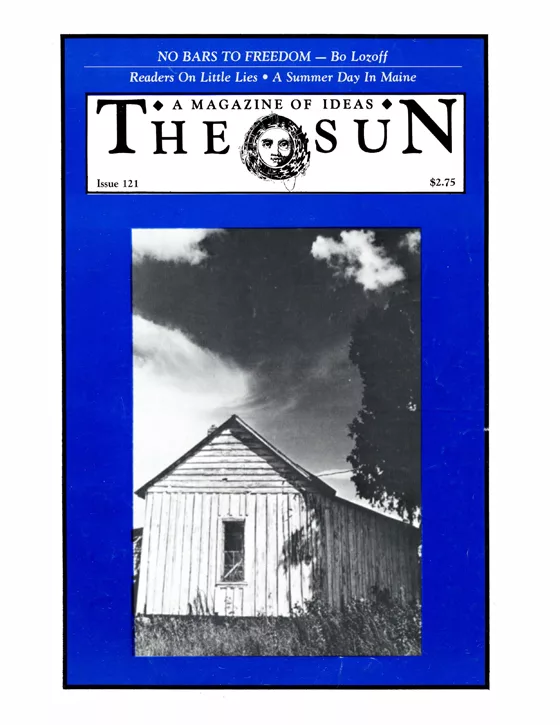
I first encountered Alice Bloom’s writing in Harper’s magazine and sent her a fan letter, which led to her sending me some other things she’s done. This piece originally appeared in The Hudson Review and we’re thankful for permission to reprint it.
Alice is a year-round Maine resident, and, when she last wrote, at the end of hurricane Gloria, had not had power for nearly a week, “and life is far from romantic, even though the store (one store) ran out of everything but patchouli-scented emergency candles, and we must eat, cook, read and grade papers by their light.”
— Ed.
For years my mother’s favorite joke has been the one about the old farmer who, finally facing the fact that his wife is raving mad, calls the State Asylum to come take her away. As the attendants are strapping her into the padded wagon, the farmer scratches his head and says, “Gee, I just can’t figure out how Maw coulda gone crazy. Why, she hasn’t even been out of the kitchen for forty years.”
Pick-Ur-Own signs begin to go up along our country roadsides early in June, beginning with Beet Greens, Spinach, then Strawberries, Peas, Red Raspberries, Pickling Cukes, Blueberries, Beans, Corn, Plums, Pears, and at the end, Apples of many kinds.
Two midwestern ladies on vacation together this Summer, two of the five million “visitors” this state of less than one million “invites” each year, refuse to pay for their lobster lunch at a coastal restaurant because the lobster has “funny green stuff” inside. They are adamant. Explanations from the kitchen do not prevail. They’ve had lobster plenty of times before, they tell the manager, and never have they seen “green stuff” till now. At last a local policeman is called in and he, according to the (delighted) local newspaper accounts, patiently explains to the ladies that “green stuff” is more properly called “tomalley,” is considered a delicacy by many, and anyhow it comes, being the very guts of it, in every Maine lobster.
As Puritans and other old-timers well knew, green stuff is the guts of everything in Maine and what’s more, it is always on the move against the human clearing. “Sixty years ago,” an old native told me, “this town was beautiful, all cleared fields, you could see right from here to Kent’s Hill, and look at it now, it’s a mess, all trees, just nothing but trees.” Today, first of September, green stuff takes the form of ten cords of uncut, unsplit birch and oak dumped in our sideyard to feed, once it’s cut, split, and stacked, two stoves this coming Winter. By early Fall, the Pick-Ur-Own is stashed away or eaten, until apples, but our own vegetable patch is on the march toward the kitchen door, armed with large, soft tomatoes and baseball bat-sized zucchini. Despite our efforts with ax, clippers, and scythe in the Spring, the alders and maple saplings and some Laocoon of a vine have taken over, once more, the meadow behind the chicken yard. The new roof is on the house, though, and the new septic field dug, new pipe and fourteen concrete leeching chambers installed, covered, newly grassed over; but school began again this week for three of the household, and more guests are coming this month, they write: on Sabbatical, which green stuff never takes.
How tempting then, given this racket of bounty, to begin a letter from Maine with the well-ripened staple of female humorists since The Egg And I: what do I know about Summer up here or anything else for that matter, what between the guests and the green stuff, I never get out of the kitchen. In ten years of living in Maine, however, I’ve learned quite a bit in the kitchen. It takes, for instance, two warm days for twenty quarts of unrefrigerated strawberries to attract fruit flies. It takes eight cups of blueberries to make two pies which, cut gingerly, will feed an unexpected seventeen. It takes one visiting city child, allowed the treat of gathering brown eggs from hot nests, four minutes to drop a basket containing a dozen and a half. It takes forty gallons of sap to make one gallon of maple syrup and many Sunday nights of waffles to use that much. It takes twenty-six pints of bread and butter pickles to get through nine months of school lunches. It takes three cars to get through one Winter because two out of the three will generally be broken down in one to four crucial places. Depending on how late in the season you pick the apples (the later, the drier the apple) it takes twelve to fifteen, fifty-pound feed sacks to make one fifty-gallon barrel of cider, and one backhoe, three sturdy men, and two good-sized logs to roll one barrel down into the cellar hole. It takes two field rats of opposite sex one Autumn under the woodshed to ensure the existence of Rat until Doomsday. Later on, it will take seven weeks of commotion and rehearsal to get thirty-eight people, children’s chorus included, organized to perform one night of A Christmas Carol for the tenth Annual Town Christmas Revels; and so on.
The view from the kitchen window is pretty-damned decent, and would encourage one to go on cooking. All looks fairly right with the world. Old friends, guests for the week, are playing and laughing in the backyard despite the drawbacks of the K-Mart badminton set. Their nice children, and ours, all of whom have good teeth, good grades, and play various musical instruments, have politely relinquished the rackets and birdies to the city-tired but newly playful adults, and are sitting at the picnic table with lemonade and (Laurel died) Hardy, the aged rabbit, who now and then makes a slumbrous, nervous jump at an oatmeal cooky. The children have also pulled a baby carrot for him, and behind this afternoon group, variously awaiting the dusk with its long lamp-lit table, sweaters, chickens marinated all day in lemon and garlic, good talk, fireflies and then stars, is the gray-green herb garden with its tidy, new, old-brick walk, good supply of basil this year, and lavender, and behind that a wash of yellow coreopsis and royal blue delphiniums and behind that, we’re grateful, the new pear trees did survive after all a first Winter of being bark-gnawed by mice. Trees surround us on every side, once fields, and in one of them, a nightly whippoorwill, around 8:30, does so rinse and wring the ear. Last night, returning home from a Farm League baseball game, there’s a baby moose eating beneath the crabapple tree. For the moment, the cars are running, the roof job wasn’t as much as we expected, a neighbor has just shown up with a blackberry tart and yes, she will stay for a round of badminton; and so out of this kitchen window with its sleeping cat, its late sun, its pot of rosemary, its fresh wind, its fading blue-checked curtains, things look good and it’s hard to remember, for the moment, that one of the badminton couples is quietly contemplating a divorce after fifteen relatively decent years and one of their nice children is suddenly having recurrent nightmares and bed-wetting; and that the friend blowing on the charcoals was just rejected by the tenure committee of a university he very much trusted to keep him; but still, despite these and other particular ills and not uncommon turns, we’re held here together this Summer afternoon, as if in the warm palm of a small, walled city.
What? What is this Summer day in Maine? A tenth-century monastery, protecting herbs and manuscripts? A prolonged performance of The Cherry Orchard? A real life Country Chic shop? Just about, all of the above. Yet it’s an assemblage of modest bits, all in all: backyard, lemonade, supper, pets, friends, the life that used to be reluctantly inherited in suites like living-room furniture, but which is now constructed stick by stick, folk art, whimsies, Victorian sideyard follies, miniature villages built with available scraps, quaint, an individual vision. “You’re just escaping reality, you know,” even good friends told us when we moved here. That has turned out to be not quite it, for on the one hand, we have never before faced so much reality, in the form of inexorable green stuff. And on the other, much of the reality we now face we have invented, which is much more cowardly and reprehensible than any escape. And on bad Summer days, the view from the kitchen window, its pleasures toted up, seems a trifling decadence, irrelevant as a gift shop. We’re poachers, cranks, decorators, dilettantes, gourmets, connoisseurs, hobbyists, and despite the ten cords of uncut wood, ivory tower dwellers to the teeth. Such invention is a by-product of the times, and even this is only possible because we’re just barely still off the edge of the times, and thus, enormously privileged.
For a while yet. We live in what an ad in a recent Maine Publicity Bureau publication calls “the Other Maine . . . still undiscovered, still unspoiled . . . there are no crowds, no traffic jams, just fresh air and quiet and untouched natural beauty that has always waited, patiently, to be appreciated.” Really? These alders don’t look to me like they’re waiting to be appreciated. They look like they want to grow right up against the windows, to me. Come inside, which they will do, have done in many abandoned farm kitchens along our undiscovered roads. Whatever, our Summer day is advertised, and it won’t be long before “Vacationland” resembles the “Garden State.”
Tourists, though, even five million a year of them, and what wheedling and cluttering is done to coax their trade, only represent a runner, sent somewhat ahead of the marauding Times. They are out there, the awful, rotten, trashy, dangerous, ugly Times, and they are moving this way fast. No need to tote that up. The Monster Pig on the horizon, one friend calls it, and no amount of green stuff can obscure its approach.
No Jeremiah paces the backyard, nor our town’s one main street, with a sign announcing the end; but even from the kitchen window, perhaps most especially from the kitchen window because what’s inside feels these days so much in need of protection, it does look as though the world is ending. I perfectly well realize that my reasons for thinking the world is ending are someone else’s reasons for thinking it’s just getting good; that my cup of dark brew is someone else’s Tequila Sunrise; that my idea of waste and danger is someone else’s idea of a swell afternoon; and that there are those who think the installation, in many country towns in Maine this past year, of — just one Image from the Times — franchised “Family Arcades” in the spare back rooms of general stores, is the best thing since refrigerated beer. And they see nothing wrong either, and they say “So?” to the daily event of teenagers who spent last Summer’s after-school hours doing sports, homework, music, helping out around the place, grooming pet pigs for the 4-H exhibit at the fair, now looped and bent with fake-vicious, fake-cool faces over two-bit, three-minute “games” of killing or being killed, in a totally absorbing, eyeball-raking, ear-abusing Outer Space where reality’s really at, in the exciting blackness of painted-out windows in the back room (still smelling faintly of kerosene, chickenfeed, seed potatoes) from whose pink and red flashing, exploding, glamorous bowels they will soon be shot, store closing-time, out into the plain, much-resented, flat, sunset world of homework, stupid teachers, parents, chores, that dumb pig mewing for its meal, the tan pedestrian future in which, barring fatal car wreck or interstellar hand-to-hand combat, this just-experienced cacophony of thrills, speed, and daring will never be duplicated, into the real everyday 5:30 of us all; returning home, no monsters, no pink weapons, nothing flashing, and the mood of return blows along the dinky country black-top road outside the store like so many dirty candy wrappers, bits of hay ground into the dust and grime, vegetable tops, empty rolling cans, the Exxon sign squeaking in the wind, dull tomorrows, Mom’s voice yelling supper out the blasted kitchen window. Ah shit, they say, and feel.
Reprinted by permission.
From The Hudson Review, Volume 36, Number 4,
(Winter 1983-84).
Copyright © by The Hudson Review, Inc.