A Vietnamese monk, author, and peace activist, Thich Nhat Hanh is one of the best-known Buddhist teachers in the West. In the fifties, in Vietnam, he helped found the “engaged Buddhism” movement, an effort to combine religious practice with active involvement in the world. When war broke out, he lived up to this philosophy, forming a nonviolent resistance movement that grew to include ten thousand Vietnamese.
In 1966, he came to the U.S. to speak out against the war. Here, he crossed paths with Martin Luther King Jr., and the affinity between the two advocates for peace was so great that King nominated Thich Nhat Hanh for the Nobel Peace Prize, saying, “I know of no one more worthy . . . than this gentle monk from Vietnam.”
For four years, Thich Nhat Hanh led the Buddhist peace delegation to the Paris peace talks. When the war finally ended, he found himself exiled from his homeland for his political activism. He settled in a small community south of Paris, and continued to aid his countrymen, organizing a rescue effort for Vietnamese boat people in 1976. He now lives and teaches in Plum Village, a retreat center for the practice of mindful living in southwestern France.
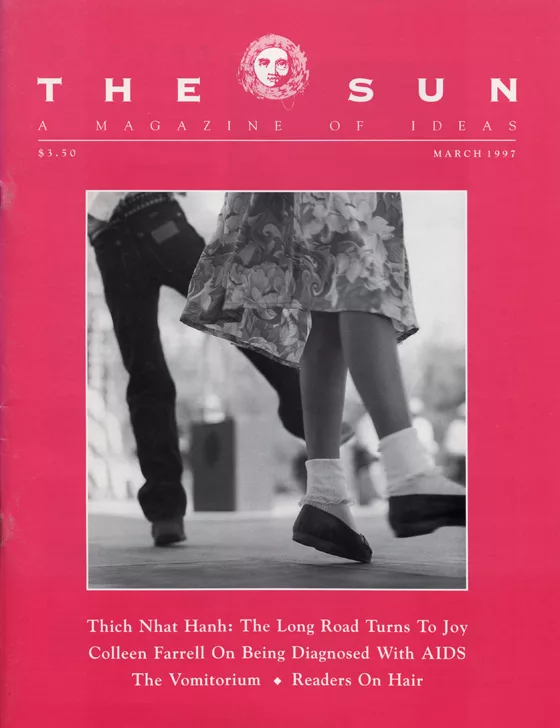
In the following excerpt, Thich Nhat Hanh describes the practice of walking meditation — walking, not to get somewhere, but to enjoy and be mindful of each step. “We walk slowly,” he says, “in a relaxed way, keeping a light smile on our lips. When we practice this way, we feel deeply at ease, and our steps are those of the most secure person on earth.”
— Andrew Snee
The Buddha was asked, “What do you and your disciples practice?” and he replied, “We sit, we walk, and we eat.” The questioner continued, “But, sir, everyone sits, walks, and eats.” The Buddha told him, “When we sit, we know we are sitting. When we walk, we know we are walking. When we eat, we know we are eating.”
Most of the time, we are lost in the past or carried away by the future. When we are mindful, deeply in touch with the present moment, our understanding deepens, and we begin to feel acceptance, joy, peace, and love.
In Buddhism, there is a word, apranihita. It means wishlessness or aimlessness. The idea is that we do not put anything ahead of ourselves and run after it. When we practice walking meditation, we just enjoy the walking, with no particular aim or destination. Our walking is not a means to an end. We walk for the sake of walking.
A. J. Muste said, “There is no way to peace; peace is the way.” Walking in mindfulness brings us peace and joy, and makes our lives real. Why rush? Our final destination is only the graveyard. Why not walk in the direction of life, enjoying peace in each moment, with every step? There is no need to hurry. Enjoy each step. We have already arrived.
The war in Vietnam caused countless injuries to the minds and bodies of people on both sides. Many soldiers and civilians lost arms or legs, and now cannot join their palms together to pay respects to the Buddha or practice walking meditation. Last year, two such people came to our retreat center, and we had to find alternate ways for them to practice walking meditation. I asked each of them to sit in a chair, choose someone who was practicing walking meditation, and become one with that person, following his or her steps in mindfulness. In this way, they made peaceful and serene steps together with their partners, even though they themselves could not walk. I saw tears of joy in their eyes.
We who have two legs can easily practice walking meditation. We must not forget to be grateful. We walk for ourselves, and we walk for those who cannot walk. We walk for all living beings — past, present, and future.
The First Noble Truth taught by the Buddha is the presence of suffering. Awareness of suffering generates compassion, and compassion generates the will to practice the Way. When I returned to France after trying to help the Vietnamese boat people, life here seemed so strange. I had just seen refugees being robbed, raped, and killed at sea, but in Paris, the shops were filled with every kind of product, and people were drinking coffee and wine under neon lights. It was like a dream. How could there be such disparity? Aware of the depth of suffering in the world, I vowed not to live superficially.
The practice of walking meditation opens your eyes to both the wonders and the suffering of the universe. If you are not aware of what is going on around you, where do you expect to encounter ultimate reality?
Every path can be a path for walking meditation, from tree-lined roadsides and fragrant rice paddies to the back alleys of Mostar and the mine-filled dirt roads of Cambodia. When you are awake, you will not hesitate to enter any path.
You will suffer, not just from your own worries and fears, but because of your love for all beings. When you open yourself in this way, you will find companions on the path of awakening who share your insight. They will work with you, side by side, to alleviate the world’s suffering.
Imagine that you and I are astronauts. We have landed on the moon, and we find that we cannot return to earth because our ship’s engine is broken beyond repair. We will run out of oxygen before Mission Control can send another ship to rescue us. We have only two days to live. At that moment, what would make us happier than to return to our beautiful planet and walk on it? When confronted with death, we realize the preciousness of walking on the green earth.
Imagine now that we have somehow miraculously survived and been transported back to earth. Let us celebrate our joy by walking on our beautiful planet together, with deep peace and concentration.
The Pure Land of Amitabha Buddha is said to have lotus ponds, seven-gem trees, roads paved with gold, and celestial birds. But to me, dirt paths with meadows and lemon trees are much more beautiful. As a novice monk, I told my master, “If the Pure Land does not have lemon trees, I don’t want to go there.” He didn’t say anything. He may have thought I was stubborn.
Later, I learned that this world and the Pure Land both come from the mind. That made me very happy.
If I had supernatural powers, I would take you to the Pure Land of Amitabha Buddha, where everything is beautiful. But if you bring your worries and anxieties there, you will defile it. To be ready to enter the Pure Land, you have to learn to take peaceful, anxiety-free steps. In fact, if you can learn to take peaceful, anxiety-free steps here on earth, you won’t need to go to the Pure Land. When you are peaceful and free, the earth itself becomes a Pure Land, and there is no need to go anywhere else.
“The Long Road Turns to Joy” is excerpted from The Long Road Turns to Joy: A Guide to Walking Meditation. Copyright 1996 by Thich Nhat Hanh. The excerpt appears here by permission of Parallax Press, Berkeley, California.