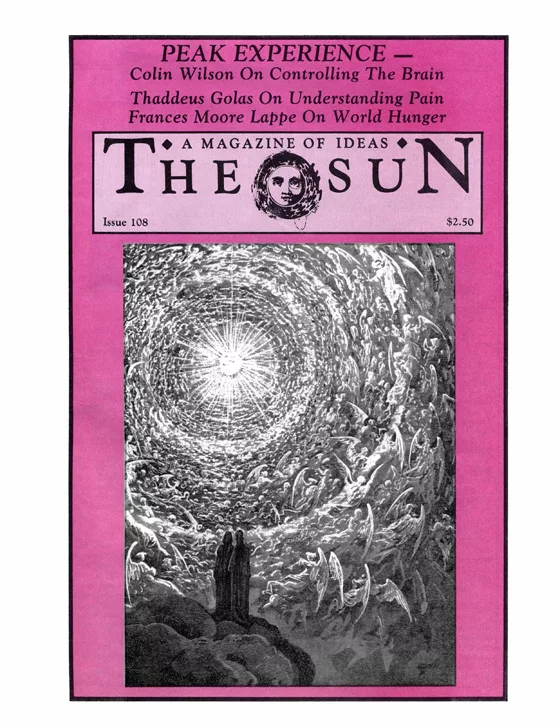
This is one of the liveliest things I’ve read in a while about human consciousness. To students of brain research it may be old-hat, but I’m delighted when such vital ideas are made so understandable. Reading it made me happy.
This talk, by Colin Wilson, is included in The Schumacher Lectures, Volume II, edited by Satish Kumar, who also edits my favorite English magazine, Resurgence.
Resurgence, generally, and The Schumacher Lectures, specifically, honor the work of Dr. Ernst Schumacher, an economist and the author of Small Is Beautiful — Economics as if People Mattered, one of the manifestos of the appropriate technology movement. Schumacher, who died in 1977, wove together insights about alternative energy sources, meaningful work, world peace and spirituality in a far-reaching vision; to honor his work the Schumacher lectures are held in Bristol, England each year.
The Schumacher Lectures, Volume II, is an important and wide-ranging book that includes talks by the poet Gary Snyder, author Wendell Berry, Russell Means of the American Indian Movement, and feminist poet and philosopher Susan Griffin.
Colin Wilson, whose “Peak Experience” is reprinted here, is the author of The Outsider and forty-five other books. He was about to write a book with Dr. Schumacher before Schumacher’s death. Colin Wilson’s most recent book is The Criminal History of Mankind (Putnam).
— Ed.
I was going to write a book about Schumacher just before he died. I feel that his ideas were a natural extension, in a social direction, of my own work.
I had always been preoccupied with the problem of the person who stands alone in a society that he feels to be too big and too impersonal. This was the basic theme of The Outsider.
Somewhere in The Outsider I say that I feel that the Outsider dislikes the whole idea of civilization itself, because it destroys the sense of individuality. That is, of course, a deliberate overstatement. And yet, lecturing in America not long after The Outsider came out, I was struck by the awful impersonality of the universities, where in many cases the classes were so big that the students had to sit in other rooms watching the lecture on TV monitor. I could see clearly that it must be almost impossible for many of these students to get that personal, individual feeling that could develop into creativity.
Because this, it seems to me, is the fundamental aim of civilization. This is what it is about. It is an attempt to promote creativity in the individual, because this is the highest thing of which the individual is capable.
In the late 1950s, I received a letter from the American psychologist Abraham Maslow, who was writing to me about a book of mine called The Age of Defeat. Maslow said that I was attacking the same problem that had obsessed him for years: that our civilization has a kind of premise of defeat — that our art, our literature, our culture seems to spring from the notion that ultimately the individual cannot make much of an impression on the civilization; he is helpless, a mere member of the crowd.
Maslow also sent me some of his papers. I must admit that when I read their rather academic titles, I delayed reading them for a long time. When I did start to read one of the papers, about six months later, I was immediately excited by Maslow’s central thesis, which was this: that psychologists are always studying sick people, because sick people are always talking about their sickness, while nobody had ever thought of studying healthy people, because healthy people never talk about their health. Maslow argued that we would do better to study the healthy. He inquired among his friends, asking, “Who is the healthiest person you know?” And then he proceeded to study a number of these healthy people, and was amazed to discover something that no one had ever discovered before, because no one had ever thought of studying healthy people: that is, most of them appeared to experience with a fair degree of frequency what Maslow called “peak experiences.” These were just sudden bubbling, overwhelming moments of happiness. They were not in any sense mystical experiences.
A young mother was watching her husband and kids eating breakfast, when suddenly a beam of sunlight came in through the window, and she thought, “Aren’t I lucky?” and went into the peak experience. A hostess who had just given a very successful party, looking around the room at the cigarette butts trampled into the carpet, and the wine spilled on the armchairs, nevertheless suddenly went into the peak experience. Maslow said that the peak experience seemed to characterize all healthy people. It was basically a sudden powerful surge of unconscious vitality. I was immensely struck by this, and wrote to Maslow about it. I ended by writing a book about him called New Pathways in Psychology.
As soon as I read Shumacher’s Small Is Beautiful, I could see that this was a logical extension of Maslow’s ideas — that the healthy person is the person who does not feel overwhelmed by his environment. He doesn’t feel helpless, he doesn’t feel a cog in a machine; he preserves a sense of drive, of individuality and creativity. And clearly the problem for the whole civilization is this problem of how to keep things “small” enough, so that as many people as possible can experience the sense of individuality.
I recognized that my own background in Leicester, my home town, had exercised a strong influence on me, largely because it was so claustrophobic and boring. And the same appears to be true of an enormous amount of writers of the present century: James Joyce’s Dublin, Bernard Shaw’s Dublin, H. G. Wells’s Lewisham, Arnold Bennett’s Burslem, Proust’s Combray — all very small places that enable their inhabitants to feel individual among other individuals. Of course, what it really amounts to is feeling yourself to be a small fish in a small pond. If you are a small fish in a big pond, you are bound to lack that sense of individuality. I recognized this when I first went to London at about the age of nineteen: the feeling of being completely lost in crowds — that if I was knocked down by a bus, nobody would care. Obviously, we all crave this sense of individuality. Now Maslow had recognized that human beings appear to evolve through a series of needs, or values; he called it “the hierarchy of needs.”
What he meant was this: that if a person was starving and had never had a square meal in his life, then he would dream about food and imagine that perfect happiness would be to have one really good meal every day. Yet if he achieved this, the next level would emerge: the need for security, for a roof over one’s head. (This is why every tramp daydreams of a country cottage with roses round the door.) If he achieves this “territorial” level, then the next level emerges: the need for love, for a feeling of belongingness, of intimacy with another person or persons. If these needs are satisfied too, says Maslow, then the next level emerges: the need for self-esteem, the need to be respected and liked by other people. This is the level at which women invite the neighbors to coffee mornings, and men join Rotary Clubs.
If the self-esteem level is thoroughly satisfied, then, said Maslow, the next level — with luck — emerges (and he said “with luck” because, for some reason, many people do not appear to ever reach this level): this is the creative level, what Maslow called “self-actualization.” By this, he didn’t necessarily mean art or science or some other form of creativity. Self-actualization means doing something purely for the pleasure of doing it well. In one case he cited, a woman was particularly good at fostering children, and continued to do this when her own children were grown up. Another man was skillful at putting ships in bottles, and he did it brilliantly: obviously, this satisfied the self-actualizing need in him. Self-actualization seems to be the pinnacle of the hierarchy of needs.
Fortunately, in our society, most people have achieved the first three levels anyway — the basic needs for food, for security and for some kind of warm human relationship. The need that a majority of people have still not satisfied, and that becomes increasingly urgent in a society like ours, is the self-esteem need — the need, if you like, for some kind of “recognition,” if only by a very small group of neighbors and friends. And this is obviously one of the basic problems of our civilization, with its increasing tendency to de-individuation: self-esteem. It obviously cannot be satisfied if you are in such an enormous pond that you feel alienated from everybody else — in other words, if you feel a nobody.
This is what I identified in The Outsider as the basic Outsider problem. Now, it seemed to me that in recognizing that it is possible to decentralize society, to live in much smaller units, Schumacher had made an immensely important contribution. He had, of course, been anticipated by idealists like G.K. Chesterton and Hilaire Belloc, who called their political philosophy “Distributism”; it was usually summarized in the phrase, “Two acres and a cow.” Clearly, two acres and a cow would not solve the problems of the modern city-dweller. But Schumacher had seen that Distributism could be brought up to date, that we could live in a completely different kind of way. When I first came upon his ideas — in a television program — they excited me so much because it was already clear to me that we have got to live in a completely different kind of way if we are to satisfy the basic human need for self-esteem. And, as Maslow said, unless we satisfy this need for self-esteem, it is impossible to move beyond it to the level of self-actualization — which would be the ideal level for society.
I wrote to Schumacher; we corresponded, and I went to see him at his home to discuss the idea of a book about him. (He was also a friend of Maslow.) Then, while the book was still in the planning stage, he died. It was only after Guide for the Perplexed came out that I realized that Schumacher, like myself, had turned away from the social aspect of the problem — which is indeed very important — toward what seems to be in a sense even more important: the problem of the lone individual in our society.
At the time when I wrote The Outsider — in my early 20’s — I was hardly interested in politics, and after every lecture I gave, somebody would always ask the same question: “This is all very well, but how could your ideas improve our society?” And I always had to admit that I couldn’t see any obvious way in which they would improve our social conditions. For, as far as I could see, improving society has to start by improving the individual. It was pleasant for me to discover that this was the conclusion Schumacher came to in Guide for the Perplexed. And in that beautiful appendix — for anyone who hasn’t read the book, I suggest you start with the epilogue — he quotes Dorothy L. Sayers on the subject of Dante; she said that Dante’s Inferno is a picture of human society in a state of sin and corruption, and then goes on to say that these are the problems of our own society: “Futility, lack of a living faith, drift into loose morality, greedy consumption, financial irresponsibility, self-opinionated and obstinate individualism, and violence.” Schumacher goes on to point out that Dorothy L. Sayers wrote this thirty years ago, and that things, if anything, are now much worse. Then he goes on to say that the real problem is that we are trying to live without a religion, and I don’t think for a moment that Schumacher meant a religion in the sense of some religious sect. What he meant was the kind of inner certainty which provides an anchor against the sense of alienation.
Even at the time I wrote The Outsider, I could see that this was the central problem. If you had an absolutely ideal society with enough material goods for everybody, it would obviously still not guarantee universal happiness. In point of fact, as a student of crime — I am writing A Criminal History of Mankind at the moment — I have always recognized that one of the worst consequences of an increasingly comfortable civilization is a soaring crime rate. What is worse still is that the crimes become increasingly violent and sadistic. There are certain crimes of the past two decades — particularly certain examples of mass murder — that would simply never have happened before the 1960’s. There has been an increase in deliberate sadism that is obviously due to sheer frustration.
Yes, the problem begins with the individual, because in an ideal society you could still not guarantee an end to all crimes of frustration. It is obviously necessary, as Schumacher says, to think in terms of religion. Bernard Shaw was one of the first people to recognize this clearly, and to state, “Modern man cannot live without a religion.” Arnold Toynbee made this one of the central theses in A Study of History. And Schumacher is the third important thinker of this century to put his finger on this basic problem.
Now religion is fundamentally something that you live by. Whitehead once said, “Religion is what a man does with his solitude.” Religion is also the ability to induce in oneself a certain inner peace. For me, one of the most important sections in The Outsider deals with the novelist Herman Hesse. (In fact, I was the first person to write about him extensively in English.) I was particularly excited by his novel Steppenwolf, which seemed to me to express this central problem with unparalleled clarity. Steppenwolf is a would-be writer who is fairly well-off; he lives in a comfortable room in a comfortable lodging house; he has plenty of books and gramophone records; he has a girlfriend; in fact, he seems to have most of the things that a human being needs to be happy. And yet, for some reason, Steppenwolf is not happy. His problem is a continual feeling of boredom and frustration, that inability to break through to forms of deeper mental intensity. He feels that his consciousness is somehow boring and lukewarm. In the early pages of the book, he describes his frustration and the occasional temptation to commit suicide. Then, later that day, he wanders along to a restaurant for a meal, and as he tastes his first glass of Moselle he experiences that curious sense of deep relaxation that Maslow calls the peak experience. He says, “The golden bubble burst and I was reminded of Mozart and the stars.”
The problem has to do with our senses, and with the curiously “impoverished view of reality” that we hold. . . . Wine, mescalin, pot — all these chemical ways of solving the problem tend to let us down half the time.
And this goes to the heart of the matter. If only there were a way in which you could push a button and induce that experience instantly — make the golden bubble burst so that you are reminded of Mozart and the stars. If only we could do that — if we could even find some drug or chemical that would do it — then we would have solved the basic problem of modern civilization. No more crime, no more war, no more frustration and hatred. Aldous Huxley, you may remember, even suggested that we should all take mescalin for that purpose; but the trouble with mescalin is that it makes you so ecstatically lazy and happy that you don’t want to do anything at all. A pile of unwashed dishes looks so beautiful that nobody would ever want to wash them. So clearly, this is not the answer. Yet you can see that, if we could find a method of inducing Maslow’s peak experience at will, we would have found the answer to this problem.
Schumacher makes another point of fundamental importance in Guide for the Perplexed, in the section called “Adaequatio”: that the problem is that the information that comes in through our senses is not reality. He points out that we see only with our eyes, but with a great part of our mental equipment as well. And since this mental equipment varies greatly from person to person, there are inevitably many things some people can see while others can’t. “Or to put it differently, for which some people are adequate while others are not. When the level of the knower is not adequate to the level of the object of knowledge, the result is not factual error but something much more serious: an inadequate and impoverished view of reality.” Now there, it seems to me, Schumacher has gone to the very heart of the fundamental problem of human existence.
This problem has to do with our senses, and with the curiously “impoverished view of reality” that we hold. And this, I could see from my Outsider days, was the heart of the problem. Steppenwolf solves it for a moment by taking a drink of Moselle, but wine doesn’t always work, and if you rely upon it you become an alcoholic. Wine, mescalin, pot — all these chemical ways of solving the problem tend to let us down half the time. This was something Maslow discovered when he and a psychologist called Hoffer were treating alcoholics. Maslow concluded that alcoholics are very often more intelligent than the average person, and consequently they find the world more dreary and boring than most people; like Wordsworth, they find that “the world is too much with them.” They drink because drinking gives them a brief peak experience, but it doesn’t always work. Sometimes you can feel completely ecstatic on a glass of wine or beer; at other times you can drink a whole bottle of gin and still feel depressed. The alcoholic nevertheless keeps on drinking because this to him seems to be the only way back to the peak experience. And, of course, as they become more resistant to the alcohol, they need larger quantities, and the problem is complicated by a feeling of guilt.
Now Maslow started from the assumption that the alcoholic was probably more intelligent than the average person. He would ask, “What kind of things gave you a peak experience before you became an alcoholic?” Some would mention visual things — paintings, beautiful scenery; others, poetry, music, ballet. What Maslow and Hoffer then did was to administer a psychedelic drug which produced a kind of artificial “lift,” and then would induce intense peak experiences by means of colors blending on a screen, music, poetry read aloud, and so on. They discovered that they got something like an eighty-five percent permanent cure rate. Why? Because the alcoholic was like a man on a kind of descending escalator, doing his best to induce peak experiences but remaining essentially passive, allowing the will to remain half-asleep — waiting, in other words, for the alcohol to carry him like a magic carpet into the peak experience. But as soon as he was carried into a far more intense peak experience by the mescalin and poetry, he would recognize clearly that the peak experience depends upon health, and that health in turn depends upon a powerful will-drive. Just as the body feels healthiest when you are taking plenty of exercise, so the emotions feel healthiest when the will is well exercised. And as soon as the alcoholic recognized this, he instantly ceased to be alcoholic. In a sense you could say that he changed drugs, and used will instead of alcohol. Now this seems to me to be getting very close to a solution of the problem of “impoverished reality.”
Graham Greene stumbled upon another clue, which he describes in an essay called The Revolver in the Corner Cupboard. He describes how, in his teens, his schoolmasters became alarmed because he appeared to dislike sport and sent him to a psychiatrist. After six months of analysis, Greene was much better “socially adjusted,” but found that he was in a state of total depression. He said that everything he looked at appeared to be gray and dull. He could look at some scene which he saw visually to be beautiful but about which he felt nothing whatever. He was in this state of inner-deadness when he discovered in a corner cupboard a revolver belonging to his older brother. He took this on to Berkhamsted Common and played Russian roulette — put one bullet in the chambers, pointed it at his head and pulled the trigger. When there was just a click, he looked down the barrel and saw that the bullet had now come into position. So he had missed death by just one chamber. He said that he instantly experienced an overwhelming feeling of ecstasy and happiness. He said, “It was as if a light had been turned on and I suddenly saw that life is infinitely beautiful.”
I was excited by this story, when I came across it in my early teens, because it shows so clearly what goes wrong with us. When we are bored and tired we are, so to speak, “spread out”; the will is slack; we are passive, like an exhausted swimmer lying on a beach. The moment Greene pointed the gun at his head and pulled the trigger, he went into violent tension. And when he heard the click, he relaxed. And that is the essence of the peak experience. It is a tensing of the will, followed by total relaxation. A movement of contraction followed by expansion. Moreover, the relaxation doesn’t work unless you become tense first. It is like those handbrakes on old cars, where you have to pull it toward you and tighten it before it can be released.
Using Greene’s insight, I evolved a technique for inducing peak experiences. What I did was this: I would take a pencil and hold it up against a blank wall. I would concentrate intently on the pencil until I saw nothing but the pencil, then I’d let go completely, until I could see the whole background of the wall behind the pencil. Then I would concentrate intently on the pencil again, and then let go again, and so on. When I had done that about ten times, I would begin to feel a kind of pain behind the eyes. When you feel that pain, press on as hard as you can, because you are almost there. Two or three more times and suddenly you relax totally into the peak experience. And if you do it with total conviction, it always works. Not long ago in Finland, I was explaining this technique to a class, and in the following session I explained to them about Wilhelm Reich’s breathing techniques. Reich said that in order to breathe properly you must take a deep breath, then allow it to go out first of all from the chest, then from the stomach, and then finally from the genitals. As Reich made his patients do this, he would say, “Out, down, through.” I was explaining the Reichian breathing to them as we all lay around on the floor and then, on the spur of the moment, I decided to try and combine it with the “pencil trick.” Breathing slowly and deeply, we held the pencil up against the ceiling, concentrated intently, and then let go. To my astonishment, the two combined perfectly. Within a few minutes, I felt almost as if I had floated up from the floor toward the ceiling. The curious thing is that the total concentration of the pencil exercise and the total relaxation of the breathing exercise somehow combine in the most peculiar way to produce an instant peak experience. We all lay there quietly for well over half an hour, until I looked at my watch and said, “Hey! We are missing lunch!”
But why does it work? I discovered the answer only a few years ago, when I was reading a book about the split-brain experiments of Roger Sperry and Michael Gazzaniga. I must admit it came to me as a revelation.
What it amounts to is this. If you could take off the top of your head and look down on the brain, it would look like a walnut joined together by a kind of bridge. This bridge is called the corpus callosum, or commissure — a block of nerve fibers. In the 1930’s it was discovered that severing the commissure would prevent epileptic attacks: it appears to prevent the electrical storm from passing from one side of the brain to the other. Oddly enough, this operation appeared to make no difference whatever to the patient. No one could quite understand why this should be so. Somebody even suggested that the only purpose of the corpus callosum is to stop the brain from sagging in the middle. It wasn’t until Roger Sperry began repeating these experiments in the 1950’s that he discovered that, in fact, there is a basic difference in split-brain patients. The difference is that you become two people.
We have known for about a century that the left side of the brain deals with speech, reason, coping with the external world. The right side of the brain deals with pattern recognition and intuition. To put it crudely, the left side is a scientist and the right an artist. For some odd reason, the left side of the brain controls the right side of the body and vice versa — no one knows why. We could also say — I am deliberately over-simplifying — that the left cerebral hemisphere controls the right eye and the right hemisphere controls the left eye. Now if you show a split-brain patient an apple with the left eye and an orange with the right — so that one cannot see what the other is looking at — and ask, “What have I just shown you?” he will reply, “An orange.” But if you say, “Write with your left hand what I have just shown you,” he will write, “Apple.” In the same way, a patient who was shown a dirty picture with the right side of her brain blushed. When asked why she was blushing, she said, “I don’t know.” One split-brain patient tried to embrace his wife with his right hand while the left tried to push her away. Another tried to do up his fly with his right hand — connected to the logical half of the brain — while the left tried to undo it. Obviously, the two different sides of the brain had completely different intentions.
Now you observe that when the patient is asked, “What have you seen?” it is the left side of the brain that answers the question. In other words, the person you call “you” lives in the left side of your head. The person who lives over there in the right-hand side is a total stranger. Now you will say that this is obviously untrue because we are not split-brain patients. Yet, in an important sense, we are. Mozart said, for example, that melodies were always walking straight into his head fully formed. What he meant was: melodies were walking out of his right brain into the part of the brain in which he lived. And this is true for all of us. Although we are vaguely aware of the right brain and its activities, we are not closely connected to it. This explains, for example, why you become self-conscious if someone looks over your shoulder when you are writing. When you are engaged in any interesting task, you “forget yourself” and become absorbed in what you are doing. The left and right brain enter into close collaboration, the right supplying the intuition, the left supplying the mechanical skills. When someone looks over your shoulder, the left becomes “self-conscious” and promptly loses contact with the right. The flow of meaning stops, and you feel somehow “stranded” in the present moment. The same thing would happen if you tried to play a piano attending to your fingers. You would play very badly indeed. A good pianist ignores his fingers — he attends from the fingers to the music. Attending to things is a sure way of screwing yourself up. You must attend from them to the meaning.
I could recognize the same process in my activity as a writer. When I first started writing, I found that trying to capture intuitions on paper seemed to strangle the life out of them. When I went back to look at what I’d written the next morning, it wasn’t there anymore. The words seemed dead and lifeless. The meaning had evaporated. I even began to suspect that words are a straightjacket that cripple the intuitions. But I kept on trying, because that was all there was to do, and eventually I found that I got good at it. One day, I re-read what I’d written the night before, and it was still there. And after that, I recognized that good writing was an interplay between two halves of the brain, very much like a game of tennis. The right produces the insights and the left turns them into words. If the left verbalizes an insight with particular neatness, the right gets excited and says, “Yes, yes, that’s exactly what I meant!” And the left would say, “Really? Thank you,” and would proceed to do it even better. And then suddenly the two of them were working together like a couple of top-class tennis players, or like two lumberjacks at either end of a double-handled saw. States like this are obviously what we call inspiration — and they consist of perfect cooperation between the right and the left.
One split-brain patient tried to embrace his wife with his right hand while the left tried to push her away. Another tried to do up his fly with his right hand — connected to the logical half of the brain — while the left tried to undo it. Obviously, the two different sides of the brain had completely different intentions.
Another interesting thing discovered by Sperry is that the left brain works much quicker than the right. The left is the go-getter. It is turned toward the external world; it copes with reality. The right, on the other hand, appears to be turned inward, toward our inner world. Its business is to supply us with energy, with strength and purpose; hence, of course, the peak experience.
But because the left is fast and the right is slow, they find some difficulty in reaching a state of empathy. This explains why the peak experiences are relatively rare. The right saunters along slowly with its hands in its pockets; the left walks with a kind of nervous haste. The result is that there is soon a large gap between them and they can no longer hear one another. There seem to be two ways of getting the two halves to work at the same speed. One is to make the left go slower, the other is to make the right go faster. We can make the left go slower by meditation and relaxation. We can make the right go faster by deliberately working ourselves into a state of excitement — this is the aim of African drumming or the repetitious beat of pop music.
Now when this happens you can compare the situation to two trains running on parallel tracks that are suddenly running side by side, so that the people can lean out of the windows and talk to one another. Here you can see we are beginning to grasp the mechanics of the peak experience.
Our basic problem, as you can see, is that the “you” who lives in the left side of the brain is not even aware that it has this immensely powerful co-worker. You notice this particularly when you feel tense and anxious: the more anxious you become, the more the “you” tends to take over, and the more it becomes separated from the source of power in the right brain. The more anxious we become, the weaker we become. You can see why I say that we are, in a factual sense, all split-brain patients. In the peak experiences, or those curious moments of total happiness and relaxation, we simply recognize that we have a powerful supporter, a companion who can take half the work from our shoulders.
For here is the important point: the right half of the brain is the creator of energy. He is the one who keeps us supplied with energy and vitality. You could compare the left and right halves to Laurel and Hardy in the old films. The left brain is Ollie, the fat one and the leader of the two. The right brain is much more vague and easy-going — that’s Stan. When you wake up on a dull Monday morning, “you” wake up — that is Ollie wakes up — and he looks out of the window and thinks, “Oh God, it’s Monday and it’s raining. . . .” Stan overhears him and Stan is, unfortunately, immensely suggestible. So he promptly sinks into depression. “Oh God, it’s Monday and it’s raining. . . .” For the trouble with Stan is that he is inclined to over-react. When Ollie is cheerful, Stan is delighted; when Ollie is gloomy, Stan is almost suicidal. But since Stan is in charge of the energy supply, he stops sending up energy when he feels depressed. So when Olllie goes down to breakfast, he feels curiously low and depressed. So he cuts himself while shaving, and trips on the pavement and drops his umbrella, and thinks, “This is just one of those days when everything goes wrong.” And again Stan overhears him and plunges into even deeper gloom. In short, you will have what you might call a negative feedback situation, in which the misery of one keeps reinforcing the misery of the other.
Conversely, when a child wakes up on Christmas morning, his “Ollie” says, “Marvelous, it’s Christmas!” And from then on, everything reinforces his feeling of delight and optimism: the decorations on the Christmas tree, the smell of cooking, the Christmas music on the radio. . . . And both Stan and Ollie finally relax into such a state of trustful happiness that life seems totally transformed. Suddenly, everything is marvelous, and all the problems of yesterday appear trivial and quite unimportant. If we could cling on to this state of mind, human beings would become gods within the next century. And the key undoubtedly lies in the “feedback mechanism” between Stan and Ollie.
Of course, it is true that there are drugs that will induce this state of intensified consciousness; Thomas De Quincey did it with laudanum. Yet neither alcohol nor drugs are a solution. Their basic effect is to produce a kind of animal consciousness. If you could get inside the skin of a cow or a dog, you would feel just as if you’d had three or four large whiskies. The world would seem pleasantly warm and real. They probably experience permanently the state that we experience only occasionally on beautiful Spring mornings. You could say that animals are permanently drunk.
This, incidentally, could be the reason that animals appear to have certain paranormal powers — for example, second-sight. The wife of the Scottish poet Hugh McDiarmid told me that she always knew when he was coming back from a long journey because the dog would go and sit at the end of the lane waiting for him a couple of days before he arrived. Human beings can also achieve these powers when they relax completely; I have noticed this again and again in myself. I am totally ESP-thick until I am either very relaxed or very excited, and when that happens, the two halves are obviously in collaboration and my right begins to tell me the answers. Three or four years ago, I discovered to my astonishment that I could dowse. When a friend offered me a dowsing rod, I told him these things never work for me. He asked me to show him how I held it, and then he said, “You are holding it the wrong way. Twist the two ends in your hands so that there’s a spring on the rod.” I did what he said, and walked toward a standing stone in the circle called the Merry Maidens. To my astonishment, the rod suddenly shot up. I was convinced that I had done it accidentally by twisting it, so I walked toward the next one — and it shot up again. Every time I went between the standing stones the dowsing rod twisted in my hands. It was quite obvious that something inside me was reacting to something in the ground or in the stones, but I, who lives in my left brain, could feel nothing whatever. What was happening, I suspect, was that my muscles were tensing unconsciously — the striped muscles that are in control of the right brain. The message was coming from the standing stones into my right brain, and the right brain was telling me that I was near something interesting by causing my muscles to convulse.
This seems to be confirmed by an experiment devised by Sperry. He tried flashing red and green lights at random into the blind eye — the left eye — of split-brain patients, and would ask, “What color have you just seen?” Of course, the split-brain had no idea. But if he was allowed a second guess he would always get it right, because if he said “red” and the color was actually green, he’d convulse as if someone had kicked him under the table. The right brain had heard the wrong guess, and was telling him so by making his muscles convulse — as in dowsing.
We tend to go around with one eye permanently closed, so we lose our distance-vision. Life becomes a kind of permanent worm’s-eye view, an endless, boring close-upness, as unsatisfactory as going into a picture gallery and being forced to peer at all the pictures with your nose only an inch from the canvas.
All this is to say that we have inside us — as Plato declared — a being who knows far more than we do, who is perfectly willing to send us up any amount of energy; for where energy is concerned, he is the quartermaster whose job is to keep us supplied. Then why doesn’t he always do so? Because, more often than not, the telephone line between the two halves is out of order. Tension isolates us in the left brain and separates us from the other half.
There is, of course, another side to this problem. When a man is drunk, he cannot insert the key into the keyhole. He is in a pleasant state of right-brain relaxation — he may even have a beautiful bird’s-eye view of the universe — but his ability to concentrate microscopically on details no longer works. We can pay for right-brain relaxation with a certain loss of precision and accuracy, just as we pay for left-brain precision with a loss of right-brain relaxation. It is as if all of us had a telescope attached to one eye and a microscope to the other — the aim being to see into the distance and to be able to study things close up. But when you look through a microscope, you close one eye. We tend to go around with one eye permanently closed, so we lose our distance-vision. Life becomes a kind of permanent worm’s-eye view, an endless, boring close-upness, as unsatisfactory as going into a picture gallery and being forced to peer at all the pictures with your nose only an inch from the canvas. It is only in those curious moments of peak experience that we open both eyes and suddenly can see into the distance as well as what it is in front of our noses. On these occasions, we see the near and the far simultaneously.
L.H. Myers wrote a novel called The Near and the Far which expresses this very precisely. At the beginning of the novel, the young Prince Jali has travelled over the desert with his father to some congress of princes called by Akbar the Great. Standing on the battlements of Akbar’s castle, he looks out over the desert and thinks, “What a pity that the desert looks so beautiful and feels so exhausting to walk over.” It is as if there were two deserts, one of which is a glory to the eye and the other one a weariness to the foot. Isn’t it a pity that we are unable to grasp the mystery and the delight of the “far”? Unfortunately, if you tried to grasp the ecstasy of the distance by rushing downstairs and out of doors, you would just get your shoes full of sand. It appears, Myers said, to be impossible to reconcile the near and the far.
Well, we can see that it is not. This is what the two halves of the brain were intended to do. When they work together, we can grasp the near and the far simultaneously.
They have another purpose which is even more interesting. In a book called The Occult, I wrote about what I called “Faculty X.” In his Study of History, Arnold Toynbee described the experience that led him to begin writing the book. He had been climbing Mount Taygetus in Greece, and was sitting on the ruined walls of the citadel of Mystra, staring out over the plain of Sparta, when suddenly it struck him like a revelation that a few hundred years ago a hoard of barbarians had poured over that wall and destroyed the town, and that ever since then it had been a ruin. This realization was so powerful that he could almost see the barbarians clambering over the wall. Now this sudden curious sense of total reality is what I call Faculty X. Chesterton once said that we say thank you when someone passes us the salt, but we don’t really mean it. We say the earth is round, but we don’t really mean it, even though it is true. But when the astronauts went into space, they could say “the earth is round” and mean it. That is Faculty X. When Proust tasted a biscuit dipped in tea, it filled him with a curious feeling of delight as it flooded him with memories of his childhood. He wrote, “I had ceased to feel mediocre, accidental, mortal.” And when he tried to remember why it had caused him such pleasure, he recalled that when he was a child in Combray, his aunt had always given him a cake dipped in her herb tea when he went to see her, and this taste had suddenly revived the whole of his childhood. That is to say, a moment before he tasted the madeleine, he could say, “Yes, I was a child in Combray,” but he wouldn’t have meant it. As soon as he tasted the madeleine he could taste it and mean it: Faculty X.
We can see what has happened. The unconscious part of the brain — and the right appears to be the gateway to the unconscious — has stored up memories of everything that has ever happened to us. But this library of tape recordings is not accessible to you unless you can relax sufficiently to somehow clear the telephone line. Or, to use my other analogy, get the two trains running at the same speed.
As absurd as it sounds, the reason we have two identical halves in the brain is so that we can be in two different places at the same time. We should be capable of being in the present and somewhere else. When we are stranded in the present, we lose all sense of perspective. We become lost in mere material reality. Our powers remain blocked and passive until we can achieve that double glimpse of the near and the far. In these moments we cease to be trapped in the worm’s-eye view, and see the world simultaneously from a worm’s-eye view and a bird’s-eye view.
And because we are almost permanently trapped in a worm’s-eye view, our instinctive feelings about the world tend to be negative. Normal consciousness can be compared to those nightmares when we try to run, but our legs seem too heavy. It is only in those moments of double-consciousness, the near and the far, that we seem to contact some source of power inside ourselves. Hence Proust’s comment: “I had ceased to feel mediocre, accidental, mortal.” The underpinning of everyday consciousness is basically negative.
I can recall sitting in a cinema as a child, and as the film ended suddenly realizing that I was feeling intensely happy and optimistic. I thought, “Why am I feeling so happy?” and then remembered, “Of course, we broke up from school today, and it’s the beginning of the August holiday.” I was feeling happy, and yet the happiness had retreated into my subconscious mind. Not, please note, into the unconscious — only into that twilight realm between consciousness and the unconscious: the subconscious. You could compare these states of subconscious optimism to a kind of underfloor lighting which creates a kind of rosy glow and makes us feel happy and relaxed. The playwright Granville Barker called it “the secret life.” Healthy people have their underfloor lighting permanently switched on — which is why they find it so easy to have peak experiences. But consider again Graham Greene’s experience of Russian roulette. When he pulled the trigger and there was just a click, “It was as if a light had been turned on and I saw that all life was infinitely beautiful.” He had switched on his underfloor lighting by deliberately inducing a crisis.
In the same way, I had an old friend who told me that his dog was subject to fits of depression. One day, he accidentally locked the dog in the cupboard and when it came out, it was bouncing with joy. From then on, whenever the dog became depressed, he would lock it in the cupboard for five minutes, and it would always emerge full of delight.
You see the absurdity? We feel bored or depressed, or just indifferent. A crisis presents itself and fills us with alarm. Then the crisis disappears, so the situation is basically the same as it was before the crisis presented itself. And yet we are now filled with a sense of delight. Moreover, this is not just a “feeling.” We can see, now that the crisis has vanished, that we have a thousand reasons for being glad to be alive. It is as if normal consciousness was somehow blinkered, like a blinkered horse. And crisis tears off the blinkers.
This is the absurd paradox of human existence. Man knows what he doesn’t want far more clearly than he knows what he does want. As Fichte says: “To be free is nothing; to become free is heaven.” There is something preposterous about this. It is like buying an expensive car, and discovering that it will do ninety miles an hour in reverse and only ten miles an hour going forward. Nature seems to have made some kind of basic error in the human design.
Camus makes the same point in his novel L’Etranger. His hero Meursault, who has gone through the novel in a state of bored indifference, suddenly wakes up when he is on the point of death, about to be hanged for a murder he did not commit. As the priest tries to persuade him to repent, he suddenly loses his temper and shakes him until his teeth rattle. The result of this discharge of emotion is a sense of immense relaxation and happiness — a feeling of oneness with the universe. He makes the curious statement: “I realized that I had been happy and I was happy still.” Is it possible to be happy and not to know it? Sperry discovered the answer to that question. It is perfectly possible for one side of the brain not to know what the other is feeling. But real happiness, such as Meursault experiences at the end of the novel, only happens when the left and right sides of the brain both feel the same thing.
The director of the BBC’s music program, Hans Keller, once described how, when he was in Germany in the 1930’s and Jews were being put into concentration camps, he swore, “If only I could get out of Germany alive I promise that I would never be unhappy for the rest of my life.” And, to a man whose life was in danger, it would seem obvious that it would be so easy to keep that promise. All he would have to do is remember what it was like to expect to be arrested and thrown into a concentration camp.
In the same way, Raskolnikov, in Crime and Punishment, says, when he thinks he is going to be arrested and executed for murder, “If I had to stand on a narrow ledge for ever and ever, in eternal darkness and eternal tempest, I would rather do that than die at once.” But what would he do on his narrow ledge? It is difficult to put into words, yet everyone of us can see the answer. Dr. Johnson said that when a man is to be hanged in the morning, it concentrates his mind wonderfully. When the mind is totally concentrated, full of a deep sense of purpose, the right and left brain suddenly begin to work in concert, and consciousness is transformed. Raskolnikov feels that he could stand on a narrow ledge for all eternity because he has the world inside his brain. He is like a man with the whole British Museum library inside his head. And we somehow know instinctively that this library is accessible to us when we can galvanize ourselves into a sense of urgency.
What we are now speaking about is what the Buddha meant by enlightenment. We have nearly translated this into Western terms. We are talking, in other words, about religion. Whenever we are able to relax and see life from a bird’s-eye view, we recognize that we are happy and that life is intensely beautiful. This never fails to happen. Any crisis, any stimulus, will release that handbrake inside us, and enable us to go into deep relaxation and the peak experience.
Why then can we not do it except by dangerous expedients like Russian roulette or alcohol or drugs? The problem, we can see, lies in the underfloor lighting. When it is switched off, life is like a dull Sunday afternoon. Let me remind you again of Schumacher’s words. “We see not simply with our eyes but a great part of our mental equipment as well, and since this mental equipment varies greatly from person to person, there are inevitably many things that some people can see and others can’t. In other words, for which some people are adequate and others are not. When the level of the knower is not adequate to the level of the object of knowledge the result is not factual error but something much more serious: an inadequate and impoverished view of reality.” You could compare this impoverished view of reality to someone who goes into a picture gallery lit only by dim lights, and who insists that he can see the pictures perfectly well. And so, in a sense, he can — in the sense of being able to describe any one of them. Yet if someone raises the blinds and lets in the sunlight, he will suddenly recognize that he is not seeing the pictures. He is only half-seeing them.
Our basic problem . . . is that the “you” who lives in the left side of the brain is not even aware that it has this immensely powerful co-worker. . . . In the peak experiences, or those curious moments of total happiness and relaxation, we simply recognize that we have a powerful supporter, a companion who can take half the work from our shoulders.
And now, I think, we can begin to see our way toward the solution. At least, we have now started to define our terms fairly clearly. We know that everyday consciousness is narrow because it is restricted to left-brain awareness. It lacks that third dimension which is added by right-brain participation. Because we easily slip into boredom, our subconscious premises tend to be negative. We feel the world is basically rather a dull place. Sudden crisis has the effect of shaking the mind awake, and making us realize that the world is full of infinite potential. We were seeing the pictures with the blinds drawn.
If only we could clearly recognize this, if we could say it to ourselves again and again until we know it to be true, we could gradually reverse this negative assumption that underlies consciousness. In short, what we must do is to reprogram our underfloor lighting.
In the 1890’s, an American newspaper editor called Thomson J. Hudson became fascinated by hypnosis, and went on to write a classic book called The Law of Psychic Phenomena. His interest seems to have begun when he witnessed a hypnotic session in which a rather commonplace young man was placed in a trance by a professor of physiology. The young man was a Greek scholar and the professor pointed to an empty chair and said, “Allow me to introduce you to Socrates.” The young man bowed reverently to the empty chair. The professor told him that he could ask Socrates any questions he liked — adding that, as Socrates was a spirit, the rest of them could not hear him. He asked the young man to repeat aloud what Socrates said. The young man proceeded to ask Socrates various questions, and then repeated his answers, which were so brilliant and apposite that some people present thought that perhaps the spirit of Socrates really was sitting in the chair. After Socrates, they introduced him to various other modern philosophers, and in each case the answers formed a brilliant and self-consistent system of philosophy.
What was happening, of course, is what happens when we dream that we are composing a piece of music, and actually hear magnificent music in our sleep. The right brain seems to have this capacity for sheer creativity.
Hudson observed many such cases, and concluded that we have two people living inside our heads — this was in 1893 — which he called the objective mind and the subjective mind. The objective mind looks out toward the external world and copes with everyday reality — in other words, the left brain. The subjective mind looks inward toward our inner being, and is in charge of our intuitions and our vital energy — in other words, the right brain. The subjective mind, said Hudson, is far more powerful than the objective mind. Under hypnosis, the objective mind is put to sleep, which explains why people become capable of far more under hypnosis than when they are awake. An old trick of stage hypnotists was to tell someone that he would become as stiff as a board, and that when he was placed between two chairs, with his head on one and his feet on the other, two men would jump up and down on his stomach without making him bend in the middle. And of course, he was able to do it. Yet it would have been totally impossible if he was awake. In other words, his “subjective mind” — or right brain — could make him do extraordinary things under the orders of the hypnotist, and yet would not do them under the orders of his own left brain. Why not? Because the right brain believes the hypnotist, but it doesn’t believe your left brain. If your left brain told it that it was going to lie between two chairs and support the weight of two men, it would sense the left brain’s lack of confidence, and feel totally undermined.
The astonishing conclusion is that what is wrong with us is lack of “left-brain confidence.” To our generation, this sounds an appalling heresy. D.H. Lawrence and Henry Miller have told us again and again that “head consciousness” is dangerous and stupid and that we ought to trust the “solar plexus” — by which they mean our instincts. That sounds very plausible, until we think about hypnosis. Then we can see that the problem is not that “head consciousness” is overconfident and conceited, but that it is far too weak and diffident.
The translator, Richard Wilhelm, tells an interesting story that underlines the point. A remote Chinese village was suffering from drought, and they finally sent for a rain-maker from some distant province. When he arrived, he asked to be conducted to a house on the edge of the village and ordered them not to disturb him. For three days, no one heard or saw him. Then suddenly it began to rain heavily; in fact, it began to snow too. When the man emerged from the hut, Wilhelm asked him how he had succeeded in making rain. The rain-maker replied, “I didn’t make rain.” “But it is raining,” said Wilhelm. “But I didn’t make it rain,” said the rain-maker. “I come from a region where everything is in order. It rains when it should and is fine when that is needed. The people are also in order and in themselves. But that was not the case for the people here. They were all out of order and out of themselves. They were not living in the way of Tao. Their attitude infected me when I arrived, so I had to go away on my own for three days until I was once more in Tao. As soon as that happened, it rained naturally.”
In other words, the people of the village had become so infected with a sense of discouragement and defeat that they were somehow making things worse. As soon as they were “in Tao” — that is, the right and left brains were working in harmony — Nature also fell into harmony, and it began to rain.
According to Taoism, our minds can somehow influence reality. In fact, they do influence reality all the time. If our minds are out of harmony, then so is reality. Jung seems to have had the same intuition when he recognized that “synchronicity” is not merely another name for coincidence, but is something more meaningful. Synchronicity is a type of coincidence caused by the mind.
Maslow, as you know, died more than twenty years ago. Since then, I have come across one other thinker who seems to me to be of comparable importance. It is unlikely that you have heard his name. He is an American doctor called Howard Miller, and he wrote to me some time in the late 1970’s. In his letters, he enclosed a couple of his papers. Like Thomson J. Hudson, Miller had become deeply interested in the mystery of hypnosis. One of his patients had been terrified of dental injections, and when he read in a newspaper an advertisement by a dentist that said he could draw teeth under hypnosis, Miller took his patient along to see him. The dentist placed her under hypnosis and then, to Miller’s surprise, said, “What is more, when I pull out the tooth you will not bleed.” This struck Miller as preposterous; you can’t tell a person not to bleed. Yet indeed when the tooth came out the patient did not bleed.
Miller began to try it on his own patients. He discovered that he was good at hypnosis, and tried hypnotizing terminal cancer patients. He began to obtain astonishing remissions, which convinced him once again that there is something in the brain which is far more powerful than the ordinary conscious self.
However, Miller went a very important stage beyond Hudson. Miller asked himself, “What is it that actually gives the order to the autonomic nervous system and prevents the bleeding?” His answer was, “The hypnotist is replacing the ‘you’ in your brain and giving the orders in its place. Which means that if the ‘you’ in your brain could give the orders with sufficient authority, you could stop bleeding without the intervention of a hypnotist.”
(Incidentally, there is a hypnotist in the Wirral called Joe Keeton who is curing cancer patients by means of hypnosis — completely and totally curing them. He even had remarkable success with a girl whose heel had been completely destroyed in a motorcycle accident; he somehow caused her to regrow the heel under hypnosis. He believes that what he is doing is simply getting through deep into the autonomic nervous system and reactivating certain healing powers which all human beings possess.)
As absurd as it sounds, the reason we have two identical halves in the brain is so that we can be in two different places at the same time.
Now Miller said that the key to all this is the “you,” the person who lives in the cerebral hemispheres of the brain and which he calls “the unit of pure thought.” (Miller holds the somewhat paradoxical view that the brain is a mere amplifier of thought, which somehow originates beyond the brain. This is why he calls the creator of thought “the unit of pure thought.”)
I read all this, and thought, “Very interesting, but it isn’t new. All Miller has done is to rediscover what the philosopher Husserl called the ‘transcendental ego.’ ” So I wrote back to Miller, thanking him for his papers and telling him about Husserl. He was obviously disappointed by my response.
About three months later, I had finished a very hard day’s writing and I went out for a walk on the cliff. Now I have gotten used to the fact that if I have been writing hard and I go for a walk, I can’t relax fully. My brain goes grinding on, and somehow I just don’t enjoy the scenery. And I discovered a long time ago that the best way to induce a state of appreciation is to play a kind of “Russian roulette” with myself. What I do is to tense myself as fully as I possibly can, and then when I am fully, totally tense, I let go. And when I do that, suddenly I can see the scenery, and I feel completely relaxed. Well, I did this on this particular occasion, and then found myself thinking, “What precisely did you just do? What part of you gave the order?” And I answered, “It was just me — my left brain.” Then I thought, “No, surely, that is impossible. The left brain is just my logical self, and everyone knows that is the villain — the person who stands in the way of inspiration.” I brooded about it for the rest of my walk, and came to the conclusion that it was my left brain that had given the order. And my right had relaxed because the left gave it with sufficient determination and authority. Then, suddenly, I realized that Miller was completely and utterly right. I wrote to him that evening to tell him so. And I re-read his paper — What is Thought? — with far more attention.
What Miller points out is that the brain is basically an enormous computer. It was the surgeon Wilder Penfield who discovered that if, during brain surgery, he accidentally touched a point in the temporal cortex, the patient was suddenly flooded with detailed memories of his childhood. The experiment makes it very clear that our brain is an enormous library.
In the same way, when a tune gets stuck in your head, you feel as if your brain contains a gramophone record that has got stuck in the groove. We have, in other words, a feeling that we have no control over our own mental states.
Yet, said Miller, let us try a different experiment. Try closing your eyes and conjure up a mental image. You will quickly realize that you can, on demand, evoke from the brain any image you desire, and cause it to be projected on a kind of inner mental screen. Order your brain to produce an image of yourself on the beach, see yourself there in total reality, visualize the color of your bathing suit, the feel of the sand, the heat of the sun. . . . Now instantly order the scene to be changed; ask a new film to be brought out. Imagine yourself at the base of a very tall mountain, look up to its summit, feel the sting of the frosty air, hear the feet crunching on the icy snow — and now on command, dissolve the entire mountain. If you take the trouble, you can become aware of the distinction between your “observer” and the scene you are observing. These scenes were being called into existence by the thought that preceded them. Your “unit of pure thought” gave the order and your brain obeyed. You are in control of the computer.
What is wrong with human beings is basically that we do not realize that we are in control. “Lack of this awareness,” says Miller, “has kept us from picking up the reins and taking control of our own brains.” The situation could be compared to a man sitting in the cinema, watching a film that seems completely scrambled and haphazard, and wondering what on earth has gone wrong in the projection room. He goes up into the projection room and discovers that in fact, there is no one there. And then, with a sudden shock, he remembers: he himself is the projectionist. We can only take control of our brains, says Miller, when we recognize that we are the projectionists.
Now I would suggest that we have stumbled upon two basic ideas that might form the foundation of a new religion. The first of these is the recognition that the “you” is basically the master of consciousness; it is in charge of what goes on inside our heads. The second is that the way in which we can establish contact with the enormous powers of the “hidden self” is by reprogramming the subconscious mind into a positive instead of a negative attitude. The Hindu saint Ramakrishna did it accidentally. He was in a state of misery and despair because his inner life had become dull and inert. In desperation, he seized a sword, and was about to drive it through his heart when he said, “Suddenly, the Divine Mother revealed herself, and I was overwhelmed by waves of shining light.” The ecstasy was so intense that he became unconscious. He had experienced the state called samadhi. And from this time on, he only had to hear the name of the Divine Mother to go into samadhi. In other words, the experience had totally reprogrammed his subconscious mind, and he could induce samadhi by pushing a kind of mental button.
Now I think you should be able to see what I mean about reprogramming the subconscious. Whenever you experience any kind of delight, whenever you experience those momentary visions of intensity, it is important to hang on to them and use the insight to reprogram your subconscious, because this is the best time to do it. Provided you do it in the moment of vision or insight, the subconscious can be totally reprogrammed. What you are trying to do is to grasp that “bird’s-eye vision” so that you can never forget it. It could be compared to trying to take a kind of aerial photograph, remembering all the salient points of the landscape below you before you plunge back to earth again.
One more example. When I was lecturing in Vancouver at Simon Frazer University, I spent a whole week talking to my students about these things, and at the end of that time I felt exhausted. I had been trying to teach them the “pen trick” — the trick of driving yourself to a point of concentration where the brain almost rebels, and then deliberately forcing yourself one stage further. I told them about a friend of mine, Bill Powell, who used to climb Nelson’s Column in Trafalgar Square. He used to do this by putting a huge belt around the Column and then edging his way up until his feet were level with the belt. He would then hitch the belt up, momentarily bending his knees and then walking up again until he was level with the belt. Bill said, “The trouble is, when you are halfway up, your knees hurt like mad and you just want to relax. But, of course, if you do, you would go straight down to the bottom.” Well, it’s the same with the discipline of the mind. And I told my students, “When it hurts, for God’s sake don’t let go. You are nearly there.”
A couple of hours later, driving home to the motel where I was staying, I could look down on the whole of Vancouver and its bay. The lights were just coming on, and it looked beautiful. I found myself thinking, “Isn’t it absurd. It looks beautiful but I am too bloody tired to appreciate it.” And then suddenly I thought, “Wilson, you fool, you have been telling them all day that when they are in this state, they are almost there.” I made a tremendous effort, and it happened instantly: the whole bay seemed to explode and become suddenly incredibly beautiful.
The absurd thing was that I had almost forgotten. I was allowing my brain to churn on mechanically, merely looking forward to getting back home and pouring myself a drink. This is the danger: giving way to our automatic mechanisms. Yet because I knew, intellectually, that I could do it, I was able to side-step the mechanisms and achieve the peak experience. And I did it basically by suddenly remembering to make the additional effort.
We can do it. The power is already there in the brain. Everything is already there inside us. The Buddha was right: the key to peace lies inside us and always has. And now that we can begin to understand it in Western scientific terms, it means that “enlightenment” is no longer one of those mystical words with no precise meaning.
One final thought. Maslow discovered that when he began to talk to his students about peak experiences, they began to remember all kinds of occasions on which they’d had peak experiences — occasions that they’d almost forgotten about. And as soon as they began to remember and discuss peak experiences, they began having peak experiences all the time. Merely talking and thinking about it had reprogrammed the subconscious.
Most Western thinkers seem to agree that the world is in an appalling state, and that the correct attitude is pessimism tempered by cautious hope. For my own part, I believe that man has arrived at the most interesting point in his evolution, and that the future has never looked more promising. It is because Schumacher shared that sense of optimism that I hold his memory in so much affection.
For information on how to order The Schumacher Lectures, Volume II, write Blond and Briggs, 55/57 Great Ormond Street, London WC1N 3HZ, England.
Resurgence magazine, which deserves your support — it’s more overtly “political” than THE SUN, but addresses the same basic concerns and shines with integrity — can be ordered from Resurgence, Worthyvale Manor Farm, Camelford, Cornwall, PL32 9TT, England. Resurgence published Volume I of The Schumacher Lectures, copies of which are still available.
— Ed.
© Copyright 1984 by Colin Wilson
Reprinted by permission of Blond & Briggs, London, England