David Spangler says there are some advantages to being known as a spiritual teacher. “It doesn’t get me cheaper fares on airlines or an honorary ticket to the Superbowl . . . but it does give masters of ceremony at conferences something to say about me.”
Since the age of 21, Spangler, who is now 36, has been lecturing on spiritual growth and the birth of a new age. From 1970 to 1973 he was co-director of the Findhorn community in Northern Scotland, famous for its 40-pound cabbages. Spangler had a lot to do with leading Findhorn beyond the garden and into the community it is today. During the time he was there, it expanded from 24 to 170 members — in his words, “a working organism seeking to accomplish what no human group has yet accomplished in the history of mankind.”
Author of Revelation: Birth of a New Age, The Laws of Manifestation, Towards a Planetary Vision, and Reflections on the Christ, Spangler, since childhood, has been able to enter an altered state of consciousness (“going upstairs,” he calls it) and draw information from non-physical beings. The power of Spangler’s writing and thinking derives, in part, from these experiences. “Having been born with this ability,” he says, “I can claim no particular merit for it; it is simply part of my life, like seeing and hearing. . . . though having it has meant needing to learn how to live with it and use it properly.”
Born in Ohio, Spangler spent most of his childhood in Morocco. He returned to the U.S. at the age of 12, lived in Massachusetts and studied genetics at Arizona State University. Right now, he’s working with the University of Wisconsin in Milwaukee, teaching and designing courses about spiritual transformation. The Lorian Association, which he founded, is also active in creating a network of educational programs focusing on spiritual growth.
These remarks are excerpted from a talk Spangler gave last May at a spiritual healing conference, sponsored by the Sufi Healing Order of the Light of the Mountains Community in Leicester, N.C. (Another spiritual healing conference will be next May 14-21; for information write Light of the Mountains, Rt. 2, Box 166, Leicester, N.C. 28747). We’re thankful to Light of the Mountains and to David Spangler for permission to print these excerpts.
— Ed.
It’s interesting that, in our culture, the Christian pattern is the dominant one, and yet when we reach out to build a new culture, it’s often the last place that we look. I can readily understand why that’s so, given the experiences that many of us may have gone through with institutionalized religion. Also, when we’re reaching out to discover our own thresholds and our own new dimensions of growth, it’s good to break away from the familiar. Having done that, it’s useful to come back and take a second or third look at the Christian tradition, and today I will be looking at a particular aspect of it.
Christianity is based on the idea that God took flesh, that divinity incarnated as a human being. This has caused endless controversy and problems for the Christian Church — the argument over the two natures of Jesus. Was he a man? Was he a God? Was he both? If he was a God and just simply took on the form of flesh, and went through the psychodrama amongst us, then in some way he doesn’t really participate in our humanness. Where is the connection, then, that is needed for redemption to take place? On the other hand, if he was a man, how could he participate in the divine estate? What Christianity ended up with was this doctrine of the two natures, man and God, sort of a cosmic amphibian. He is somehow both, thereby providing a bridge between two otherwise separate estates: the human condition of being a creature, created, and the divine condition of being the creator, the one source. The reason that many of my Christian friends don’t consider me a Christian is that while I say God did incarnate in Jesus and Jesus was divine, I say that’s true for all the rest of us as well, that’s true for all life — which is a very pagan point of view, pagan in the best sense of the word, in terms of the ancient, mystery religions that saw a divine spirit resident in all things.
Here I am, in a body. The fact that I have been born does not necessarily mean I have incarnated in any meaningful sense. I could go through my life as a blank, perfectly embodied — which is what incarnation means, to take flesh, to take body — but not interacting with the world in a definitive fashion. The movie “Being There” is a story of a wonderful fellow named Chauncey Gardner, who in some ways is not incarnated. He has grown up watching television, he has lived inside a house all his life, and he’s in his fifties when he gets kicked out. He is the archetype of the totally passive individual. Anyone can see anything they want in him. As he goes out into the world he becomes acclaimed as a wise person, because people see reflected in him what they want to see. He is such a total blank that other people take their incarnation through him. Chauncey Gardner is like a living mirror. He has no will of his own, he is not active in his world, and for that matter, he is not reactive, but totally neutral.
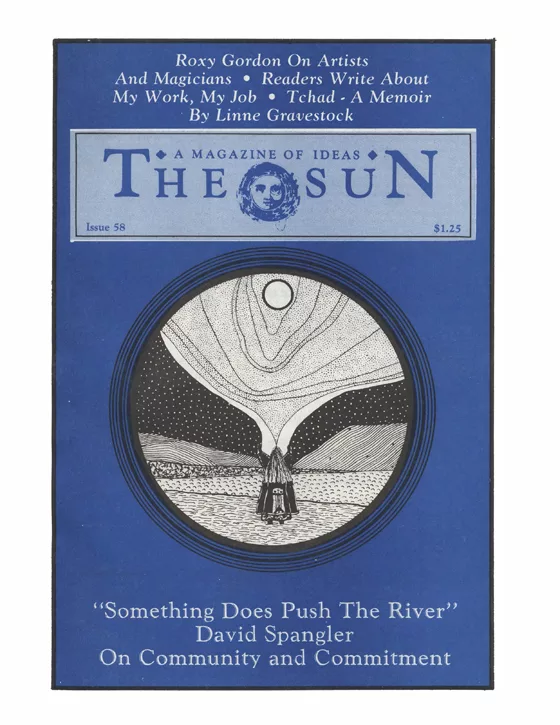
Something does push the river. The river gets pushed and pulled and tugged, by various forces. The river meanders, and there are many alternate routes that it could take. Sometimes it takes all of them — we call that a swamp, or a delta.
For me, to incarnate means that I take on a body, not just of flesh, but a body of purpose, of relationship, of thought, of will and awareness, a body of interaction and community with the life around me. Another way of saying that is that I can’t really incarnate myself only as myself. Incarnation doesn’t happen in a vacuum. I only begin truly to incarnate when I become part of our whole incarnation. I begin to work to incarnate others and I’m open to their incarnating me. That is the process of relationship. By relating with you I am assisting you to become what you are. By your relating to me, you are assisting me to become what I am, part of a web of life, a network. That is what is incarnating: the entirety, the wholeness. My ability to incarnate runs through my capacity to work in consciousness with that whole, that community, however restrictive that may be for me.
Back in the Sixties, it became a catchword to say, “Let’s go with the flow, let’s surrender to the process.” And the image that was often used was that of the river. The river just sort of does its thing, goes from the mountains down to the ocean. Nobody has to get out there and push the river. But, like all analogies, it’s somewhat limited because it suggests to us an image of passivity. In point of fact, that’s not the way it is. The river is a very dynamic system. It’s part of a whole cycle of water upon the earth, rain, evaporation. Something does push the river. The river gets pushed and pulled and tugged, by various forces. The river meanders, and there are many alternate routes that it could take. Sometimes it takes all of them — we call that a swamp, or a delta. In the dynamics of our life, we are involved with both being part of a process — an unfolding process, if we wish to see it that way, a flow — and we are involved with choice and the act of will, which is also part of that flow. We are presented with the need to make choices; we cannot encompass everything. Even saying, “I will not make a choice, I will just go where it takes me,” is a choice. It is much better to make that choice deliberately and to say, “Right, I am deliberately going to go where it takes me and I do this with consciousness, with conscious acceptance of where it takes me.” In order to have the privilege of coming here I had to make a choice. There are things that you are not doing in order to be here, there are sacrifices you’ve made. You may not see them as such, you may make them willingly, but they are sacrifices nonetheless.
There is always consequence. There is always the result of our action, and those results become our body. The consequences of our choices are our body. We explore the body that we are creating in order that we can become more incarnate within it, more at home within it. Incarnation is a dynamic process of will and spirit and responsibility and choice-making, and of response to others, of participation in the community of life. The extent to which I am incarnated is the measure of the extent to which that spirit and that involvement is actually present in my life. In the image of the Christ, we say that God incarnated in human form, and in the sense that I’m speaking of it, that does not mean only that God took on a human body. We could say God always takes on a human body and all other bodies as well. We say that through the incarnation a divine will, a divine consciousness, accepted the consequences of creation and became part of that, and participated deliberately and with involvement in the human community.
For me or you to incarnate divinity is a similar process. In what way can I make my involvement in life, my relationships, my participation, my community, a reflection of, a connection with, an embodiment of what I consider to be divinity? What is this divinity? The question really cannot be answered, if by “answer” we mean some final kind of definition. But I would suggest that one element of this divinity is our capacity to embody infinity. What does that mean? Consider for a moment, as I am rambling on up here, an angel appears in back of me and I begin to wonder why you all suddenly start staring at me with rapture. Is it the brilliance of my presentation? Is it my good looks? And I turn around and see the angel. Crestfallen, I ask this being, “Why have you interrupted my talk? I thought angels had a sense of timing.” And it says, “Well, the time is up, and it wasn’t that good a talk anyway. I’m Gabriel and here’s my flugelhorn. Now is the moment when infinity breaks upon the earth.” I never thought it would happen at a conference in North Carolina. “Now, what we’re going to do, ladies and gentlemen, is file up before me and offer me one day of your life, and on the basis of that day, you will be given your heavenly assignment. This is where you will find your niche for eternity, based on what you did and expressed on that day.” Gosh, Gabe, couldn’t we have at least two days?
The problem immediately becomes evident. What day would I pick out of my life that expresses me? I don’t know. I don’t really have a day that does that. Each day I discover something new about myself. Some days it makes me very happy, other days I wish I hadn’t gotten up. Each day offers an opportunity to express something new. We need many days just to begin to approach the fullness of what we are as human beings, as personalities, much less as divinity. The problem becomes insurmountable if I attempt to tackle it only in a finite way. Hence, the desire for immortality. There are just not enough days for me to express all that I can be, so let me have all the days there are and then some more, let the days never stop. But I can look at it another way and say, suppose we pool all our days. Suppose we each take the best day we can think of and we put them all together and we come up with a universal day that is the conglomeration of all of us. Even that might not be wholly suitable, but it would come closer to saying something about who and what we are. I would like to learn to paint, but I have yet to learn how to draw a straight line. But undoubtedly someone of you is a fine painter. So I have one of your days, when you have painted like you never painted before, and in your day I become the painter that I would like to be. Perhaps one of you is a fine singer, or a scientist, or a mother or father. Perhaps two of you have discovered a profound beauty in human lovingness. We have so much that we can share in our great days and moments that by myself I’d need more than a lifetime to experience. I don’t need immortality, what I need is community and the ability to share deeply and the ability to discover an identity capable of participating in that sharing. So here we are, blending our days, and we’ve outfoxed good old Gabe and he’s going to have to give us all of heaven to express in. And if we reach out to all humanity, we’re going to come out with an awful lot of different days, some of which are not very pleasant but are still part of the human experience of the moment.
So, incarnation is a shared process, and for me to incarnate divinity, I want to incarnate that sharing, so that we aren’t a bunch of little separate lives struggling for infinity, but we are a shared life in which infinity becomes visible because we’re sharing our finiteness and through that sharing creating a space through which great potential can emerge. And, as I said before, that doesn’t have to stop with humanity. What is a day in the life of a great tree like? Or a day in the life of a dolphin, or a day in the life of an ant? Then we get into wholly different perspectives.
If we imagine all the days that ever were and all the perspectives that ever could be, and days yet to come, and lump them together into one view, we would begin to have a shadow of what divinity is like. Yet, that great consciousness is that participation of all these others. It is incarnating itself. We are part of that process. So, on the most simple level, to incarnate divinity becomes an exercise in relationship, an exercise in how to expand relationship along many dimensions, not just three, not just human or social. Love, openness, defenselessness, sharing, these are the tools we use and the qualities that help us to expand those relationships.
Which brings me to the communion. The image of the Last Supper, when Jesus says here is my body and here is my blood, here is the bread and the wine, in this symbolic act of the communion — to me Jesus is saying, here is the essence of incarnation, here is how divinity becomes flesh, by sharing itself. He was saying, here is my vital substance, here is what makes me what I am, as symbolized by body, form, the flesh, and the blood or the spirit, the life-giving essence that flows through us. The mystical body of Christ is the body of divinity, it’s the body of life itself. In my particular approach to this, Jesus is saying not just, partake of my being, but he is saying, here is the formula for incarnation, for partaking of divinity by realizing divinity in our earthly life. And that is, put colloquially, to nibble on each other, to be able to share our substance and essence. Now, our substance can take many forms. It can be tangible substance, possessions, clothing, finances or what have you. It can be emotional and mental substance. But the point is that we are all nourishing each other and we are nourishing our world, or at least we should be. That is a key.
Letting it all hang out in a purely personal way is not necessarily the same thing as providing a nourishing diet, and is sort of the inner McDonald’s.
As we develop in the whole sphere of our being, we provide nourishment, substance, energy, vitality that enriches the world about us, or at least so we hope. Communion represents the act of deep and profound sharing, a sharing of identity. You may be what I am, I open my identity to you, and I would like to partake of your identity. This can be a very scary process, because we all have, or think we have, parts of ourselves that we really wouldn’t wish anyone to partake of, and we might not be all that willing to partake of some of the juicier aspects of someone else. Back when the human potential movement and encounter groups began to develop, it was a kind of humanistic communion, a sharing of feeling, of being defenseless and vulnerable to each other. One of the people at that time defined communication as the art of sharing vulnerabilities. I’ve always liked that definition. On the other hand, letting it all hang out in a purely personal way is not necessarily the same thing as providing a nourishing diet, and is sort of the inner McDonald’s. In fact, I had friends who got very involved in the human potential movement, for whom sharing became a fast-food process and they had their ready-made encounter group personas which they could warm up in their inner microwaves and dish out on a moment’s notice. They became consummate actors. But the kind of sharing that I have in mind is a bit deeper.
Identity is two things. We think of it in terms of content. Here are all the things that make me up. Here’s my list of experiences and memories, the things I own, the things I do, the content of my mind, which I trundle forth upon inquiry in order to define myself. Some of us have short lists, some have very long lists. Behind that is the context that helps to organize it. Sometimes that context is very subtle and hard to get our hands on. What are the organizing principles of our life and our identity? Why is certain content selected and other discarded as being unimportant to our make-up, our definition of who we are? And even perhaps deeper than that is what I call the will. The will to me is not just force — I will do it — and action, but it’s something more related to being. When I get right down to it, I will do most effortlessly that which I am, and the most powerful will in the world is the will of what is.
What is the energy that makes me what I am? That energy is what links me in participation with the co-creative processes of my world. What I am is a point of creation, the creation process, continually fashioning itself. Now, that’s the substance and nourishment I want to share. To say, “Here’s what I did when I was ten and eleven, and here’s my job, and here’re pictures of my children” — all that may be very wonderful, and it’s the grease in human interaction, the wonderful small talk that lubricates things until we can get our gears to mesh in deeper sharing. But that sharing of identity is not the same as communion. It’s just the hors d’oeuvres.
At some level of our being, we are convinced we are divine. We know that whatever Jesus did, we could do it as well, probably better. That’s what he said, we could do it better. That was a very beautiful thing to say, evoking the promise of eternal evolution. But how often do we allow that to surface? Sometimes when it does surface we don’t know what to do with it and it becomes pathological, because we don’t know how to integrate it into our daily life. What in heaven’s name would a God be doing working in this factory or doing these dishes? What is a God doing in the midst of all this trivia?
In God’s perspective, nothing is insignificant. Consider the time-frame of a blade of grass and its growth. It is filled with all the drama and power that our lives are filled with, just expressed differently. In The Once and Future King, Merlin is training Arthur to become king, and he does so by transforming Arthur into various forms — fish, bird — so he can experience what life is like as an animal, as another form of being. All of us have had that experience too. We may not remember, but it’s there. We share it with the life around us, if we can pause for a moment and be sensitive enough to entertain a perspective different from the human. We glorify nature, we romanticize it, but we don’t actually participate in it. We go out into it and say, “Gee, it’s wonderful, it’s lovely, it makes me feel good.” But to actually get into nature, touching some things that aren’t groovy at all by our standards, that are very strange, not human, alien in some respects, and to try to think like a tree, a rock, a river, is not an anthropomorphic exercise.
A very close friend of mine went through a period when she became convinced she was the bride of God, and was to give birth to the Second Coming, which would not be a physical birth, but a birth in her. Then she would become the Second Coming. Under normal circumstances, she would be trotted right off to the local place where Second Comings are assisted in their mission without overly disrupting society. But she wasn’t that way all the time, and she had a long involvement with metaphysical studies and had some clue as to what was happening to her. And more importantly, her family, her children, and her sisters also realized that she wasn’t going round the bend, but rather touching a very deep wellspring which her personality was having great difficulty integrating. So they performed something like a vision quest, a dance, in which they didn’t exactly confirm her in a delusion, but they sought to take her starting point — “I am the bride of God” — and to help her draw it out and work with it so she could incarnate it as a personality. One of the things they did was to go through a ritualistic pattern that lasted all night; they celebrated a marriage, a birth. At times the children would take roles that they thought were important and at other times she would give them roles. “You will now be the Holy Spirit, or you will be this angel,” and so on. In this particular case, they weren’t trying to humor her, they were literally trying to take on and to objectify the principles and powers that she was experiencing in order to get them out of her head and into her environment, so they could dance with them together and anchor that power a bit. Well, that helped a great deal, and over a period of time, the whole process became a very transforming one. But she could not have done it without the help of her family or someone who could help her balance that out and not be pulled into it.
The emergence of our divinity is something that requires all of us. We all need to participate in it. It’s not something I can do only on my own. I can touch my divinity and you can touch yours, but to actually incarnate it is a community process.
In the Zen tradition there is a beautiful set of paintings, the Ox-Herder. The story is of an ox-herder who seeks enlightenment, has various adventures, becomes enlightened, and returns to being an ox-herder. The first picture and the last picture are identical. At the end of the quest he is back where he started. From an outer viewpoint there is no difference. From an inner viewpoint, they are worlds apart.
We may find that the incarnation of divinity in a world of everyday trivia is not all that much different in appearance — though in some cases it might be — from what we now experience. We still have to relate to each other, we have to relate to people who are different than we are, who don’t always share our perspectives, and shouldn’t share our perspectives. We have to relate to form, process, pain, hope and struggle. It’s just that we relate to them differently, and we help each other relate to them differently. The process of incarnating divinity as a community project transforms the world in a very deep way by transforming our ability to nourish each other. At the very least, it helps us dispense with a number of things we now use to indirectly nourish each other or to grab nourishment from each other when we think we’re not going to get it, and that would ease things a lot, just getting rid of some of those games. But the everyday drama of living on this physical earth will remain one of always seeking to honor the finite as a gateway to the infinite, and to work with limits, those limits that are necessary at any given moment to provide the next step for the infinite.
Redemption follows from that. Jesus the Christ is considered in Christianity as the saviour of humanity. This is the third element necessary to being a true Christian, to accept the Christ as a saviour, to see in the crucifixion-resurrection process some kind of redemptive act. Creation is an ongoing process. And evil — that’s what we’re being redeemed from, by the way, evil, and its effect upon us — is simply the unfinished business of creation.
There is an unintegrated stuff in our world, and that stuff is the source of power if we want to tap it and utilize it. I can work out of positions of unintegration as easily as out of positions of integration, maybe more easily, because the power may be more accessible in some ways in a state of chaos than it is in a state of order. This is not always the case, though. There is unintegrated material, and it needs to be taken on. In a personal way, I have it in my own life, things that I have not yet quite dealt with in order to be a whole being — my jagged edges. And occasionally they catch on things in my life, and I get hooked or bruised or turned around, or somebody gets cut from one of my jagged edges, or I get cut from one of theirs. Some of these edges, some of this jaggedness, I’m not going to be able to integrate all by myself. Others need to help me and vice versa. There are some places that itch that are very difficult to scratch, so I look for someone else to scratch them. There are some places where I hurt that I can’t quite get a hold of. Someone else may be able to, in an act of love, forgiveness or understanding, or just a neutral act of saying, “Yeah, I see that you hurt there and this is how I see it. I have no judgment about it one way or another, but acknowledge it and affirm your ability to deal with and heal it.” I may find that inaccessible place has suddenly become accessible. In a sense, the Christ represents the big scratch, the fingers that can reach just about anywhere. He said, I forgive the world. Wherever it hurts in there that you can’t get to, I can get to it and I’ve already forgiven it. I have already acknowledged it. I am a healing process at work, so work with me.
Perhaps the great tragedy of evil is its cheapness. It cheapens everything, by passing off what is incomplete in the name of what is perfect.
There is this little cartoon — you can get in on t-shirts — that says, “Have patience with me, God is not finished with me yet.” That being the case, we are in a process of struggle to learn how to come together in new ways, in appropriate ways that do honor to us as individuals, to us as a group, as a species, and to our world life as a whole. And the energy that we bring into that struggle, that process, that communion, is a redemptive energy. We are redeeming ourselves from stopping in the process, from becoming caught in our own non-integration. We don’t have to think of it in terms of sin or not sin, unless we choose to. We can think of it in terms of realizing that we are an unfinished project and that evil in one way comes out of our unfinishedness, and evil might be perceived as the attempt to pass off that which is unfinished as a finished thing. Perhaps the great tragedy of evil is its cheapness. It cheapens everything, by passing off what is incomplete in the name of what is perfect.
Part of our challenge is that we have an abundance of images about the Christ — historical, religious, philosophical. Sometimes you just have to let all these images go for a time, because in confronting the Christ within myself — each of us does this — we are confronting our divinity, and it is the most intimate and sacred confrontation. It is unique. It has not happened to anyone else the way it happens to us, nor will it happen to anyone else again the way it happens to us, nor is it a one-time happening. All teachings, everything I learn and study, the benefits I receive from great teachers will only bring me to a point and at that point I have to step off into my own abyss, into my own faith. There is a point beyond which no teacher, no teaching, no guideline, can really tell us what it’s going to be like or what’s there. We need to discover that for ourselves.
In Ursula Le Guin’s Earthsea Trilogy, the magician is saying, “An act is not as young men think, like a rock that one picks up, and it hits or misses and that’s the end of it. When that rock is lifted, the earth is lighter, the hand that bears it, heavier, and when it is thrown, the circuits of the stars respond, and where it strikes or falls, the universe is changed.” All forms of magic, or spiritual endeavor, or living endeavor have that quality. We are part of an unbreakable and unbroken system. So when I come to that edge, the universe comes there with me, and when I step over, everything steps over with me, and I step over into everything.
That edge is in our minds. It could be called the edge of growth, because when I grow, change, take on a process of transformation, however modest it may be, I’m really undertaking a very courageous act. In its pure nakedness, I am saying, I will now be different, and because of that difference I accept the possibility that the universe will be different, particularly the universe that interrelates with me. To shield myself from that nakedness and what it represents, I may surround growth with a lot of support structures and jargon, but it does come down to the fact that I am changing reality. In that process I will be changed and I may find myself in a world that is unfamiliar to me when I look at it through the eyes of yesterday.
I work for the University of Wisconsin in Milwaukee, where we are trying to develop a series of courses that reflect New Age themes — spiritual, transformational themes. One of the courses we just completed was called “A University for the Future,” which was a critique of the existing university system, in an attempt to re-vision it. What would a New Age university be like? And how to go about creating it. Time and again, it was brought up how modern education tends to stifle, to confine people. One person brought up the idea of the hidden curriculum: you go to school, but what you really learn is obedience, punctuality and respect for authority. There is another way of looking at that, which is that we all gather together in a sort of unspoken conspiracy to make growth non-threatening. Education is a doorway to growth, or it can be. All these data, new relationships, new insights come to us, and conceivably can shatter what we have previously believed or accepted. Education can be very frightening. But we conspire to make it less scary, by saying, “Let’s learn things, but let’s not change too much, let’s establish some limits.” Perhaps the first stage towards a New Age education would be to confront that feeling directly, and ask, “Am I willing to go whole hog with the potentials of education, to accept the consequences of radical transformation if that’s where it leads to? Am I willing to bear the pain of discontinuity with the familiar for however long I may need to bear that?”
The Christ, on a personal level, is that force which brings us to the edge and then steps over with us, in order that a profound continuity may be maintained, in order that the bonds of love and communion are not shattered by the appearances of growth, and also to have the courage to take those steps, to risk that. The edge is in our minds, and is really the confrontation with our fear of growth, our fear of change. Everyone does it with me and I do it with everyone else. I realize that I am growing, not only for my own sake, but I am the earth, the spirit of the whole moving forward. When I feel that I grow for myself — this is my growth, in much the same way that this is my college education or my car — it is a more scary proposition. That edge is much more personal. I am growing in order more largely to share a process that is the growth of all things. I need to grow in the same way that plants need to grow, that leaves come out in the Spring, that rivers flow to the ocean, that winds circulate about the earth. To explore the seasons of my humanness, to see where my roots and sprouts will go, is part of a great ecology of growth, of unfoldment, of life. It expands our awareness, gives us a new context in which we can see the processes.
Sometimes we embark on a venture, like starting a community or a spiritual project, and it fails. The form does not coalesce properly, and disperses, so we say it fails. But out of that process can come very deep knowledge and experience that will reweave itself into future forms that will not fail. It’s a matter of perspective.
My physical body in my mother’s womb goes through a process of recapitulating many earlier forms. They appear and reform and appear and reform until my human shape develops, and I don’t think anything of it there in my mother’s womb. In the womb of society, of a larger life, similar things are happening. We recapitulate earlier stages of consciousness. I’ve seen this in most groups and can’t think offhand of an exception. The evolution of individuals is often more advanced than that of the groups that they form, so they come together to form a community and immediately they’re at a quite different level of group expression. They begin recapitulating human history in one way or another, sometimes very fast, sometimes more slowly. Different phases of human government, different phases of human relationship. Groups have their embryology as well. We realize that a particular stage or form may come into existence briefly only because it’s a step toward what is actually trying to emerge, and when it dissolves, it is not that anything has failed, it is that the process is working. I feel very fortunate the fish stage of my embryological development failed. Of course, I did get trapped at the human stage, but that’s the way it goes.
A tree does not say, “I’m divine, so here’s some color, some shade, some food.” Just, “I am a tree.” A tree may do this, from our point of view, unself-consciously. Our challenge is to learn to do it self-consciously.
This process of forming and reforming, dissolving, dying and rebirth, of going back and forth over these edges, is very much a collective one, and we struggle to form together the kind of collective that would represent our values and vision for a new world. Because it’s collective I can’t assume that the success or failure of my growth and my efforts are wholly and totally my own responsibility. That’s not quite the word I want, but — all roads don’t lead to David. Sometimes things that I would like to bring into being, parts of myself that I would like to touch, may be in timing for me as a person but are not in timing for me as a collective person. So, that’s partly what I mean by not being able to cross this edge just by myself. In crossing it I may take a step that has very little to do with my own growth, but has to do with the growth of someone around me. I call it the spirit of the Christ that coordinates all that, enables it to happen. It is that spirit that says to me, “I am this personal divinity within you, but I am also a universal spirit. I act that you may grow, for your well-being, but also for the well-being of all that is.” This doesn’t mean that I necessarily have to do an inventory of everyone around me whenever I choose to make a growth step, but it does mean that I have a perspective that my growth is in a context. I might say, I’d be so much further along if it weren’t for so-and-so whom I have to deal with, and I’m just being held up because of him or her. But sometimes being held up is the best thing that could happen to us, in order maybe to look more deeply into our process and be more fully in touch with it.
All of us have our rough times, our moments when we think, “I don’t want to get up this morning.” Sometimes those moments are not when something horrendous is happening, but it’s the weight of trivia, of the familiar, that is just too much. It is at that moment that we draw on that resource, when we say, “I’ll just take one step in front of me.” That’s being heroic. And we are heroic. It’s that power that lets us do that, when we don’t want to get out of bed but we do. It’s what underlies that power that we share with each other when we talk about, “Here is my body, here is my blood.”
It is said that one of the persistent images in many of the great religions is that of sacrifice: the Buddha renouncing all of the treasures of the world in order to achieve enlightenment, Jesus sacrificing his life, Osiris being ripped to shreds in order to be reformed, Orpheus descending into the depths in order to be reformed. This is a powerful image in which a greater life gives itself in order to provide energy, vitality, nourishment to lesser lives who are struggling with inertia, finiteness, form. So in communion, we participate in that. We say, like Osiris, Orpheus, Buddha, Jesus, “I renounce, I surrender. Rip me apart, eat of me, get energy and let’s do it. Be nourished that we can go on, and let me be nourished by you.” In redemption, that is also a collective experience in which we take on the unintegrated matter of our lives and we work, integrate it, form it, heal it. All of this requires our mutual power and our ability to generate that mutual power, to be mutual. The personal Christ is our ability to touch those qualities in us, as noble or as mundane as they may be, that at any given moment we can rise to the occasion and do what’s necessary to preserve or express our human community.
Which leads on to the image of planetary healing and the avatar event. I have a little challenge talking about the Christ simply because I don’t like to give an impression of exclusivity. The Christ to me is an avatar, or a divine incarnation, a divine expression. There are many other avatars. What we are dealing with is a great planetary event, in which we are trying to touch and become aware of and expressive of our wholeness, our inheritance, our remembrance that we are princes and princesses of the kingdom.
There was a wonderful book written years ago called Flatland, about the adventures of the beings in a two-dimensional world. The hero of Flatland is a square, who has a dream in which he is visited by a three-dimensional being, and has great difficulty trying to grasp the third dimension of depth. But eventually he does, and goes out to proclaim to the world the existence of the third dimension and ends up being committed to a mental institution. Consider for a moment what the interaction of a three-dimensional being with a two-dimensional world — say, a table — would be like. Imagine I have a basketball and I pass the ball through the plane. At any given moment the inhabitants of that plane are going to experience that ball as a plane. They are not going to see its depth, just its surface, and what they’re going to see is not a ball but a series of different events. You slice the tip of the ball and it’s just little, and then you slice in the middle and get the whole diameter, and then it starts getting smaller again. So you get this bell-shaped curve of an event. They would experience a basketball in terms of duration, as a process, but we would experience it as just a ball. Trying to communicate that to somebody living in this two-dimensional place would be difficult. They would tend to see the ball as history.
Well, that’s what I feel about the Christ. The Christ is the manifestation of a basketball passing through the table of our universe. It’s a multidimensional event which we are trying to grasp four-dimensionally. We would see it as history, as a succession of events. Which means that the event is still happening. It is not in history, it is history, it is still happening. We are in the midst of it at this moment. I don’t know just where we are along the basketball.
I think of all the great prophets, spiritual leaders and avatars. Quite a bit of conflict tends to develop around them all and around different spiritual teachings. Different groups happen to be active in experiencing the event when their bit of the table interacted with it. Naturally that’s going to seem the most real and powerful aspect of that event. To a person in Mecca in the fifth or sixth century AD, talking to Mohammed is going to seem a lot more real than listening to somebody tell about someone named Jesus who lived five hundred years before. And it is a logical assumption to say, this is the reality and what comes after will be the reflection, and what came before was preparation. As this polydimensional basketball dribbles its way through our universe, we keep encountering the real thing over and over again, to which everything else is preparation and everything following is consequence. We may miss the point of view that it is really all one thing, it is one event. Part of that event could be described as the incarnation of spirit within our world, our world going through a process of birth or of incarnation, a consciousness coming to birth within our planet, our world-soul becoming more integrated, and a process of spirit interacting with the world just like our own soul interacts with us, to draw all our scattered parts together in a process of remembrance, to where we become whole.
Perhaps the point which we are reaching is where we approach the diameter of this basketball — obviously my metaphor may begin to break down here — but let us say we approach the point at which the avatar event becomes a collective event as it has never been before. We are talking about planetary healing, the incarnation of wholeness within our world, where humanity is not separate from itself, nor from nature. All our dreams and visions of the future that somewhere in our hearts we know will happen are going to happen. It is happening now, because it is the basketball. The new age, or the golden age, or utopian age, is the same as the avatar event. In the past, culture has not been able to embody it. People have been able to embody it; collectives have not been able to embody it, except in small degrees. We do not have civilizations that express the Buddha nature. We have civilizations that believe in Christ, in Buddha, that practice Christianity or Buddhism, but not civilizations that are the Christ, that are the Buddha. But it is such a civilization that has always been trying to emerge — it is the human civilization. At some point it must become a collective process.
How do we heal our planet, give birth to this planetary culture? I believe the first step is a recognition of this avatar event and that it embraces us, that we are now that event. We have great teachers that come to us, who have the luxury, the ability, because they are only dealing with themselves, to bring it to a clear focus, to catalyze it, to keep reminding us. But how can I look into myself and say I am divine? That may be a particularly Western problem, the struggle with the identity of divinity. How can we say, “I am one with the Earth, I am one with the stars”? How can we look at each other and say, “I want you to know I am the Christ, the Buddha, the Earth, and I take responsibility for that, so I will seek to act out of that reality”? And you say, “I accept that, and I am the Christ, I am the Buddha, the Earth, and I take responsibility for that. Let’s live out our fantasies.” To share on that deep level is something we need to learn. But the sharing is not in words. Nature provides the perfect example of it. A tree does not say, “I’m divine, so here’s some color, some shade, some food.” Just, “I am a tree.” A tree may do this, from our point of view, unself-consciously. Our challenge is to learn to do it self-consciously. I love myself, and I offer myself to you as nourishing food.
I am an optimistic and upbeat person. It is not that I do not see that in pursuing the avatar event we are confronting a whole history of fears which can generate stress, but that is not the operative reality. What we’ve been engaging in this weekend is the reality. It is customary at many of these conferences to come to get one’s batteries recharged. We also come to do a piece of work and to be co-workers. It is nice to have our fellowship and be affirmed, but we are workers and we come because here we get a taste of the collective we are trying to create, and hopefully to evolve enough momentum to let us go out and see it and evoke it out of our world. It is useful to remember that the great representatives of the avatar event have always worked in the world. And they are infinitely accessible and very human.
So, if we are taking on the avatar event, our tendency is to say, as a person, I really would like to come together with others who share this event with me, and live somewhere where we can pursue it. But as a collective consciousness, we work in the world. The world is our marketplace, not just the Western world, but the whole world.
Sometimes people in the most unlikely places, for a shining moment in their lives, become outposts of the avatar event without even knowing it. It can become a game to look for that, to look in the shadowed corners and say, is there an avatar lurking in there? At the next desk, in that church down the street? How we work out our relationship to this is something that each of us needs to do, but my contribution is simply to say that there is a planetary process of healing going on and it places an extraordinary demand on us to learn to see ourselves as part of a collective event, a polydimensional event which in order to make itself known on our level has to become collective. If we truly want to celebrate the avatar event, we end up celebrating the spirit in all of us.
© Copyright Light of the Mountains, 1979