One way to look at a border is to see it as a dividing line, a boundary that keeps people apart. For twenty-eight years, on one side of the Berlin Wall—in West Berlin—were freedom and Coca-Cola; outside were Communism and a surveillance state. Even if most East Berliners and East Germans would have preferred to reside in West Berlin, the border wall, mostly, kept them out.
The dismantling of the wall in 1989 showed the world that when barriers come down, people do come together, especially when the barrier that divided them was erected for dubious political reasons. Tracking the shifting contours of borders over centuries often reveals them to be arbitrary, temporary, and unstable.
Journalist and translator John Washington examines the history of these shifts as a reporter for Arizona Luminaria in Tucson. Much of his reporting has focused on migrants who have fled their homelands in search of safety and a better life. He has trekked through the desert and across mountains—exploring every stage of the journey these human beings take through Central America, Mexico, and the Southwestern US. In his 2024 book, The Case for Open Borders, Washington rejects the idea that closed borders improve security, arguing that border enforcement itself creates a lucrative market for the smuggling of drugs, guns, and people. And making unauthorized migrants live in fear, he writes, only pushes them further into the shadows, leaving them more vulnerable to human predators and exploitation.
Even amid the fierce debate in US politics over migration, there remains a lingering notion of America as a nation of immigrants. In his farewell address President Ronald Reagan described his notion of America as a shining city on a hill, full of all kinds of people living together and open to “anyone with the will and the heart to get here.” Assessing his administration’s successes, which included an amnesty for nearly three million unauthorized immigrants, Reagan claimed that the nation was “still a beacon, still a magnet for all who must have freedom, for all the pilgrims from all the lost places who are hurtling through the darkness, toward home.”
Washington, who happens to be a distant relative of the first American president, won an award for investigative journalism from the Institute for Nonprofit News in 2023 for his reporting on deaths at the Pima County jail. A related documentary, Death Behind Bars, premiered on public television earlier this year and can be viewed at PBS.org. He spoke with me in April and June of this year, over two discursive video chats from his home near the US–Mexico border in Arizona. He says the idea of this country as a welcoming place for immigrants is largely a myth Americans like to tell ourselves. “There’s never really been this heyday of absolute welcome in the United States,” he said. “That’s a false notion.” But could we create such a welcoming beacon in the future? He thinks so.
Not all conversations are as linear and succinct as they appear. This interview has been condensed and edited for clarity.—Ed.
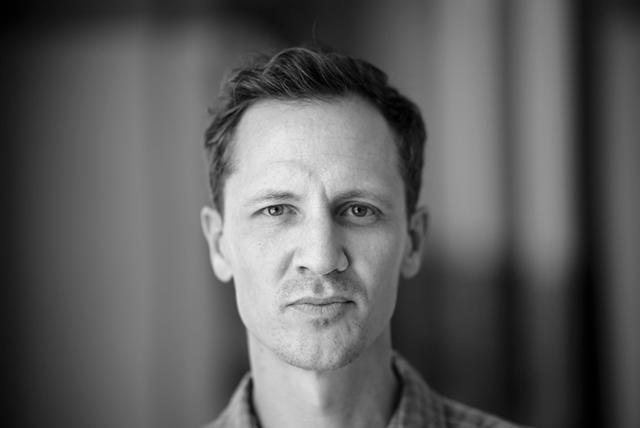
John Washington
© Michael McKisson
McDermon: What does “open borders” mean to you?
Washington: It means freedom of movement. It means people have the right to seek safety and opportunity. It doesn’t mean no borders. Open borders means that people with the necessary paperwork are allowed to move in an orderly way through designated ports of entry. Think of what happens when people in the United States change residency from one state to another. They don’t have to go through ports of entry, but they do have to reregister. This is for the benefit of both the people themselves, so they can receive benefits and correspondence, and for the communities, so they know who is living in their midst.
One of the principal objections to such freedom of movement is that all sorts of people will come here. But that’s exactly what’s happening now. It’s just that, under the current system, we don’t know who those people are, because they’re compelled to hide, to sneak across the border, to not register, which makes them targets for exploitation. I think that opening borders would quickly solve that problem.
McDermon: So you’re not calling for the unification of all nations.
Washington: No. Part of the difficulty of trying to govern a country of 350 million people—or a billion people—is that it’s too big. Global governance is something that we haven’t seen really great examples of. I’m not saying that there shouldn’t be international accords. I think international bodies have done some good and could do a lot more. But I think that concentrating more on local governance and local communities is actually the way to go. And open borders fits nicely with that.
McDermon: What is your vision of a world of open borders?
Washington: The most powerful countries in the world today have power largely because of a relatively recent history of violent imperialism, and part of that imperial project was attempting to redefine populations by deciding who is welcome and who is not. The genocide that happened on this continent during colonization was in part premised on racial divisions. We saw the first legal definitions of race laid out around the same time that colonizers were coming to North America. Those newly defined divisions were forged to try to take control of this huge swath of land, which involved the redrawing of borders multiple times over the first couple of hundred years of this country’s existence.
Today, people living in Nogales, Arizona, have much more in common—linguistically and culturally—with their neighbors across the border in Nogales, Sonora, than they do with someone in New York or Maine. To me it makes more sense not to draw a militarized line between people with so much shared culture and history. I think opening up those borders is simply a more natural form of governance.
McDermon: You have a lot of personal experience working near the border. How has that influenced the way you think?
Washington: I’ve reported from throughout Central and North America on people who are undocumented or in the process of gaining legal status. I’ve spent a lot of time in migrant shelters throughout Mexico. I live and work very close to the Mexican border and have seen firsthand the struggles that people go through to find their way here. It’s an incredibly dangerous situation.
I was recently in Mexico City, talking to a Venezuelan family who’d been deported from the United States. They had gone hungry. They had suffered extreme violence. They’d been kidnapped, threatened, extorted, and beaten, all because they couldn’t stay where they were and had decided to try to find a better life. They’d suffered the full force of the US government in collusion with the Mexican government. Meanwhile, an American who wants to move to Mexico or Venezuela wouldn’t face these same hardships.
I grew up hearing stories about border crossings. My mother is a migrant. She left Romania as a child with her parents and brother. I have a lot of cousins, aunts, and uncles who had to sneak across borders. Once I became an adult, I began asking: Who’s benefiting from drawing these lines? Why are these boundaries here? That question isn’t usually part of the conversation around immigration. There’s this idea that borders have always been like this, that this is the way we must govern ourselves. But it doesn’t have to be.
McDermon: There’s evidence that the number of people crossing the southern border of the US has gone down since January 2025. Have you seen changes in the border region under the new administration?
Washington: I have. In fact, some might question my claim that border enforcement doesn’t work, because fewer people are crossing compared to a year and a half ago. But that is one of the ways that borders blind us. Most of these people aren’t just turning around and going home. Largely they are stuck on the Mexican side of the border. They have been forcibly displaced from their home countries and cannot go back. They are struggling just to find a place to be. That’s the case with the Venezuelan family I just mentioned. Anti-immigration advocates might say the US “successfully” got rid of them, but we didn’t solve the underlying problem of having over a hundred million people across the globe being displaced. All our government is doing is pushing back people from certain countries.
The swiftness and cruelty with which people are being picked up and deported has also gone up, but it’s a difference of degree and not of kind compared to past administrations. Of recent US presidents, Barack Obama did the most, until Donald Trump’s second term, to militarize the US–Mexico border. Clinton and Bush played a huge role as well, but Obama absolutely kept that policy up, and Joe Biden further restricted asylum at the US–Mexico border after he promised to restore it in his 2020 campaign. So this is mostly par for the course for administrations on both sides of the aisle. The overt attacks on free speech, and the ostentatious militarization of interior immigration enforcement, such as we’re seeing in LA, however, are new. The word concerning doesn’t nearly capture the dangerous precedent.
People living in Nogales, Arizona, have much more in common—linguistically and culturally—with their neighbors across the border in Nogales, Sonora, than they do with someone in New York or Maine. To me it makes more sense not to draw a militarized line between people with so much shared culture and history. I think opening up those borders is simply a more natural form of governance.
McDermon: I can imagine a skeptic of open borders asking why it must be the responsibility of the US to take in people who have fled their homeland.
Washington: Most moral and religious foundations suggest we have a responsibility to help displaced people, to “welcome thy neighbor.” So that’s a strong moral argument. Our nation’s founders attained political power by invading this land, killing most of the people who were already living in it, stealing large swaths of land from other countries, and then saying, “This is ours, and no one else can come in.” It’s hard to defend that moral claim.
Another factor we can’t ignore is why people are leaving their home countries. The US has had a heavy hand in economically exploiting entire populations, especially in Latin America, and installing right-wing dictatorships or pseudo-dictatorships. And we play an outsize role in spewing carbon dioxide into the atmosphere, causing hurricanes, floods, droughts, and other catastrophic events that force so many people to leave their homes. If you force someone from their home and then try to wash your hands of that, you are shirking responsibility.
The fear that drives a lot of immigration skeptics is overstated. If we allowed more people into the US, the situation would not be nearly as dire or scary as many people have been led to believe.
McDermon: There’s still some popular sense of America as a place for everyone—the Ellis Island notion that anyone can come here and become an American—but that is declining and being replaced by old-school nativism. Do you think it’s possible to arrest that change or reverse it?
Washington: The idea that the United States is a “nation of immigrants” in the sense that it is inclusive and welcoming is a myth. John F. Kennedy intended to use his book of the same name in his efforts to eliminate the bias and cruelty of our immigration laws. The Johnson administration’s Immigration and Nationality Act of 1965 was based on a draft bill Kennedy sent to Congress. In the decades prior to that, the US was welcoming only to a narrow subset of the global population. We had what amounted to race-based quotas in the guise of country-by-country quotas. Public officials relied on those quotas to deny entry to Germans fleeing Nazi Germany, before and during the Holocaust, as well as to people from Southern and Eastern Europe, where there were high concentrations of Jews facing persecution. Laws put in place in the 1880s prohibited Chinese people from immigrating to the US, and by the early 1900s our immigration laws excluded all Asian people. So is this a nation of immigrants? Some immigrants.
And, yes, that myth is absolutely in decline, as you say. But it’s possible to stop that decline. We can do immigration differently. We took a more open-borders approach prior to the 1880s—though in reality we’ve never quite had open borders. It’s always been open borders for some. There were state laws that kicked out poor immigrants and Irish immigrants, sometimes even deporting them. But there was no border infrastructure at all. We could go back to that, which I think would be a step in the right direction.
McDermon: In Europe there’s been a recent surge in migration from the Middle East and North Africa, largely as a result of political upheaval after the Arab Spring and subsequent government crackdowns. Germany took in a large number of migrants, which is one reason there’s been increasing support for the AfD [a far right party—Alternative for Germany—that was the second-most-popular party in Germany’s 2025 federal election—Ed.], mostly in the poorer regions of the former East Germany. The early part of this surge coincided with a number of sovereign-debt crises that hit European countries like Spain, Greece, and Portugal as well. One centrist argument against allowing migration goes something like “We can barely take care of ourselves. How can we be expected to take care of more people?” Do you see a tension there between what’s right and what’s attainable?
Washington: It’s reasonable to argue that governments haven’t been doing enough to take care of their own people, but that doesn’t mean it’s impossible to allow migrants into a country. And it’s not a question of overpopulation. In fact, in some Western countries, the population is dropping. There isn’t enough of a tax base. There aren’t enough people to do some of the service jobs needed or to care for children and the elderly.
You’re right that, especially in the more socially conservative regions in Eastern Germany, migration drove a right-wing resurgence. Just the idea that they would take in a million or so refugees, mostly from Syria, was too much for some people. And yet Germany did accept many refugees, and those people’s fears weren’t all borne out. There wasn’t a rise in crime. Welfare privileges were not reduced. Cities were not taken over. Unfortunately, because of poor reporting and misunderstanding, those fears are still seen as real concerns.
Although migrants may temporarily push down wages for a very small sliver of the population, study after study after study in the US, Europe, and around the globe, by economists across the political spectrum, show that high levels of migration, even very rapid migration, do not broadly depress wages. In fact, in the long term, wages increase. Same with employment.
McDermon: Well, Germany did stop taking in so many migrants.
Washington: They did, but not because they were depleting their country’s resources. They stopped it because the Right was able to leverage those political fears.
McDermon: But maybe they would have had to cut benefits if the number of immigrants had continued.
Washington: Sure, that’s a possibility. But we can also look at other examples in recent history and see that countries with increasing immigration haven’t had to cut welfare and haven’t been negatively impacted by migration. If a billion people tried to migrate to Germany, that would be a problem. I’m not even advocating that twenty million people should go to Germany, or anywhere. In an open-borders world, migration would be spread out, and as it became a problem in, say, Germany, more people would have to go to France, or England, or other countries that actually could receive more people. As it was, Germany did the right thing, taking in people who were fleeing imminent death, while other countries like France, Greece, the Netherlands—even the US—tried to seal their borders, which meant Germany bore the brunt of that wave of migration.
McDermon: Many opponents of open borders suggest that immigration drives down wages or adds to unemployment.
Washington: All the evidence says that’s not true. No economist worth their fiscal salt would say otherwise, though a few have raised minor objections. George Borjas, out of Harvard, has become famous, especially on the Right, for studies showing that high levels of migration do push down some wages. But although migrants may temporarily push down wages for a very small sliver of the population, study after study after study in the US, Europe, and around the globe, by economists across the political spectrum, show that high levels of migration, even very rapid migration, do not broadly depress wages. In fact, in the long term, wages increase. Same with employment. And even Borjas doesn’t claim that employment goes down with high levels of immigration.
People tend to think of the economy as a zero-sum game: They imagine there is a set number of jobs, so if someone takes one, that’s a job no longer available for someone else. But that’s not how economies work. Jobs beget more jobs. And there’s a lot of evidence that removing people from populations can depress wages and increase unemployment. Right after the stock market crash in 1929, the Mexican Repatriation Act began. It kicked out lots of people, both Mexicans and Mexican Americans, and the areas of the US with some of the highest unemployment levels saw those levels go even higher after they started deporting people. Maybe they were deporting a shop owner, or an essential worker at a shop, which then wasn’t able to stay open, so more people lost their jobs. Once you scratch the surface, you see that migration is good for wages and employment. Right now, with inflation and the effects of Trump’s tariffs still unknown, we are increasingly dependent on migrant labor. A number of sectors of the economy currently have massive shortages of employees: health care, construction, childcare, eldercare. If we kick thirteen million people out of this country, those industries are going to suffer immensely, and so will native-born Americans.
McDermon: Another claim I hear often is that immigrants drive up crime rates, even though statistics show that immigrants are less likely to commit crimes than nonimmigrants. Given how deeply ingrained the idea of immigrant criminality is with a lot of Americans, how do you change people’s minds?
Washington: People react to crime reports with fear. They want answers, which aren’t always immediately forthcoming. In the meantime, it’s easy to scapegoat and blame immigrants. But last year, much to the chagrin of a lot of Texas Republicans, a study showed a higher rate of crime, including violent crime, among native-born Americans in Texas than among recent arrivals. In Germany there were a couple of high-profile crimes committed by asylum seekers, but overall crime in Germany has gone down after that influx of refugees, including in the cities that welcomed the most asylum seekers. Some people have theorized that immigrants are so focused on making sure they can stay, they dare not break the law. They spent a lot of money, time, and emotional capital to get where they are. Why risk it committing a petty crime?
Now, someone might say, “If we can stop one single crime from happening by closing the border, then it’s worth it.” Perhaps the most prominent talking point on the Right in recent years is the tragic case of Laken Riley, who was killed by an undocumented migrant. She now has a bill named after her. But can you stop all crime by deporting a huge swath of the population? No. Some immigrants will commit crimes, yes, even grievous ones, and that’s a shame, but we can deal with that through the justice system, the way we do other crimes. When a young white male murders a young woman, do we say, “Let’s lock up all of the young white males to stop such crimes from happening in the future”? It’s a fool’s errand to think that you can stop crime by sealing off your borders.
McDermon: You note that in the United Nations’ Universal Declaration of Human Rights there is the right to leave any country, but there is no corollary right to enter another country. What’s wrong with that?
Washington: Freedom of movement is a fundamental human right. In the past couple of decades much of the world has taken great strides toward recognizing other fundamental human rights, like freedom from discrimination based on skin color, religion, or sexuality. But discrimination based on where someone was born remains prevalent. Take the Venezuelan family I was talking about earlier: If they had been born in the US, none of that would have happened to them. The color of their passport is what made the difference. When people are under threat, when their children face potential starvation, they’re going to move. Protecting their right to do so is just a basic moral stance, but we are not taking it.
I think that’s going to change because it must. This issue is going to come to a head even more than it already has. The global population is more on the move than it’s ever been, and we still don’t fully understand how climate change will affect that going forward.
McDermon: Should there be an open border between, say, Ukraine and Russia?
Washington: War is bad. Territorial conquest is bad. But I think the false idea of a national identity is one of the main causes of the problem. Are a lot of the people in Eastern Ukraine ethnic Russians? Yeah. Should they be part of Russia? I don’t know. But does it matter so much that you need to bomb a country for years and kill hundreds of thousands of people? I don’t think so.
Part of the problem is these fictions we create to try to define ourselves; a bigger problem is how people are claimed by different nation-states whose borders were created somewhat arbitrarily in the first place. For centuries various powers have been jockeying over these regions, trying to control them, trying to take back land, take back populations, all based on these often recently concocted ideas about identity.
McDermon: Some of the people who most desire the kind of identity that we’re talking about are ethnic minority populations that have been oppressed. I think of the Kurds in the Middle East, who are spread across numerous countries. When you’re being attacked for who you are, it’s inevitable that you will cling even more tightly to that identity. That reinforces the need, in their mind, to establish their own state. Is that wrong?
Washington: The citizens of a nation-state all share a basic identity, but there’s really no population in the world that is completely ethnically homogeneous. There’s always going to be diversity within that group. Throughout history people have been moving; populations are always in flux. If the Kurds were to have their own nation-state, would it be only for Kurds? There are certainly non-Kurdish people living in what we see as Kurdish territory right now. Will those people have to leave? Will only Kurdish people be allowed to come in? Trying to define and exclude people based on ethnic identity demands increasingly draconian use of force and has led to some of the worst violence we’ve seen in human history.
Do we have a right to a political identity, and even an ethnic identity? Absolutely. But we can also create plurinational states, which include people of multiple nationalities. We can create states without nations, governmental entities that do not presume or require a fixed national identity at the same time. This is an idea that was put forward by political scientist Jacqueline Stevens and some other theorists: that you can create a governmental and political organization without the state being inherently exclusive.
McDermon: What’s the distinction between a state and a nation-state?
Washington: A state is basically the organization of a large group of people under the same government. There’s a boundary around it, and there are people who are citizens of the state and people who are not. I think drawing that political boundary is OK.
A nation-state adds to that the idea that only certain people can be citizens and others can’t. American nationalism is basically a fiction. What if I don’t believe in this idea of Americanness? Then what? I’m here. What do you do to me? When there are enough people who are labeled as un-American—or un-French, or whatever—that’s when you start drawing not just political lines but military lines around the country. That’s when you start kicking people out or depriving them of rights because they’re “not American enough.” That’s when you start seeing things like the House Un-American Activities Committee. That’s when you start to see people oppressed because of their political speech.
There are a lot of examples in history of the bald creation of national identities. Irish historian Benedict Anderson has a really good book on this called Imagined Communities, and one of his major case studies is Indonesia—a country comprising thousands of islands. [It is the world’s largest archipelagic state.—Ed.] There are islands in every direction beyond Indonesia’s borders. So how do you decide which island is part of the country and which is not? Government officials come in and say, “We’re drawing the line here. You’re Indonesian on this side, and you’re Malaysian over there.” In this case, many Indigenous groups with tight ties found themselves on opposite sides of that political boundary. It took decades to forge a national identity within the in-group and exclude the rest. The same thing happened when the US went to war with Mexico and annexed slightly more than half of its territory. Once that new border was drawn, they immediately started trying to differentiate between the people on either side. And here we are now with a thirty-foot-tall border wall.
We are increasingly dependent on migrant labor. A number of sectors of the economy currently have massive shortages of employees: health care, construction, childcare, eldercare. If we kick thirteen million people out of this country, those industries are going to suffer immensely, and so will native-born Americans.
McDermon: Earlier you mentioned false ideas about identity connected to nation-states. Could you give me an example of that?
Washington: It goes back to what I was saying about Nogales, Arizona, and Nogales, Sonora. The people in those places have a lot in common, while someone in Nogales, Arizona, and someone from Maine share very little besides this constructed idea of what it means to be American. And yet this fictional identity binds them. I’m not saying that’s necessarily a bad thing. I like community and esprit de corps, but not when it is leveraged to exclude other people. Not when it goes from nationalism to jingoism to xenophobia to protofascism.
McDermon: How do you convince people that national identity is a false notion? Trying to convince an Armenian or a Turk that their identity isn’t real doesn’t seem like a productive approach.
Washington: I am not trying to disabuse people of their identities. The difference between an Armenian and a Turk goes back a lot further than our identities as Americans. There are many historical ties that I don’t think people should give up—they’re often what create cultural richness. But you can also see how these ties have been weaponized. One of the first genocides of the twentieth century happened because of that conflict between Turks and Armenians, because of the idea that “these people are the problem.”
Some people of different nationalities have stronger ties than others, and Indigenous peoples around the world clearly have long-standing cultural practices that are distinct from their near neighbors. We should celebrate those and not try to erase them. But nationalism is still a problem in our recent history. Look at the Indian boarding schools in the United States and Canada. We were trying to erase those distinctions, the nuances of culture, to forge a much broader, more diffuse culture shared by around fifty million people around the time the first school opened in the US. That’s where this gets dangerous.
McDermon: Many prosperous nations, such as our own, have made room for very diverse populations. Just over the course of my life, we have seen a huge increase in American diversity. Countries like ours are becoming more heterogeneous, and also less focused on the melting-pot myth. Does that change your analysis?
Washington: The reality is that we are actually a plurinational state. Calling the US a nation-state is incorrect, and I think we should acknowledge our diversity. We didn’t start to do that in earnest until the Kennedy administration—some sixty-plus years ago. It was a good thing to start acknowledging, because the melting-pot myth has a veneer of amicability, or generosity, that covers up a lot of ongoing harm.
McDermon: In the book you write that migrants of today “are not threats to freedom, but much-needed threats to a global system of oppression. In their mere movement, they are freedom fighters.” What are they fighting for?
Washington: The freedom of movement, the freedom of mobility. We celebrate enslaved people in the US South who stood up for their basic human dignity. Today the migrants coming to the US aren’t escaping chains, but they are politically persecuted. They are suffering hunger and privation and a lack of freedoms. They want to be able to live a free and dignified life. That’s what they’re fighting for, and they should be honored for standing up for those rights that we claim to believe in.
McDermon: One nation that has avoided the political shift toward the far right is Denmark, which offers its citizens a robust social safety net including free health care and education. It’s also a generous supporter of international aid. Denmark’s leftist prime minister said recently that these policies are possible only with a strong sense of national identity and strong border protections.
Washington: Denmark is not completely homogeneous. There is some diversity within the country. It’s also a small country compared to Germany or the United States. So I think they have an easier time maintaining that cultural identity. And does its strong cultural cohesion depend on ethnic homogeneity? I think there can be cohesion with more-diverse and fluctuating populations. I would need evidence to the contrary to persuade me otherwise.
I’m not saying the movement toward open borders will be completely seamless. There will be shake-ups. There have to be. The US is shaking up the globe right now through our extractive industries, through our military actions, through our CO2 emissions—all of which drive migration. Denmark has had a hand in all of those things as well, and to expect that they will not see any repercussions in terms of a changing population is naive. Can they figure it out? Yeah. Can they offer welfare if another million people come to the country? From an economic standpoint, probably. That might make them even more robust. Will there be politicians on the Right exploiting fears of the other and arguing to cut welfare benefits? Yeah, that’s what right-wing politicians have always done.
McDermon: How would we become a country with open borders? What are some of the steps we would take?
Washington: We would need to undo a lot of laws on the books right now that make migration arduous. Pulling down the seven-hundred-some miles of wall along the US-Mexico border is essential both symbolically and for the health of ecosystems. A number of provisions could be written out of laws or just changed to let more people in. The process of obtaining a green card is onerous and could be made easier. I think families should be reunited and allowed to stay in the same place. When a migrant worker comes in and is able to bring family over on temporary visas, I think that there should be pathways to permanent legal status. I don’t think those secondary visas should be limited.
We have to open asylum back up and allow more refugees to come to the US. Lowering the asylum threshold rather than raising the bar would not be that hard, and providing protection to people who need it seems like one of the most basic ethical principles we can get behind. We’re currently going the other way. The federal government just transferred a huge strip of land along the border to the Army. Undoing that and allowing states and local municipalities to control border land is another obvious step we could take.
There also needs to be some acknowledgment of our reliance on immigration. When push comes to shove, even the most hardcore right-wing immigration opponents know that we need migrants. Texas politicians know their state is hugely dependent on migrants, and if they were to get rid of all undocumented immigrants, their economy would be in bad shape.
Rhetoric matters. The way that we talk about migrants—likening their arrival to an “invasion,” for example—is incredibly dehumanizing and has led to them being slaughtered in Pittsburgh, Pennsylvania, and El Paso, Texas, to list two of the most egregious examples. Just the everyday hate lobbed at migrants, the fear that they live under—we need to end that. Migrants are people. They belong in our communities. They’re in our communities already, and we need to let them know we’re not going to get rid of them. Embracing these ideas would be a simple, cost-free first step to take.
Immigration enforcement is incredibly expensive. The so-called Big Beautiful Bill gave more money than we’ve ever seen to immigration enforcement. More than $400 billion has been spent already on immigration and border enforcement over the past couple of decades, to very little effect. Stopping excessive spending would save us money as well.
Freedom of movement is a fundamental human right. In the past couple of decades much of the world has taken great strides toward recognizing other fundamental human rights, like freedom from discrimination based on skin color, religion, or sexuality. But discrimination based on where someone was born remains prevalent.
McDermon: The idea of open borders seems light-years away from where things stand in American politics at the moment. Given the 2024 election result and what our president is committed to doing, is this even the time to talk about open borders as a goal?
Washington: I think it’s essential to talk about it. Part of the reason we’re in this mess is that Democrats and politicians on the Left have not stood on principle. They haven’t even stated the principle. Bill Clinton set in place a number of laws that are elemental in how we restrict immigration and that allowed George W. Bush to run rampant after 9/11. Then Obama, despite his kinder, softer rhetoric, became deporter-in-chief. And Trump used a lot of the tools that Obama had put in place to continue to affect deportation. Biden said he was going to restore asylum and put a moratorium on deportations for a hundred days, but he ultimately did neither of those. Then Trump came back and doubled down on the anti-asylum policies. So look where being soft-spined on immigration has gotten us. I think we need to stand up and say: “I believe in basic human dignity for people no matter where they are born. I believe that people should not be ripped from their communities.” That is open borders, and fear of calling it by its name is part of the problem.
McDermon: Aren’t you concerned that, by making that explicit argument, you provide fuel to extremists on the other side?
Washington: They have turned “open borders” into a slanderous, scandalous, absolute nightmare scenario, but it’s not. We need to win back the term, which simply says that people should have freedom. I think it’s a shame that we’re scared to say that. Maybe we can come up with a slightly different term—open migration, or the freedom of movement. We should not be fighting for a return to the Biden years, or to the Obama years. Things were absolutely less bad under previous presidents, but we weren’t in a good place then either. We were still seeing family separation and people dying in the desert and immigration raids.
Turning back the clock to the pre-Trump era isn’t good enough. We need to return to the very basics of what asylum is: giving protection to the people who need it most; enshrining the fundamental right of movement in both international and domestic law. If we don’t start fighting for those things, we’re going to keep shifting to the right while counting it as a win if we manage to block Stephen Miller and Donald Trump from doing the most egregious, inhumane things they want. But that’s not winning. That’s just avoiding the worst-case scenario. The only just response is letting people go where they can be safe and prosper and be with their families. That’s more or less the definition of open borders.