If the high priests of American society are its white-robed doctors, with their seeming power of life and death over the rest of us, Dr. Irving Oyle is a renegade urging us to reclaim our power, to take responsibility for our own health.
“Don’t put me in the spook section,” Dr. Oyle says. “I’m just a family doctor turned medical researcher trying to find out what it is that gets people well — and approaching the job with an open mind.”
Dr. Oyle’s books include The Healing Mind; Time, Space and Mind; and, most recently, The New American Medicine Show. He earned his doctor of osteopathy degree in 1953 at the age of 28, and for the next 15 years had a private practice in New York City.
In 1966, he went to Mexico, to run a clinic for the Tarahumara Indians. Then, returning to New York, he set up a clinic on the city’s Lower East Side for Puerto Rican and black children. He now lives in Mendocino, California, and is a teaching associate at the University of California, Santa Cruz Extension.
For the last 10 years, he has investigated different models of reality and consciousness, exploring their application to health. Disease doesn’t “happen” to us, he suggests, nor does health. Our power to heal ourselves is greater than we’ve been led to believe.
What follows are excerpts from a talk Dr. Oyle gave last October in Asheville, N.C. at a conference on education and health sponsored by Light of the Mountains, a Sufi community. We’re thankful to Light of the Mountains for permission to print Dr. Oyle’s talk. The community’s next conference, on Spiritual Healing, will be May 8-11; for information write Light of the Mountains, Rt. 2, Box 166, Leicester, N.C. 28748.
— Ed.
There’s an old Buddhist story about the teacher who holds up the staff and says, “Look, if you understand this, you understand everything.” If I were to take a holographic picture and cut it into a million little pieces, and shine a light through each, each one of those pieces would show you the whole thing. Now that totally changes our concept of reality. What about you, the guy who’s looking at that. What they’re saying now is that all that is in you.
Your brain, which we’re just now beginning to understand, is between five and fifteen million years old, according to the latest theories. And if you want to take a computer analogy, the fastest computer that we have on the outside, which will tell me what seat my Uncle Louis is sitting in when he flies from London to Zurich on TWA, has about fifteen million bits. A bit is a point of light that is either on or off, and by the arrangement of the ons and offs it carries all this information. Does anybody have any idea how many bits or cells your brain has that can be on or off? Twenty billion. You have in your head at this minute a twenty billion-bit, fifteen million-year-old computer. Know what it does? It creates reality.
That’s what we talk about when we say reality goes from inside out. Now to deal with these kinds of questions we did a program at the University of California, called Transition 21. What I’d like to do is frame my remarks within the information that came out of that conference. What we wanted to know was: what ideas are kicking around now which represent the 21st century? In case anybody hasn’t noticed, we’re living at the turn of the century. The 21st century is already here. You hear all the talking about apocalypse, the end of the world, the disaster. Who’s going to experience that? Those who insist on living in the 21st century with 20th century notions, let alone 17th century notions.
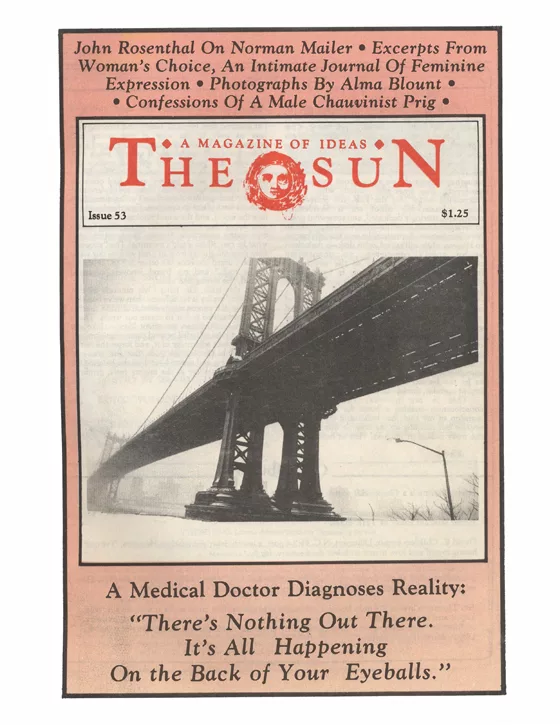
There’s a paradigm shift happening in our society. What does that mean? The last time the scientists pulled this they told us the world is not flat but round. So there were meetings like this one and somebody like me got up and said, “Hey everybody, the world is not flat.” You know what they’re saying now? It isn’t there. There’s nothing out there, it’s all happening on the back of your eyeballs. So if you want the basic message from me to you, as a family physician, if it’s all happening on the back of your eyeballs you might as well write a light romantic comedy instead of a heavy tragedy. And that I think is the basic message.
One of the speakers at our conference was Brian O’Leary, a physicist-astronaut who was on the moon. Dr. O’Leary said that we are living through a change, equivalent to the time when life first crawled out of the water on to dry land. What’s the nature of the change? The nature of the change is the paradigm shift. What no longer works is the idea that this universe is composed of separate entities and that you can know anything about it by analyzing it, by breaking it down to its smallest bits. We used to believe that atoms were the smallest bits, and then we found out atoms are made up of protons and neutrons and electrons spinning around, and then Heisenberg comes along and says, well, they’re not always there, and it’s mostly space. Now we know that the smallest little bit is a quark. Do you know where the word comes from? The word doesn’t mean anything. It comes from James Joyce — three quarks from us to Mark. He had to have a word to rhyme with Mark so he made up the word quark. Dr. Fritjof Capra says that quarks, which make up the basic building blocks of our reality, don’t exist. As a physician I was interested in what this physical body that you bring to me to fix is made of. You say, listen, this pile of quarks isn’t working, fix it. Well what am I supposed to say when Dr. Capra comes along and says quarks can’t possibly exist? So that this physical body is made up of a bunch of things which have no real existence.
That’s part of the paradigm shift. The idea that there’s something real out there is a mistake. Another of the speakers was Dr. David Finkelstein, the physicist from Georgia who came up with the idea of black holes in space. Dr. Finkelstein looks like Ram Dass. We had Ram Dass, too. They look alike, and they’re essentially saying the same thing. Dr. Finkelstein’s thesis is that physics was given the task of examining the physical world. And its job is complete. It’s examined the physical world and found that there’s nothing there.
One of the other speakers we were supposed to get was a Dr. Eugene Wigner, who won a Nobel prize for working on the atom. And he couldn’t come for some reason, and I called him up and I said, “Well, Dr. Wigner, what would you like to tell the people? Dr. Wigner’s message is that consciousness is all there is. Just consciousness.
And that’s what Dr. Karl Pribram is talking about. Dr. Pribram says that your brain takes in information from your five senses about the physical world out there, puts it together in the form of a three-dimensional picture, a hologram, and projects it as if it were out there. That’s what I mean when I say it’s all happening behind your eyeballs. And he’s running around the world telling everybody that and they haven’t put him away yet. They argue with him but his arguments are very powerful.
It’s the end of about 300 years of illusion, of an era. Heinz von Forster, a cyberneticist, says the basic shift in our society today is the elimination of the difference between the observer and the observed. The idea that I can study something objectively is asinine. An objective scientist is somebody who watches something very carefully and takes copious notes to find out what it does when nobody’s looking at it. Think about that one.
The same is true about the body. We used to think, my body which is this pile of quarks, does whatever it does regardless of what I think about it. Carl Jung said back in 1919 that the predominant feeling in medicine is that the brain secretes consciousness the way the kidneys secrete urine. Dr. Jung summed up the Skinnerian attitude beautifully. It’s just as likely that consciousness creates the brain. We don’t really know for sure. Nobody really knows what’s going on. Everybody’s got ideas, theories, hypotheses. It’s round, flat, it’s real, nobody really knows. So what do you do in a situation like that? What I do is retreat into the philosophic position of William James, who talks about truth as what works. People talk about truth as though they have seen directly into the mind of God, and find some unalterable verity there. That is simply not possible. The best we can hope for is what works, which is great for a general practitioner. If you have asthma, and you go out and whistle Dixie and your asthma goes away, I don’t really care why you get better, just so you get better.
We are presented now with two different ways of looking at the world. One is, it’s out there and it’s doing it to me. I mean, this germ attacks me, I was walking along and suddenly this cold virus comes along and suddenly I got a cold. I’m not attacking the germ theory, although I find it a little hard to swallow at this point. You know the story of the Legionnaire’s disease. There were two guys in the same hotel room, they drank at the same bars, they went to the same places, they ate together, and one got Legionnaire’s disease and died, and the other didn’t even get sick. It’s not enough to find out what “caused” one to get sick; this is the basic transition that American medicine is going through.
What we’re beginning to look at now is the guy who didn’t get sick. Now this is a complete turnabout. We’re not looking out there anymore. We’re beginning to look at the consciousness. We’re beginning to examine the position of Dr. Wigner that consciousness is all there is, that there is no mind-body separation but that the body is a function of the consciousness. You want a simple proof? You ever notice that husbands and wives look alike after they’ve lived together for a long time — not all of them, some of them. Some people’s dogs look like them. How you think creates how your body is.
I want to give you some evidence for this. I want to build a model which can help you in terms of taking care of your own health. Krishnamurti said that we’re very careful around rattlesnakes because we know what they’re capable of. He said if you knew what your thoughts were capable of, you would be even more careful around them than you are around rattlesnakes. The suggestion coming down from the best minds in the scientific community today is that the world is crystallized thought. What you think creates your world. There’s an old Buddhist image of two mirrors facing each other — each one reflecting and creating the other. That’s the way it is with your consciousness and your physical reality.
I can make parking spaces. For ten years I’ve been making parking spaces. That’s a simple little thing, you know. It really works.
One of the basic things that’s happening, as the 21st century comes, is the downfall of the cult of atheistic scientific materialism. There are still some high priests of that cult around, telling us the world is flat, or it’s real, or it’s objective. But the crescendo of work which is coming out of the best institutions all over the world is beginning to overwhelm that point of view. And you hear that pretty much in backwaters, scientific and medical backwaters where people are still stuck on Descartes and scientific materialism, and objectivity.
The cult of atheistic scientific materialism is based on the idea that matter is God, and that the only thing that really matters is matter. The old Greek concept is that matter was put here by God, and only the mind of God can change matter, so that my mind, a mere mortal’s, cannot have any effect on matter. Now that was a mistake. It really isn’t like that. That’s why you get religious healings. People would pray to God to interfere with the malfunctioning of matter in their bodies, to change it. Now we’re beginning to understand that possibly, in terms of being able to manipulate matter directly with mind, each one of us is God. Now you can move matter with your mind, you know, by scratching your head. You decide you’re going to scratch your head and your finger goes up, and scratches your head, in exactly the place you want it. Remember the involuntary nervous system. Remember that old myth? I think they still teach it in some medical schools. I find it hard to believe that there’s such a thing as an involuntary nervous system. According to the new science, the new physics, and 21st century medicine, there is no part of your body that you cannot theoretically affect directly with your consciousness.
The suggestion coming down from the best minds in the scientific community today is that the world is crystallized thought.
I can remember when Dr. Hans Selye first came out with his idea of psychosomatic disease, the idea that the way you think can actually initiate a disease process. Now the medical profession in my time, and I got out of medical school in 1953, were led, kicking and screaming, to the idea that a patient’s lifestyle and thought processes can actually initiate a heart attack, or an ulcer, or allergies. Now we’re beginning to look at psychogenic factors in almost all disease. I personally think that almost all human disease is probably psychogenic — psychologically caused. If you want to look back, Buddha said that the root of all human suffering is attachment, that it’s just the unwillingness to let go of something. Dr. Selye showed how it worked. He isolated the hormones, and he got objective evidence. What we’re saying now, of course, is if you can think yourself sick, you can think yourself well.
We know, according to the work of Bogan and Sperry, that there are two sides to your brain. The left side thinks, does time and space, it’s linear. The right side makes pictures. If we presume that they’re right, what kind of a mode can we create which will help us stay healthy?
Dr. Selye, who limited himself to the left side of the brain, says that there are two kinds of thoughts that you can have — one kind is catatoxic and one kind is syntoxic. Now what is a catatoxic thought? Catatoxic comes from the word catastrophe. An optimist is sure that this is the best of all possible worlds. The pessimist agrees and says, “I worry about that.” Now what happens when you say, “I worry about that”? You look at the world, which is just doing what it’s doing, there’s no good or bad in it, and you look at this and you decide that it’s bad. Catatoxic thoughts, through what he calls neurohumoral transducers, translate the electrical impulses you experience as thoughts into hormones, which then create a bodily state which instantaneously reflects your thoughts. You cannot have a single thought in your head which is not instantaneously translated into a bodily sensation. If you have a pessimistic or a catatoxic thought, you make adrenaline. Instantaneously. You have a worried or a frightened thought, you get a squirt of adrenaline. That’s the connection between mind and matter. Anybody that doesn’t know it, I think, is just a little bit behind the times. The other thoughts you can have are syntoxic thoughts, like from the word symphony, and when you have syntoxic thoughts, you create cortisone-like hormones. He calls them the doves among the hormones. So if you happen to be an optimist and you think everything is fine, you’re constantly bathing yourself in these syntoxic, happy hormones.
Let’s include Dr. Meyer Friedman’s model, too. A cardiologist from Mt. Zion in San Francisco, Dr. Friedman wrote Type A Behavior and Your Heart, in which he worked out his Type A and Type B personality concept. The Type A personality is a person who is constantly struggling against time and other people for survival. Type B personalities don’t do that. They know how to relax. And he’s been doing a study for 17 years, and he has a standing offer that if any Type B personality dies of a heart attack, he will pay for the funeral. He says he has not had to pay for a funeral yet.
You’ve got two kinds of people in the world and you see them every place. You’ve got the hard-nosed realist who knows how it is; I mean he or she is objective — “I know how it is and how it is is terrible.” On the other hand, and I see a lot of them in California, the pollyanna whitelighter. “Oh, I can cross the street and I can put white light on myself and the bus won’t hit me. Everything will be just fine.” The hard-nosed realist says, “Well, listen, you’re going to get killed, you’re just not going to survive.” Well, the facts are interesting. It seems that the hard-nosed realists die twice as fast of heart attacks as the pollyanna whitelighters. So if you think about the survival of the fittest, you know, it’s almost as if Nature herself through heart attacks is eliminating the hard-nosed realists. Practical application, see, because the pollyanna whitelighter really knows that the white light is going to protect him or her and bathes himself in cortisone and does not put the body under what is called chronic stress, which is a killer.
Now, there’s one other basic piece of research, and this will nail it down: It happened last year at the University of California Medical School in San Francisco, by Field and Associates. And set next to the Nobel work of Guillemin and Schally, who proved that the human brain secretes hormones, which affect the pituitary, it’s a revolution in medicine. Western medicine will never be the same. It’s a work on placebos. A placebo is an empty capsule or an injection with nothing in it, no active chemical. Mind you, we’re proceeding on the assumption it’s the matter, it’s the atoms, it’s those little quarks in that syringe or in that pill that’s really going to fix you. And what you think about it doesn’t really matter. So that, if somebody has a pain and I give them an empty capsule which has no quarks in it, just nothing, maybe milk sugar, and the pain goes away, the general feeling is that the pain is in your head, right? That you didn’t really have the pain. Dr. Field took 51 people with pain in their head. They had pain because they had just had teeth pulled. So that there’s no doubt that they had real pain. What he did was then give them placebos. Eighteen out of those 51 reported complete relief. Now, what happened? I give you an empty capsule and I look you straight in the eye and I say, “I’m the doctor, and I’m going to stop your pain.” You know what happens? Your brain makes morphine. They’re called endogenous morphines. Now, I don’t know what the limit to that is. Which means that as a physician it totally changes my approach to a patient. I no longer care about the objective disease that the patient has. Right now, I do care, because I could get sued. I have to have a diagnosis and the patient under the care of a reputable physician or some kind of institution, and a lot of the centers that are growing up are beginning to include all this. You still have to touch the base of objective reality because we are in a transition time.
Dr. Carl Simonton, who was one of the people in one of the early conferences that we did about five years ago, says what is killing his cancer patients is the notion that they have an incurable disease. The idea that they’re supposed to die. Implications in geriatrics are enormous. Dr. Rosenfeld talked about evidence that this body is built to go at least 150 years. I remember being told that after 25 it’s all downhill. Well, that’s what creates it. Just like Field giving you a placebo and saying your pain is all gone, if all the doctors say that after 25 it’s downhill and you have to expect to get old and feeble and senile, that is a direct command to your body to do that.
Mary Leakey found human footprints exactly like ours in Africa in a stratum of rock that was three million years old. Three million years ago, people at least with feet like ours were running around on the planet. Now why should just the feet be like ours? The idea occurs: well, how did we survive, let’s say three million years, without drug stores? How did we do that? I mean, running around with the dinosaurs, what got us through it?
For that I have to adopt a model of Julian Jaynes of Rutgers University. He brings in the function of the right side of the brain. The right side of the brain makes pictures, it’s the image-making side of the brain. What are these pictures that your brain makes? You have a dream, or you close your eyes and you see a picture, what is it? Well, Dr. Jaynes believes that the images — Carl Jung calls them the archetypes; Jaynes calls them the gods — are actually hallucinations spontaneously produced by the right side of the brain to guide us and direct us. He says, for instance, if Org was walking along and came to a split in the road, or was walking along and had to eat, he wouldn’t say, “I’m hungry now, I think I’ll go kill a dinosaur.” That the right side of the brain would create an image and Org would see this god standing in front of him who would say, “Org, take spear, kill dinosaur, and eat.” You begin to think of these ancient images of hunting scenes in the caves at Altamira. Dr. Jaynes suggests that the Trojan Wars were directed by hallucinations. Most of our major religions are based on hallucinations. It’s quite conceivable when Moses saw the burning bush, or Bernadette saw Our Lady of Lourdes, it was a hallucination produced by her right cerebral hemisphere, to guide her.
There’s an old Indian legend that when the primal parents were first born, when they were first walking on the planet, they didn’t know what to do. So they asked the Great Spirit. And the Great Spirit said that they were to watch the animals in their dreams. And the animals in their dreams would direct them. The animals taught them how to hunt, fish, build shelters and plant corn. The information for how to survive on the planet came from spontaneous visual images which arise in the right-hand cerebral hemisphere. Jung codified this into the method of active imagination, and I’ve been playing around with it for 10 years, and let me tell you, it’s dynamite; I think it’ll cure anything.
At another program we did, Elisabeth Kübler-Ross talked about how consciousness does not die. At the end of life, she says, the body is cast aside like an old overcoat and the consciousness continues. What the consciousness is, we really don’t know. What some people are beginning to feel is that what we call consciousness and light are the same phenomenon. You begin to think about Einstein’s “E=mc2.” Energy is the same as matter. Einstein told us several times that there is no difference between the thing that’s moving and the motion. That the thing is crystallized form of the motion. Things are crystallized energy, just as ice is crystallized water. What they’re saying now is that the continuum is not just energy and matter, but it’s mind, energy, matter. Consciousness, energy, matter are a single continuum.
I’m a general practitioner and I’m operating on the implicit agreement between patient and physician that goes on today. I make a house call, and the problem is that my patient has a pain in the right buttock. I do a careful examination of the patient, and being a very astute physician, I discover that my patient’s rear end seems to be impaled upon a tack which is sitting on this chair. Okay, so now I’m going to do 20th century medicine. The job is, get rid of the symptom, using the finest technology available. Going to give you a shot of morphine. Not only is your pain going to go away but you’re going to be one happy fellow for about three or four hours. Great, you’re a great doctor, fantastic. But I know that after about three hours the pain is going to come back, and I don’t want to make another house call. I’m going to leave some codeine tablets. I’m going to say, “Take two codeines and call me in the morning.” I leave the codeines, and when the pain comes back you take two codeine tablets and every four hours you take two tablets and your symptom will be destroyed using the finest technology available. Of course I get a call, maybe the next day, maybe two or three days later, “Well, I don’t know, the pain used to go away, now it’s back every two hours, and I’ve got to take six tablets, and it only goes away partially, and I’m sick to my stomach and I vomit all the time, and I don’t know, I don’t think your medicine is working.” So I say, “It’s not my medicine, it’s Eli Lilly’s medicine. Don’t blame me for the medicine.” However, if it’s not working, I have to presume that our pharmaceutical technology has not solved this problem. We have here a medical failure. What do you do when you’ve got a medical failure? I’ve got a friend, Sam the Surgeon, he’s really good — it costs a little more than me, but Sam is a specialist, he’s very good at cutting sciatic nerves. He’ll cut the nerve. Your foot might drag a little bit, but it won’t hurt.” “No, I don’t like that one.” “Well, I have a friend, Norman the Neurosurgeon — he can do what’s called a dorsal root rhizotomy. He’ll just cut the sensory nerve. Of course if Norman hiccups or sneezes while he’s in there you might have a lot of trouble, if you survive the anesthesia. And it is expensive.” Well, he doesn’t like that. “Well, we can go on the thalamus, the pain center. We can stick a needle in it, we can fry it or freeze it. And most of the time it works. Most of the time. If you don’t like that we can do the piece de resistance, which is a pre-frontal lobotomy. In that case, your rear end would still hurt but you wouldn’t notice it. It wouldn’t matter. Or I can send you to a psychiatrist who can teach you to live with your pain.” Of course, I could say, “Why don’t you get up off the tack?” I could say that, right? But you know what the answer is? The answer is, “But Doc, I make my living sitting on tacks.” Now, that sounds dumb. Now let’s extrapolate this to an executive with an ulcer, or with anginal pains, a truck driver with a back pain, a football player with a bad knee, a housekeeper with arthritis, okay? That’s the approach we have been using to destroy the symptom using the finest technology available. Using this approach, we spent approximately 192 billion dollars last year without significantly affecting our mortality rates at all.
Now, imagine the way this 20 billion-bit computer works. The bottom part, which is the part we share with lizards, is the computer. And it doesn’t think, and it’s pretty good. And that’s as old as life, because the lizards have this computer which can detect a fly, shoot the tongue out, and swallow it. Fully automatic. It doesn’t need anything — no consciousness as we know it is required of a lizard to perform its function. So you’ve got the computer which is running your whole body. Now the question is, if the body is malfunctioning, we now begin to suggest that there’s some bad program in there. There’s a program in there that has to be changed. And there are two ways you can change the program. You can give your computer direct instructions from either side of the brain. Either side will program with thoughts, which is the old power of positive thinking. “I will get well.” There’s a lot of evidence for that. That you can actually command your body to get well. The other side of it, which is worrying about what it might do, is also a command because computers are stupid.
I can remember when I was in general practice, I used to get from the drug companies beautiful little three-dimensional models that would show you all the horrible things that can possibly happen to you. And those are just suggestions. The doctor says this is going to happen, and sure enough, it happens. It happens because you have put a program into the computer. What we’re saying now is if we can make morphine, why can’t we command a diabetic pancreas to secrete insulin? How far does this go? The other way is to make a very clear picture of how you want your body to be. And this is for pain relief, and I’ve had a lot of experience with it, and a lot of people all over the country have been doing it. Let’s say you have pain in your back. The right brain works through pictures. So you can’t tell your right brain, I have rheumatoid arthritis, fix it, because it doesn’t know what you’re talking about. If you have a back pain, and it feels like there’s a knife stuck in your back, a very clear image of the knife coming out of your back, in my experience on a general practice level, will work 98 percent of the time. It really works for pain relief. Beyond that, what we need is to understand why did you get the symptom. What is it trying to tell you?
We did a program on that: Birth and Rebirth. Two of the speakers we had were Arthur Janov and Frédérick Leboyer. And the reason for having those two was to describe that there are two ways you can be born. You can be born kicking and screaming, or happily floating around in warm water with the lights out. Now that’s on the physical level. If everything is a hologram, where everything is in everything else, we say, if this is the physical model, it must be reflected on the psychological level. Now, how is it reflected on the psychological level? Let’s look at an infant at term, at nine months. This happened to all of us. For nine months we were floating around, upside down, if we were lucky, in our mother’s womb and protected by these huge muscular walls, and this nice thing of water surrounding us, attached by a stalk to a root which sunk into the maternal soil and sucked up nourishment. You hear your mother’s voice, and you slosh around in the water and everything is fine, you know? Great, it couldn’t be better, it’s perfect. And one day somebody pulls the plug. The water runs out, and the same walls which protected you try to kill you. Then, the next thing you know is your stalk is cut and your roots are pulled up and some idiot has got you upside-down and is whacking you on the backside. This is the old medicine, it’s not the new medicine anymore. If you try to resist that, you die. Any creature which does not go through the birth process dies, and in terms of the forces to which you were subjected — if your head today were subjected to the forces that it was subjected to at birth, it would be crushed like an eggshell. So, that’s birth. You’re out, and you look around, and okay, somebody takes care of me, somebody feeds me, well this isn’t so bad. I see these two big people, Mamma and Daddy, and they take care of me, it’s fine, I think I really like this, and as soon as you decide you like this, off to school you go. There you are in school, and finally you get used to that, and you get to play with the boys and the girls, and then one day you notice there’s a difference between the boys and the girls. And you have to deal with that one, right? Sex. Okay, you go through the problems and trials of adolescence, and going from childhood to sexually active adolescence. You go to see the psychiatrist or whatever you do, and you make it, you even decide you like it. As soon as you decide you like it, you’ve got the hang of it, poof, it’s gone. Finished. That one’s over. Well, what’s happening? I’m getting older. I’m older but people ask me questions, they listen to me now, they think I know something. As soon as you’ve got that one down, you die. That’s the human condition. We have to go through these phases. We are constantly turning into somebody else. As soon as you think you know who you are you’ve got to give it up. And if you don’t give it up, you suffer. So you begin to realize that disease, suffering, pain is an ally, it’s a friend, it’s goading you to evolve. Of course, the one thing that consciousness does is evolve and change. It simply does not stop. Each one of us is the means by which the human race evolves. There’s nobody here but us. It’s possible there’s nobody here but you. You’re making all this up so I can tell you this, right? That if you don’t evolve, if you try to stop, you simply get recycled, you know, back to the drawing boards and start all over.
There are two ways you can program the computer — you program it with thoughts and you program it with visual images. The left side thinks and the right side makes pictures. Both sides serve a dual function. A, it will carry messages from you to your body and will tell your body what to do. B, it will carry messages from your body to you, which will tell you what your body wants you to do, why it made the symptom. For example, your body gives you the pain in your rear end because it wants you to get up off the tack, or a heart attack because it doesn’t want you to keep that job anymore. It has direct effects in your day-to-day life.
John Lily talks about programming and meta-programming, that the universe knows what it’s doing and it means us no harm. When Albert Einstein was asked, “What is the most important question facing the human race today?” he said, “Is the universe friendly?”
If you decide the universe is not friendly, then that’s harmful to your health; if you have to fight the whole universe, the odds are really against you. If you decide that it’s friendly, whatever happens to you, you decide that it’s happened for a good reason. For your own edification, your own evolution.
There can be no inappropriate pictures in a perfect universe. The left side of the brain that looks at the universe and says, “that’s inappropriate” is a about three thousand years old. Language started three to eight thousand years ago; until we had that we could not have any opinions at all about the image. The part that makes the image is about five million years old.
How can there be an inappropriate picture in a perfect universe? It has been my experience that there are no inappropriate pictures.
© Light of the Mountains