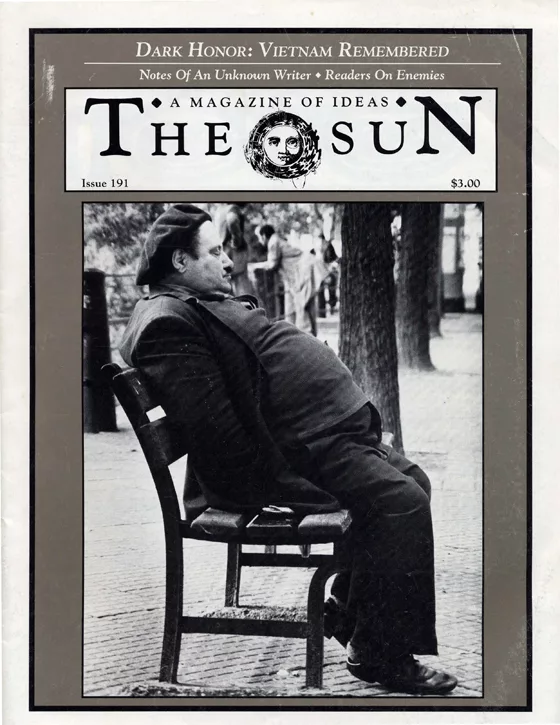
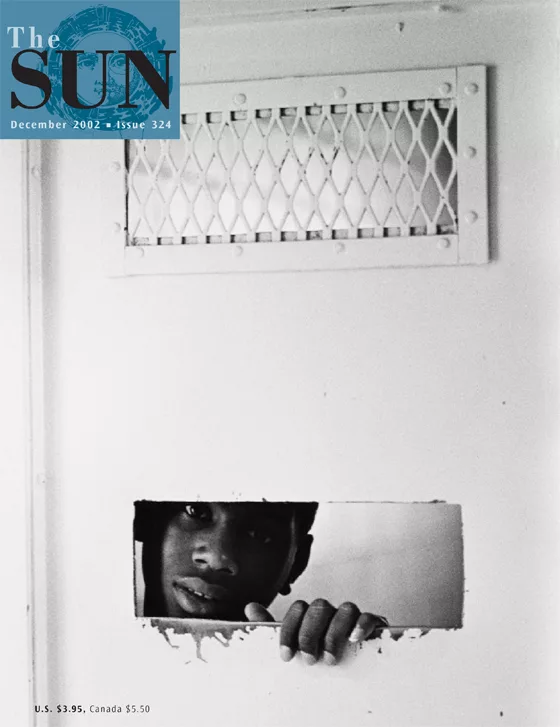
“Notes Of An Unknown Writer” consists of excerpts from Robert Roth’s journal. They first appeared in And Then, edited by Roth and Arnold Sacher, and designed by Shelley Haven. Published in New York City, And Then is an annual collection of spirited and often disquieting writing, photography, and art.
Single issues of And Then can be ordered for five dollars postpaid from And Then, c/o Robert Roth, 210 West 10th Street, #3D, New York, NY 10014.
I am now at an age where I have watched people grow old. They look older, maybe more feeble, their bodies thickening, their bones feeling more frail or their bodies a little stooped, their faces worried in a way I have always associated with older people. I see my friends looking more and more like my aunts and uncles did when I was a child. This is the first generation I have seen grow old. And it is a shock. I feel a surge of hostility whenever I see people take on mannerisms or physical characteristics that I associate with people who are older. I think it is willed and I am angry.
Trip to Buffalo coming to a close. Had a chance to see every close friend, meet one or two new people. Sitting in newly discovered park. No one here, just birds.
How is someone feeling when flattered in a way that someone else might see as offensive, but who seems to be enjoying the appreciation? At April’s party, an actress, long legs, short dress, nasal, high-pitched voice, a situation-comedy voice, appeared genuinely flattered when a man she had known in Hollywood, whose name she didn’t remember, said that his name for her was “precious.” She said that was sweet. Someone else might have thought the guy was creepy. But then he might not have said it to someone else. It had taken him a while to gather the nerve to tell her the nickname he had for her.
When someone is patronized but feels flattered — smiling face lighting up — how is this different from the emotions a person feels when the compliment is altogether genuine? What I’m getting at is that if a person is patronized, insulted, unconsciously mocked — do they understand it deep inside even if they think they are being complimented? Do they think the person is friendly? Appreciative? Or do they perceive, however dimly, that deep down the flatterer is, even in ways not intended, hostile, bigoted, unfriendly? How many lifelong contacts — friendships, love affairs, fall inside this pattern? What subterranean understandings are at play? What did I feel toward the actress? Toward the man? What did I want them to think of me?
Your phone number always here at my fingertips. For six months I haven’t been able to dial it.
Waiting for Marilyn on the Staten Island side of the Staten Island Ferry. Not exactly sure where we are to meet. Hope we don’t miss each other. Hot sun on this miserable summer day. Nice ride on ferry. It was actually cool. Had to wear the cotton sweater Mark gave me as a present. Mark injured his back trying to help Linda move. He offered to help after an exhausting week working double shifts in the unbearably hot stacks of the Harvard Business School library. No air conditioning. The stacks are maybe twenty degrees hotter than the rest of the building. Mark’s work partner just retired, the full burden of his absence falling on Mark’s shoulders. All this while he is also working very hard on the union drive there. Not exactly sure where Marilyn and I are supposed to meet. If we’re both early then one of us is waiting in the wrong location.
Hiroshima Day: can’t talk to Akemi. Today the separation is particularly painful. Probably permanent.
“Free Sherman McKoy” his T-shirt read.
“Are you Sherman McKoy?” I thought to myself.
What if I wore a T-shirt that read “Free Robert Roth”?
The hottest day has not turned into the hottest of nights. In fact it is almost cool. Anyone with any money sits in cafes. Those without sit in small parks.
I see so many fewer people I know in the streets. I no longer run into people I know. For years I was often the one person any number of people would on occasion run into. There was much more of a street culture of people I was friends with. I can still see people at events. But not walking the streets. All day I can walk and not run into a person I know. Years ago I could just take a walk and let each person I would meet usher me through some part of the day. Now I have to make phone calls for appointments. Very rarely does someone just drop by.
Friday night ten p.m., in the street. Man lying unconscious, beaten up in a fight. Cops and paramedics attending to him in rubber gloves. They discard gloves in the street. One woman goes over to complain. Clearly, she feels pleased with herself.
I can hear my own voice — that tired, depressed sound. I don’t feel a connection; more it is I don’t feel able to challenge what people have to say when I’m in disagreement with them. I go along with what they say — not agreeing — but keeping my differences muted. I don’t engage the person. This is not quite right. Can’t quite get it. Don’t feel an excitement.
Work won’t resume for another month. My money is dwindling. Have been on an austerity budget. Eating too little. Losing weight.
Magazine not coming together. I’m always coming back to Akemi, my father, my trip to Israel, my job as newspaper distributor, playing basketball in the church. My father’s death. Hostile Christian faces staring at me during basketball game at the church.
Park cleanup welcome. But each improvement could be laying the groundwork for further gentrification. August is almost over. Two months go by. I do nothing. The days just disappear. The park is filled with people. The park attendant sprays pigeons with his hose, playing with them. They scatter in panic. A man in a suit is eating a banana. Another man is talking to himself, making a speech. Two women are complaining about the people they’re working with. Fences around parks are springing up throughout the city. They want to make parks safe, want to keep “undesirables” out. Too many pigeons here right now. I have to leave.
After my father slipped back into a coma they attached an external pacemaker to him. This operation took a number of hours to perform. It was supposed to be a simple operation, but it wasn’t.
On the day he died, I had visited him in the morning. The doctor I had spoken to said he had improved. He in fact seemed a little better. I left the hospital feeling somewhat hopeful. Later that day his pacemaker malfunctioned and everything went haywire. They brought him to the operating room but after a number of hours he died. I saw him in a viewing room. Blood was dripping from beneath the sheet covering him onto the floor. The blood was dark, watery, with little air bubbles. I wanted to stick my hand into the blood and then rub it all over my face. But I didn’t.
My father died with a white beard and a peaceful face. For two and a half weeks no one shaved him. Slowly as his beard grew in, his personality transformed. He died as a man with a white beard — a poet? a peace activist? a prophet? He did look different. Only his forehead was the same. I didn’t even know that his beard would be white. His lips had been stretched (maybe into a smile) by the respirator shoved down his throat. And so he died a man with a white beard and a peaceful smile and very long nails that no one would cut. I looked at my father’s wise peaceful face and kissed his forehead. His forehead was cool but his body was still warm. I felt his death as an offering, a present. It was a present I could not accept. My whole life I have not allowed the full force of experience to affect upon me. I have always been too numb, too frozen by life-shock.
A worker from Con Edison saw my father’s car swerve and knock into a lamppost. He pulled my father out of his car and gave him CPR and brought him back to life. The ambulance came and took him to Elmhurst General Hospital in Queens where they worked over him, stopped him from dying, and gave us two and a half more weeks to be with him.
To prevent him from dislodging the various tubes inside him, my father’s hands were tied with a soft cloth to the railings on the side of the bed. When I entered his room the first thing I saw was his chest heaving in and out, the respirator expanding and contracting his lungs. Toothless, his blue eyes unfocused, his skin still remarkably smooth, his head moving from side to side I pictured him as the marathon swimmer he had been in his youth.
Struggling for breath, his head moving from side to side, weighted down by the water-logged swimsuit his mother had made from an old pajama top, I could actually see his small, firm, immigrant body fighting the waves, the water, the exhaustion. This time however it seemed as if he might be defeated. He looked so vulnerable lying there in his bed. What I mean by vulnerable is that he seemed like a rare and gifted athlete with a will of iron, faced with maybe just one obstacle too many. Not a man who might be dying.
After two days my father emerged from the coma. He was in an altered state of consciousness. An almost stoned, blissful state. He was playful and affectionate. “She’s very pretty,” he said of the nurse across the room. “Go, go tell her you’re a writer.” He could not grasp where he was. And if he did he would immediately forget. Every ten minutes he wanted to go home. He wanted to be moved to New York Hospital. He would ask my mother to call up doctor friends long dead to rescue him. At one point it occurred to him that he had blacked out. He mused as he said the word “blackout.” It was almost as if he were delighted to have experienced something he had always heard about.
The first words he spoke, no one could understand. Impatiently he gestured for paper and pencil. He scrawled “kosher” on the paper. Then “roll and coffee.” The only thing he was allowed to eat was ice. “Here’s your roll and coffee,” I said. His tongue thirstily drank in the ice. “You know, this is manna from heaven,” I said to him. And whenever I or my brother fed him ice we would imagine it to be the most delicious of foods.
Lying in the bed next to my father was a young black prisoner in critical condition. He had complained of fatigue at Rikers Island. They did not take his complaint seriously. He soon fell into a coma. Young interns on loan from Mount Sinai Hospital, those clean-faced, energetic, “brilliant” young doctors slavishly worked over him. Supervised by the “top” doctor-teachers, they used every modern device and instrument on him. While they worked on him, his wife and family waited outside the room.
When my father emerged from his coma joy overcame my family. White Jewish family, momentarily joyous. Black family grim and resigned. A very painful and confusing moment.
The doctors took great pains to explain to the prisoner’s wife exactly what they were doing, what his condition was, what they were going to do next. They were extremely gentle with her. At one point she turned to me and said, “Now they treat me like a queen.”
The NYU clerical workers are going on strike. I’ll have to deliver school papers there. What will be the best way to do it? Leave the papers outside the buildings? How to do this right. I wonder how long it will take them to settle. I need this strike like a hole in the head.
Carl’s more compulsive patterns seem suspended this year. Fell in love. Joan is pregnant. No-nonsense person. Carl is kept in check. Problems with her pregnancy intensifying a deep sadness. There they are, two wonderful, aware people, after a wedding, inside a state of pregnancy confusion. Now there is the reality. Not easy to handle.
Akemi/Robert: race, gender, class. Japanese/Jewish. Inside that reality. All the goodwill needed to overcome social divisions, neurotic personalities. Deep love not always enough. Strong enough to join us, not strong enough to sustain us. Pain in this disappointment. Boredom. Both hearing each other’s stories once too often. The most nightmarish experience is waking up next to someone after three years, seven years, ten years, wondering who that person is. Knowing that person only inside the dynamic that has been established. In five minutes you might know more about Akemi than I do after two years. “Let’s start from the beginning. Do you have any hobbies?” Akemi asked me after our first really big fight. I see similarities between Akemi trying to get her green card and Joan and her pregnancy.
Akemi’s family is upper middle class. Her father, a former table-tennis star, is a banker. Her mother was tennis champion of a whole region of Japan. Akemi, intimidated by her mother’s ferocity, would lose, still lose, any game she played against her.
As a young girl she discovered a book by Mao and studied it. Her two favorite political figures were Mao and Rosa Luxemburg. Akemi became a student leader in college. Started her own sect, a women’s liberation sect. She designed a shocking-pink helmet for its members to wear. Akemi made speeches in front of forty thousand people. She said, though, that they weren’t speeches, but agitations. The difference was that an agitation was an engagement of equals while a speech was talking down to people. Her agitations could last as long as forty minutes. Wearing a helmet and kerchief over her face, as well as not being able to see individual faces from the podium, made it easier for her to speak in front of a huge crowd. She is, in fact, a painfully shy person.
I asked her once to do an agitation into her telephone answering machine. It sounded quite impressive. “Ladies and gentlemen under my command” was how she translated the beginning of her agitation. It was only when she started working with peasants and had to break her ideas down into a simpler language that she first began to understand her own politics.
Over at Carl and Joan’s. Three heterosexual couples eating dinner. Sex turning into comfort. I don’t want to be that comfortable with anyone.
Worried about my weight. I see how people become anorexic. Losing weight, and all I can concentrate on is my belly. And my nose seems to be growing larger with each passing day.
I need sex. With whom I don’t know. Very demoralized of it ever happening again.
It seems to have happened almost overnight. My face seems to have rearranged itself into a markedly older face. I don’t know how this face is seen by others. It is not a face that will drive people away. But I don’t know if anyone will ever again be drawn to it.
I touched my father’s nipple while leaning over his hospital bed. “I hope he doesn’t die this minute,” I thought to myself, laughing.
The memorial service for Carol’s father, Louis Klein, at Alternative [the radical school located in Brooklyn]: Carol, who for more than ten years has presided over countless events at the school, also presided over this one. People were dressed in black — black suits, black dresses. Many older people, family members mostly, and friends of Louis. I didn’t see too many of Carol’s friends there. Just her best friends. A left-wing family, part of a counterculture, that of the old Left, rather than the counterculture of the sixties. There was an expansive humanity in the room: people who for decades had worked for social change. Some, I suspect, had also been part of a sordid history of betrayal and the rationalization of awful governments and fucked-up political movements. The people there were not all that different from some of my father’s sisters and brothers.
My father was a Jewish small businessman. I remember how angry I was at my uncle Sandor when he described my father that way. I remember sitting in Sandor’s car, thinking furiously that my father was a “big” businessman. My father was an Orthodox Jew and a political liberal. He also knew that in the crunch his brothers and sisters would always come back to him for help (they, I think, would see it differently). This gave him a certain smugness, as well as a certain insight into the world. Anyone venturing too far afield with whatever flair or independence would, when they failed, fall back on the security offered by a world they held in contempt. So, in a sense, my father knew me all too well. He had seen me before in some of his seven brothers and sisters. He could not understand what we were trying to live for. He understood us in terms of our defeats and humiliations and our dependence on him: everyone coming back to him for protection. So there was pride in his son’s accomplishments, but also a certain vindication in his son’s defeats. There was also a largeness to my father, a warmth and a wild sense of humor. He was very generous. Once, when I needed to borrow a large sum of money, he did not ask me what it was for. He knew it was for something important and both trusted my judgment and knew I would pay it back. My father was compassionate, neurotic, filled with confusion and hysteria — told, I suspect, to take cold showers or long walks to cool off desire. He could, however, step out of his own prejudices when it mattered and attend to the problem that presented itself.
Louis Klein seemed stern and demanding. He brought his children to demonstrations. He was a war hero and a fighter, a real fighter for social change. He was hot-tempered but always yielded to the wishes of his children if they pressed him enough. He had fond memories of the Party, struggled for justice till the very end. Carol stood in front of the room, composed and articulate.
There was no memorial service for my father, though hundreds came in a summer rainstorm to fill the chapel. He had always made time for people, paying a special attention to anyone he might know. Neither my mother nor brother nor I spoke at the funeral. Jonathan Berger and his journalist friends all spoke at his brother George’s funeral. He introduced all the speakers in a deep, resonant voice. “George was a genius of a father,” he said at one point. “Then why did he die before his son was ten?” I thought to myself, surprised by my own bitterness.
A beautiful change in the weather. Two days ago I wrote a letter to Z [a libertarian left-wing magazine], the only really or almost really good thing I have written in a while. Then I had a cappuccino. I should have written more. Caffeine is a powerful drug for me; it brings up feelings that could be released in writing. Instead I spoke to Arnie on the phone. I was jittery, depressed, a little sick for a day and a half. I think if I had better used the caffeine high it might not have happened. Somehow half my emotions surfaced. Or more precisely, my emotions surfaced halfway and then got stuck. Next time I drink coffee I’ll try not to squander it.
My aunt Irene slept with a black mask over her eyes. She loved to dance when she was young. I knew her only when she had multiple sclerosis. The mask kept the light out of her eyes so that she could sleep. I remember the mask and the smell of witch hazel that she rubbed on her body. I loved that smell and would be surprised, in fact not believe, how strong it smelled up close. Or how awful it tasted. She loved to tell me that the song “Good Night, Irene” was written for her.
In Israel, Lolita cried herself to sleep each night listening to love songs sung by English and American rock musicians. I still can see that big tape deck/radio in her small basement apartment. I felt enormous gratitude toward those singers for the solace they gave her.
On a farm in South Carolina, my friend Emmet Durant kept his sanity as a child by reading Rimbaud and not feeling like a total freak.
The leaves are falling outside my window, which is why they call it the fall.
I constrict my cheeks, squint my eyes as if by an act of will they will catch on fire.
Now that the weather is cold I have to find somewhere inside to write. Today it is the library. The Jefferson Market Library which had once been a courthouse.
Woke up with a cold and a swelling around my asshole. Two years ago when I had the same thing the doctor told me it was hemorrhoids.
The library is filled with school kids from I don’t know where. Some older people. More eccentric types. My academic friends use the NYU library. They use personal computers and credit cards. They write books, work hard, make money. They are always on the move when they haven’t collapsed.
The intense sexual longing no longer in Akemi’s face. I remember the moment love left her eyes. A loss, a loss so enormous.
I wake up. My nose hurts; my ass hurts. I wish I got this from a nighttime of pleasures, not from doing nothing.
I came home to an apartment filled with steam. The whole building complaining. Something wrong with the boiler. This building can be a living hell. Had to organize against the landlord a couple of years ago. Conditions improved somewhat. Carlos came to fix the toilet. What he did was build a huge mound to secure the toilet to the floor. He mixed cement in two pots of mine, ruining them both. I have to piss on an incline now.
Rashes all over Akemi’s body the last time I saw her.
I look a wreck. Dark circles under my eyes. I am fatigued and feeling depressed. A deep, deep sadness.
High-energy blonde comedian whom I saw last night in the restaurant talking with her friends. If I had gone home with her, with my hemorrhoids and upscale cement-mounded toilet, I would not want to know of the jokes she would tell her audience.
Going to see Harvey, I stopped at the Most Wanted display and looked at the criminals at large. The photos are constantly changing. Only one white face among all the black and Hispanic faces. Most of the people are younger than I. But they look like older men.
Again I’m here at the Municipal Building waiting for Harvey. It seems I’m always waiting here for him. Certainly it’s true in relation to this journal. I’ve worked five more hours with Alice, reading her book out loud. It is exhausting. We still have three chapters to do — all considerably shorter than the ones we have already done. I want to beat this cold that is coming over me. I see Claudia tomorrow night. If anything develops I don’t want it interfered with by a cold. I think some deep romantic feeling was killed off by ending with Akemi. Akemi a more recurrent theme in this journal than Harvey. So is my father. I suspect they are the only two people mentioned more often.
Harvey’s ankle is swollen. He is being driven very hard at work. Like Mark, Harvey takes on a huge load of work. They both do slave away under the burden of useless work. Work which in another context would be far from useless, though probably still exhausting. But maybe less exhausting than now. Mark works in the stacks of the library of the Harvard Business School, Harvey for the Department of Environmental Protection. Mark lugs books around all day, fetching them for students and faculty. It is an endless job. This along with helping to organize the union has left him depleted. He just got a promotion. But since he doesn’t have a degree he can never be a full librarian. Harvey is an economist who continually does paperwork and has to make suggestions. Any real suggestion he might make of course would never be taken seriously. A clean environment and a well-functioning library. Two essential needs of our future society can be helped brought into existence by my two close and tired friends. What they can’t do now they can do then.
The night Emperor Hirohito died: I don’t have Akemi to drink a glass of sake with and then have Arnie tell me how he never celebrates the death of another human being.
Hirohito’s death a historical moment that could not put me back in touch with Akemi. What a waste!
I think of Akemi sitting in the darkened kitchen of my apartment early one morning, taking long drags on her cigarette. A very lonely person in a new and strange country. Deep anxiety momentarily relieved with those drags. Italian and Japanese radicals smoke cigarettes differently. For the time being I’m going to leave it at that .
My nerves are on edge. In addition, Gorbachev is visiting New York. Traffic could be hell. My job could get all fucked up. I remember leaving the funeral service for James Baldwin. I went with Gary and another friend to an Italian restaurant near Saint John the Divine where the service had taken place. As we walked in, Gorbachev had just arrived at the airport and was being greeted by Reagan. This was being shown on a TV in the restaurant. The funeral service had been overwhelming. The love in that room and the grief! And then to see these two white men ready to figure how best to divide the world.
Max ran into Akemi at the post office this morning. She is very thin but looking well. She had been in the hospital for a month with a bleeding ulcer. She is no longer working in the restaurant, having been sick since October. She is moving out of her apartment. Her English, according to Max, has improved considerably. She has a friend, a professor, whom she speaks to a lot. Possibly a lover. I think I will call her later. Or write her a card. It has been a long time. I need to put some kind of closure or a different continuation on this. Too much pressure on her. Too much pressure. It was easier for her to meet someone than it has been for me. I do feel estranged. I did feel a special bond to her — I still do. But this I think might free me. I hope we can meet. Probably for lunch. She was in the hospital for a month without calling me. So clearly I’ve been placed way out of her mind. I have no need to place myself back in. But if possible I want some contact. I don’t feel there was bitterness toward me, more a falling out of love. A disappointment in who I am. More I think when she saw me so close up she stopped seeing me altogether. Both disappointment and relief, more than horrible panic, marked our breakup for me. And some guilt in not having the imagination to bridge the gaps which separated us. Probably she’s with someone who doesn’t “respect” her feelings as much as I did. So the person in a way is probably relating to her better. For both good and bad, I always take people at their word regardless of what I think they’re feeling. This sometimes provides me with an out. I avoid engaging the person. Sometimes it is just that I am bored with the drama that often ensues. The cutoff with Akemi — her not calling me when she was sick, having a new lover — maybe will allow us to be friends. Because I do respect a person’s decisions, maybe to a fault, maybe we can be friends.
This feels almost too important to write down. But if I don’t I’ll have to stop writing in my journal. I spoke to Akemi Wednesday. When she answered the phone we moved right into the conversation. It was clear that she was happy to hear from me. Clearly she had expected me to call. From October 23 to November 23 she was in and out of the intensive care unit of the hospital. They gave her codeine which she thinks was too strong for her. She threw up blood and twice fainted in the street. I don’t remember the exact sequence of events. This morning, thank God, was to be her last visit to the doctor. She was much better.
Her English is much improved. She speaks with great beauty and poetry. Very melancholy and sad. She has a boyfriend whom she wants to live with. They are looking for a place to live. A bigger place. In Manhattan. She said she is too frightened to live in Manhattan alone. She doesn’t want to give me her new address because she wants to keep me in her past. Very sad, very sad. I was sick Wednesday night. My stomach was aching. I hardly slept. Thursday night I went to bed at eight and felt much better in the morning. This was an extremely sad experience for me. I remember when we first met. I did feel we should be careful. She did seem very young — naive. It did scare me. Then to have such an absolute passion come toward me. And then have her history unfold. Someone similar to Rosa Luxemburg — still naive and crazy — Rosa herself very crazy. Trembling lips. Discovering sex for the first time — an explosion.
The happiest day turned into the beginning of the end. She invited me for lunch at her restaurant. Sweating, working so hard, she served Harvey and me a banquet. The bill was the equivalent of an appetizer. We didn’t know what type of tip to leave. Harvey thought three times the tax. It came to less than five dollars. We should have left ten. The meal was so exquisite. Her rage was so deep. We should have spoken before about what to do about the tip. I should have put more money down in any case. The beginning, really, of the end. No way to undo it. I bought a ten-dollar record for Shizo, the other person waiting tables that day. He was surprised and very happy. Still, a wall between us was now there.
Over our last year together Akemi started to scapegoat me. I was the only person she could yell at. I was the only person she could say “no” to. I think she enjoyed fighting. I just couldn’t get angry back when she insulted me. I thought her rage grew largely out of circumstance. I didn’t like to be a target of her rage. But it didn’t seem to have that much to do with me. She could make me guilty but not angry. I still hope there will be a time when we can be close again. This has been a hard time for her — a hard time for me. Maybe the degree of love she felt for me — though it didn’t feel entirely personal, though often that is the case — I never quite trusted it and maybe that is how I lost it. I feel almost as if I’m being faithful — proving my love by not meeting anyone else. But everyone I know — and clearly she also — wants to live with someone. That someone can’t be me. I’m too restless, too claustrophobic. Being with me does create problems. I don’t have something to offer besides sex, love, and empathy. Day-to-day life becomes a bore with me. I do have too many moments when I grow edgy or withdrawn. I can die when I see Carl and Joan or Alice and Martin. There does seem to be genuine love and concern there — but I would be dead before I would be in that situation. It is what they want. I think the degree of alienation and separation I would feel — the deadness I would feel — would overwhelm me. They have all lived through hard times, difficult times. They seem happy with their choice. Released from a certain type of struggle. One type of loneliness abated. I can’t now imagine anything resembling a sexually free world anymore. I mean even a place where people wish to take such a concern seriously. So really my decision is to be alone. People getting married in droves. Others getting into “relationships.” The Institution of Marriage. The Institution of Relationships. No one even talks about marriage as an oppressive patriarchal institution anymore. Here again I’m talking about the institution, not about individual choices.
Now Akemi wants to live with a man. Something she never thought she would do. She sounded so knocked about on the phone. Her dreams so flattened. Protection so dear to her now. She has thrown herself into another dangerous situation.
I can give someone intimacy, love, sexual pleasure. But I can’t help structure a life. Carl and Martin are able to help create an environment where life exists: work space, living space, entertainment, friends, cooking, vacations, a home, a shelter, and they certainly are interesting and intimate enough. There is something about those lofts, those meals, those vacations — the ability to “create” a life that until now I thought was nothing. And it is not something that I want. Still it provides a buffer so people can be together without necessarily bumping up against each other. Though all those dramas are played out there too. But still there is something there that I can’t provide. I can’t enter the routine, but I have no real substitute. Except for my refusal to participate! Alice is much happier than when she was alone. I don’t know what I’m talking about.
The fire has been knocked out of Akemi. Bravado may have hidden certain needs or maybe didn’t allow her to see what risks were involved in certain decisions. The society will extract its price wherever there is real life. Living in the United States has taken its toll. A person almost from another planet. A Japanese woman outside her culture, a Jewish man outside his. Yet she’s Japanese and I’m Jewish. The way we’re outside our cultures was as remarkably similar as it was different. I think the problem of understanding was as much hers as it was mine. Martin, Alice, Carl, Joan all have an abundance of energy. The structure of their lives somehow allows their lives to continue. Something is going on that I don’t understand. To me that type of contact is death. There is something positive there that I just don’t see. It seems like death to me.
A couple of weeks after the election of George Bush, friends and I went to see the political folk group Bright Morning Star at the Somerville Theatre. The concert was part of their tenth-anniversary tour. The group seemed at first a little depressed and tired. Years of political struggle had clearly taken their toll. Jokes about Quayle, statements of defiance, could not offset a deep sense of defeat. The audience, mostly older Movement people, had about it a weariness mixed with a genuine spirit.
The previous night we had gone to the same theater. The opening performer sang political folk songs, while the featured performer sang more raucous “personal” songs. The audience was somewhat younger. On both nights there was a large women’s/lesbian presence.
One section of the theater seemed reserved for deaf people. The first night two different women, one for each singer, stood in front of that section, translating songs and spoken words into sign language. Sign language is very expressive and powerful. The women, both wearing black, while clearly in a subordinate role to the singers, were also spectacularly independent of them. After each performance, when the signer’s name was mentioned, she received long, sustained applause.
The next night there was a change. The signer actually entered into the performance itself, doing a dance number with one of the Bright Morning Stars. At one point a group of deaf people from the corner of the auditorium started to sign back at the stage as their voices rose into a beautiful chorus. The signer, through her gestures, encouraged the rest of the audience to join in the singing. New voices. Then suddenly new hands were gesturing in the air. The whole audience was then asked to sign. One deaf woman just exploded in delight.
I remember once playing basketball in Tomkins Square Park with a group of black players. In between games, five or six transvestites, a rainbow coalition of transvestites, black, Hispanic, and white, all powerfully built and gorgeously dressed, walked by the basketball court in their high heels. Some of the players ran to the fence that enclosed the court and started hooting at the procession. There was no threat of violence and the transvestites didn’t seem at all fazed by it. Still, it was very unpleasant. But what struck me most was how these most graceful of athletes, through bigotry and panic, had suddenly frozen into the most rigid and ridiculous of people.
My friend Harilyn Rousso recently read a poem as part of a performance given by women with disabilities. There were many people in wheelchairs in the room. Some people were missing limbs, some were blind. All types of disabilities. One woman read a poem of her adjustment to her double mastectomy. It was a powerful evening. As a person from the outside, I entered a space where oppression was being responded to, where solidarity was strong, where communication was deep. I was part of the alien and hostile world of the able-bodied — or more accurately, as it is now being defined, part of the world of the temporarily able-bodied. I was a visitor into a world rising in spirit. I felt incredibly awkward moving about. My legs felt like encumbrances. To write about this sounds like an indulgence. It might be an indulgence. But the experience was real.
The deaf people that night in the Somerville Theatre were excited by the signing of the rest of the audience. But I didn’t know what I was doing. The stupidity one can feel learning a new language! They genuinely seemed to appreciate our attempt to sign as well as enjoy how funny many of us looked in trying. A significant change, I think, had taken place that night — a change growing out of years of collective and communal experience and struggle: a genuine small leap forward.